This compound belongs to the class of organic compounds known as aryl iodides. These are organic compounds containing the acyl iodide functional group.
External Descriptors
Not available
1. Djoumbou Feunang Y, Eisner R, Knox C, Chepelev L, Hastings J, Owen G, Fahy E, Steinbeck C, Subramanian S, Bolton E, Greiner R, and Wishart DS. ClassyFire: Automated Chemical Classification With A Comprehensive, Computable Taxonomy. Journal of Cheminformatics, 2016, 8:61.
Determine the necessary mass, volume, or concentration for preparing a solution.
Dilution Calculator
Determine the dilution needed to prepare a stock solution.
Reconstitution Calculator
Recensioni
Recensioni dei clienti
Application Protocols
No validated bioassay protocols are provided for this small-molecule building block. For synthetic use, consider these general, non-validated outlines to assist setup (adapt and optimize as needed):
To a dry vessel add 3-iodopyrazole (1.0 equiv), amine (1.5 equiv), NaOtBu (3 equiv), Pd2(dba)3 (1 mol% Pd), XPhos (2 mol%) in toluene.
Heat 90–110 °C; monitor by LC/MS; aqueous workup and chromatography.
These outlines are for experienced synthetic chemists and require optimization. Consult primary literature for ligands/bases appropriate to heteroaryl iodides and manage the pyrazole N–H accordingly.
Biological Roles
No intrinsic biological role is assigned to 3-iodopyrazole itself; it is a synthetic building block. The pyrazole motif, however, is common in bioactive small molecules and cofactors.
Pyrazole scaffold (general biochemistry):
Occurs in numerous synthetic ligands that interact with kinases, GPCRs, and enzymes via hydrogen bonding from the ring nitrogens and π–π/π–cation interactions.
Modulation at C-3 (enabled by this iodide) tunes electronic distribution and pKa of the N–H, affecting binding modes in SAR campaigns.
Iodination effects:
Iodine incorporation increases polarizability and hydrophobic surface area, potentially enhancing halogen-bonding interactions in designed ligands (conceptual, design-stage only).
Labeling/derivatization:
The iodo substituent can serve as a handle for radiolabel exchange (e.g., 125I/131I) in tracer synthesis, or as a precursor to install reporter groups via cross-coupling.
All statements above are general, literature-informed observations about pyrazoles as chemical motifs, not functional or clinical claims. This product is for research use only, as noted in the Product Data.
Buffer Applications
3-Iodopyrazole is not a buffering agent and is not typically used to prepare biological buffers or electrophoresis running solutions. It lacks a conjugate acid/base pair with suitable aqueous solubility and buffering capacity in physiological ranges.
For practical use cases with this reagent, refer instead to the sections on Reaction & Applications, Synthetic Utility, and Reaction Conditions.
Green Alternatives
Greener process design with 3-iodopyrazole focuses on solvent/base/catalyst choices and waste minimization, as the iodide itself is inherently less green than lighter halides.
Greener solvent swaps (general guidance):
Replace DMF/DMAc/NMP with 2-MeTHF, CPME, Me-THF/H2O biphasic, or propylene carbonate when compatible with the catalyst system.
Use ethanol/water for Suzuki couplings where substrates allow; many modern Pd precatalysts tolerate aqueous media.
Catalyst/ligand efficiency:
Employ highly active Pd precatalysts (e.g., Pd-PEPPSI, Buchwald precatalysts) to reduce catalyst loadings to 0.1–1 mol%.
Nickel catalysis may enable lower-cost, potentially greener alternatives for some couplings, though heteroaryl iodides often favor Pd.
Bases and additives:
Favor inorganic carbonates/phosphates over strong alkoxides when feasible; aqueous base reduces solvent burden.
Energy and workup:
Microwave or flow chemistry can shorten times and improve selectivity; aqueous workups with phase separation reduce halogenated solvent use.
Comparison (general; illustrative):
1,4-Dioxane vs 2-MeTHF: Similar coupling performance; 2-MeTHF is bio-derived, lower toxicity, but may require temperature adjustment.
DMF vs EtOH/H2O: EtOH/H2O is greener and simpler to remove; solubility of heteroaryl iodides may limit use without co-solvents.
Note: Greenness must be balanced with yield/selectivity. Validate EHS, solvent recovery, and PMI metrics in scale-up.
Pharmaceutical Uses
There are no excipient or pharmacopeial roles specified for 3-iodopyrazole in the Product Data. It is provided for research use only.
Role in drug discovery (general, non-clinical):
Serves as a heteroaryl iodide linchpin to access diverse 3-substituted pyrazoles for SAR during hit-to-lead and lead optimization.
Enables installation of vectors impacting potency and ADME via Suzuki (aryl/alkenyl), Sonogashira (alkynyl), or Buchwald–Hartwig (amino) couplings.
Process considerations:
Iodinated intermediates can streamline late-stage diversification; however, iodine content may be removed in final APIs for elemental impurity control.
Workups should minimize iodide waste; consider halogen management strategies and appropriate waste disposal.
No therapeutic claims are made. This product is not intended for human or veterinary use.
Physical Properties
Key physicochemical parameters for this specific catalog item are not provided in the Product Data. Use the CoA/Spec Sheet for authoritative numbers. Below are general/literature-based expectations for 3-iodoheteroarenes of this class; do not treat them as specifications for this lot.
Appearance: Not specified for this item; refer to CoA/Spec Sheet.
Melting point: Not specified for this item; refer to CoA/Spec Sheet. (Heteroaryl iodides are often low-melting solids.)
Boiling point: Not specified for this item; refer to CoA/Spec Sheet. (Iodinated 5-membered heteroarenes frequently decompose before distillation.)
Density: Not specified for this item; refer to CoA/Spec Sheet. (Aryl iodides typically show higher densities vs. lighter halides.)
Solubility (general):
Good solubility in polar aprotic organics (DMF, DMSO, NMP, MeCN) and chlorinated solvents (DCM, CHCl3).
Limited solubility in nonpolar hydrocarbons; miscibility in alcohols varies with temperature.
LogP and pKa (literature, qualitative):
Aromatic iodination increases hydrophobicity relative to pyrazole; the pyrazole N–H remains weakly acidic (typical pyrazole pKa of conjugate acid ~2–3; N–H acidity in DMSO often ~14–17, literature) — values vary with substitution and medium.
Refractive index/UV cut-off: Not specified for this item; refer to CoA/Spec Sheet.
Note: For process design, determine exact melting/solubility behavior of your batch experimentally under intended conditions.
Quality and Grades
Grade and purity are not specified in the Product Data for this SKU. Refer to the CoA/Spec Sheet for assay, impurity profile, and any stabilizers.
What grade means (general guidance):
Research/technical grade: Suitable for most synthetic applications; typical limits on common impurities; may not include low-UV screening.
High-purity/synthetic grade: Tighter assay and trace-metal controls, favored for cross-couplings where catalyst sensitivity can matter.
HPLC/LC-MS grade (if applicable): Tailored for analytical work with low nonvolatile residues and low UV background; less common for solid building blocks.
Stabilizers/inhibitors: None listed in the Product Data. If stabilizers are present (e.g., acid scavengers), they will be declared on the CoA. Absence or presence can affect catalysis (e.g., bases or amines can poison Pd catalysts); verify before use in sensitive transformations.
Trace metals/peroxides/water:
Not specified for this item; refer to CoA/Spec Sheet.
Suitability notes (practical):
For Pd/Ni couplings, even low ppm of sulfur-, phosphorus-, or amine-containing impurities may influence activity. If reactions underperform, consider re-purifying (e.g., short plug of silica or recrystallization) and confirm identity by 1H/13C NMR and HRMS.
Confirm N–H content (vs protected forms) as it impacts base choice and ligand selection.
Reaction and Applications
3-Iodopyrazole is a highly reactive heteroaryl iodide that participates in a broad set of bond-forming reactions. The iodine substituent enables facile oxidative addition while the pyrazole N–H requires strategic base/ligand selection or temporary protection.
Cross-couplings (literature/general):
Suzuki–Miyaura: Couples with (hetero)aryl and alkenyl boronic acids/esters to access 3-substituted pyrazoles. Pd(PPh3)4 or Pd(dppf)Cl2 are common, bases like K2CO3/Cs2CO3; mixed aqueous-organic media. Heteroaryl iodides typically react at 25–100 °C.
Sonogashira: Terminal alkynes to give 3-alkynylpyrazoles; Pd(PPh3)2Cl2/CuI and amine bases (Et3N, i-Pr2NH) under inert atmosphere.
Buchwald–Hartwig C–N coupling: Amination at C-3 with primary/secondary amines using Pd catalysts with biaryl phosphines (XPhos, BrettPhos); strong bases (NaOtBu) in toluene/dioxane/DMF. Manage potential N–H coordination by ligand choice or N-protection.
Negishi/Kumada/Stille: Via organozinc, Grignard, or stannane partners for robust C–C formation.
Halogen–metal exchange (general):
I/Li or I/Mg exchange provides 3-metallated pyrazole equivalents for electrophile trapping (acylation, formylation, halogenation). Typically requires N-protection (e.g., N-Boc) to suppress competing deprotonation at N–H.
Electrophilic/nucleophilic substitution:
Deiodination/hydrogenolysis to regenerate pyrazole; iodide can be replaced by nucleophiles under Pd or copper catalysis (e.g., C–O with phenoxides, Ullmann-type couplings).
Medicinal chemistry utility:
Rapid SAR around a pyrazole core by modular installation at C-3; compatible with many functional groups when employing modern ligands and mild bases.
Practical tips: Use inert atmosphere, dry solvents, and screen ligands that mitigate heteroatom coordination. Avoid strong base with unprotected N–H unless desired.
Reaction Conditions
Typical literature conditions for heteroaryl iodides like 3-iodopyrazole are provided as general guidance; optimize for your substrate set. These are not specifications for this item.
Suzuki–Miyaura (C–C):
Catalyst: 0.5–2 mol% Pd(PPh3)4 or Pd(dppf)Cl2·DCM; ligand tuning may be required for heterocycles.
Base: K2CO3, K3PO4, or Cs2CO3 (2–3 equiv).
Solvent: 1,4-dioxane/H2O (4:1), THF/H2O, or DMF; 50–100 °C; 2–16 h.
Notes: Add water to accelerate transmetalation; degas solvents; monitor for proto-deiodination.
Sonogashira (C–C):
Catalyst: 1–2 mol% PdCl2(PPh3)2 with 2–5 mol% CuI.
Base/Solvent: Et3N or i-Pr2NH (neat or in THF/DMF/MeCN); 25–80 °C; 1–12 h.
Notes: Exclude oxygen/moisture to suppress Glaser coupling; copper-free variants with bulky ligands reduce side reactions.
Buchwald–Hartwig amination (C–N):
Catalyst/ligand: Pd2(dba)3 (0.5–1 mol% Pd) with XPhos/BrettPhos; or precatalysts (e.g., XPhos Pd G3).
Base: NaOtBu or Cs2CO3 (2–3 equiv).
Solvent: Toluene, 1,4-dioxane, or DMF; 60–110 °C.
Notes: N–H of pyrazole can chelate; N-protection or specific ligands may improve yields.
Halogen–metal exchange:
Reagents: t-BuLi (−78 to −40 °C, THF) or i-PrMgCl·LiCl (−20 to 0 °C, THF/2-MeTHF).
Notes: Strongly recommend N-protection to direct metalation and prevent N-deprotonation; quench with electrophiles at low temperature.
Always run small-scale screens to identify optimal ligand/base/solvent combinations for your substrate.
Safety and Handling
No specific GHS classification or H-statements are provided in the Product Data. Always consult the product SDS for authoritative hazard information and local regulatory compliance.
GHS & pictograms: Not specified for this item; refer to SDS. Heteroaryl iodides are commonly classified as irritants; avoid assumptions and verify.
Likely hazards (general for aryl iodides/heteroarenes): Skin/eye/respiratory irritation; harmful if swallowed; may cause organoleptic irritation on heating. Avoid dust and aerosols.
Special risks: Halogenated aromatics can liberate iodine and hydrogen iodide on strong heating or combustion; the pyrazole N may coordinate to metals and bases, potentially impacting catalyst performance if not controlled.
Incompatibilities: Strong oxidizers, strong bases (risk of deprotonation at N–H and side reactions), strong reducing agents (possible dehalogenation), and reactive metals. Avoid contact with finely divided metals in the presence of moisture.
Handling recommendations:
Work under inert atmosphere (argon or nitrogen) as specified; the Product Data indicates Argon charged storage, which should be maintained after opening.
Use dry glassware/solvents for air- and moisture-sensitive couplings.
PPE: lab coat, safety glasses, nitrile gloves; use fume hood to control vapors/dust.
First aid (overview; follow SDS): Rinse eyes/skin with water for 15 minutes if contacted; remove contaminated clothing; move to fresh air if inhaled; seek medical attention if symptoms persist.
Spill/leak: Collect solids by sweeping with minimal dust; for solutions, absorb with inert material; dispose of as halogenated organic waste per institutional policy.
Solvent Selection
3-Iodopyrazole is a polar, heteroaryl iodide. Solvent choice is dictated by the transformation (cross-coupling, metal–halogen exchange, nucleophilic substitution) and the need to manage the pyrazole N–H.
Polarity/miscibility (general):
High solubility in polar aprotic solvents (DMF, DMAc, NMP, DMSO) and chlorinated solvents (DCM, CHCl3); moderate in MeCN and EtOAc; often limited in hydrocarbons (toluene, xylene) unless heated.
Cross-coupling:
Suzuki–Miyaura: 1,4-dioxane/H2O, THF/H2O, MeCN/H2O, or DMF with inorganic base (K2CO3, K3PO4, Cs2CO3).
Sonogashira: THF, DMF, or i-Pr2NH/Et3N as both base and solvent; toluene for higher temperatures.
Buchwald–Hartwig amination: Toluene, dioxane, or DMAc/DMF with bulky phosphine or biaryl phosphine ligands; avoid highly coordinating solvents if catalyst is base-sensitive.
Metal–halogen exchange/halogen–metal dance:
Ethers (THF, 2-MeTHF) at low temperature with i-PrMgCl·LiCl or t-BuLi (N-protection recommended to avoid deprotonation at N–H).
Comparison (general):
DMF/DMAc: excellent solubilization, high-boiling; challenging workup and green profile.
1,4-Dioxane: coupling-friendly but with safety/green concerns.
2-MeTHF/CPME: greener ethers; may need longer times for dissolution but often adequate for Pd couplings when warmed.
Dry, degassed solvents are recommended for Pd/Ni catalysis. Match base solubility to solvent for reliable phase behavior.
Storage and Reconstitution
Storage conditions (from Product Data):
Store at room temperature, Argon charged.
Shipped in: Normal.
General storage guidance (consistent with Product Data):
Keep container tightly closed under inert gas (argon or nitrogen) to limit air/moisture exposure that can affect sensitive coupling reactions.
Store in a dry place, preferably with desiccant. Protect from prolonged light and heat to minimize potential decomposition or iodine release.
After opening, backfill headspace with argon and recap promptly. If frequent access is expected, consider aliquoting to minimize air exposure.
Reconstitution/solution preparation:
Solid-state reconstitution is typically not applicable. For stock solutions, dissolve in dry, oxygen-free solvents appropriate to your application (e.g., DMF, DMSO, THF, MeCN, or 1,4-dioxane). Filter if particulates are present.
For long-term stock solutions, store under inert gas in amber vials at controlled room temperature or refrigerated depending on solvent stability; test stability by LC/HPLC prior to critical use.
Stability notes:
No specific shelf-life or stabilizer is provided for this item. Verify integrity by NMR/LC-MS prior to scale-up, especially after extended storage.
Research use note: For research use only, as stated in the Product Data.
Structure and Identity
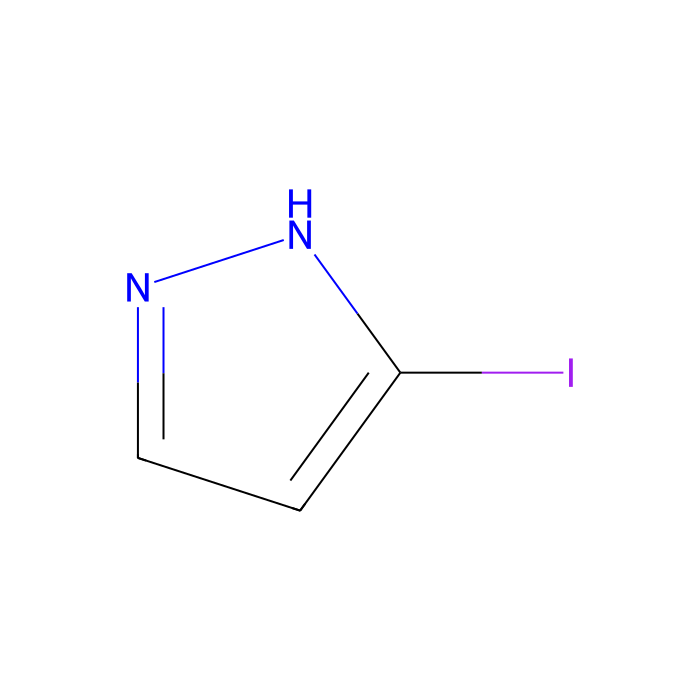
A halogenated, 5-membered diazole heteroaromatic, 3-Iodopyrazole is a versatile electrophilic building block for C–C and C–heteroatom cross-couplings on a pyrazole core.
Item-specific identifiers (from Product Data):
SKU: I157634
Product Name: 3-Iodopyrazole
CAS: 4522-35-4
InChIKey: 326312 (as provided; consult SDS/CoA for a full-length InChIKey)
SMILES: Not specified for this item; refer to CoA/Spec Sheet.
Structural features (general description):
Contains a pyrazole ring (a 1,2-diazole) with two adjacent ring nitrogens; one is typically protonated as [N–H] in the neutral form.
An iodine substituent at the 3-position (C-3) renders the ring a highly reactive heteroaryl iodide suitable for oxidative addition to Pd(0)/Ni(0).
Aromatic, planar 5-membered system; no stereocenters.
2D structure in words (general): A five-membered aromatic ring with two adjacent nitrogens (N1–N2), bearing an N–H at N1 and an iodine atom on the carbon between the two ring carbons (C-3).
Synthetic Utility
Functionally, 3-iodopyrazole is an electrophilic heteroaryl partner with a privileged balance of reactivity and selectivity for C–C and C–heteroatom bond construction.
Key reactive site: C-3 iodide undergoes oxidative addition readily (I > Br > Cl), making it suitable for low-temperature or low-catalyst-loading couplings.
Complementary reactivity:
Suzuki couplings deliver 3-aryl, 3-heteroaryl, or 3-alkenyl pyrazoles from boronic acids/esters.
Sonogashira affords 3-alkynyl derivatives amenable to further cycloadditions (e.g., click chemistry after alkyne elaboration).
Buchwald–Hartwig enables 3-amino substitution; oxygen- and sulfur-nucleophiles can be installed via C–O/C–S couplings (Pd or Cu catalysis).
Lithiation/magnesiation at C-3 via I–Li or I–Mg exchange (often after N-protection) enables electrophile capture (acyl, formyl, silyl, boryl, halogen).
Regiochemical value:
C-3 functionalization complements N- or C-4/C-5 modifications, allowing orthogonal diversification of the pyrazole core.
Protecting group strategy:
N–H can coordinate or be deprotonated; consider N-Boc, N-tosyl, or N-SEM to improve metalation selectivity and catalytic performance, then deprotect under mild conditions.
These features make the reagent a practical entry point to libraries of pyrazole derivatives and late-stage diversification of complex scaffolds.
Target Specificity
Not applicable. This product is a small-molecule reagent, not a biological targeting agent (e.g., antibody, ligand panel). No target, epitope, or species reactivity information is associated with this SKU.
Domande frequenti
What is the purity of this product, and how is it determined?
This product is supplied at ≥97% purity, determined by gas chromatography (GC). Lot-specific values are stated on the Certificate of Analysis.
How should this product be stored?
Store at room temperature under argon. It is supplied under an argon blanket; reseal under inert gas after each use.
How is this product shipped?
This product ships under standard ambient conditions. No temperature-controlled packaging is required.
What are the CAS number, molecular formula and molecular weight?
The CAS Number is 4522-35-4, the molecular formula is C3H3IN2, and the molecular weight is 193.98 g/mol. InChIKey RUKDVLFJSMVBLV-UHFFFAOYSA-N.
What documentation is provided?
Available product documentation, including Certificates of Analysis (COA), Safety Data Sheets (SDS), and specification sheets, is shown in the product document area. Document availability and access follow the current site policy.
Utilizziamo i cookie per garantire il corretto funzionamento del sito web e, ove consentito, per migliorare la tua esperienza. Puoi gestire le tue preferenze in qualsiasi momento nelle Impostazioni. Per saperne di più, consulta la nostra Cookie Policy.
Desidera che le inviamo un messaggio quando avremo sconti disponibili?
Ricordamelo più tardi
Grazie! Controlli la sua casella di posta per confermare.
Products are supplied to verified businesses, institutions, and qualified professionals for research and development use only. Not for use in humans, animals, diagnosis, or therapy.

 I1817030