≥98%(GC) for sensitive chromatographic and analytical workflows requiring minimal baseline interference.
🌡
Storage & shipping
Room temperature,Argon charged Ships Normal Check lot-specific COA for exact specifications.
📋
Quality documents
SDS, COA, datasheet, and spec sheet available for download. Lot-specific COA accessible via lot number lookup.
📚
Literature proof
Cited in 6 peer-reviewed publications across chromatography, organic synthesis, and cross-coupling reactions.
Panoramica
The spectral binding affinity for 3-methoxyphenethylamine was studied to examine the determinants of P450 2D6 catalysis. Activated phenethylamine used in the perfluorooctanesulfonic acid catalyzed Pictet-Spengler reaction.Also used in a synthesis of 1,3-oxazepines via palladium-catalyzed intramolecular coupling.
This compound belongs to the class of organic compounds known as phenethylamines. These are compounds containing a phenethylamine moiety, which consists of a phenyl group substituted at the second position by an ethan-1-amine.
External Descriptors
Not available
1. Djoumbou Feunang Y, Eisner R, Knox C, Chepelev L, Hastings J, Owen G, Fahy E, Steinbeck C, Subramanian S, Bolton E, Greiner R, and Wishart DS. ClassyFire: Automated Chemical Classification With A Comprehensive, Computable Taxonomy. Journal of Cheminformatics, 2016, 8:61.
Determine the necessary mass, volume, or concentration for preparing a solution.
Dilution Calculator
Determine the dilution needed to prepare a stock solution.
Reconstitution Calculator
Recensioni
Recensioni dei clienti
Application Protocols
No item-specific validated biological assay protocols are provided for this small-molecule reagent. For synthetic applications, see the Reaction Conditions and Synthetic Utility sections for general, literature-based procedural guidance (e.g., reductive amination, acylation, and protection strategies).
Biological Roles
No biological testing is provided for this catalog item. The following are general, literature-based notes about chemical class only (not product claims and not for clinical use):
Phenethylamine scaffold: The phenethylamine backbone is common in biogenic amines and small-molecule ligands; substitution on the aromatic ring (here, meta-methoxy) modulates lipophilicity, basicity, and receptor-binding profiles across chemical biology studies.
Protonation state: At physiological pH, primary amines exist largely as ammonium ions, influencing uptake and distribution in biological matrices.
Metabolic liabilities (class-level): Primary amines are subject to oxidative deamination (e.g., MAO in vivo), N-acetylation, and phase II conjugation when studied biologically. The anisole ether (–OMe) can undergo O-dealkylation to phenols in metabolic systems.
This product is supplied strictly for research and laboratory use; no claims are made regarding biological activity, safety, or suitability for any clinical application.
Buffer Applications
This compound is a reactive primary amine used as a synthetic building block and is not commonly employed as a defined buffering agent in biochemical assays.
General note: While primary amines exhibit buffering capacity near the pKa of their conjugate acids (phenethylamine class typically ~9–10, literature), they are seldom used as standard buffers due to reactivity with biomolecules and carbonyl contaminants.
Recommendation: Choose established buffer systems (e.g., Tris, HEPES, phosphate) for pH control. Use this amine under controlled synthetic conditions rather than as a buffer component.
Green Alternatives
Greenness considerations apply to the processes using this amine rather than to the amine itself.
Solvent choices (greener comparisons):
Replace chlorinated solvents (DCM, CHCl3) with ethyl acetate, 2-MeTHF, CPME, or MeCN where compatible.
Alcohol media (EtOH, i-PrOH) for reductive amination offer benign profiles and facile workup.
Comparison snapshot (literature-based):
DCM vs 2-MeTHF
Environmental: DCM is problematic (halogenated, VOC); 2-MeTHF is biorenewable and has better EHS profile.
Performance: 2-MeTHF often matches DCM for acylations and extractions; water tolerance can simplify operations.
THF vs CPME
Peroxide risk: THF forms peroxides; CPME has reduced tendency and higher stability.
Boiling point and recyclability: CPME higher bp facilitates separation and solvent recovery.
Reagent alternatives:
Reductive amination: Prefer NaBH(OAc)3 or catalytic H2 over NaBH3CN to avoid cyanide waste; explore transfer hydrogenation (HCO2H/Et3N, HCO2NH4) with Pd/C or Ru catalysts.
Acylation: Use coupling reagents with improved atom economy (e.g., CDI for carbamates/ureas) and avoid over-stoichiometric halogenated acyl donors when possible.
Workup and isolation:
Favor salt crystallization (e.g., HCl salt in EtOH/Et2O) over chromatography to reduce solvent consumption.
Implement solvent recycling and LCA-based selection using common solvent selection guides (GSK/ACS).
Pharmaceutical Uses
No pharmacopeial status or excipient role is specified for this item.
General formulation/manufacturing context (literature-based, not product specification):
Synthetic intermediate: 3-Methoxyphenethylamine can serve as a key building block in the preparation of amides, sulfonamides, ureas, and secondary/tertiary amines within small-molecule API research programs.
Salt forms: The formation of crystalline salts (e.g., hydrochloride, sulfate, p-toluenesulfonate) can improve handling, enable salt screening, and support solid-form diversification studies.
Impurity control: Amines can engage in side reactions (e.g., N-oxide formation, imine formation with aldehydes). Manufacturing workflows typically control oxygen and carbonyl contaminants and specify residual solvents and water by Karl Fischer.
No therapeutic, diagnostic, or clinical claims are made for this product; it is for research use only.
Physical Properties
Item-specific values: Not specified for this item; refer to CoA/Spec Sheet.
Literature/typical properties for 3-methoxyphenethylamine (for reference only; not product specification):
Molecular weight: ~151.21 g/mol (from formula C9H13NO)
Physical state: often encountered as a colorless to pale liquid or low-melting solid in the phenethylamine family (contextual, varies with purity and temperature).
Basicity: primary aliphatic amine; conjugate acid pKa typically ~9–10 for phenethylamines (literature range; exact pKa depends on substitution and medium).
Solubility profile: expected to be miscible with polar organic solvents (alcohols, acetone, chloroform, ethyl acetate) and to form water-soluble salts upon protonation with mineral/organic acids.
Odor: amine-like (general for primary amines).
Practical notes (general):
Forms stable salts (e.g., HCl, sulfate, tosylate) that are often crystalline and easier to handle than the free base.
The methoxy substituent increases polarity compared with unsubstituted phenethylamine and may modestly reduce volatility.
Quality and Grades
Item-specific grade/purity: Not specified for this item; refer to CoA/Spec Sheet.
Context and guidance:
If provided, “research grade” or “analytical grade” typically indicates low levels of common impurities and suitability for synthetic/analytical workflows. For amines used in synthesis, trace water and residual solvents often determine performance in moisture-sensitive transformations (e.g., acylations, reductive aminations).
UV/fluorescence background: Not typically marketed as “HPLC grade” because it is a reagent, not a solvent; however, low UV background and low metal content can be relevant if used in photochemical or catalytic settings. Item-specific limits (water, peroxides, metals, UV cutoff) are Not specified for this item; refer to CoA/Spec Sheet.
Stabilizers: None indicated in Product Data. If a stabilizer or acid scavenger is present, it will be listed on the Spec Sheet. Absence of such a note generally implies neat free base.
Verification: For sensitive work, request and review the CoA for assay method (e.g., GC, NMR), residual solvent profile, and titratable amine content.
Reaction and Applications
As a meta-methoxy–substituted phenethylamine, this reagent serves as a versatile nucleophile and building block.
Key application areas (literature/general):
Amide and carbamate formation:
Acylation with acid chlorides/anhydrides or coupling with carboxylic acids (EDC/HOBt, HATU) to access meta-methoxybenzamide-linked phenethyl frameworks.
Carbonate/chloroformate reagents afford carbamates; Boc/Fmoc protection for orthogonal strategies.
Reductive amination and imine chemistry:
Condensation with aldehydes/ketones to imines/oxazolidines, then reduction (NaBH3CN, NaBH(OAc)3, or H2/Pd-C) to secondary amines. Methoxy substituent can modulate electronic effects on benzylic reactivity.
Urea/thiourea and sulfonamide synthesis:
Reaction with isocyanates/isothiocyanates or sulfonyl chlorides to deliver ureas/thioureas and sulfonamides.
N-alkylation (SN2/Mitsunobu variants):
Alkyl halide coupling under basic conditions; phase-transfer catalysis may be used for challenging substrates.
Aromatic transformations (on the ring):
The methoxy group is an ortho/para director; however, the side chain is activating as well. Demethylation (e.g., with BBr3 or HBr) can convert –OMe to phenol for further diversification.
Salt formation and resolution:
Crystalline salts (e.g., HCl, p-toluenesulfonate) aid purification; chiral acids can be used for diastereomeric salt formation in kinetic resolution of downstream chiral amines.
Practical tips:
Dry the amine and solvents when performing moisture-sensitive acylations or imine formations.
Add bases last to control exotherms; vent appropriately when generating HCl salts in situ.
Use inhibitor-free conditions for hydrogenations; amines can poison catalysts—pre-saturate or use excess catalyst as needed.
Reaction Conditions
General, literature-based guidance for common transformations involving this amine (not product specifications):
Reductive amination:
Typical solvents: MeOH, EtOH, i-PrOH, MeCN, THF.
Conditions: Carbonyl (1.0 eq), amine (1.2–2.0 eq), NaBH(OAc)3 (1.5–2.0 eq) in AcOH-buffered DCE/MeCN/MeOH at rt to 40 °C; 2–18 h. Alternatively, NaBH3CN in MeOH with pH 5–6 buffer; or H2 (1–5 bar) with Pd/C.
Amide coupling:
Solvents: DMF, DCM, MeCN.
Conditions: Carboxylic acid (1.0 eq), coupling reagent (e.g., HATU 1.1–1.2 eq), base (DIPEA 2–3 eq), 0 °C to rt, 1–12 h.
N-acylation with acid chlorides/anhydrides:
Base: Et3N, pyridine, or Na2CO3 aqueous biphasic.
Solvents: DCM, EtOAc, THF. Temperatures 0–25 °C; slow addition to control exotherm.
Carbamate/urea formation:
CDI (1.1–1.5 eq) in THF/MeCN at rt to 50 °C; or chloroformates/isocyanates under basic conditions.
Protection (Boc):
Boc2O (1.1–1.5 eq), base (NaHCO3, DIPEA) in DCM/MeCN; 0 °C to rt, 1–4 h.
Workup and isolation tips:
Quench borohydrides with buffered aqueous solutions to avoid gas evolution/over-reduction.
Form the HCl salt in alcoholic solvents by gaseous HCl or 4 M HCl/dioxane addition for crystallization.
For catalytic hydrogenations, pre-wet Pd/C and filter through celite; monitor for over-reduction of sensitive aryl substituents (methoxy usually stable under mild conditions).
Safety and Handling
Research use: For research use only.
GHS/SDS: Item-specific GHS signal word, hazard statements, and pictograms are not provided here. Always consult the SDS for authoritative and complete safety information.
General safety guidance for primary aliphatic/aromatic amines (literature-based, not product specification):
Likely hazards: Skin/eye irritation or burns; respiratory irritation; can be harmful if swallowed or absorbed through skin. Some amines may cause sensitization.
PPE: Chemical-resistant gloves (e.g., nitrile), lab coat, splash goggles. Work in a fume hood to avoid inhalation of vapors or aerosols.
Handling:
Avoid contact with acids/acid chlorides/anhydrides without proper control—vigorous salt formation or acylation may occur.
Keep away from strong oxidizers; aryl ethers/benzylic amines can oxidize/discolor upon air exposure.
Minimize exposure to moisture and CO2 to prevent formation of ammonium carbamates and to maintain free-base integrity.
First aid (summary; follow SDS):
Skin: Remove contaminated clothing, wash with soap/water.
Eyes: Rinse cautiously with water for several minutes, remove contact lenses if present; seek medical attention.
Inhalation: Move to fresh air; seek medical attention if symptoms persist.
Ingestion: Rinse mouth; do not induce vomiting unless directed by medical personnel.
Storage incompatibilities: Segregate from acids, acylating agents, isocyanates, and oxidizers. Use air/moisture-protective closures.
Special risks: Primary amines can react with carbonyls (Schiff base formation). Avoid unintended contact with aldehyde-containing reagents or surfaces.
Solvent Selection
This product is a reactive amine reagent, not a solvent. Selection below refers to media for reactions, workup, or purification.
Polarity and miscibility (general):
The free base is polar, hydrogen-bonding, and typically miscible with polar organics (MeOH, EtOH, i-PrOH, acetone, acetonitrile, DCM, ethyl acetate). Limited solubility in nonpolar hydrocarbons unless co-solvent is used.
Salts (e.g., HCl salt) are water-soluble and facilitate aqueous workups or crystallizations.
Typical use scenarios:
N-acylation/carbamate formation: DCM, THF, EtOAc, or acetonitrile with base (e.g., DIPEA, Na2CO3).
Reductive amination: Alcohols (MeOH/EtOH/i-PrOH) or MeCN/THF with NaBH3CN, NaBH(OAc)3, or catalytic hydrogenation.
Protecting group chemistry: Boc/Fmoc protection often in DCM/MeCN or mixed solvents.
Practical purification:
Convert to the HCl salt to crystallize from IPA/Et2O or EtOAc/hexanes, then regenerate free base as needed.
For chromatography, add 0.5–2% Et3N to eluents to suppress amine tailing on silica.
Comparison notes:
Alcohols often enhance imine formation rates for reductive amination, while aprotic solvents can favor clean acylations. Choose based on chemoselectivity and downstream isolation strategy.
Storage and Reconstitution
Storage conditions (from Product Data): Store at room temperature; Argon charged. Shipped under normal conditions.
Practical storage guidance (general for primary amines; not product specification):
Keep container tightly closed under inert gas (Ar or N2) to minimize oxidation/discoloration and uptake of CO2/H2O.
Store in a dry place away from acids and oxidizing agents. Use amber glass if long-term storage to reduce light exposure effects on color.
For long-term storage or to improve handling, consider converting to a crystalline salt (e.g., hydrochloride) and store desiccated.
If solidification occurs at lower temperatures, gently warm to room temperature and mix thoroughly before use.
Reconstitution:
If supplied as a neat liquid, use as provided; no reconstitution required.
For salt formation/regeneration, dissolve in appropriate solvent (e.g., Et2O/EtOAc for salt precipitation; aqueous base/organic extraction to regenerate free base). Always verify identity and purity by NMR/GC/LC as needed prior to critical applications.
Structure and Identity
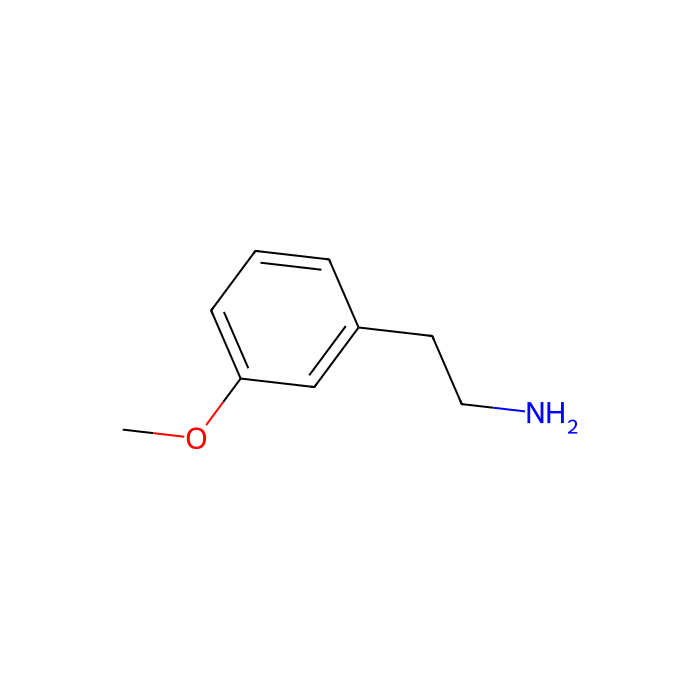
Brief overview: 3-Methoxyphenethylamine is a meta-methoxy–substituted phenethylamine; it contains a primary aliphatic amine (–CH2–CH2–NH2) attached to a benzene ring bearing a methoxy (–OCH3) substituent at the 3-position.
Item-specific identifiers (from Product Data):
CAS: 2039-67-0
CID: 74866 (PubChem)
InChIKey: Not specified for this item; refer to CoA/Spec Sheet.
SMILES: Not specified for this item; refer to CoA/Spec Sheet.
Literature/typical identity data (for reference only; not product specification):
Molecular formula (literature): C9H13NO
Molecular weight (literature): ~151.21 g/mol
Representative SMILES (literature): NCCc1cccc(OC)c1 (one of several equivalent depictions for the meta isomer)
Structural features (general description):
Aromatic ring (benzene) with a meta methoxy substituent.
Benzylic ethylamine side chain (primary amine, nucleophilic/basic).
Ether (aryl–O–Me) is deactivating/ortho–para-directing for electrophilic substitution relative to the side chain; the meta relationship between –OCH3 and the –CH2CH2NH2 substituent distinguishes this isomer from the ortho/para analogs.
No stereocenters; achiral molecule.
2D description in words: A benzene ring bearing an –OCH3 at C3 and a –CH2–CH2–NH2 at C1 (meta-substituted anisyl ethylamine).
Synthetic Utility
Functional groups and reactivity (general):
Primary amine (nucleophilic/basic): readily acylated, alkylated, sulfonylated; forms imines/enamines with carbonyls.
Aryl methoxy (anisole): directs electrophilic substitution ortho/para on the ring; can be demethylated to phenol for further diversification (ether cleavage, e.g., BBr3).
Benzylic activation: The ethylamine side chain is adjacent to an aromatic ring, enabling potential benzylic functionalizations in derivatives.
Representative transformations (literature):
Amide coupling to carboxylic acids (HATU, EDCI, COMU) to furnish meta-methoxybenzylamide motifs.
Reductive amination with aldehydes/ketones to build secondary amines; hydrogenation over Pd/C or Raney Ni for imine reduction.
Carbamate and urea synthesis using chloroformates, CDI, or isocyanates.
Protection strategies: Boc protection (Boc2O, base) or Fmoc (Fmoc-Cl) to mask the amine during multi-step synthesis.
Aryl O-demethylation to phenol, enabling sulfonation, ether formation, or Mitsunobu-type derivatizations at oxygen after demethylation.
Practical considerations:
Use anhydrous conditions for coupling/imine steps; water can suppress imine formation and reduce acylation efficiency.
When purifying on silica, elute with base-modified solvents (e.g., 1% Et3N in hexanes/EtOAc) to mitigate tailing and adsorption.
Convert to crystalline salts for long-term storage or to streamline isolation and analytical characterization.
Target Specificity
Not applicable. This product is a small-molecule amine reagent, not an antibody, enzyme, or affinity reagent. No target, epitope, or isotype information is associated with this item.
Utilizziamo i cookie per garantire il corretto funzionamento del sito web e, ove consentito, per migliorare la tua esperienza. Puoi gestire le tue preferenze in qualsiasi momento nelle Impostazioni. Per saperne di più, consulta la nostra Cookie Policy.
Shall we send you a message when we have discounts available?
Remind me later
Thank you! Please check your email inbox to confirm.
Products are supplied to verified businesses, institutions, and qualified professionals for research and development use only. Not for use in humans, animals, diagnosis, or therapy.

 E2227233