This compound belongs to the class of organic compounds known as benzophenones. These are organic compounds containing a ketone attached to two phenyl groups.
External Descriptors
Not available
1. Djoumbou Feunang Y, Eisner R, Knox C, Chepelev L, Hastings J, Owen G, Fahy E, Steinbeck C, Subramanian S, Bolton E, Greiner R, and Wishart DS. ClassyFire: Automated Chemical Classification With A Comprehensive, Computable Taxonomy. Journal of Cheminformatics, 2016, 8:61.
Determine the necessary mass, volume, or concentration for preparing a solution.
Dilution Calculator
Determine the dilution needed to prepare a stock solution.
Reconstitution Calculator
Recensioni
Recensioni dei clienti
Application Protocols
No application protocols are provided for this catalog item beyond its use as a general synthetic building block. Typical workflows include:
Preparing stock solutions: dissolve in dry DMSO or DMF (e.g., 10–100 mM) for reaction screening; dilute with the chosen reaction solvent. Verify solubility at intended concentrations.
Solid-phase or parallel synthesis: dose as a weighed solid to vials, add solvent/base/coupling partners, and heat or stir per Reaction Conditions.
Photochemical trials: if leveraging the benzophenone core, evaluate absorption and triplet reactivity under your irradiation source; include actinometry and appropriate controls. Shield personnel from UV.
Because conditions are transformation-specific, consult Reaction Conditions for starting parameters and tailor to your substrate and equipment. For analytical characterization, HPLC-UV (254–280 nm) and 1H/13C NMR in DMSO-d6/CDCl3 are commonly suitable for benzophenone derivatives.
Biological Roles
This product is intended for research and laboratory synthesis. No endogenous biological role is established for 4-amino-3-nitrobenzophenone.
General context (literature/general):
Aromatic benzophenones are not typical metabolic intermediates in biology. The presence of an aniline and nitro group suggests potential for redox and conjugation reactions in biological matrices, but such interactions are outside intended use and not characterized here.
Benzophenone scaffolds can act as photoreactive probes in chemical biology when suitably functionalized; however, this specific compound is provided as a synthetic intermediate, not as a validated probe.
For all work involving cells, enzymes, or biomolecules, evaluate cytotoxicity and off-target effects empirically, and adhere to institutional biosafety practices. No claims are made regarding biological activity or suitability for clinical/diagnostic use.
Buffer Applications
This compound is a non-ionic, hydrophobic aromatic solid and is not a buffering agent. It does not define a useful acid/base pair in the aqueous physiological pH range for buffer preparation.
If used in biochemical assays, dissolution typically requires organic co-solvents (e.g., DMSO) before dilution into aqueous media. Assess precipitation risk and final organic content to maintain assay performance.
For aqueous buffer selection supporting reactions involving this compound (e.g., diazotization or reductions), see Reaction Conditions for guidance on typical media and pH control.
Green Alternatives
As a specialized aromatic building block, the “green” conversation centers on synthesis route and process choices rather than substituting the molecule itself.
Greener process choices (literature/general):
Solvents: prefer dimethyl carbonate, 2-MeTHF, EtOAc, Me-THF, or water/EtOH mixtures where solubility and reactivity permit, instead of DMF/NMP/CH2Cl2.
Reductions of the nitro group: catalytic hydrogenation (H2, Pd/C or Raney Ni) in EtOH/IPA is typically greener than stoichiometric SnCl2 or Fe/acid workups that generate halogenated or iron-containing waste.
Acylations/sulfonylations: use acyl anhydrides or activated esters and organic bases to avoid acid chlorides where feasible; capture HCl with benign bases.
Photochemistry: LED sources and continuous-flow reactors reduce energy input and improve safety versus high-pressure mercury lamps.
Comparison snapshot (general guidance):
DMF/NMP vs 2-MeTHF/EtOAc
Worker/EHS profile: 2-MeTHF/EtOAc favored.
Performance: 2-MeTHF often dissolves aromatic ketones sufficiently and supports coupling chemistry; confirm solubility.
Selectivity: catalytic routes can offer cleaner profiles but require hydrogen handling.
Given the fixed target structure, choose greener reagents, catalysts, and solvents, and implement in-process controls to minimize energy and waste. Life-cycle improvements usually come from solvent switches and catalytic over stoichiometric methods.
Pharmaceutical Uses
No pharmacopeial monograph or excipient role is provided for this item. This product is supplied strictly for research use only.
Synthetic intermediate in discovery chemistry programs, enabling access to benzophenone-derived scaffolds via amide formation, nitro reduction to diamines, or imine chemistry.
Photoreactive handle for affinity labeling after further functionalization of the benzophenone core.
There are no therapeutic, diagnostic, or clinical claims for this product. For any work related to drug substance or drug product development, ensure material specifications, impurity profiles, and residual solvent limits are defined and supported by CoA and stability data per your quality system.
Physical Properties
Item-specific physicochemical specifications were not provided in the Product Data and should be confirmed on the CoA/Spec Sheet for your lot.
Appearance: Not specified for this item; refer to CoA/Spec Sheet.
Melting point (MP): Not specified for this item; refer to CoA/Spec Sheet.
• General note: Many substituted benzophenones are solids with MP typically in the 80–200 °C range (literature/general; verify for this exact compound).
Boiling point (BP): Not specified for this item; refer to CoA/Spec Sheet.
• General note: Aromatic ketones often decompose before boiling at atmospheric pressure; reduced-pressure distillation or solid handling is typical (literature/general).
Density: Not specified for this item; refer to CoA/Spec Sheet.
Refractive index: Not applicable to solids; if an oil is observed at elevated temperature, measure as needed (general guidance).
Solubility (qualitative, literature/general):
Water: expected very low solubility for aromatic ketones bearing nitro; verify experimentally.
Organic: typically soluble in polar aprotic solvents (DMSO, DMF, NMP), moderately soluble in acetone/EtOAc/MeCN, and sparingly soluble in alkanes; exact behavior is method- and temperature-dependent.
LogP/logD: Not specified for this item; refer to CoA/Spec Sheet.
• General expectation: aromatic ketone with one donor/one acceptor substituent tends toward moderate hydrophobicity (literature/computational expectations; confirm for this compound).
pKa: Not specified for this item; refer to CoA/Spec Sheet.
• Anilinium pKaH typically ~4–6, nitro is non-ionizable; actual values depend on substitution and solvent (literature/general).
Always rely on your lot’s CoA/SDS for numeric specifications.
Quality and Grades
Grade/Purity: Not specified for this item; refer to CoA/Spec Sheet.
Guidance on interpreting grades (general):
Research-grade organic building blocks commonly specify an assay by HPLC/GC and limits for common impurities (residual solvents, related substances). Where applicable, stabilizers or inhibitors are declared on the label/CoA.
If HPLC grade is stated for solvents or chromatography reagents, it implies low UV absorbance baselines; for solids like substituted benzophenones, grade usually reflects chemical purity and sometimes ash/metals or moisture limits. None are specified here for this item.
Stabilizers/inhibitors: Not specified for this item; refer to CoA/Spec Sheet. Benzophenone derivatives are generally shipped neat without stabilizer; verify if your application is photochemical or trace-metal sensitive.
Testing and documentation: Request CoA, NMR, HPLC chromatogram, and, where needed, residual solvent and water content data for regulated workflows.
Batch-to-batch considerations: Nitro/aniline-containing aromatics can show minor hue variation from pale to yellow/orange solids due to trace conjugated impurities; color alone is not a purity specification. Confirm by analytical methods (HPLC, NMR, MS).
If a specific analytical grade or impurity limit is critical for your use (e.g., photochemical work, medicinal chemistry screening), please contact us to source a lot with documented specifications.
Reaction and Applications
As a bifunctional benzophenone, 4-amino-3-nitrobenzophenone serves as a versatile intermediate in synthesis, enabling orthogonal transformations on the amine, nitro, and ketone.
Transformations on the aniline (–NH2):
N-acylation/sulfonylation to tune electronics for subsequent aromatic substitutions or to protect the aniline during nitro reduction.
Diazotization (NaNO2/HX, 0–5 °C) to form diazonium salts for azo coupling (colorants/materials) or Sandmeyer-type substitutions after prior nitro manipulation.
Reductive amination at the benzophenone carbonyl can proceed after temporary protection of the aniline to prevent polymerization.
Transformations of the nitro group:
Chemoselective reduction to the corresponding phenylenediamine derivative using H2/Pd-C, transfer hydrogenation, Fe/AcOH, or SnCl2/HCl, enabling access to diamide/urea scaffolds and polyfunctional ligands.
Partial reduction strategies (e.g., to hydroxylamine) are possible but condition-sensitive in the presence of an aniline.
Carbonyl chemistry (benzophenone unit):
Formation of imines/Schiff bases with primary amines (water removal essential); subsequent reduction furnishes benzhydrylamines.
Photochemistry: benzophenone cores are classic triplet photosensitizers; substitution modulates triplet energies, enabling H-abstraction or Paternò–Büchi reactions (literature/general; evaluate for this derivative).
Cross-coupling strategies:
After installation of a halogen on the unsubstituted ring, Suzuki/Heck/Buchwald–Hartwig routes can elaborate the scaffold.
Applications span dyes/pigments (via azo coupling), ligand/material precursors, and medicinal chemistry intermediates. Optimize protecting-group strategy to manage the contrasting directing/electronic effects of –NH2 (activating) and –NO2 (deactivating) on the same ring.
Reaction Conditions
General, literature-based guidance for typical transformations involving 4-amino-3-nitrobenzophenone. Optimize for your substrate, scale, and equipment.
Nitro reduction to an aniline:
H2 (1–5 bar), 5–10 wt% Pd/C (5–10 mol% Pd relative to substrate) in EtOH or IPA, 20–50 °C; monitor by HPLC. Add acid (HCl) cautiously to keep the aniline protonated if needed. Alternative: Fe powder (4–8 equiv) in AcOH/H2O (3:1) at 60–90 °C; filter iron salts hot.
Aniline protection/acylation:
Ac2O or benzoyl chloride (1.1–1.5 equiv) with DIPEA or pyridine in DCM/MeCN, 0 °C to rt, 1–3 h. For sulfonylation: TsCl (1.1–1.3 equiv) with base, 0 °C to rt.
Imine formation at the benzophenone carbonyl:
Primary amine (1.2–2.0 equiv), toluene or MeOH, 3Å molecular sieves or Dean–Stark, 60–110 °C, 2–16 h; reduce with NaBH3CN or H2/Pd as desired.
Diazotization/azo coupling (from aniline):
NaNO2 (1.1 equiv) in 2–6 M HCl at 0–5 °C to form diazonium; couple with activated aromatics/phenols in buffered aqueous/EtOH at 0–10 °C. The nitro group decreases ring nucleophilicity; pre-activation or choice of coupling partner is critical.
Electrophilic aromatic substitution on the second ring:
Halogenation (Br2 or NBS) in AcOH/CHCl3 at 0–25 °C; follow with Pd-catalyzed cross-couplings (Suzuki: Pd(PPh3)4, base K2CO3, dioxane/H2O, 80–100 °C).
These are starting-point conditions from general literature precedent for related substrates; confirm selectivity and safety at small scale before scale-up.
Safety and Handling
Safety data specific to this catalog item were not provided. Consult the product SDS for authoritative classification and precautions.
GHS/CLP (item-specific):
Signal word: Not specified for this item; refer to SDS.
Hazard statements (H-): Not specified for this item; refer to SDS.
Pictograms: Not specified for this item; refer to SDS.
Anticipated hazards (general for aromatic nitro/aniline ketones; not item-specific):
May cause skin/eye/respiratory irritation. Nitroaromatics can present methemoglobinemia risk upon significant exposure. Dust may be harmful if inhaled. Avoid ingestion and prolonged/ repeated exposure.
PPE and engineering controls (good laboratory practice):
Use gloves compatible with organic solids (e.g., nitrile), lab coat, splash goggles.
Handle powders in a fume hood; avoid dust formation and inhalation.
First-aid overview (general):
Inhalation: move to fresh air; seek medical attention if symptoms persist.
Skin/eye contact: rinse with water for at least 15 minutes; remove contaminated clothing; seek medical advice.
Ingestion: rinse mouth; do not induce vomiting unless directed by medical personnel; seek medical attention.
Incompatibilities/conditions to avoid (general):
Strong oxidizers or strong reducing agents (due to nitro functionality). Avoid strong acids/bases that could promote decomposition or undesired reactions. Protect from excessive heat and light during storage.
Spill and waste (general):
Avoid dust; collect mechanically and place in suitable container. Dispose of according to local regulations for nitroaromatic organic waste.
Always defer to the SDS for your lot and local institutional safety policies.
Solvent Selection
This product is a multifunctional aromatic solid rather than a solvent. Solvent choice should be driven by your intended transformation and analytical workflow.
Polarity class (analyte perspective): moderately nonpolar aromatic core with polar functional groups (ketone C=O, aniline –NH2, nitro –NO2). Expect best solubility in polar aprotic media.
Common solvents (general guidance):
High solubility: DMSO, DMF, NMP. Useful for stock solutions for screening and coupling chemistry.
N-acylation/sulfonylation: DCM, THF, MeCN, or DMF with a non-nucleophilic base (DIPEA, pyridine).
Nitro reduction: protic ethanol/IPA with catalytic hydrogenation; or EtOH/AcOH or MeOH/Fe for transfer reductions.
Condensations at the carbonyl (Schiff bases, imines): toluene or MeOH with azeotropic water removal or molecular sieves.
Diazonium chemistry from aniline: aqueous mineral acid with tert-butanol/MeCN co-solvent at 0–5 °C.
Analytical: for HPLC-UV, acetonitrile/water with 0.1% formic acid often gives acceptable peak shape for aromatic ketones; methanol can be used but may give different selectivity.
Always verify actual solubility and compatibility with your base/acid and catalysts; dry and degas solvents as required by your protocol.
Storage and Reconstitution
Storage (item-specific from Product Data):
Store at room temperature.
Shipped at ambient conditions (Normal).
Container and handling:
Keep tightly closed in a dry, well-ventilated place. Protect from excessive heat and direct light to minimize potential discoloration or photoreactions of the benzophenone core.
Minimize headspace humidity; consider desiccant for long-term storage if local humidity is high.
Shelf-life/stability: Not specified for this item; refer to CoA/Spec Sheet. In general, dry aromatic ketone solids are stable when protected from moisture, light, and oxidants.
Reconstitution and preparation:
The product is a solid; no aqueous reconstitution is typically used. Prepare solutions in appropriate organic solvents (e.g., DMSO, DMF, EtOAc, MeCN) just prior to use.
For sensitive transformations, pre-dry solvents (molecular sieves) and purge with inert gas. Filter any particulate before use in microfluidic or LC systems.
Freeze–thaw: Not applicable to solids. For stock solutions, store aliquots at low temperature (e.g., −20 °C) if needed and avoid repeated freeze–thaw; check for precipitation and re-dissolve with sonication or gentle warming.
Always refer to the lot-specific CoA/SDS for definitive storage recommendations and stability information.
Structure and Identity
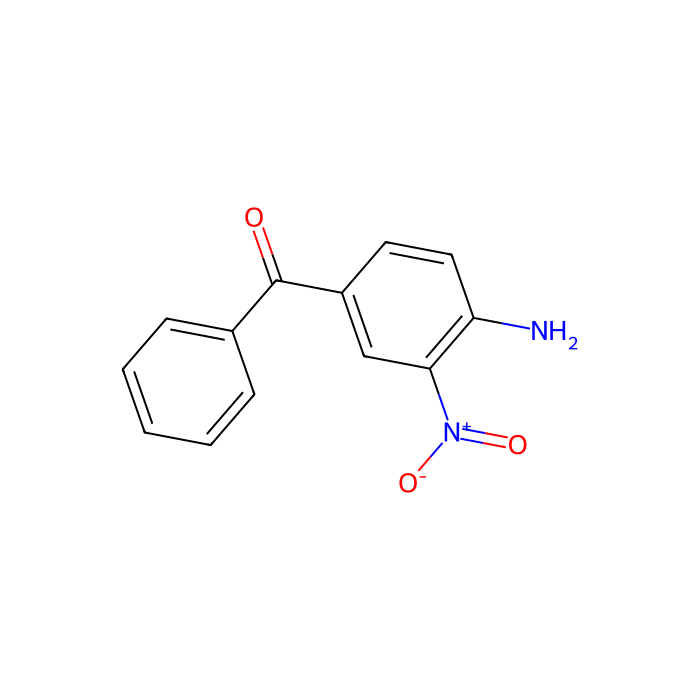
4-Amino-3-nitrobenzophenone is an anilide-like, multifunctional benzophenone derivative bearing both an electron-donating amine and an electron-withdrawing nitro group on one phenyl ring of the benzophenone core.
Item-specific identifiers (Product Data)
CAS: 31431-19-3
PubChem CID: 596970
InChIKey: 237999 (as provided)
SMILES: Not specified for this item; refer to CoA/Spec Sheet.
Formula and formula mass
Molecular Formula: Not specified for this item; refer to CoA/Spec Sheet.
• Literature/computed for the named structure: approximately C13H10N2O3 (literature/structure-based).
Molecular Weight: Not specified for this item; refer to CoA/Spec Sheet.
• Literature/computed for C13H10N2O3: ~242.23 g/mol (literature/structure-based).
Structural features (general description)
Core scaffold: benzophenone (diphenyl ketone) with a carbonyl (aryl–C(=O)–aryl).
Ring substitution: on one phenyl ring, para-amino (–NH2) and meta-nitro (–NO2) relative to the carbonyl-bearing carbon (nomenclature consistent with “4-amino-3-nitro-”).
Electronic character: strongly polarized ring due to the push–pull combination (–NH2 donor, –NO2 acceptor) conjugated with an aryl ketone.
2D depiction in words: two phenyl rings connected by a carbonyl; one ring carries –NH2 para to the carbonyl and –NO2 meta to the carbonyl; the second ring is unsubstituted.
Stereochemistry: none (achiral, no stereocenters).
Note: Where not item-specific, values above are literature/general descriptions to aid method development; confirm identity against CoA/SDS for release-critical details.
Synthetic Utility
Functional group set and strategic leverage points:
Aniline (–NH2):
Protecting groups: Boc, Cbz, acyl, or sulfonyl protection to modulate electronics and prevent side reactions during nitro reduction or electrophilic steps.
Couplings: urea/carbamate formation (triphosgene/carbonyldiimidazole), amide formation with acyl donors, or diaryl urea assembly after nitro-to-amine reduction.
Nitro (–NO2):
Gateway to diversity: reduction to an aniline furnishes 3,4-diaminobenzophenone derivatives; from there, cyclizations to benzimidazoles or quinazolinones become accessible under dehydrating conditions (literature/general).
N–O chemistry: partial reductions or formation of nitroso intermediates under controlled conditions.
Benzophenone carbonyl:
Imines/oximes/hydrazones: classical condensations; subsequent reductions give benzhydrylamines/hydrazides.
Photochemical hydrogen abstraction or Paternò–Büchi reactions leveraging the benzophenone triplet (substitution modulates reactivity; verify for this substrate).
Aromatic manipulation:
The substituted ring bears conflicting directors (–NH2 activating/ortho–para; –NO2 deactivating/meta). Protecting or protonating –NH2 can steer reactivity. The second ring (unsubstituted) can be selectively functionalized (e.g., halogenation then cross-coupling).
Retrosynthetic value: 4-amino-3-nitrobenzophenone can arise from acylation of appropriately substituted anilines with benzoyl chlorides, or via Friedel–Crafts acylation on a protected aniline followed by nitration and deprotection (route-dependent; literature/general). Careful step order minimizes over-nitration and aniline oxidation.
Target Specificity
Not applicable. This product is a small-molecule research chemical and not an antibody, enzyme, or biologic. No target binding specificity, isotype, or species reactivity data are provided or implied.
Domande frequenti
What is the purity of this product?
This product is supplied at ≥98% purity (chemical assay). Lot-specific values are stated on the Certificate of Analysis.
How should this product be stored?
Store at room temperature.
How is this product shipped?
This product ships under standard ambient conditions. No temperature-controlled packaging is required.
What are the CAS number, molecular formula and molecular weight?
The CAS Number is 31431-19-3, the molecular formula is C13H10N2O3, and the molecular weight is 242.23 g/mol. InChIKey NGOOFAMQPUEDJM-UHFFFAOYSA-N.
What documentation is provided?
Available product documentation, including Certificates of Analysis (COA), Safety Data Sheets (SDS), and specification sheets, is shown in the product document area. Document availability and access follow the current site policy.
Utilizziamo i cookie per garantire il corretto funzionamento del sito web e, ove consentito, per migliorare la tua esperienza. Puoi gestire le tue preferenze in qualsiasi momento nelle Impostazioni. Per saperne di più, consulta la nostra Cookie Policy.
Desidera che le inviamo un messaggio quando avremo sconti disponibili?
Ricordamelo più tardi
Grazie! Controlli la sua casella di posta per confermare.
Products are supplied to verified businesses, institutions, and qualified professionals for research and development use only. Not for use in humans, animals, diagnosis, or therapy.

 J2218420