10mM in DMSO for sensitive chromatographic and analytical workflows requiring minimal baseline interference.
🌡
Storage & shipping
Store at -80°C Ships Dry ice packs + Cold packs Check lot-specific COA for exact specifications.
📋
Quality documents
SDS, COA, datasheet, and spec sheet available for download. Lot-specific COA accessible via lot number lookup.
📚
Literature proof
Cited in 92 peer-reviewed publications across chromatography, organic synthesis, and cross-coupling reactions.
Panoramica
4-Chlorobenzoic acid is a degradation product of indomethacin. It is degraded by Acinetobacter sp. strain ST-1 and causes its dehalogenation to yield 4-hydroxybenzoic acid under both aerobic and anaerobic conditions. 4-Chlorobenzoic acid was used to determine the diversity of 2-, 3- and 4-chlorobenzoate degraders in two pristine soils with similar physical and chemical characteristics.
Specifications
Specifiche e purezza
10mM in DMSO
Condizioni di conservazione di stoccaggio
Store at -80°C
Spedito in
Dry ice packs + Cold packs
Questo prodotto richiede spedizione a catena fredda. I servizi di terra e altri servizi economici non sono disponibili.
Determine the necessary mass, volume, or concentration for preparing a solution.
Dilution Calculator
Determine the dilution needed to prepare a stock solution.
Reconstitution Calculator
Recensioni
Recensioni dei clienti
Application Protocols
Not applicable. No validated bioassay protocols (WB, IHC, IF, FC) are associated with this small-molecule reagent. For chemical applications, see the Reaction & Applications, Synthetic Utility, and Reaction Conditions sections for practical guidance.
Biological Roles
This compound is a synthetic aryl carboxylic acid and is not a natural metabolite. No specific biochemical role is typical. General information (literature):
Xenobiotic fate: Aromatic carboxylic acids may undergo Phase II conjugation (e.g., glucuronidation) in biological systems; para-chlorinated derivatives can be more persistent and are often substrates for oxidative metabolism at the aromatic ring only slowly.
Protein/biomacromolecule interaction: Carboxylates can engage in ionic/hydrogen-bonding interactions, but 4-chlorobenzoic acid is primarily used as a chemical probe/intermediate rather than as a ligand in biochemical assays.
Enzyme inhibition/activation: No well-established, selective biological target is associated with 4-chlorobenzoic acid; any observed effects are generally nonspecific and context-dependent in research systems.
Research use note: For research use only. Not for human or veterinary use.
Buffer Applications
4-Chlorobenzoic acid is not commonly used as a laboratory buffer due to low water solubility and a pKa (~3.9–4.0, literature) that provides a narrow, acidic buffering window.
If an aryl carboxylate buffer is required near pH 4, benzoic acid/benzoate is generally preferred due to better characterization and availability.
Practical guidance: To work in aqueous media, prepare the sodium or potassium 4-chlorobenzoate by neutralizing with NaOH/KOH; this improves solubility but still offers limited buffering capacity compared with standard systems (acetate, citrate, formate).
Green Alternatives
Green chemistry considerations focus on solvent and reagent choices rather than the substrate itself (literature/guidance):
Prefer greener solvents where possible:
Replace DMF/DMSO with Me-THF, CPME, ethyl acetate, or propylene carbonate when solubility/reactivity allow.
Use ethanol or 2-propanol for Fischer esterifications instead of chlorinated solvents.
Reagent choices:
Avoid SOCl2/oxalyl chloride when feasible; use CDI or EDC•HCl with catalytic DMAP for amide/ester formation to reduce corrosive off-gassing and chlorinated waste.
Enzymatic esterifications/amidations in organic media or DESs (deep eutectic solvents) can be explored for select substrates.
Workup/waste:
Select solvents with favorable EHS profiles and enable solvent recycling (ethyl acetate/IPA water-compatible biphasic systems).
Comparison snapshot (literature):
| Task | Conventional | Greener alternative | Trade-offs |
|---|---|---|---|
| Acid chloride formation | SOCl2 in DCM/toluene | CDI activation in EtOAc/MeCN | Slower for hindered substrates; different byproducts |
| Amide coupling | HATU/HOBt in DMF | EDC/oxyma in EtOAc/MeCN | May require solubility optimization |
| Esterification | DCM with acid chloride | Fischer in ethanol with acid cat. | Equilibrium control needed (water removal) |
| Solvent for couplings | DMF/DMSO | MeCN/EtOAc/2-MeTHF | Possible lower solubility; need warming |
Note: Final choices should be validated empirically for your substrate set and performance targets.
Pharmaceutical Uses
No specific pharmacopeial grade or excipient role is indicated for this item.
Grade/Purity: Not specified for this item; refer to CoA/Spec Sheet.
Pharmaceutical context (general): 4-chlorobenzoic acid is primarily a synthetic intermediate for preparing aryl amides/esters and aryl acid chlorides used in medicinal chemistry campaigns and process development. It is not a common preservative or excipient.
Formulation notes (R&D): In preclinical discovery labs, stock solutions are often prepared in DMSO or ethanol and subsequently diluted; ensure compatibility of residual solvent with downstream assays and materials.
Regulatory note: This product is for research use only and is not intended for use in humans or clinical applications.
Physical Properties
Item-specific specifications: Not specified for this item; refer to CoA/Spec Sheet.
Literature/typical values (for reference only; not item specifications):
Appearance: white to off-white crystalline solid (literature)
Melting point: ~241–245 °C (literature)
Boiling point: not typically distilled; decomposes/sublimes before boiling (literature)
Density (solid): ~1.5–1.6 g/cm³ (literature, indicative)
Aqueous solubility: low at room temperature; increases with heat and in basic media as the benzoate salt (literature)
Solubility in organic solvents: soluble in polar organics (methanol, ethanol, acetone, ethyl acetate, DMSO, DMF); sparingly in nonpolar solvents (literature)
Notes for use (general):
Poor water solubility can limit direct aqueous work; dissolution in a polar aprotic solvent (DMF/DMSO) or conversion to the sodium/potassium benzoate salt improves handling in water.
For analytical reference, confirm exact MP and purity on receipt per CoA; recrystallization (e.g., ethanol/water) can provide analytical samples if needed.
Quality and Grades
Grade/Purity: Not specified for this item; refer to CoA/Spec Sheet.
Appearance: Not specified for this item; refer to CoA/Spec Sheet.
Interpretation and guidance (general):
For synthesis and method development, typical benchmarks include identity by NMR/IR/MS and purity by HPLC/GC or qNMR. If UV applications are intended (e.g., calibration), low-UV-absorbing impurities are relevant; consult CoA for chromatographic profile.
Trace inorganic content (metals) is generally not critical for 4-chlorobenzoic acid unless used in metal-sensitive catalysis or materials applications; if needed, request a metals screen on the CoA.
Water content (Karl Fischer), residual solvents, and halide content may be specified on some lots. In the absence of listed specs, verify with in-house QC if critical to your application.
Stabilizers/additives: Not specified for this item; refer to CoA/Spec Sheet.
What to request/confirm for demanding uses:
Residual halides/benzoates by HPLC.
Water content if using moisture-sensitive coupling reagents.
Melting point range and polymorph (if relevant to crystallization studies).
Reaction and Applications
Typical uses of 4-chlorobenzoic acid leverage both the carboxylic acid and the para-chloro handle (literature/generic guidance):
Acyl derivatives:
Conversion to 4-chlorobenzoyl chloride using SOCl2 or oxalyl chloride (cat. DMF), enabling acylation of alcohols (esters) and amines (amides/ureas). Useful for synthesizing para-chloro–substituted benzamides and polyamides.
Mixed anhydrides (pivaloyl chloride, isobutyl chloroformate) for mild peptide-type couplings.
Direct couplings/activations:
Carbodiimide-mediated couplings (EDC/HOBt, DCC, HATU) to form esters and amides from the acid in DMF/DCM/MeCN.
CDI activation to form acyl imidazoles as versatile acyl transfer intermediates.
Decarboxylative transformations:
Photoredox- or copper/nickel-catalyzed decarboxylative cross-couplings generating aryl radicals for C–C and C–X bond formation (literature: Ni/Ir systems in MeCN/DMF; Ag-assisted variants exist).
Hunsdiecker-type modifications (via silver salt/halogenation) to access para-chloroaryl halides, though modern photoredox routes are typically preferred.
Ring functionalization:
The para-chloro substituent allows further derivatization by metal–halogen exchange (e.g., Grignard or Li–halogen exchange at low temperature) followed by electrophile trapping, or by Pd-catalyzed cross-couplings (after transforming the acid to a boronate or via decarboxylative arylation pathways).
Applications include synthesis of liquid crystals, dyes, agrochemical intermediates, and functional monomers, where the para-chloro group is a handle for subsequent diversification.
Practical notes: Dry, acid-free conditions help during acyl chloride formation; for couplings, control base strength to minimize O→N acyl migration in esterifications vs amidations.
Reaction Conditions
General literature guidance (not item specifications):
Cross-coupling: NiCl2·dtbbpy (5–10 mol%), photoredox catalyst (e.g., Ir(ppy)3 0.5–1 mol%), base (Cs2CO3), MeCN/DMF, blue LEDs, rt–40 °C, 4–16 h.
Typical outcomes: Good to excellent yields for acyl transfer reactions; decarboxylative cross-couplings are substrate- and condition-dependent—optimize catalyst loadings and light intensity.
Safety and Handling
Item-specific hazard classification: Not specified for this item; refer to SDS for authoritative details.
General GHS expectations for aryl carboxylic acids (literature/guidance only):
Potential classifications: Eye Irrit. 2, Skin Irrit. 2; not acutely toxic by oral exposure at typical laboratory quantities, but handle as harmful if swallowed or inhaled.
Pictograms: exclamation mark (if classified). Consult SDS.
PPE and handling (good laboratory practice):
Wear safety glasses, lab coat, and appropriate chemical-resistant gloves (e.g., nitrile). Use in a fume hood to avoid dust inhalation.
Avoid generating dust; use spatulas/scoops and localized ventilation when transferring solids.
Incompatibilities and reactivity (general):
Strong bases convert to benzoate salts (exotherm possible in concentrated systems).
Strong oxidizers may react with the aryl moiety; acyl chlorination (with SOCl2/oxalyl chloride) releases corrosive HCl/Cl2-containing fumes—perform strictly in a hood.
First aid (overview; defer to SDS):
Inhalation: move to fresh air; seek medical attention if symptoms persist.
Skin/eye contact: rinse with copious water for ≥15 minutes; remove contaminated clothing; obtain medical advice.
Ingestion: rinse mouth; do not induce vomiting; get medical attention.
Waste: Collect solid residues and chlorinated organic solutions for disposal per institutional and regulatory guidelines.
Solvent Selection
As a moderately lipophilic aromatic carboxylic acid, 4-chlorobenzoic acid dissolves best in polar organic solvents and in aqueous base as its benzoate salt.
Esterification (Fischer): methanol or ethanol with catalytic acid; remove water via Dean–Stark (in toluene) for higher-boiling systems.
Amide coupling: DMF, DCM, or MeCN with EDC/HOBt, HATU, or CDI; maintain an organic base (DIPEA) for activation.
Acid chloride formation: anhydrous DCM or toluene as solvent with SOCl2/oxalyl chloride; catalytic DMF often used.
Recrystallization: ethanol/water or isopropanol/water mixtures commonly give good crystals; adjust ratio to achieve dissolution hot and crystallization on cooling.
Comparison (literature):
DMSO/DMF maximize solubility and reaction rates but complicate workup; ethyl acetate and MeCN balance solubility with easy removal; toluene/DCM useful for acyl chloride routes but are less green.
Storage and Reconstitution
Storage (item-specific):
Storage Conditions: Store at -80 °C (per Product Data).
Allow container to equilibrate to room temperature in a desiccator before opening to minimize condensation.
Reseal promptly; protect from moisture and prolonged light/heat exposure.
Reconstitution and working solutions (general guidance):
Solubility: readily dissolves in DMSO, DMF, acetone, ethyl acetate, methanol, and ethanol (literature). For aqueous work, dissolve in minimal organic co-solvent or convert to the sodium/potassium salt.
Typical stock solutions: 10–100 mg/mL in DMSO or DMF; filter (0.2 µm PTFE) if particulate is present. Label with concentration, solvent, and date.
Stability of solutions: aromatic carboxylic acids are generally stable in anhydrous organic solvents at 2–8 °C for weeks; for long-term, store aliquots at -20 to -80 °C to minimize freeze–thaw.
Specifications not provided for this item (consult CoA/SDS as needed):
Appearance, assay/purity, water content, residual solvents: Not specified for this item; refer to CoA/Spec Sheet.
Research Use Note: For research use only.
Structure and Identity
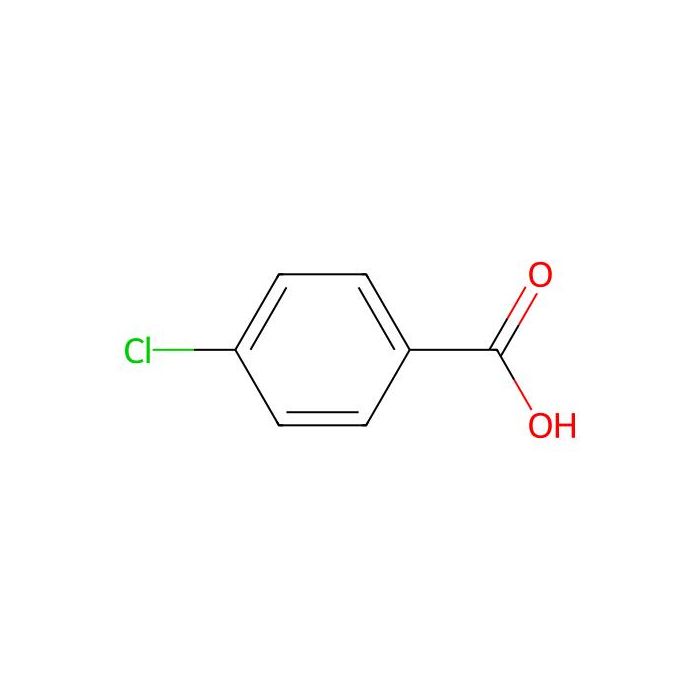
Brief description: 4-Chlorobenzoic acid is a para-chloro–substituted benzoic acid (aryl carboxylic acid) useful as a building block for acylation, esterification, amidation, and decarboxylative cross-coupling chemistry.
Regiochemistry: chlorine and carboxyl at 1,4-positions (para).
No stereocenters; planar conjugated system across the ring and the carbonyl.
2D structure in words (literature): A benzene ring with the carboxylic acid at position 1 and a chloro substituent directly opposite at position 4; the carbonyl C=O is conjugated with the ring, and the hydroxyl completes the –CO2H moiety.
Synthetic Utility
Key reactivity elements (literature):
Carboxylic acid chemistry:
Activation via acid chlorides (SOCl2/oxalyl chloride), mixed anhydrides, CDI, or carbodiimides enables efficient formation of esters, amides, and imides.
Direct coupling with alcohols/amines under Mitsunobu-like or Steglich/EDC conditions.
Aromatic chloride handle:
Oxidative addition under Pd(0)/Ni(0) catalysis for Suzuki–Miyaura, Buchwald–Hartwig, and related cross-couplings after appropriate intermediate formation (commonly from the acid’s derivatives or via decarboxylative routes when direct aryl chloride activation is challenging).
Halogen–metal exchange (n-BuLi at low temperature) to access para-functionalized derivatives via electrophile trapping (requires careful control to avoid lithium–halogen exchange side reactions with the acid; protect/activate appropriately).
Decarboxylative strategies:
Photoredox/Ni-catalyzed decarboxylative arylations and borylations from N-hydroxyphthalimide (NHP) esters derived from the acid, enabling C–B, C–C, C–S, and C–N bond constructions.
Retrosynthetic value: Serves as a linchpin for building para-substituted benzamides/esters while retaining or transforming the chloro group, facilitating late-stage diversification in SAR studies.
Target Specificity
Not applicable. This product is a small-molecule chemical reagent, not a biological targeting reagent. No antigen/epitope, species reactivity, clone, or isotype information applies.
We use cookies to ensure the website functions properly and, where permitted, to improve your experience. You can manage your preferences at any time in Settings. Learn more in our Cookie Policy.
Shall we send you a message when we have discounts available?
Remind me later
Thank you! Please check your email inbox to confirm.
Products are supplied to verified businesses, institutions, and qualified professionals for research and development use only. Not for use in humans, animals, diagnosis, or therapy.