This compound belongs to the class of organic compounds known as aminopiperidines. These are compounds containing a piperidine that carries an amino group.
External Descriptors
Not available
1. Djoumbou Feunang Y, Eisner R, Knox C, Chepelev L, Hastings J, Owen G, Fahy E, Steinbeck C, Subramanian S, Bolton E, Greiner R, and Wishart DS. ClassyFire: Automated Chemical Classification With A Comprehensive, Computable Taxonomy. Journal of Cheminformatics, 2016, 8:61.
Determine the necessary mass, volume, or concentration for preparing a solution.
Dilution Calculator
Determine the dilution needed to prepare a stock solution.
Reconstitution Calculator
Recensioni
Recensioni dei clienti
Application Protocols
No antibody/assay application protocols (WB, IHC, IF, FC, etc.) are applicable to this small-molecule reagent. For synthetic applications, refer to the Reaction Conditions, Reaction & Applications, and Synthetic Utility sections for practical usage guidance.
Biological Roles
This compound is a synthetic aliphatic diamine without known endogenous biological function.
General considerations (literature):
Not a natural metabolite; any biological interactions are expected to arise from generic amine basicity (e.g., protonation at physiological pH leading to salt formation with acids and potential membrane interactions typical of cationic amines).
As a small, lipophilic diamine, it could interact nonspecifically with proteins, membranes, or nucleic acids via electrostatic and hydrophobic interactions; such effects are not selective and are context-dependent.
Readily forms water-soluble salts with biocompatible acids (e.g., HCl), but this does not imply suitability for in vivo or clinical use.
Research Use Notice (from Product Data): For research use only.
No medical or clinical claims are made or implied. For biochemical assays or materials research, verify interference/blank activity of aliphatic amines under assay conditions, as they can affect pH, enzyme activity, or dye/indicator readouts at millimolar levels.
Buffer Applications
This product is not commonly used as a defined buffering agent in analytical biochemistry.
General note (literature): aliphatic amines can provide buffering capacity near their pKaH values (roughly pH 9–11 for conjugate acids of secondary/tertiary aliphatic amines), but volatility, odor, and potential reactivity with electrophiles limit their utility in standard buffer systems.
Practical guidance:
If a basic environment is required transiently (e.g., for a reaction workup), an aqueous solution of its acid salt (e.g., hydrochloride) can be prepared and basified as needed; however, for defined buffers, prefer established systems such as Tris (pKa 8.1), CAPS (pKa 10.4), or carbonate/bicarbonate.
For routine electrophoresis, cell culture, or enzymology, use validated buffers; this reagent is better suited to synthetic chemistry applications.
Green Alternatives
Choice of organic base/nucleophile can impact EHS and sustainability.
Considerations for 4-(dimethylamino)piperidine (general):
Advantages: dual functionality can reduce the number of additives (separate base + nucleophile), potentially simplifying workups. Often effective at ambient temperature.
Trade-offs: amine odor/volatility, potential aquatic toxicity of amines, and challenges in solvent recovery if used in large excess.
Alternative bases/nucleophiles (literature; selection is context-dependent):
DIPEA (Hünig’s base): less nucleophilic, lower risk of side alkylation; typically lower odor impact; good for acylations as an acid scavenger.
DBU/DBN: stronger, non-nucleophilic amidines; can reduce amine-derived byproducts; may be more corrosive and costlier.
Polymer-supported tertiary amines (e.g., PS-DIEA): facilitate separation and reduce amine contamination in effluents.
Bicyclic guanidines (TBD/TMG): powerful catalysts for transesterifications and ring-opening polymerizations; typically used catalytically.
Solvent greening around this reagent:
Favor MeTHF, CPME, EtOAc, or 2-propanol over chlorinated solvents when compatible with kinetics/selectivity.
Comparison snapshot (qualitative):
Goal: acylation with minimal nucleophilic interference → choose DIPEA or 2,6-lutidine.
Goal: nucleophilic ring opening or tethered diamine reactivity → this reagent can outperform non-diamine bases.
Always balance EHS, cost, and performance; validate substitutions at lab scale before scale-up.
Pharmaceutical Uses
No pharmacopeial excipient status or formulation role is specified for this item; refer to CoA/Spec Sheet.
General context in pharmaceutical process chemistry (literature):
May serve as a base or nucleophilic additive in API intermediate synthesis (e.g., acylations, SNAr, reductive amination set-ups) where a compact, aliphatic diamine is beneficial.
Acid salts (e.g., hydrochloride, p-toluenesulfonate) can improve handling (reduced volatility/odor) during plant operations and may crystallize to facilitate purification of intermediates.
Quaternization of the dimethylamino group affords ammonium salts potentially useful as phase-transfer catalysts in certain transformations.
Regulatory reminder:
For any use related to GMP or clinical manufacturing, define and justify material specifications (identity, assay, impurities, residual solvents, water), and qualify vendors. Perform risk assessments for nitrosamine formation in amine-containing processes and apply appropriate controls.
No therapeutic claims are made. This product is offered for research use only.
Physical Properties
From Product Data (item-specific):
Appearance: Not specified for this item; refer to CoA/Spec Sheet.
Literature/Computed values (typical for the free base; provided for reference only and not specifications for this item):
Physical state: typically a colorless to pale yellow liquid for the free base (literature, aliphatic tertiary/secondary amines of this size are often liquids).
Acid–base behavior: dibasic; forms stable mono- and di-protonated salts with mineral or organic acids (literature).
pKa (conjugate acid, typical ranges): secondary aliphatic amine pKaH ≈ 10–11; tertiary dimethylamino pKaH ≈ 9–10 (literature, general ranges for aliphatic amines; exact values for this compound not cited here).
Solubility (qualitative):
Miscible with many polar organic solvents (e.g., alcohols, ethers, chlorinated solvents, DMF, DMSO) (literature, general behavior of low-MW amines).
Reacts with CO2 and dissolves CO2 to form carbamate species in the presence of moisture; forms water-soluble ammonium salts upon acidification (literature).
Volatility/odor: aliphatic amines are typically volatile with strong amine odor; handle in a fume hood (general literature guidance).
Item-specific critical parameters (UV cutoff, refractive index, water, residual metals, peroxide level, density, bp, mp, logP): Not specified for this item; refer to CoA/Spec Sheet.
Quality and Grades
From Product Data (item-specific):
Grade/Purity: Not specified for this item; refer to CoA/Spec Sheet.
Guidance on grades and implications (general information for amine reagents):
Research grade amines are typically suitable for organic synthesis, catalysis screening, and method development. If low UV background is required (e.g., LC/UV detection), consider HPLC-grade or specially purified material.
Low-water/low-peroxide specifications are sometimes reported for sensitive applications; when not specified, verify by CoA or perform in-house KF titration and peroxide/peracid screening as needed.
Stabilizers/inhibitors: Amines are seldom shipped with stabilizers; however, they may arrive as the free base or as an acid salt. The free base is more nucleophilic/basic; the salt form offers improved handling and reduced volatility. Confirm the delivered form on the CoA.
Metals/background ions: For applications such as catalysis benchmarking or battery electrolyte additive development, trace metals can matter. If critical, request an extended CoA or perform ICP-MS screening.
If using in GMP-related development or regulated filings, align material with suitable pharmacopeial monographs (if any) or define internal specifications (assay, identity, related substances, water) and retain batch CoAs for traceability.
Reaction and Applications
4-(Dimethylamino)piperidine is a bifunctional aliphatic diamine (secondary + tertiary amine), useful as both a basic additive and a nucleophile.
Representative uses (literature/general):
As an organic base for neutralizing acids and promoting condensations (e.g., imine formation, reductive amination set-ups) where a moderately strong, non-metal base is desired.
Nucleophilic substitution and conjugate addition to activated electrophiles (e.g., acyl chlorides/anhydrides to form amides/carbamates at the secondary N; Michael acceptors under appropriate conditions).
Catalyst/activator in ring-opening polymerizations or small-molecule epoxide/aziridine ring-opening, leveraging diamine nucleophilicity.
Precursor to quaternary ammonium salts and ammonium ionic liquids via alkylation/quaternization of the dimethylamino group; these salts can serve as phase-transfer catalysts or task-specific ionic media.
Building block for heterocycle synthesis via urea/thiourea formation with carbonyl diimidazole (CDI), phosgene equivalents, or isothiocyanates, followed by intramolecular cyclizations.
Selectivity notes:
Chemoselective acylation of the secondary (ring) amine is typically favored over the tertiary dimethylamino group; choose coupling agents (e.g., acid chlorides, anhydrides, CDI) and conditions to exploit this.
Protonation preferences can be exploited for protecting-group-like behavior: converting to a mono- or di-protonated salt to modulate nucleophilicity during multi-step sequences.
Practical tips:
Use anhydrous conditions for moisture-sensitive electrophiles. The free base can absorb CO2; brief inert-gas purge prior to use helps maintain consistency.
For clean amide formation, control temperature (0–25 °C charging, then 25–50 °C as needed) and employ stoichiometric base only as needed, since one tertiary site can scavenge acid.
Reaction Conditions
General guidance from literature for reactions employing 4-(dimethylamino)piperidine (not item-specific specifications):
As base in condensations/acylations:
Solvents: DCM, THF, EtOAc, MeCN.
Temperature: 0–25 °C for addition; warm to 25–50 °C as needed.
Equivalents: 1.0–2.0 equiv relative to acid halide or activated ester when used as acid scavenger; catalytic amounts possible when an external base is present.
As nucleophile for amide/carbamate/sulfonamide formation (at secondary N):
Reagents: acid chlorides/anhydrides, CDI/DSC, sulfonyl chlorides; include a base (e.g., DIPEA) if required to neutralize byproduct acid.
Solvents: DCM, THF, DMF.
Typical times: 0.5–6 h depending on electrophile and temperature; monitor by LC.
Temperature: 20–80 °C; control exotherm and add electrophile slowly.
Ring-opening of activated epoxides/aziridines:
Solvents: MeCN, THF, IPA.
Catalysis: can be used stoichiometrically or catalytically; 20–60 °C.
Workup/purification tips:
Amines can cause emulsion; salt-out with brine, or convert to acid salt for extraction/crystallization, then basify to regenerate free base if needed.
Drying agents: K2CO3 or Na2SO4; avoid acidic desiccants. Remove residual amines by acid wash when purifying neutral products.
Safety and Handling
From Product Data (item-specific):
Storage Conditions: Room temperature
Shipped In: Normal
GHS Classification, Signal Word, H-Statements, Pictograms: Not specified for this item; refer to SDS.
General safety considerations (literature; consult the SDS for authoritative guidance):
Hazards typical of low-molecular-weight aliphatic amines include skin/eye irritation or burns, respiratory irritation, and harmful if swallowed. Strong, penetrating amine odor is common; work in a certified fume hood.
Flammability: aliphatic amines can be flammable liquids/vapors; keep away from ignition sources; ground/bond containers when transferring.
Incompatibilities: strong oxidizers; acid chlorides/anhydrides and isocyanates (vigorous acylation/urea formation); carbon dioxide (carbamate formation) and strong acids (exothermic salt formation). Avoid copper and its alloys which may catalyze oxidation of amines.
PPE: lab coat, safety goggles/face shield, and appropriate chemical-resistant gloves (e.g., nitrile). Use splash protection for bulk handling.
First aid (overview): move to fresh air upon inhalation; rinse skin with water/soap for prolonged contact; irrigate eyes for ≥15 minutes and seek medical attention; if ingested, rinse mouth and seek medical attention. Do not induce vomiting unless directed by medical personnel.
Spill response: absorb with inert material (vermiculite/diatomaceous earth), ventilate area, and neutralize residues cautiously with dilute acid if appropriate. Dispose according to local regulations.
Always defer to the product-specific SDS for exact hazard classifications and response measures.
Solvent Selection
This product is an organic base/nucleophile, not a chromatographic or reaction solvent. Solvent choice should be driven by the transformation in which 4-(dimethylamino)piperidine participates.
General solubility/miscibility profile (literature, qualitative):
Highly soluble in common polar organics (e.g., THF, EtOH, MeOH, MeCN, DCM, DMF, DMSO).
Forms water-soluble ammonium salts upon acidification; the free base has limited but non-negligible water solubility due to two amine sites.
Practical guidance:
For base-mediated reactions and nucleophilic substitutions: use aprotic solvents (THF, MeCN, DMF) to maximize nucleophilicity and maintain low viscosity.
For acylations of the secondary amine: dichloromethane, THF, or EtOAc are common; include a tertiary base scavenger only if needed (the substrate already contains a tertiary amine).
For salt formation/purification: choose alcohols/ethers for crystallization of acid salts (e.g., HCl, p-TsOH salts) when appropriate.
Comparison (selection hints):
If strong base but low nucleophilicity is desired, DIPEA/Hünig’s base may outperform. If higher nucleophilicity is desired (e.g., for ring-opening of activated epoxides), this diamine can be advantageous.
Storage and Reconstitution
From Product Data (item-specific):
Storage Conditions: Room temperature
Shipped In: Normal
General handling guidance (literature; not item-specific specifications):
Store tightly sealed to minimize uptake of atmospheric CO2 and moisture (which can form carbamate/salt). If long-term storage is anticipated, consider blanketing the headspace with inert gas (N2/Ar).
Keep away from acids, acid chlorides/anhydrides, and oxidizers. Use amber glass if extended light exposure is expected, although aliphatic amines are not typically light sensitive.
If the product is received as a free base liquid, dispense using dry syringes/pipettes in a fume hood to control odor and exposure. If received as an acid salt, store in a desiccator to avoid deliquescence.
Reconstitution: Not applicable to neat liquids. If solid salt form is supplied, dissolve in a compatible anhydrous solvent (e.g., DCM, THF, MeOH) or water depending on application; filter if necessary.
Freeze–thaw: Not generally required. Avoid cold storage below the solvent’s freezing point when in solution; for solution stocks, prepare small aliquots to limit repeated opening.
Always consult the product’s CoA and SDS for definitive storage and handling instructions.
Structure and Identity
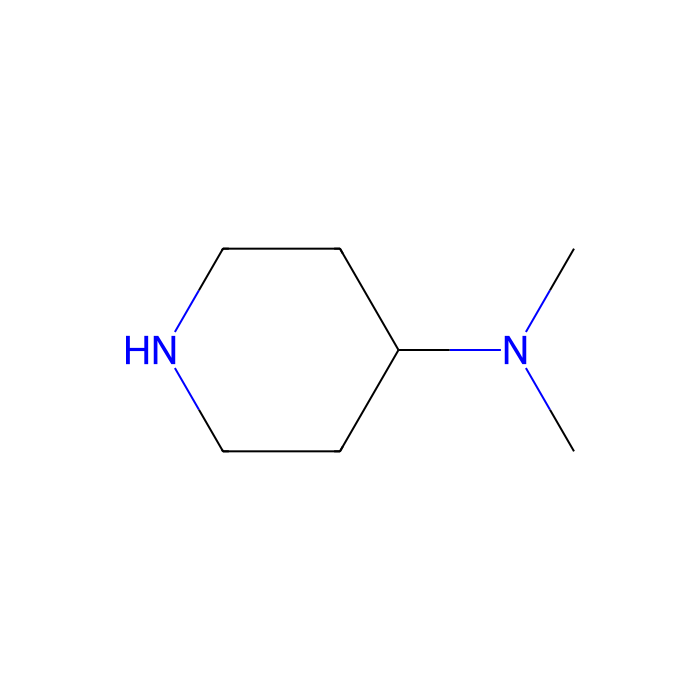
Brief overview: 4-(Dimethylamino)piperidine is a small aliphatic diamine featuring a saturated six‑membered piperidine ring bearing an N,N‑dimethylamino substituent at the 4‑position. It contains both a secondary amine (ring nitrogen) and a tertiary amine (dimethylamino substituent).
From Product Data (item-specific):
CAS: 50533-97-6
InChIKey: 435890 (as provided)
SMILES: Not specified for this item; refer to CoA/Spec Sheet.
Molecular Formula: Not specified for this item; refer to CoA/Spec Sheet.
Molecular Weight: Not specified for this item; refer to CoA/Spec Sheet.
Literature/Computed (for reference only; not item-specific specifications):
2D structural description: a chair-like piperidine ring (–N–(CH2)5–) with the 4‑carbon (para to the ring N) substituted by –N(CH3)2. The two nitrogen atoms are separated by a three‑carbon spacer across the ring carbon framework.
Structural features relevant to reactivity (general):
Two basic centers with different steric/electronic environments enable selective protonation and differential nucleophilicity.
The tertiary dimethylamino group is non-acylatable under standard amide coupling, whereas the secondary ring nitrogen is acylatable/alkylatable, enabling chemoselective transformations.
Synthetic Utility
Functional handles and reactivity (general literature):
Secondary ring amine (piperidine N):
Amenable to acylation (amides, carbamates) and sulfonylation (sulfonamides) with standard reagents (acid chlorides/anhydrides, CDI, DSC; sulfonyl chlorides) under mild conditions.
Alkylation to tertiary amines via SN2 with primary halides/mesylates under basic, aprotic conditions (control for over-alkylation).
Tertiary dimethylamino substituent:
Quaternization with alkyl halides or dialkyl sulfates to give ammonium salts (useful for phase transfer or as ionic liquid precursors).
Can act as an internal base/ligand to stabilize developing charge, occasionally improving rates in acylations and condensations.
Diamine synergy:
Selective monoacylation often achievable by stoichiometry/temporal addition; protonation state control provides chemoselectivity.
Potential to form chelating adducts with electrophiles (e.g., CO2, CS2, isocyanates) enabling urea/thiourea synthesis and downstream heterocycle construction.
Retrosynthetic value:
Serves as a nucleophilic piperidine building block already bearing a tertiary amine handle, allowing rapid access to densely functionalized diamines, piperidides, and quaternary ammonium derivatives without additional protection/deprotection steps.
Process tips:
Use anhydrous aprotic solvents (THF, MeCN, DMF) for nucleophilic substitutions; 0–25 °C initiation to moderate exotherms.
For clean amide formation, pre-generate acid chlorides or employ coupling reagents compatible with amines; monitor by TLC/UPLC and quench with controlled acid addition to avoid emulsions.
Target Specificity
Not applicable. This product is a small-molecule reagent (aliphatic diamine) and does not have biological target specificity data (e.g., antigen, epitope, clone). No item-specific target information is provided.
We use cookies to ensure the website functions properly and, where permitted, to improve your experience. You can manage your preferences at any time in Settings. Learn more in our Cookie Policy.
Shall we send you a message when we have discounts available?
Remind me later
Thank you! Please check your email inbox to confirm.
Products are supplied to verified businesses, institutions, and qualified professionals for research and development use only. Not for use in humans, animals, diagnosis, or therapy.

 G2304520