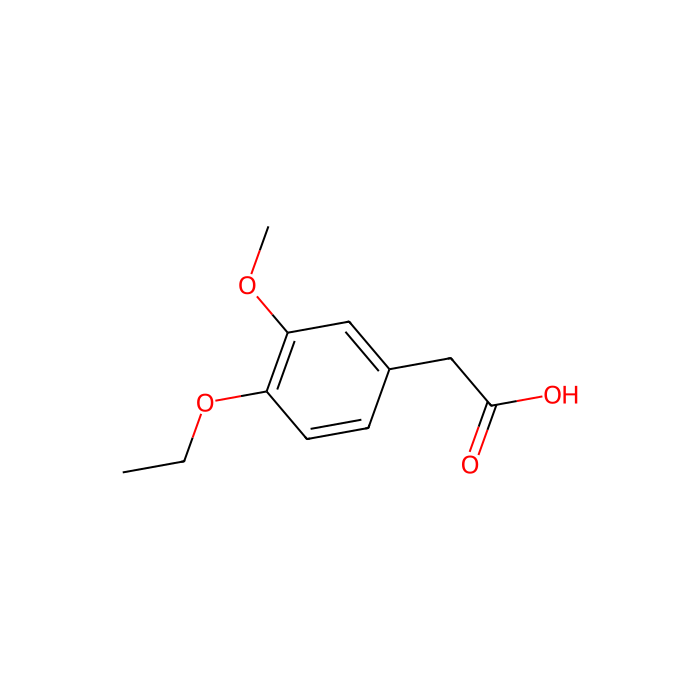
This compound belongs to the class of organic compounds known as anisoles. These are organic compounds containing a methoxybenzene or a derivative thereof.
External Descriptors
Not available
1. Djoumbou Feunang Y, Eisner R, Knox C, Chepelev L, Hastings J, Owen G, Fahy E, Steinbeck C, Subramanian S, Bolton E, Greiner R, and Wishart DS. ClassyFire: Automated Chemical Classification With A Comprehensive, Computable Taxonomy. Journal of Cheminformatics, 2016, 8:61.
Certificati (CoA, COO, BSE/TSE e tabella di analisi)
C of A & Other Certificates(BSE/TSE, COO):
Analytical Chart:
Proprietà chimiche e fisiche
Sensibilità
Moisture sensitive
Peso molecolare
210.230 g/mol
XLogP3
1.600
Hydrogen Bond Donor Count
1
Hydrogen Bond Acceptor Count
4
Rotatable Bond Count
5
Exact Mass
210.089 Da
Monoisotopic Mass
210.089 Da
Topological Polar Surface Area
55.800 Ų
Heavy Atom Count
15
Formal Charge
0
Complexity
205.000
Isotope Atom Count
0
Defined Atom Stereocenter Count
0
Undefined Atom Stereocenter Count
0
Defined Bond Stereocenter Count
0
Undefined Bond Stereocenter Count
0
The total count of all stereochemical bonds
0
Covalently-Bonded Unit Count
1
Calcolatori di soluzioni
Molarity Calculator
Determine the necessary mass, volume, or concentration for preparing a solution.
Dilution Calculator
Determine the dilution needed to prepare a stock solution.
Reconstitution Calculator
Recensioni
Recensioni dei clienti
Application Protocols
Not applicable. No validated biological assay protocols (e.g., WB, IHC, IF, FC) are associated with this small-molecule reagent. For chemical applications, see the Reaction & Applications and Reaction Conditions sections.
Biological Roles
This product is provided strictly for research use. No clinical/diagnostic use is intended.
General biochemical context (literature)
Phenylacetic acid is a known microbial and mammalian metabolite; ring-alkoxy substitution modulates acidity, lipophilicity, and potential interactions with transporters/enzymes compared with the parent acid.
Electron-donating substituents (methoxy/ethoxy) can influence binding in biochemical assays that probe aromatic acid recognition sites (e.g., carboxylate-binding pockets), though specific biological targets for this exact substitution pattern are not established in the literature.
In plant and microbial systems, substituted phenylacetic acids are often used as probes or intermediates in biosynthetic studies of phenylpropanoid-related pathways; the current compound may serve as a reference ligand or synthetic intermediate for biochemistry experiments.
Practical lab notes
For biochemical assays, prepare stock solutions in DMSO or ethanol; verify that final cosolvent concentration does not perturb the assay system.
The carboxylate form (pH > pKa) will be more water soluble but more polar; select form based on assay requirements.
No specific endogenous role or target is attributed to 4-ethoxy-3-methoxyphenylacetic acid in standard biochemical databases based on general literature trends.
Buffer Applications
This compound is not typically used as a laboratory buffer.
Relevance
As a monocarboxylic aromatic acid, it exhibits a single acidic pKa likely in the ~4.2–4.6 range (literature estimate for phenylacetic acids). While such pKa could, in principle, be used to make low-capacity buffers around pH ~4–5, specialized buffer systems (e.g., acetate, citrate) are strongly preferred for reproducibility and low UV background.
Practical guidance
If used as a reference acid in method development, prepare the sodium or potassium carboxylate to target pH ≥ pKa. Confirm solubility and UV absorbance interference for analytical methods.
For routine buffering needs, select established buffers (acetate, citrate, MES) rather than this specialized aromatic acid.
Green Alternatives
Greener choices focus on solvent and coupling-reagent selection rather than changing the substrate.
Solvent choices (literature/general)
Prefer EtOAc, MeTHF, 2-propanol, or ethanol over chlorinated solvents where feasible.
For amidation, use green polar aprotics like Cyrene or propylene carbonate in place of DMF/DMSO when compatible.
Coupling strategies
Minimize urea waste by using catalytic coupling systems (e.g., COMU, EDCI with in situ active esters) or direct dehydrative couplings with green additives.
Enzymatic esterification in green solvents (MTBE alternatives like CPME or 2-MeTHF) can be effective for protected derivatives.
Workup/purification
Replace DCM with EtOAc for extractions; use heptane/EtOAc instead of hexane/EtOAc on silica.
Consider crystallization-based purifications to reduce silica usage.
Brief comparison (literature)
DCM vs EtOAc: EtOAc offers lower toxicity and better biodegradability, with similar extraction efficiency for this moderately lipophilic acid/esters.
DMF vs Cyrene: Cyrene is biorenewable with lower toxicity profile; note higher viscosity and water sensitivity (trade-offs in heat transfer and dosing).
Implement solvent switches after small-scale feasibility checks to confirm solubility and reaction rate are maintained.
Pharmaceutical Uses
No excipient or pharmacopeial role is specified for this item; refer to CoA/Spec Sheet.
General research/manufacturing context (literature)
Substituted phenylacetic acids are common intermediates in medicinal chemistry programs, enabling rapid generation of ester/amide series for SAR.
The electron-rich dialkoxy ring can modulate metabolic stability and plasma protein binding relative to unsubstituted analogs.
In process chemistry, the acid function allows salt formation for isolation/crystallization studies (e.g., Na+, K+, organic amines), which can aid in polymorph screening.
Compliance note
This product is for research use only and is not manufactured to GMP standards unless explicitly stated. It is not intended for use as a drug substance, excipient, or in clinical applications.
Physical Properties
Item-specific (Product Data)
Appearance: Not specified for this item; refer to CoA/Spec Sheet.
Literature/computed values (general reference; not specifications for this item)
State: typically a crystalline organic solid for many dialkoxy-substituted phenylacetic acids.
Approximate molecular weight: ~210.23 g/mol (computed from C11H14O4)
Acidic pKa (phenylacetic acids): typically ~4.2–4.6 (literature); electron-donating alkoxy groups can slightly increase pKa relative to phenylacetic acid (pKa ~4.31, literature).
Solubility profile (typical):
Water: low to very low at neutral pH; higher solubility in basic aqueous media as the carboxylate salt.
Organic solvents: good solubility in polar aprotic solvents (DMSO, DMF, NMP), alcohols (MeOH, EtOH), acetone, ethyl acetate; limited solubility in alkanes/hexanes.
LogP (phenylacetic acids with dialkoxy ring): expected moderate lipophilicity due to two alkoxy substituents (qualitative, literature).
Not provided for this item (do not consider as specifications): melting point, boiling point, density, refractive index, water content, residual solvents, metals, or UV cutoffs. For exact values, please consult the CoA/Spec Sheet for this specific lot.
Quality and Grades
Item-specific (Product Data)
Grade/Purity: Not specified for this item; refer to CoA/Spec Sheet.
What grade means (general guidance)
Research/technical grade denotes material suitable for most synthetic and analytical R&D. Where specified (e.g., ≥98%, HPLC-grade), purity criteria, residual solvents, and UV-absorbance limits are controlled.
Stabilizers/inhibitors: Not specified for this item; refer to CoA/Spec Sheet. For carboxylic acids of this class, stabilizers are typically unnecessary.
Recommended quality verification upon receipt (best practices)
Verify identity by 1H/13C NMR (DMSO‑d6 or CDCl3 with a drop of base to sharpen carboxyl proton) and HRMS.
Assess purity by HPLC/UPLC with UV at 220–280 nm; the anisole-like chromophore gives good absorbance.
If chirality/reagent residues are a concern (not applicable here; achiral), check for inorganic content by residue on ignition (ROI) or ICP-MS if needed.
Documentation
For exact specifications (purity threshold, residual solvents, metals, water, and assay method), consult the lot-specific CoA/Spec Sheet provided by Aladdin Scientific.
Reaction and Applications
As a dialkoxy-substituted phenylacetic acid, this molecule is a versatile building block in synthetic organic chemistry.
Transformations of the carboxylic acid (literature/general)
Amide couplings: EDCI/HOBt, HATU/DIPEA, or CDI to access benzylacetamide derivatives for SAR libraries.
Esterifications: Fischer (ROH, acid catalysis), Steglich (DCC/DMAP), or via acid chloride (SOCl2, oxalyl chloride) followed by alcoholysis.
Reductions: Borane (BH3·THF) or LiAlH4 to benzyl alcohol derivatives via the corresponding primary alcohol (–CH2–CH2OH after reduction of –CH2–CO2H).
Decarboxylation: Thermal or copper-catalyzed protocols to the corresponding dialkoxy toluene derivative (literature-dependent).
Benzylic and aromatic functionalization
Benzylic halogenation: NBS/AIBN (radical) to the bromide, enabling further substitution (SN1/SN2) or cross-couplings.
Oxidation: Benzylic position oxidations (e.g., to ketones/acids) using SeO2 or MnO2 variants; ring oxidation is attenuated by alkoxy activation.
Electrophilic aromatic substitution: The methoxy/ethoxy groups are ortho/para directors, enabling regioselective nitration, sulfonylation, or Friedel–Crafts acylation at remaining activated positions (subject to deactivation by the benzylic acid).
Utility in discovery chemistry
The dialkoxy pattern modulates electronics and lipophilicity vs unsubstituted phenylacetic acid, useful for tuning permeability and potency in medicinal chemistry scaffolds.
The acid function offers a convergent handle for late-stage diversification (esters, amides, ureas via Curtius from the acyl azide).
Notes: Conditions above are literature guidance; optimize per substrate. Avoid over-acylation or cleavage of aryl ethers under strongly acidic Lewis conditions.
Reaction Conditions
The following are general literature conditions for common manipulations of arylacetic acids; they are guidance, not specifications for this item.
Amide coupling
Reagents: HATU (1.1–1.3 eq) or EDCI (1.2–1.5 eq) with HOAt/HOBt (0.1–0.2 eq), base (DIPEA 2–3 eq)
Solvent: DMF, DCM, or MeCN (0.05–0.2 M)
Temperature/time: 0–25 °C, 1–16 h
Notes: Pre-activate acid where nucleophile is hindered; monitor by LC–MS.
Esterification (Fischer)
Reagents: alcohol (5–10 eq), catalytic H2SO4 or p‑TsOH (1–10 mol%)
Solvent: neat alcohol or toluene with Dean–Stark
Temperature/time: reflux, 2–18 h
Notes: Remove water continuously; neutralize and extract with EtOAc.
Acid chloride formation
Reagents: SOCl2 (2–4 eq) or (COCl)2 (1.5–2 eq) with catalytic DMF
Solvent: DCM or toluene
Temperature/time: 0–25 °C to reflux, 1–4 h
Notes: Exclude moisture; distill off reagents; quench cautiously.
Benzylic bromination
Reagents: NBS (1.05–1.2 eq), AIBN (catalytic)
Solvent: CCl4, PhH, or greener alternatives like EtOAc under photochemical initiation
Temperature/time: reflux or hv, 2–8 h
Notes: Control equivalents to avoid overbromination; protect acid as ester when needed.
Reduction to alcohol
Reagents: BH3·THF (1–2 eq) or LiAlH4 (1–1.5 eq)
Solvent: THF/Et2O
Temperature/time: 0–25 °C, 1–4 h
Notes: BH3 is chemoselective for acids over esters/amides.
Always conduct small-scale trials and adapt to substrate sensitivity (aryl ether stability, acid/base lability).
Safety and Handling
Item-specific (Product Data)
Storage Conditions: Store at 2–8 °C
Shipped In: Wet ice
GHS Classification / Signal Word / H-Statements / Pictograms: Not specified for this item; refer to SDS.
Research Use: For research use only.
General safety guidance (literature/standard practice; defer to SDS for authoritative data)
Likely hazards: Carboxylic acids and aromatic ethers commonly cause skin/eye irritation; avoid inhalation of dusts. Treat as harmful if swallowed.
PPE: Use lab coat, nitrile gloves, and safety goggles. Handle powders in a fume hood to minimize dust exposure.
Incompatibilities: Strong bases (forms carboxylates; exotherm possible upon neutralization), strong oxidizers (can oxidize benzylic positions/ethers), strong reducing agents.
First aid (general):
Skin/eye contact: Rinse with plenty of water for at least 15 minutes; remove contaminated clothing; seek medical attention if irritation persists.
Inhalation: Move to fresh air; seek medical attention if symptoms occur.
Ingestion: Rinse mouth; do not induce vomiting; seek medical attention.
Handling tips: Avoid prolonged exposure to elevated temperatures to prevent discoloration or degradation. Keep container tightly closed and well-sealed to limit moisture uptake and contamination. No specific peroxide-formation risk is associated with this solid; nonetheless, store away from light/air as good practice.
Always consult the product’s SDS for definitive hazard and response information.
Solvent Selection
This compound is a moderately lipophilic aromatic carboxylic acid. Solvent choice is driven by the need to dissolve the acid or its salt and the intended transformation.
Limited solubility in nonpolar hydrocarbons (hexanes, heptane); may be extractable as the carboxylate into aqueous base.
Water solubility is low at neutral pH, elevated as the sodium/potassium carboxylate at basic pH.
Practical selections by task
Stock solutions for screening: DMSO (50–200 mg/mL typical) or MeOH/EtOH.
Acid chloride/amide coupling: dry DCM, THF, DMF, or MeCN; add base (DIPEA, TEA) as required.
Esterification (Fischer): MeOH or EtOH with catalytic H2SO4 or p‑TsOH, azeotropically removing water if needed (Dean–Stark in toluene for higher alcohols).
Purification: Normal-phase silica using EtOAc/hexanes or EtOAc/DCM; reverse-phase preparative LC using aqueous MeCN/MeOH with 0.1% acid for peak shape.
Comparison notes (literature)
DMSO vs DMF: DMSO affords higher solubility for polar aromatics; DMF often simplifies workup and is easier to remove than DMSO.
EtOAc vs DCM for extraction: EtOAc is greener and often sufficient; DCM can provide cleaner phase splits for very lipophilic mixtures.
Storage and Reconstitution
Item-specific (Product Data)
Storage: Store at 2–8 °C
Shipping: Wet ice
General guidance (literature/best practice)
Packaging: Keep tightly sealed under dry air or inert gas to minimize moisture uptake and potential hydrolysis of activated derivatives.
Short-term handling: Allow container to equilibrate to room temperature before opening to prevent moisture condensation.
Long-term storage: Protect from light and excessive heat. For multi-month storage, a desiccated environment is recommended.
Reconstitution/stock solutions: Prepare concentrated stocks in DMSO (e.g., 50–200 mg/mL) or ethanol/methanol as needed for screening. Filter (0.22 µm PTFE) if particulate forms. Record exact solvent and concentration on the vial.
Aqueous use: Dissolve first in a minimal volume of organic cosolvent, or convert to the sodium/potassium salt to enhance water solubility. Adjust pH carefully and avoid CO2 absorption if preparing basic solutions.
Freeze–thaw: Solid state is preferred. If solutions must be stored, aliquot and freeze at ≤−20 °C to avoid repeated freeze–thaw cycles; verify stability and absence of precipitation upon thawing.
For any specific stability-indicating parameters (assay limits, impurities), please refer to the lot-specific CoA/Spec Sheet.
Structure and Identity
Brief description: 4-Ethoxy-3-methoxyphenylacetic acid is a substituted phenylacetic acid bearing two ring alkoxy groups (methoxy and ethoxy) ortho/para to the benzylic acetic acid side chain.
Substitution pattern: phenylacetic acid ring bearing a methoxy at the 3-position and an ethoxy at the 4-position relative to the –CH2–CO2H side chain.
Structural features (described)
An electron-rich anisole-like arene that is para-ethoxy and meta-methoxy substituted.
A benzylic –CH2– linking the ring to a carboxylic acid; the benzylic position is reactive toward radical halogenation and oxidation.
Two ether substituents increase lipophilicity and activate the ring to electrophilic substitution relative to unsubstituted phenylacetic acid.
Synthetic Utility
Key reactivity arises from the benzylic acetic acid and the activated anisole-like arene.
Functional group handles
Carboxylic acid: activation to acyl chlorides/anhydrides; coupling to amides/esters; Curtius rearrangement to isocyanates (via acyl azide) for urea/carbamate formation.
Aryl ethers: ortho/para directors for EAS; potential demethylation/deethylation under strong Lewis/Brønsted acids (e.g., BBr3 for demethylation of anisoles; harsher for ethoxy).
Retrosynthetic value
Accessible from 3-methoxy-4-ethoxybenzaldehyde or corresponding toluene via side-chain homologation (e.g., cyanomethylation/hydrolysis or Willgerodt–Kindler variants) or via Ar–CH2–CO2R formation followed by saponification.
Dialkoxy pattern allows late-stage diversification: selective ether cleavage, cross-coupling after halogenation, or directed ortho-metalation adjacent to alkoxy (under specialized conditions).
Applications
Fragment for assembling arylacetic pharmacophores, peptidomimetic linkers, and prodrugs (esters). Useful for probe synthesis where a carboxylate is needed to engage cationic residues.
Note: The above are general literature strategies; optimize protecting-group schemes to avoid ether cleavage or Friedel–Crafts acylation side reactions under strongly acidic conditions.
Target Specificity
Not applicable. This product is a small-molecule reagent, not a biological antibody/protein. No antigen/epitope, species reactivity, clone, or isotype information applies.
We use cookies to ensure the website functions properly and, where permitted, to improve your experience. You can manage your preferences at any time in Settings. Learn more in our Cookie Policy.
Shall we send you a message when we have discounts available?
Remind me later
Thank you! Please check your email inbox to confirm.
Products are supplied to verified businesses, institutions, and qualified professionals for research and development use only. Not for use in humans, animals, diagnosis, or therapy.