This compound belongs to the class of organic compounds known as phenol ethers. These are aromatic compounds containing an ether group substituted with a benzene ring.
External Descriptors
Not available
1. Djoumbou Feunang Y, Eisner R, Knox C, Chepelev L, Hastings J, Owen G, Fahy E, Steinbeck C, Subramanian S, Bolton E, Greiner R, and Wishart DS. ClassyFire: Automated Chemical Classification With A Comprehensive, Computable Taxonomy. Journal of Cheminformatics, 2016, 8:61.
Determine the necessary mass, volume, or concentration for preparing a solution.
Dilution Calculator
Determine the dilution needed to prepare a stock solution.
Reconstitution Calculator
Recensioni
Recensioni dei clienti
Application Protocols
Not applicable. No immunoassay or cell-based test protocols are specified for this small-molecule building block. For synthetic applications, refer to the Reaction Conditions tab for representative coupling procedures and to the primary literature for substrate-specific optimization.
Biological Roles
This product is intended for research and synthetic chemistry; no biological role is specified for the item.
General chemistry/biochemistry context (literature)
Boronic acids form reversible covalent complexes with 1,2- and 1,3-diols (e.g., saccharides), enabling applications in sensing, affinity separations, and responsive materials.
The aryl fragment in this compound bears electron-donating substituents (ethoxy, methyl), which can tune binding equilibria and hydrophobic interactions in materials or probe design.
Such interactions are pH-dependent (enhanced binding above the pKa of the boronic acid due to boronate formation). Specific pKa values for this item are not provided.
No clinical/therapeutic claims are made; for research use only.
Buffer Applications
Not typically used as a buffering agent. Boronic acids can participate in pH-dependent diol binding, but this compound is not employed to prepare standard biochemical buffers. If your application involves diol complexation studies, select buffer components that do not contain competing diols (avoid high glycerol) and control pH to modulate boronate formation.
Green Alternatives
Greener solvent systems for cross-coupling (literature)
Replace 1,4-dioxane with 2-MeTHF/H2O or EtOH/H2O mixtures; these reduce toxicity and improve sustainability metrics.
Use water-rich media with surfactants (micellar catalysis) to minimize organic solvent volumes while maintaining high rates.
Alternative boron handles
Potassium aryltrifluoroborates: enhanced bench stability, solid handling, often compatible with aqueous couplings; may reduce solvent/drying burdens.
MIDA boronates: enable iterative synthesis and chromatography-free processes in some workflows; hydrolyze under mild basic conditions to regenerate the boronic acid in situ, potentially reducing waste from protecting group manipulations.
Comparison snapshot (general)
Arylboronic acid vs. ArBF3K: acids are highly reactive and widely validated; trifluoroborates provide improved shelf stability and tolerance to air/moisture but may need stronger activation or different bases.
Dioxane vs. 2-MeTHF: similar coupling performance; 2-MeTHF is from renewable feedstocks and has a better safety profile, though it can contain peroxides—monitor and manage accordingly.
Process considerations
Favor catalytic systems that operate in alcohol/water at room temperature to cut energy use.
Recover and recycle precious-metal catalysts where possible; heterogeneous Pd or supported catalysts can aid recovery.
Pharmaceutical Uses
No pharmacopeial grade or excipient status is specified for this item; refer to CoA/Spec Sheet.
General notes (non-clinical)
Arylboronic acids are common intermediates in the synthesis of APIs and advanced intermediates via Suzuki–Miyaura coupling.
Process-friendly alternatives (e.g., aryltrifluoroborates, MIDA boronates) may be preferred in GMP settings for stability and handling; however, the boronic acid is often the reactive form used at coupling.
Solvent and residual metal limits for pharma manufacturing are process- and region-specific; validate by ICH Q3D/Q3C guidelines during downstream development. No limits are specified for this catalog item.
Physical Properties
Item-specific specs
Appearance: Not specified for this item; refer to CoA/Spec Sheet.
Molecular weight: Not specified for this item; refer to CoA/Spec Sheet. (Reference/calculated FW for C9H13BO3 ≈ 180.01 g/mol; literature)
Literature/computed (general reference values for this structure class; not item specifications)
Physical state: Typically a crystalline solid for substituted arylboronic acids of this size.
Solubility profile: Often sparingly soluble in nonpolar hydrocarbons; soluble to moderately soluble in polar organic solvents (e.g., THF, dioxane, acetone, acetonitrile) and in mixed aqueous basic media due to formation of boronate salts.
Acid-base behavior: Boronic acids are weak Lewis acids/Brønsted acids; they form tetrahedral boronate anions in the presence of base and bind diols to form cyclic boronate esters (reversible).
Volatility: Low; negligible vapor pressure at ambient conditions relative to common solvents.
Hygroscopicity: Limited; however, boronic acids can absorb moisture sufficient to suppress boroxine formation and may gain mass via hydration.
Practical handling notes (general)
Dry heating or prolonged vacuum can lead to partial dehydration to boroxines; mass percent and melting behavior may change accordingly, but reverts upon exposure to moist solvents/water.
Refractive index, UV cutoff, pKa, logP, melting/boiling points: Not specified for this item; refer to CoA/Spec Sheet.
Quality and Grades
Item-specific grade/purity: Not specified for this item; refer to CoA/Spec Sheet.
General notes on quality for arylboronic acids
Typical quality controls include NMR (1H, 13C; sometimes 11B), HPLC/GC purity, and water content (Karl Fischer) due to boroxine/monomer equilibria.
If a stabilizer or special drying is used, it will be listed on the CoA; none is specified here.
Lots may vary in monomer vs. boroxine content depending on drying; this does not necessarily affect performance in cross-couplings, as boroxines hydrolyze under aqueous/basic conditions.
For cross-coupling applications, low levels of metal contaminants and halides are desirable; consult CoA for trace metals and assay.
Practical implications
For sensitive catalysis, pre-screen a small-scale reaction to confirm activity with your catalyst system.
If UV transparency is important (e.g., photochemistry, analytics), use spectroscopic data from the actual lot; low-UV grades are sometimes specified for solvents, less so for solids like boronic acids.
Reaction and Applications
As a boronic acid building block, this reagent is designed for carbon–carbon and carbon–heteroatom bond construction. The ethoxy and methyl substituents tune electronic/steric properties of the aryl fragment delivered.
Key reaction families (literature)
Suzuki–Miyaura cross-coupling with aryl/vinyl halides or pseudohalides to form biaryls and aryl–vinyl motifs. Transmetalation proceeds via boronate species under base.
Chan–Lam coupling (Cu-mediated) to form aryl–N and aryl–O bonds with amines, anilines, azoles, phenols, and alcohols under air.
One-pot Miyaura borylation/Suzuki sequences are less applicable here since the boron is already present; however, iterative couplings via protecting as MIDA boronate are possible for multistep assembly.
Conversion to organotrifluoroborates (K[ArBF3]) for enhanced stability/handling; these can then be used in similar couplings.
Formation of cyclic boronate esters with diols (pinacol, neopentyl glycol) to give boronate esters that may exhibit different solubility/reactivity profiles.
Practical tips
Maintain a small amount of water (5–20%) in Suzuki reactions to aid boronate formation; strict anhydrous conditions are usually unnecessary.
If material is partially dehydrated to the boroxine, it typically performs equivalently; it will hydrolyze to the active boronic acid under aqueous/base conditions.
Electron-donating substituents (ethoxy, methyl) can accelerate oxidative addition in biaryl formation by increasing aryl nucleophilicity; adjust catalyst/temperature accordingly.
Degassing (N2/Ar) improves reproducibility for Pd-catalyzed reactions; Chan–Lam generally requires air/O2.
Reaction Conditions
Literature guidance for arylboronic acids (general; optimize per substrate and catalyst):
Suzuki–Miyaura C–C coupling
Catalyst: Pd(PPh3)4 (1–3 mol%), Pd2(dba)3/XPhos or SPhos (1–2 mol% Pd), or commercially available precatalysts.
Solvent: 1,4-dioxane/H2O, THF/H2O, toluene/H2O, 2-MeTHF/H2O, or EtOH/H2O.
Temperature/time: 50–100 °C, 1–16 h; microwave heating can reduce time to minutes.
Atmosphere: Inert (N2/Ar); rigor varies by system. Degas solvents where practical.
Notes: Add arylboronic acid last to minimize proto-deboronation at high temperatures; electron-rich aryls are generally robust.
Chan–Lam C–N/C–O coupling
Catalyst: Cu(OAc)2 or Cu(OTf)2 (5–20 mol%), often with pyridine or diamine ligands.
Base: Mild bases (NEt3, pyridine) or none; oxygen is the terminal oxidant.
Solvent: MeOH, EtOH, DCM/MeOH, MeCN. Ambient temperature to 50 °C; air atmosphere.
Notes: Water content can be beneficial; avoid strong bases that suppress Cu(II) oxidation cycle.
Boronate ester formation
Reagents: Diol (e.g., pinacol, 1.1–1.5 equiv), Dean–Stark or molecular sieves to remove water.
Solvent: Toluene, benzene, or acetonitrile; reflux or room temperature with sieves.
Workup/purification
Typical quench with water/brine; extract into EtOAc or MTBE; silica gel chromatography. Boronic acids may streak—boronate ester protection can aid purification.
Safety and Handling
Item-specific hazard data
GHS classification, signal word, H-statements, pictograms: Not specified for this item; refer to SDS.
General safety guidance for arylboronic acids (informational; consult SDS for authoritative data)
Expected hazards: Typically low acute toxicity; may cause eye/skin irritation. Dust may irritate respiratory tract.
PPE: Wear lab coat, safety glasses or face shield, and appropriate chemical-resistant gloves (e.g., nitrile). Use in a fume hood to avoid dust inhalation and to contain solvent vapors during reactions.
First aid (general): If on skin/eyes, rinse with water for at least 15 minutes; remove contaminated clothing. If inhaled, move to fresh air. If ingested, rinse mouth; seek medical attention in all cases per institutional policy.
Incompatibilities: Strong oxidizers; strong bases can generate boronate salts and increase solubility. Avoid dehydrating conditions if monomeric boronic acid content must be maintained (boroxine formation under dry heat/vacuum).
Fire safety: As an organic solid, it is combustible. Use CO2, dry chemical, or foam. Combustion may produce CO/CO2 and boron oxides.
Spill/cleanup: Avoid dust generation; sweep up carefully, place in appropriate container. Wash area with water/solvent per local regulations.
Waste: Dispose according to local regulations for organic laboratory chemicals; solutions from metal-catalyzed couplings contain heavy metals and should be collected separately.
Solvent Selection
This compound is a moderately lipophilic arylboronic acid; selection focuses on coupling compatibility and dissolution.
General solubility/miscibility (literature-based)
Polar aprotic solvents (THF, dioxane, DMF, DMSO, acetonitrile): generally good dissolution; commonly used in Suzuki–Miyaura reactions with water co-solvent.
Alcohols (MeOH, EtOH, tBuOH): often suitable, especially for copper- or nickel-catalyzed systems and Chan–Lam couplings; may assist transmetalation via boronate formation.
Hydrocarbons (toluene, xylene): limited solubility; use with phase-transfer strategies or elevated temperatures.
Aqueous media: Solubility increases under basic conditions (boronate salts). Mixed solvent systems (e.g., 1,4-dioxane/H2O, THF/H2O, MeOH/H2O) are routine.
Choosing solvents by application
Suzuki–Miyaura: 1,4-dioxane/H2O, THF/H2O, toluene/H2O with bases such as K2CO3, K3PO4, Cs2CO3. For greener setups, 2-MeTHF/H2O or EtOH/H2O.
Chan–Lam (C–N/C–O): MeOH, EtOH, DCM/MeOH, or MeCN under air with Cu(II) salts.
Boronate ester formation: Anhydrous toluene, benzene, or acetonitrile with molecular sieves to drive dehydration with diols.
Brief comparison (literature)
1,4-Dioxane: excellent for Pd-catalyzed couplings; regulatory scrutiny in pharma.
THF/2-MeTHF: good balance of solubility and process safety; 2-MeTHF favored for greener metrics.
EtOH/H2O: inexpensive, benign; may require base/catalyst optimization.
Container: Store in a tightly closed container with desiccant to minimize moisture swings; avoid prolonged heating or high vacuum that can promote boroxine formation.
Light/air: Typically air-stable as a solid. No special light protection is usually required, but amber bottles are acceptable standard practice.
Stability: Boronic acids can slowly equilibrate with boroxines under dry conditions; this is reversible upon exposure to moist air or aqueous solvents and rarely impacts coupling performance.
Reconstitution/solution preparation
Solvents: THF, 1,4-dioxane, DMF, DMSO, MeCN, MeOH, EtOH, or mixed aqueous basic solutions (to form boronate). Choose based on the intended reaction and catalyst system.
Typical solution concentrations: 0.1–1.0 M for stock solutions in dry organic solvent; prepare fresh for sensitive catalysis.
Freeze–thaw: Not generally applicable for solids; if storing solutions, keep under inert gas at low temperature and use promptly to minimize hydrolysis/oxidation.
Always consult the product CoA and SDS for lot-specific stability and handling information.
Structure and Identity
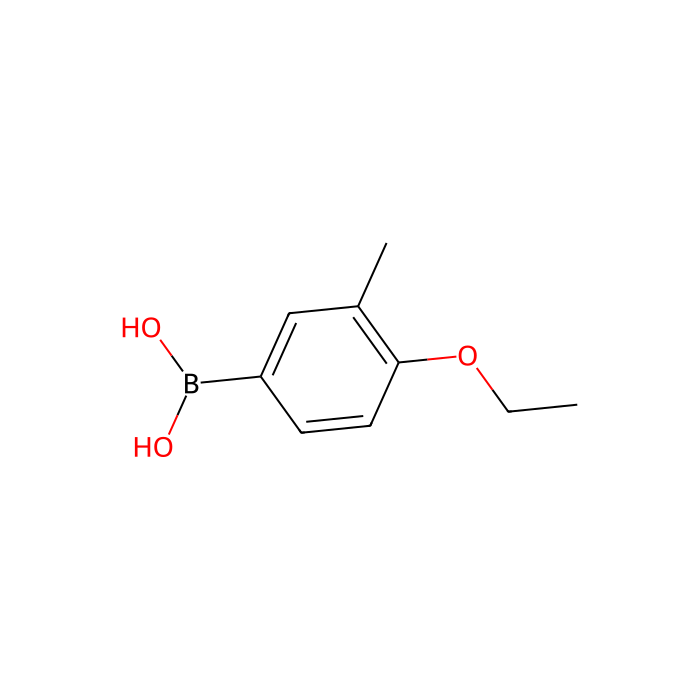
A substituted arylboronic acid useful as a cross-coupling building block. The benzene ring bears a boronic acid group and two para/meta alkoxy/alkyl substituents.
Structural description (2D): A benzene ring with the boronic acid substituent at position 1, a methyl group at position 3 (meta to B), and an ethoxy group at position 4 (para to B). The boronic acid is trigonal planar at boron with two hydroxyls capable of forming cyclic boroxines upon dehydration.
General notes
Arylboronic acids exist in equilibrium with their cyclic trimers (boroxines) under dry conditions and rehydrate in moist air/solvent.
Synthetic Utility
Functional group delivery
Provides an electron-rich 3-methyl-4-ethoxyphenyl fragment via boron-to-metal transmetalation in cross-couplings. The ethoxy substituent can serve as a synthetic handle (e.g., demethylation/alkyl manipulation if exchanged) or as a permanent directing/solubilizing group.
Transformations (literature)
Suzuki–Miyaura coupling to aryl/vinyl halides and triflates to forge biaryls and styrenyls.
Chan–Lam couplings to form aryl–N (anilides, amides, imidazoles) and aryl–O (phenolic aryl ethers, carbamates) bonds under oxidative conditions.
Boronate ester formation (pinacol, neopentyl glycol) for protection, purification, or modulation of reactivity.
Conversion to aryltrifluoroborate salts for enhanced bench stability and alternative coupling protocols.
Retrosynthetic value
Complements electrophilic partners bearing complementary functionality, enabling late-stage diversification of ethoxy/methyl-substituted aromatic frameworks found in agrochemicals, materials monomers, and probe molecules.
Selectivity considerations
Electron-donating groups favor faster oxidative addition of the corresponding electrophiles and can improve coupling rates under milder conditions; steric profile at the 3-position may influence ortho interactions in downstream substitutions.
Target Specificity
Not applicable. This product is a small-molecule synthetic reagent, not a biological macromolecule or affinity reagent. No antigen/epitope, clone, or species reactivity is associated with this item.
We use cookies to ensure the website functions properly and, where permitted, to improve your experience. You can manage your preferences at any time in Settings. Learn more in our Cookie Policy.
Shall we send you a message when we have discounts available?
Remind me later
Thank you! Please check your email inbox to confirm.
Products are supplied to verified businesses, institutions, and qualified professionals for research and development use only. Not for use in humans, animals, diagnosis, or therapy.

 L2216378