This compound belongs to the class of organic compounds known as pyridines and derivatives. These are compounds containing a pyridine ring, which is a six-member aromatic heterocycle which consists of one nitrogen atom and five carbon atoms.
External Descriptors
Not available
1. Djoumbou Feunang Y, Eisner R, Knox C, Chepelev L, Hastings J, Owen G, Fahy E, Steinbeck C, Subramanian S, Bolton E, Greiner R, and Wishart DS. ClassyFire: Automated Chemical Classification With A Comprehensive, Computable Taxonomy. Journal of Cheminformatics, 2016, 8:61.
Determine the necessary mass, volume, or concentration for preparing a solution.
Dilution Calculator
Determine the dilution needed to prepare a stock solution.
Reconstitution Calculator
Recensioni
Recensioni dei clienti
Application Protocols
No vendor-tested bioassay or immunoassay protocols are provided for this small-molecule reagent. Usage is application-dependent (e.g., as a base, ligand, or building block) and should follow standard synthetic organic procedures.
General handling protocol (informational):
Equilibrate to room temperature under inert atmosphere before opening.
If moisture-sensitive steps are planned, pre-dry over K2CO3 or 3 Å sieves and handle via syringe/septum techniques.
Verify purity by GC/GC–MS or 1H NMR prior to critical applications; distill under reduced pressure if necessary to remove low-boiling impurities.
For analytical uses (e.g., internal standard), establish calibration and response factors under your exact instrumental conditions.
Biological Roles
Item-specific biological data: None provided for this product; for research use only.
General context (biochemistry of pyridines; informational only):
Pyridine as a ring system is central to numerous biomolecules (e.g., nicotinamide in NAD+/NADP+), vitamins (niacin), and enzyme cofactors. However, simple alkylpyridines like 4-ethylpyridine are not endogenous metabolites and are typically xenobiotics.
Biotransformation: Alkylpyridines undergo hepatic oxidative metabolism in mammals. Typical routes include N-oxidation to pyridine N-oxides and benzylic oxidation of the side chain (first to alcohol/aldehyde then to acid), mediated by cytochrome P450s (literature generalization).
Interaction with biomacromolecules: The basic ring nitrogen can form cation–π and ionic interactions when protonated, which is why pyridine motifs are frequent in medicinal chemistry scaffolds. That said, 4-ethylpyridine itself is generally used as a chemical probe/reagent rather than a bioactive agent.
Analytical use: Substituted pyridines can serve as derivatization agents or internal standards in some analytical workflows due to their UV activity and distinctive MS fragmentation, though 4-ethylpyridine is not a standard derivatization agent.
Note: No claims are made regarding therapeutic or diagnostic use. Handle as a laboratory chemical; avoid biological exposure pathways.
Buffer Applications
Not typically applicable. 4-Ethylpyridine is not commonly employed as a biological buffer due to toxicity, odor, and relatively low buffer capacity around physiologic pH (its conjugate acid pKa is in the mid-5 range, literature). If a pyridine buffer system is needed in nonaqueous or specialized analytical settings, standard pyridine/acetic acid or collidine-based buffers are more typical and better documented.
For aqueous buffering and biochemistry, use established systems (phosphate, Tris, HEPES, MOPS) matched to the required pH range and ionic strength.
Green Alternatives
Perspective: 4-Ethylpyridine reduces volatility vs pyridine but remains a petro-derived, odorous, flammable, and toxic heteroaromatic. Selection should be justified by unique performance (ligand/basic catalyst) or structural needs.
Potential greener choices depending on role:
If used as a base/scavenger:
Carbonates/bicarbonates (K2CO3, NaHCO3) in biphasic or micellar systems: inorganic, low-toxicity; limited solubility and basicity may require phase-transfer catalysts.
Aqueous organic bases (e.g., ammonia, aqueous amines) or solid-supported tertiary amines can reduce fugitive emissions.
Sterically hindered amines (DIPEA, 2,6-lutidine) may provide lower nucleophilicity and, in some cases, improved odor control; not inherently “green” but operationally safer.
If used as ligand/promoter:
Replace with less odorous pyridines (polymer-supported pyridine) to improve handling and recovery.
N-oxide variants can sometimes replace neutral pyridines as ligands under oxidizing conditions, easing separation.
If considered as solvent/co-solvent:
Prefer bio-based ethers (2-MeTHF) or CPME where applicable; far lower toxicity/odor and improved safety profile. However, they are not basic and cannot substitute mechanistically when pyridine-like basicity is required.
Quick comparison (general):
4-Ethylpyridine: Basic, nucleophilic; strong odor; flammable; good metal-ligand.
K2CO3 (solid): Green base; heterogeneous; lower basicity, often needs phase-transfer.
Trade-offs: Greener options may need higher temperatures, catalysts, or different workflows (e.g., flow/micellar media) to match performance.
Pharmaceutical Uses
Item-specific pharmacopeial/excipient status: Not specified for this item; refer to CoA/Spec Sheet.
General notes (non-clinical, manufacturing context only):
Role in process chemistry: 4-Ethylpyridine can function as a base, acid scavenger, or ligand in synthetic steps during API intermediate preparation. Its higher boiling point vs pyridine can simplify solvent recovery yet complicate complete removal; plan for adequate purge steps.
Intermediate: The ring can be quaternized or N-oxidized to generate salts or N-oxides that serve as intermediates to other heteroaromatics via rearrangements (e.g., Boekelheide). Benzylic functionalization of the ethyl substituent can yield aldehydes/acids that are valuable fragments.
Impurity considerations: Residual pyridine derivatives are tightly controlled in drug substances due to odor/toxicity; validated analytical methods (GC headspace, LC-UV) are required to meet ICH residual solvent/reagent guidelines.
No therapeutic or clinical claims are made; this product is intended for research and manufacturing development use only.
Physical Properties
Item-specific physical properties provided for this catalog entry:
Appearance: Not specified for this item; refer to CoA/Spec Sheet.
Grade/Purity: Not specified for this item; refer to CoA/Spec Sheet.
Solubility: Miscible with common organic solvents (EtOH, acetone, ethers, chlorinated solvents); limited solubility in water (tens of g/L range; literature).
UV: Aromatic π–π* absorption; ε in near-UV typical of substituted pyridines (literature qualitative note).
Practical notes (general):
Volatility is lower than pyridine due to the ethyl substituent; odor still strong and persistent.
The benzylic CH2 can undergo slow air oxidation; maintain closed under inert atmosphere to minimize discoloration and peroxide/oxide byproducts.
Quality and Grades
Item-specific quality details for this SKU:
Grade/Purity: Not specified for this item; refer to CoA/Spec Sheet.
Stabilizers/Additives: Not specified for this item; refer to CoA/Spec Sheet.
Interpretation and guidance (general):
In the absence of a stated “HPLC,” “GC,” or “anhydrous” grade, assume this listing is a general research-grade reagent. For moisture- or oxygen-sensitive applications (e.g., strong base-promoted chemistry, low-level catalysis), verify water content, acidity, and UV background via the item’s CoA.
For chromatographic applications (as mobile-phase additive or modifier in nonaqueous systems), HPLC-grade pyridines are typically controlled for UV cutoff/absorbance; if required, request low-UV grade and documentation.
For organometallic or coordination applications, trace metal content and basic impurity profile (e.g., pyridine, 3-ethylpyridine isomer) may be relevant; consult the Spec Sheet.
Odor control and color: Fresh 4-ethylpyridine is usually colorless; minor yellowing indicates oxidation/polymerization byproducts. Argon packaging (as provided) helps maintain quality.
Documentation:
Always reconcile batch-specific CoA values (assay, GC purity, residual solvents, water, acids, metals) with your protocol requirements. If a specific specification is needed and not listed, request a custom CoA or pre-qualification sample.
Reaction and Applications
4-Ethylpyridine is a versatile basic heteroaromatic that serves as a nucleophilic base, ligand, and building block.
As a base/nucleophile (general):
Acts as a Brønsted base and nucleophilic catalyst in acyl-transfer and activation chemistry (conceptually similar to pyridine/DMAP, though less activated than DMAP). Useful for forming acyl pyridinium intermediates in acylations of weakly nucleophilic substrates under forcing conditions.
Scavenger for acid halides/anhydrides, capturing HX as pyridinium salt.
As a ligand:
Monodentate N-donor ligand to late transition metals (e.g., Pd, Pt, Cu, Ag) for complex synthesis, tuning sterics/electronics vs pyridine. Employed in formation of coordination polymers/MOFs where para-alkyl substituent modulates packing and solubility.
As a building block:
Quaternization at N with alkyl halides to give ionic liquids/quaternary pyridinium salts.
N-oxidation (mCPBA, H2O2 systems) to 4-ethylpyridine N-oxide, a useful oxidized derivative for further rearrangements (e.g., Boekelheide) or as ligand modifier.
Benzylic functionalization at the ethyl side chain (radical halogenation, oxidation to aldehyde/acid, or cross-coupling after benzylic halogenation).
Metalation/functionalization of ring:
Electrophilic substitution on pyridines is limited; directed lithiation under strong base may target benzylic CH2 preferentially. Minisci-type radical C–H functionalization on protonated pyridine ring can introduce substituents under photoredox/oxidative conditions.
Practical tips:
Drying: If needed, dry over K2CO3 or molecular sieves; avoid strong desiccants that may react with the base.
Odor control: Perform transfers in a hood; use septum-sealed syringes where possible.
Inerting: Maintain argon blanket (as supplied) to limit oxidation/discoloration.
Reaction Conditions
General guidance only (literature-informed; not product specifications):
Solvents: Acetonitrile, acetone, MeOH, or neat; 20–80 °C.
Notes: Exothermic; control addition. Quaternary salts often precipitate from less polar media.
N-oxidation to N-oxide:
Reagents: mCPBA (0–25 °C, DCM) or H2O2/acetic acid (rt–50 °C).
Workup: Neutralize acid; watch for overoxidation or benzylic oxidation under harsh conditions.
Benzylic bromination (ethyl side chain):
Reagents: NBS, AIBN or light; solvents: CCl4, benzene, or greener options like PhMe/MeCN; 0.5–6 h, 25–80 °C.
Follow-up: SN2 substitution (e.g., with cyanide, thiols) or oxidation.
Acylation (as base/nucleophile):
Reagents: Acid chlorides/anhydrides; solvents: DCM, toluene, EtOAc; 0–25 °C.
Use excess base to trap HX; monitor by TLC/GC for acylpyridinium intermediates.
Coordination complex formation:
Metal salts (e.g., AgBF4, PdCl2) with 4-ethylpyridine in MeCN/EtOH; rt–reflux; ligand:metal 2–4:1 often yields stable adducts.
Minisci-type C–H functionalization:
Conditions: Protonated substrate (acidic medium), radical source (e.g., carboxylic acids with persulfate or photoredox); 0–40 °C.
Typical yields vary widely (40–90%) depending on substrate and conditions. Always perform small-scale optimization and ensure adequate ventilation due to odor and volatility.
Safety and Handling
Item-specific safety information provided:
Storage conditions: Room temperature; Argon charged (store under inert atmosphere).
Shipment: FedEx DG Service (hazardous materials shipping).
GHS classification, pictograms, signal word, H-statements: Not specified for this item; refer to SDS.
General safety guidance for 4-alkylpyridines (informational; consult SDS for authoritative data):
Likely hazards: Flammable liquid and vapor; harmful if swallowed or inhaled; causes skin and eye irritation; strong, persistent odor typical of pyridines.
PPE: Use chemical-resistant gloves (e.g., nitrile), lab coat, splash goggles; work in a fume hood to control vapors/odor.
Handling: Avoid heat, sparks, open flames. Ground/bond containers during transfer. Use only with adequate ventilation. Keep container tightly sealed under inert gas as supplied.
Incompatibilities: Strong oxidizers (risk of exotherm/oxidation), strong acids (forms pyridinium salts with heat evolution), acylating agents (may react), and reducing alkali metals.
First aid (overview):
Inhalation: Move to fresh air; seek medical attention if symptoms persist.
Skin: Wash with soap and water; remove contaminated clothing.
Eyes: Rinse cautiously with water for several minutes; remove contact lenses if present; seek medical advice.
Ingestion: Rinse mouth; do not induce vomiting; get medical attention.
Fire-fighting: Alcohol-resistant foam, dry chemical, CO2; water spray for cooling. Combustion can produce NOx.
Waste: Collect as hazardous organic base/flammable waste per institutional and local regulations.
Solvent Selection
Applicability: 4-Ethylpyridine is primarily a reagent/ligand and not a routine bulk solvent. Nonetheless, its solvent-like behavior and miscibility can be leveraged in niche cases.
Polarity/proticity class (general): Polar aprotic, basic heteroaromatic; hydrogen-bond acceptor only.
Miscibility (literature/general): Miscible with many organics (alcohols, ethers, ketones, aromatics, chlorinated solvents). Limited water miscibility, but it can dissolve appreciable amounts of water compared to nonpolar solvents.
Dielectric behavior: Comparable to substituted pyridines; supports ionic species better than hydrocarbons but below strongly polar amides/sulfoxides.
When to consider using 4-ethylpyridine:
As a co-solvent and base in reactions where the reagent itself participates (e.g., as ligand or nucleophilic catalyst) and where odor/volatility reduction vs pyridine is desired.
In coordination chemistry crystallizations where the ligand should be present at high activity in solution.
When to avoid:
As mobile-phase component for analytical HPLC/UV work unless low-UV grade is documented; strong UV absorbance and odor can be problematic.
Aqueous/biological systems due to toxicity and volatility.
Comparison (general):
Pyridine: More volatile/odorous; higher water miscibility; similar basicity but lower bp.
2,6-Lutidine/collidine: More hindered, less nucleophilic; often better non-nucleophilic bases but higher bp/viscosity.
NMP/DMAc/DMSO: Far more polar/high-boiling; better for ionic chemistry but different reactivity (nonbasic vs basic acceptor differences).
Storage and Reconstitution
Item-specific instructions (from Product Data):
Storage conditions: Store at room temperature under argon (argon charged packaging).
Shipping: Shipped via FedEx DG Service.
Additional guidance (general best practices for pyridine bases):
Keep container tightly sealed to minimize air/oxidant ingress and odor emissions. Use PTFE-lined caps.
Store away from strong oxidizers and sources of ignition. Segregate from acids.
If long-term storage is planned, periodic GC or NMR checks are prudent to detect oxidation/discoloration; redistill if necessary.
No reconstitution is required; product is supplied neat. If preparing solutions, use dry, oxygen-free solvents when sensitive chemistry is planned and label solution stability accordingly.
Freeze–thaw: Not applicable to a room-temperature liquid. Avoid cold storage that could lead to viscosity increase or crystallization of impurities.
Always refer to the lot-specific CoA and SDS for definitive storage limits and compatibility information.
Structure and Identity
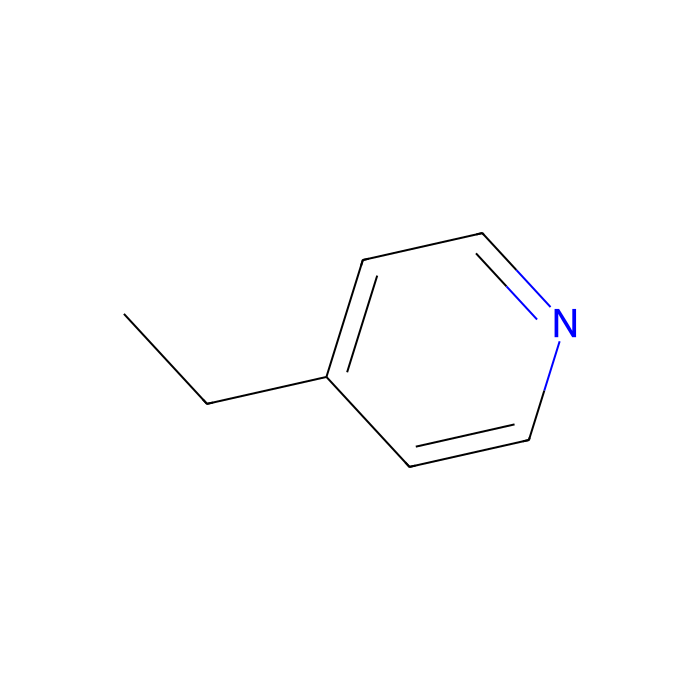
Brief overview: 4-Ethylpyridine is a mono-alkylated pyridine (para-ethyl) used as a basic heteroaromatic building block and ancillary ligand.
Item-specific identifiers (from Product Data):
CAS: 536-75-4
SKU: E106225
InChIKey: 380947
Category: 化学和生化试剂 (research chemicals)
Research use: For research use only
Item-specific composition fields:
Molecular Formula: Not specified for this item; refer to CoA/Spec Sheet.
Molecular Weight: Not specified for this item; refer to CoA/Spec Sheet.
SMILES: Not specified for this item; refer to CoA/Spec Sheet.
Literature/typical identity data (for reference only; not product specifications):
Aromatic six-membered ring with one ring nitrogen (pyridine).
Ethyl substituent at the 4-position (para to the ring N), providing a benzylic CH2 adjacent to the ring.
Planar heteroaromatic core; one basic ring nitrogen (sp2 lone pair orthogonal to the π-system).
No stereocenters. The molecule is neutral and weakly basic (via ring N).
Synthetic Utility
Functional profile:
Basic, nucleophilic heteroaromatic (ring N lone pair) with a benzylic ethyl side chain (activated C–H for radical/oxidative functionalization). Aromatic ring is deactivated toward electrophilic substitution but amenable to radical or metal-catalyzed C–H functionalization under appropriate activation.
Halogenation: Benzylic bromination/chlorination (NBS under radical initiation) to access coupling handles (e.g., for SN2, cross-coupling after conversion to organometallics).
Cross-coupling enablement: Convert benzylic position to boronate (via lithiation/borylation after halogenation) enabling Suzuki-type coupling to build diversified side chains.
Minisci/photoredox: Protonated ring undergoes radical addition (e.g., with carboxylic acid-derived radicals) to install substituents on the ring.
Coordination chemistry: Acts as a monodentate ligand in assembling discrete complexes and coordination polymers; sterics/electronics tuned by the ethyl substituent compared with pyridine.
Retrosynthetic value:
Serves as a readily available para-alkyl pyridine core from which libraries of side-chain-modified pyridines or pyridinium salts can be derived. The para orientation simplifies interpretation of regiochemistry and NMR analysis in SAR studies.
Target Specificity
Not applicable. This product is a small-molecule chemical (heteroaromatic base), not a biological targeting reagent. No antigen, epitope, clone, or isotype information is relevant for this item.
Utilizziamo i cookie per garantire il corretto funzionamento del sito web e, ove consentito, per migliorare la tua esperienza. Puoi gestire le tue preferenze in qualsiasi momento nelle Impostazioni. Per saperne di più, consulta la nostra Cookie Policy.
Desidera che le inviamo un messaggio quando avremo sconti disponibili?
Ricordamelo più tardi
Grazie! Controlli la sua casella di posta per confermare.
Products are supplied to verified businesses, institutions, and qualified professionals for research and development use only. Not for use in humans, animals, diagnosis, or therapy.

 J22111001