This compound belongs to the class of organic compounds known as alkyl-phenylketones. These are aromatic compounds containing a ketone substituted by one alkyl group, and a phenyl group.
External Descriptors
Not available
1. Djoumbou Feunang Y, Eisner R, Knox C, Chepelev L, Hastings J, Owen G, Fahy E, Steinbeck C, Subramanian S, Bolton E, Greiner R, and Wishart DS. ClassyFire: Automated Chemical Classification With A Comprehensive, Computable Taxonomy. Journal of Cheminformatics, 2016, 8:61.
Determine the necessary mass, volume, or concentration for preparing a solution.
Dilution Calculator
Determine the dilution needed to prepare a stock solution.
Reconstitution Calculator
Recensioni
Recensioni dei clienti
Application Protocols
No standardized bioassay or immunoassay protocols apply to this small-molecule building block.
General laboratory guidance
For synthetic procedures, see Reaction Conditions for representative setups.
For analytical characterization, typical methods include 1H/13C/19F NMR, IR (C=O stretch), GC–MS/LC–MS, and HPLC for purity assessment.
Note: This product is for research use only.
Biological Roles
This compound is a synthetic, non-natural aromatic ketone. It has no recognized endogenous biological role.
General context (literature; not product-specific and not medical claims)
Aryl fluorides are frequently used in chemical biology and medicinal chemistry to probe electronic effects and metabolic stability; the fluorine’s strong C–F bond modulates oxidative metabolism relative to the parent arene.
The acetophenone moiety is a classic handle for derivatization (oximes/hydrazones) that can serve as affinity tags or linkers in probe development.
The compound itself is for research use only and is not intended for use in humans or diagnostics.
Note: Any bioassay use should be guided by institutional safety protocols; evaluate cytotoxicity and off-target effects empirically for the specific system under study.
Buffer Applications
Not typically applicable. 4'-Fluoro-3'-methylacetophenone is a hydrophobic small-molecule building block rather than a buffering agent. It does not form defined pH buffer systems. For relevant details, see Reaction & Applications, Synthetic Utility, and Reaction Conditions.
Green Alternatives
As a building block, the compound itself is not replaced by a “green solvent,” but greener choices can be made for transformations performed on it.
Greener solvent swaps (literature guidance)
Ethereal media: Replace THF/Et2O with 2-MeTHF or CPME where compatible (better safety profile, renewably sourced 2-MeTHF, higher boiling for heat-intensive steps).
Chlorinated solvents: Prefer EtOAc, MeCN, or 2-MeTHF instead of CH2Cl2/CHCl3 for oxidations/extractions when performance allows.
Polar aprotics: Consider propylene carbonate or sulfolane derivatives as alternatives to DMF/DMSO/NMP for high-temperature SNAr, balancing viscosity and workup.
Process-intensification and waste reduction
Catalytic hydrogenation over stoichiometric hydrides when reducing the carbonyl (lower waste, easy workup).
Use of aqueous oxime formation protocols (EtOH/H2O) to reduce solvent load.
Employ continuous-flow heating for SNAr to minimize solvent volume and improve heat transfer.
Trade-offs
2-MeTHF/CPME may alter enolate geometry/selectivity relative to THF; verify outcomes at small scale.
Propylene carbonate can be difficult to remove and may hydrolyze under strong basic conditions. Always validate substitutions with DOE.
Pharmaceutical Uses
Formulation/excipient role: Not applicable. This product is supplied for research use only and is not intended as an excipient or API.
Medicinal chemistry context (literature; no therapeutic claims)
Commonly employed as a fragment/intermediate in SAR exploration where para-fluoro substitution is used to tune potency, lipophilicity, and metabolic stability.
The ketone allows rapid diversification (reductive amination after conversion to anilines/amines via SNAr, oxime/hydrazone libraries, alpha-functionalization for side-chain introduction).
Regulatory note
No pharmacopeial monograph is implied. Any GMP or clinical manufacturing use would require independent qualification and regulatory assessment outside the scope of this catalog listing.
Physical Properties
Item-specific specs
Appearance: Not specified for this item; refer to CoA/Spec Sheet.
Grade/Purity: Not specified for this item; refer to CoA/Spec Sheet.
Literature/general properties (reference information; not product specifications)
Physical state: Typically a colorless to pale yellow liquid for many substituted acetophenones; aromatic odor
Molecular formula and weight (literature): C9H9FO; ~152.16 g/mol
Volatility: Moderate; far less volatile than low-boiling solvents; handle in a fume hood to control vapors
Solubility profile: Sparingly soluble in water; miscible with common organic solvents (e.g., alcohols, ethers, esters, chlorinated and aromatic hydrocarbons) — typical for aryl methyl ketones
Acid/base behavior: Carbonyl is non-basic; alpha C–H is mildly acidic enabling enolate formation under basic conditions
Partitioning: Expected to be lipophilic due to aryl and methyl substituents; fluorine slightly modulates polarity (qualitative)
Spectroscopic handles: Strong IR C=O stretch near ~1680–1715 cm⁻1 (literature, conjugated ketone range); 19F NMR (singlet) and characteristic aromatic/acetyl resonances in 1H/13C NMR
Notes
Do not use literature values as acceptance criteria. For exact numerical specifications (bp, mp, density, refractive index, UV cutoff, water/peroxide/metal limits), refer to the product CoA/Spec Sheet.
Quality and Grades
Item-specific quality details
Grade/Purity: Not specified for this item; refer to CoA/Spec Sheet.
Guidance on grades (general information)
Research grade: Suitable for most discovery and synthetic applications; actual purity, moisture, and trace impurities are defined on the CoA.
Low-UV/HPLC grade (if applicable): Ensures low background in chromatographic detection; absence of stabilizers that interfere with UV — only applicable if explicitly stated on CoA/spec.
Stabilizers: This product is not typically stabilized; any stabilizer would be disclosed on the CoA/spec.
What to check on receipt
Confirm identity by NMR/GC–MS/LC–MS if needed for critical applications.
Review CoA for assay (GC or NMR), residual solvents, and any specified limits (water, metals, UV). If not listed, request the spec sheet.
For moisture/oxidation-sensitive transformations (e.g., strong-base enolate chemistry), consider in-house titration (e.g., Karl Fischer for water) and pre-drying even if the item is supplied at ambient conditions.
Reaction and Applications
Scope: 4'-Fluoro-3'-methylacetophenone is a multifunctional aryl ketone useful as both an electrophile (at the carbonyl) and as an enolate precursor; the para-fluoro is positioned for SNAr under appropriate activation.
Representative applications (literature)
Carbonyl derivatization: Formation of oximes/hydrazones/semicarbazones for characterization or as synthetic intermediates. Typical conditions: NH2OH·HCl with base (pyridine/NaOAc) in EtOH or MeOH at rt–reflux.
Reductive transformations: NaBH4 or catalytic hydrogenation to the corresponding secondary alcohol; Wolff–Kishner or Clemmensen protocols to access the p-fluoro-m-tolyl core (decarbonylation in multistep sequences).
Enolate chemistry: Alpha-functionalization (halogenation, alkylation, Michael donors). LDA or LiHMDS in dry THF at −78 to −20 °C enables regioselective deprotonation at the methyl-bearing carbonyl alpha-position.
Baeyer–Villiger oxidation: Conversion to the corresponding aryl acetate (migration selectivity typical of aryl ketones) using mCPBA or peracetic acid; useful for accessing phenyl acetates amenable to further substitution.
Nucleophilic aromatic substitution (SNAr): The para-fluoro substituent is activated by the para-acyl group; strong nucleophiles (amines, alkoxides, thiolates) in polar aprotic solvents at elevated temperature can substitute F, introducing diverse heteroatom functionality.
Directed metalation/functionalization: The meta-methyl can sometimes assist in directed ortho-lithiation to install additional substituents ortho to Me (with strong bases and appropriate directors).
Use cases
Intermediates in agro/medchem SAR libraries, where the F atom modulates electronics/metabolism and the ketone serves as a handle for diversification.
Building block for synthesizing para-aminated, para-alkoxylated, or para-thioether analogs via SNAr from the aryl fluoride.
Reaction Conditions
General literature guidance (representative, not product specifications)
Enolate formation/alkylation: LDA (1.1–1.5 equiv) in dry THF at −78 to −20 °C, 0.1–0.5 M; quench with electrophile (e.g., MeI, benzyl bromide). Typical reaction time 0.5–3 h after base addition.
Oxime formation: Hydroxylamine hydrochloride (1.2–2.0 equiv) with pyridine or NaOAc in EtOH or EtOH/H2O (rt–78 °C), 1–4 h; monitor by TLC/LC–MS.
Carbonyl reduction: NaBH4 (1.0–2.0 equiv) in MeOH or EtOH at 0–25 °C, 0.5–2 h; or Pd/C hydrogenation (1–10 mol% Pd) in EtOH/EtOAc under 1–5 bar H2 at rt–50 °C until consumption.
Baeyer–Villiger: mCPBA (1.2–2.0 equiv, 77%) in CH2Cl2 or MeCN at 0–25 °C, 2–16 h; include buffering (NaHCO3) to manage acidity; avoid over-oxidation.
SNAr at para-F: Nucleophile (e.g., amine/alkoxide/thiolate, 1.2–3.0 equiv) in DMSO, DMF, or NMP; 80–140 °C (oil bath or sealed tube) for 2–18 h. Inorganic base (K2CO3/Cs2CO3/NaH) often required; ensure water control.
Workup/purification tips
Quench enolates cautiously (NH4Cl or HOAc) at low temperature to control exotherm.
For peracid oxidations, scrub residual peracid/peroxide (Na2SO3/Na2S2O3 wash) before concentration.
SNAr mixtures can be viscous; dilute with EtOAc/MTBE and wash with brine; silica gel often retains polar byproducts—optimize eluents with small % MeOH or Et3N modifier.
Yields vary widely with substrate and conditions; optimize via DOE and analytical monitoring.
Safety and Handling
Item-specific hazard data
Signal Word: Not specified for this item; refer to SDS.
H-Statements: Not specified for this item; refer to SDS.
GHS Classification/Pictograms: Not specified for this item; refer to SDS.
General safety guidance (for aromatic ketones; informational only)
Likely hazards: Combustible liquid; may cause skin/eye irritation and respiratory irritation upon vapor exposure. Avoid inhalation and direct contact. Aromatic ketones can cause defatting of skin.
PPE: Lab coat, safety glasses or chemical splash goggles, and appropriate chemically resistant gloves (e.g., nitrile). Work in a functioning fume hood.
Handling: Prevent aerosol formation. Keep away from ignition sources. Use secondary containment to avoid spills.
Incompatibilities: Strong oxidizers (risk of exotherm), strong bases/acids (can lead to aldol/condensation or hydrolysis under forcing conditions), alkali metals.
First aid (overview; defer to SDS):
Inhalation: Move to fresh air; seek medical attention if symptoms persist.
Skin: Wash with soap and water; remove contaminated clothing.
Eyes: Rinse cautiously with water for several minutes; remove contact lenses if present and easy to do; seek medical evaluation if irritation continues.
Ingestion: Rinse mouth; do not induce vomiting; seek medical attention.
Fire response: Use CO2, dry chemical, or alcohol-resistant foam. Cool containers with water spray.
Always consult the product’s SDS for authoritative hazard classification, response measures, and exposure limits.
Solvent Selection
This product is a reactive building block, not a solvent. Solvent choice depends on the intended transformation of the aryl methyl ketone.
General solvent guidance for common manipulations (literature)
Enolate chemistry (alkylation, aldol): Polar aprotic solvents such as THF, 2-MeTHF, DME, MTBE, or DMF/DMAc; for strong bases (LDA, LiHMDS), use rigorously dried ethereal solvents (THF/Et2O) at low temperature.
Oxime/hydrazone formation: Alcoholic solvents (EtOH, iPrOH) or mixed EtOH/H2O with buffering base (pyridine, NaOAc).
Baeyer–Villiger oxidation: CH2Cl2, PhCH3, or MeCN with peracids (mCPBA, peracetic acid) under controlled temperature.
Reductions of the carbonyl: MeOH, EtOH, or THF for NaBH4; protic solvents avoided for borane or hydrosilylation systems depending on catalyst.
SNAr at the aryl fluoride: Polar aprotic solvents (DMSO, DMF, NMP) to solubilize nucleophiles (amines, alkoxides, thiolates); elevated temperature often required.
Tip: Where feasible, consider greener alternatives (2-MeTHF, CPME, MeCN, EtOAc) instead of chlorinated solvents, balancing rate/solubility/selectivity.
Storage and Reconstitution
Item-specific conditions (from Product Data)
Storage Conditions: Room temperature
Shipped In: Normal
General guidance
Keep container tightly closed in a cool, well-ventilated place away from ignition sources and incompatible reagents (strong oxidizers, strong bases/acids under forcing conditions).
Protect from prolonged light and moisture ingress; consider using septum-sealed bottles with inert gas headspace for moisture-sensitive enolate work.
If solidification or crystallization occurs on cold storage, gently warm to ambient and sonicate if needed; no special reconstitution is required for neat liquids.
For long-term sample integrity, aliquot into amber vials to minimize repeated headspace exposure and potential oxidative discoloration.
Always consult the product label/CoA for any additional, item-specific storage notes.
Structure and Identity
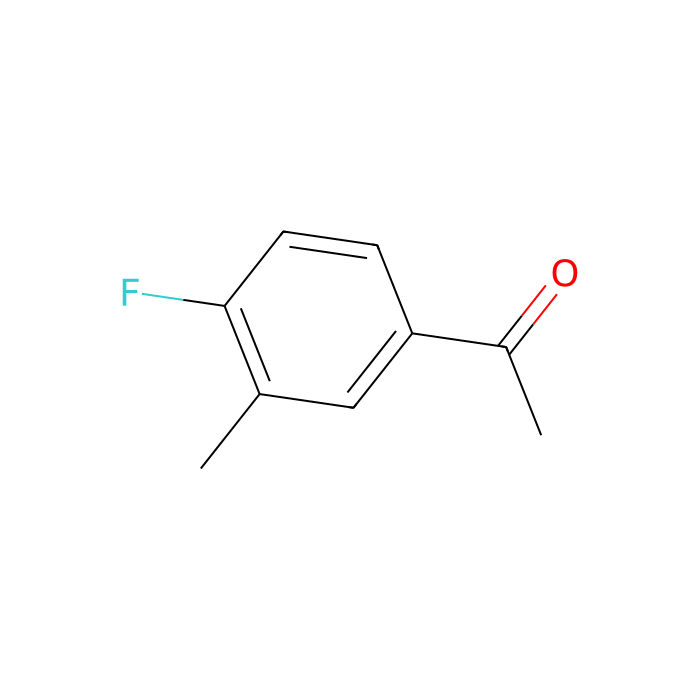
Brief: 4'-Fluoro-3'-methylacetophenone is an aryl methyl ketone bearing a para-fluoro and meta-methyl substituent on the acetophenone core; a versatile electrophile/enolate precursor for synthesis.
Item identifiers (from Product Data)
SKU: F136285
Product Name: 4'-Fluoro-3'-methylacetophenone
CAS: 369-32-4
PubChem CID: 289328
InChIKey: Not specified for this item; refer to CoA/Spec Sheet.
SMILES: Not specified for this item; refer to CoA/Spec Sheet.
Computed/Literature identity (for reference only; not item specifications)
Preferred IUPAC name (literature): 1-(4-fluoro-3-methylphenyl)ethan-1-one
Molecular formula (literature): C9H9FO
Formula weight (literature): ~152.16 g/mol
Example SMILES (literature): CC(=O)c1cc(C)cc(F)c1 (one of several equivalent aromatic representations)
Structural features (general chemistry description)
Core: Acetophenone (aryl methyl ketone) scaffold
Ring substituents: para-fluoro (–F) and meta-methyl (–CH3) relative to the acyl substituent
Functional groups: Aryl fluoride, methyl ketone (prototypical for enolate chemistry), and a lipophilic methyl substituent
2D description: A benzene ring bears an ethanone group (–COCH3) at C1, a methyl group at C3 (meta to carbonyl), and a fluorine atom at C4 (para to carbonyl); no stereogenic centers; planarity dominated by the aromatic ring and carbonyl conjugation
Synthetic Utility
Key reactive elements
Methyl ketone: Enables enolate generation for alpha-functionalization; supports classic transformations (halogenation, alkylation, aldol, Mannich). Carbonyl also forms reversible adducts (imines/oximes/hydrazones) and undergoes selective reduction.
Aryl fluoride (para to carbonyl): Activated toward SNAr due to the electron-withdrawing effect of the para-acyl group; allows substitution by O/N/S nucleophiles under polar aprotic conditions.
Meta-methyl: Modulates sterics/electronics; ortho-lithiation adjacent to Me may be accessible under strong base conditions for further elaboration.
Representative transformations (literature)
Alpha-bromination (Br2/AcOH) followed by nucleophile substitution to build side chains.
Baeyer–Villiger oxidation (mCPBA) to aryl acetates for downstream transesterification or phenol unveiling via hydrolysis.
Carbonyl reduction (NaBH4, catalytic hydrogenation, or hydrosilylation) to secondary alcohols; further ether/ester formation from the alcohol.
SNAr diversification at para position: Installation of anilines, alkoxides, or thioethers to access analog libraries without needing pre-activated aryl halides.
Retrosynthetic value
Serves as a convergent node linking aryl fluoride chemistry with enolate methodologies, enabling orthogonal diversification at the ring and side-chain.
Target Specificity
Not applicable. This product is a small-molecule chemical building block and does not possess immunological target specificity (no antigen/epitope, clone, isotype, or species reactivity).
We use cookies to ensure the website functions properly and, where permitted, to improve your experience. You can manage your preferences at any time in Settings. Learn more in our Cookie Policy.
Shall we send you a message when we have discounts available?
Remind me later
Thank you! Please check your email inbox to confirm.
Products are supplied to verified businesses, institutions, and qualified professionals for research and development use only. Not for use in humans, animals, diagnosis, or therapy.

 J22111094