This compound belongs to the class of organic compounds known as phenol ethers. These are aromatic compounds containing an ether group substituted with a benzene ring.
External Descriptors
Not available
1. Djoumbou Feunang Y, Eisner R, Knox C, Chepelev L, Hastings J, Owen G, Fahy E, Steinbeck C, Subramanian S, Bolton E, Greiner R, and Wishart DS. ClassyFire: Automated Chemical Classification With A Comprehensive, Computable Taxonomy. Journal of Cheminformatics, 2016, 8:61.
Determine the necessary mass, volume, or concentration for preparing a solution.
Dilution Calculator
Determine the dilution needed to prepare a stock solution.
Reconstitution Calculator
Recensioni
Recensioni dei clienti
Application Protocols
Not applicable. No validated bioassay protocols (WB, IHC, IF, FC) are associated with this small‑molecule reagent. For chemical synthesis, see Reaction Conditions and Synthetic Utility sections for practical guidance.
Biological Roles
This compound is a synthetic aromatic aldehyde and is not known as a natural metabolite.
Endogenous role: None established; not part of primary metabolic pathways.
Biochemical interactions (general): Aromatic aldehydes can form reversible adducts (Schiff bases) with primary amines (e.g., lysine side chains) under suitable conditions; this is a chemical reactivity consideration rather than a defined biological function.
Materials/chemistry interface: Para‑alkoxybenzaldehydes are often used to construct imine‑linked frameworks, liquid‑crystalline mesogens, and donor–acceptor chromophores for optoelectronic studies.
No biological activity claims are made; for research use only (per Product Data).
Buffer Applications
Not typically applicable. 4‑n‑Octyloxybenzaldehyde is highly hydrophobic and not used as a buffering agent or in aqueous buffer preparation. For aqueous experimental systems, dissolve in a compatible organic co‑solvent (e.g., DMSO, ethanol) and add to buffers at low percentages if needed for assay setups.
Green Alternatives
Greener choices primarily affect solvent/reagent selection around the aldehyde functionality rather than the substrate itself.
Greener solvent options (literature/general):
Replace DCM/CHCl3 with ethyl acetate, 2‑MeTHF, cyclopentyl methyl ether (CPME), or toluene where compatible.
For imine formation, use bio‑ethanol or 2‑MeTHF with molecular sieves/azeotropy rather than chlorinated solvents.
Energy efficiency: Utilize higher‑bp green ethers (2‑MeTHF, CPME) to enable reflux water removal and reduce solvent exchanges.
Catalysis: Employ organocatalysts (e.g., secondary amines for enamine catalysis) or earth‑abundant Lewis acids (e.g., Mg2+, Fe3+) instead of precious metals when feasible.
DCM | Good solubility, low bp | 2‑MeTHF / EtOAc | Better EHS profile; dry over sieves.
THF | Widely used | 2‑MeTHF | Similar polarity; more hydrophobic, easier phase splits.
CHCl3 | Strong solvency | Toluene / CPME | Lower toxicity; higher bp aids water removal.
Trade‑offs: substrate solubility and base/reagent compatibility must be re‑validated. Ensure water activity control (sieves/Dean–Stark) when moving to greener, less polar media.
Pharmaceutical Uses
No pharmacopeial or excipient status is indicated. This product is supplied for research and laboratory synthesis only.
Potential roles are limited to synthetic intermediate use in discovery chemistry (e.g., building imine libraries, styryl derivatives) rather than direct formulation.
Verify impurity profile and residual solvents per internal QA if materials will be advanced into regulated process development. No clinical or therapeutic claims are made.
Physical Properties
Item-specific physicochemical specifications (BP/MP, density, UV cutoff, metal/peroxide limits) are not provided.
Boiling point / melting point: Not specified for this item; refer to CoA/Spec Sheet. (Aryl aldehydes of comparable size are typically low-melting solids or high-boiling liquids; literature varies by chain length and purity.)
Density / refractive index: Not specified for this item; refer to CoA/Spec Sheet.
Solubility (qualitative, literature/general):
Practically insoluble in water; readily soluble in common organic solvents (e.g., dichloromethane, chloroform, THF, ethyl acetate, toluene, alcohols).
Enhanced solubility in nonpolar and moderately polar aprotic media due to the long n‑octyl chain.
Partitioning (literature expectation): High hydrophobicity (alkoxybenzaldehydes with C6–C10 chains exhibit high logP); exact logP for this item not specified.
Vapor pressure (general): Expected to be low at ambient temperature for C15 aryl aldehydes (use fume hood to minimize exposure).
pKa: Not applicable; aldehyde does not ionize appreciably in water. Phenolic acidity absent (aryl ether).
For method development, verify exact constants (mp, bp, density, nD) against the lot-specific CoA/SDS when preparing quantitative solutions or calibrations.
Quality and Grades
Grade/Purity: Not specified for this item; refer to CoA/Spec Sheet.
Without a declared grade, users should verify key quality attributes on the supplied CoA/SDS before critical applications:
Purity (% area by GC/HPLC or qNMR)
Identity (1H/13C NMR, MS, IR)
Residual solvents and water content (KF)
Stabilizers or additives (if any)
Actual appearance and color specification
Implications for use:
For synthesis and materials applications (e.g., liquid‑crystal Schiff bases, cross‑coupling precursors), confirm aldehyde content and absence of oxidized acid impurity to avoid stoichiometry errors and side reactions.
Chromatographic uses (if any) may require low UV background and narrow impurity profile; verify UV trace if relevant.
If stabilized: No stabilizer is indicated in the product data. When stabilizers are present for certain aldehydes, they can influence reactivity; check the CoA if your process is acid/base or catalyst sensitive.
Reaction and Applications
This substrate couples an electrophilic aldehyde with an electron‑donating para‑alkoxy aryl ring, enabling broad utility in organic synthesis and materials.
Condensations:
Imine/Schiff base formation with primary amines (including aromatic diamines) for liquid‑crystal and organic electronic materials; drive to completion by removing water (Dean–Stark or sieves).
Knoevenagel with active methylene compounds (e.g., malononitrile, cyanoacetates) to access push–pull cinnamaldehyde analogs.
Aldol-type reactions with enolates/enamines (control self‑condensation by base choice and dilution).
Olefination:
Wittig/Schlosser/HWE to install vinyl groups; the electron‑rich ring can tune photophysical properties in the product styrenes.
Reductions/oxidations:
Selective reduction (NaBH4, DIBAL-H) to the corresponding benzyl alcohol; acetalization as protective strategy.
Controlled oxidation to the para‑octyloxybenzoic acid (useful intermediate) using TEMPO/Oxone or Jones variants.
Cross‑coupling (indirect): Convert aldehyde to vinyl/benzyl halides or boronates, then apply Suzuki/Heck as needed; the –OR group is para‑directing and can influence regioselectivity in subsequent transformations.
Electrophilic aromatic substitution (on other partners): The –OR substituent activates ortho/para positions; here para is occupied, leaving ortho positions relatively activated for future substitutions.
Practical tips: rigorously dry glassware/solvents; aldehydes are moisture/air sensitive (slow oxidation). Monitor by TLC/GC; consider in situ 1H NMR (aldehyde CH ~9.5–10 ppm) to track consumption.
Reaction Conditions
General literature guidance for reactions of para‑alkoxybenzaldehydes (optimize per substrate and scale):
Imine (Schiff base) formation:
Solvent: toluene, ethanol, isopropanol, or 2‑MeTHF.
Conditions: 60–120 °C with Dean–Stark (in toluene) or RT–60 °C with 3Å molecular sieves; catalytic acetic acid (0.1–5 mol%) often accelerates.
Typical times: 1–16 h; monitor by TLC/1H NMR (disappearance of ~9.7–10 ppm aldehyde proton).
Wittig olefination:
Solvent: anhydrous THF, toluene, or DCM.
Base: n‑BuLi or NaHMDS for ylide generation; 0–25 °C, 1–6 h; E/Z ratio depends on ylide type.
HWE (phosphonate) olefination:
Solvent/base: THF/DMF with NaH, t‑BuOK, or DBU; 0–25 °C; often provides E‑selective alkenes.
Knoevenagel condensation:
Partners: malononitrile, cyanoacetates.
Catalysts: piperidine, ammonium acetate, or basic alumina; solvents: ethanol, toluene, or acetonitrile; RT–80 °C, 1–8 h.
Selective reduction to alcohol:
NaBH4 (MeOH/EtOH, 0–25 °C, 0.5–2 h) or DIBAL‑H (DCM/THF, −78 to 0 °C). Protect ether as needed if using acidic workups.
Notes: Maintain anhydrous and oxygen‑reduced environments to limit oxidation to the acid. For scale‑up, confirm exotherms (calorimetry) in condensations and olefinations. Yields and selectivities are substrate‑ and reagent‑dependent; verify with pilot reactions.
Safety and Handling
Hazard classifications and pictograms are not specified for this item; consult the product SDS for authoritative information.
General hazards (aromatic aldehydes): May be irritating to skin, eyes, and respiratory tract; can cause sensitization in susceptible individuals. Avoid inhalation and prolonged contact.
PPE: Lab coat, safety glasses or face shield, and appropriate chemically resistant gloves (e.g., nitrile). Work in a certified fume hood.
Handling notes:
Prevent exposure to air/oxidants; aldehydes may slowly oxidize to the corresponding acid.
Avoid strong bases (which can promote self‑condensation) and strong oxidizers.
Minimize headspace oxygen; the item is supplied for storage under inert gas (argon).
First aid (overview; defer to SDS):
Eye/skin contact: Rinse with water for ≥15 min; remove contaminated clothing; seek medical attention if irritation persists.
Inhalation: Move to fresh air; monitor breathing; seek medical attention if symptoms occur.
Ingestion: Rinse mouth; do not induce vomiting; obtain medical advice.
Spill response: Absorb with inert material (vermiculite, sand), collect for disposal; ventilate area.
Waste: Dispose according to institutional and local regulations for organic aldehydes/ethers.
Storage/Shipping (from Product Data): Store at 2–8 °C, argon charged. Shipped on wet ice.
Solvent Selection
As a hydrophobic, para‑alkoxy aryl aldehyde, 4‑n‑octyloxybenzaldehyde dissolves well in nonpolar to moderately polar organic solvents.
Imine/Schiff base formation: Toluene, ethanol, or isopropanol with Dean–Stark (for azeotropic water removal) or molecular sieves.
Wittig/Knoevenagel: THF, toluene, or DMF depending on base/reagent solubility; maintain anhydrous conditions.
Electrophilic aromatic substitutions (on other partners): Use chlorinated solvents or nitrobenzene alternatives as required by catalyst system; note the ring is activated by –OR.
Workup/purification: Normal‑phase silica gel typically effective; aldehydes may streak—use 0.5–2% triethylamine in eluent if needed, or reduce polarity to sharpen bands.
Comparison (general):
Toluene vs DCM: toluene higher bp supports water removal; DCM enhances rate for some condensations but requires low‑temp handling and separate drying strategy.
THF vs 2‑MeTHF: 2‑MeTHF offers greener profile and water‑tolerance; verify solubility of bases/reagents.
Storage and Reconstitution
Storage (from Product Data): Store at 2–8 °C under argon (argon‑charged container). Shipments are on wet ice.
Container/atmosphere: Keep tightly closed under inert gas to minimize air oxidation to the corresponding benzoic acid. Purge headspace after each use.
Light/moisture: Protect from light and moisture. Use desiccant in secondary containment when possible.
Stability: Aldehydes can slowly oxidize/polymerize over time; monitor by 1H NMR/GC for appearance of acid or alcohol impurities if stored long‑term.
Reconstitution/solution prep:
No special reconstitution required. Dissolve directly in a suitable anhydrous organic solvent (e.g., toluene, THF, DCM, ethanol) to desired concentration.
For aqueous assays, prepare a concentrated stock in DMSO or ethanol, then dilute into buffer keeping final cosolvent ≤1–2% v/v to avoid precipitation.
Aliquoting: For long‑term use, prepare small argon‑purged aliquots to reduce repeated headspace exposure and freeze–thaw.
Labeling: Record date of opening and solvent used for any solutions; follow institutional policies for shelf‑life and periodic re‑testing.
Research Use Note: For research use only.
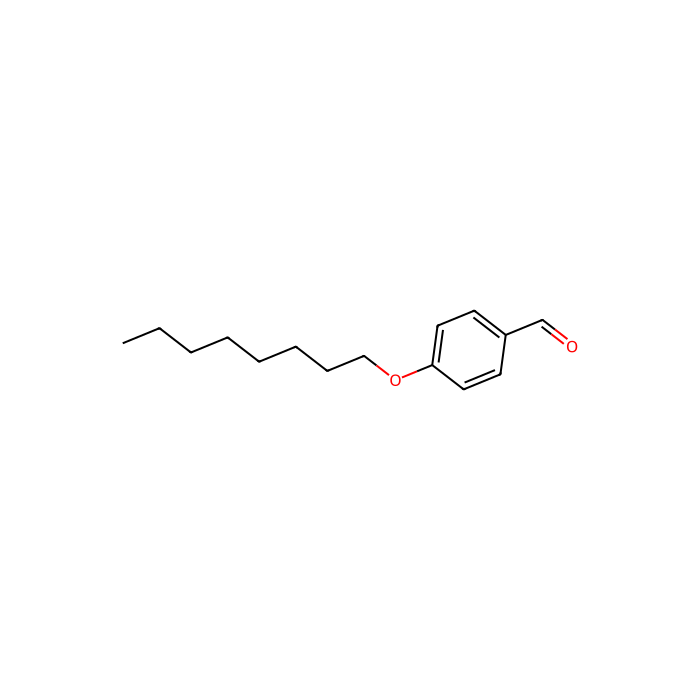
Structure and Identity
A para-alkoxy-substituted aryl aldehyde useful as a hydrophobic, electron-rich benzaldehyde building block.
Product name (SKU): 4-n-Octyloxybenzaldehyde (N159014)
CAS: 24083-13-4; PubChem CID: 90358
InChIKey (as provided): 190767
SMILES: Not specified for this item; refer to CoA/Spec Sheet.
Molecular formula (literature): C15H22O2
Molecular weight (literature): ~234.33 g/mol
Structural features (descriptive):
Core: Benzaldehyde ring (benzene bearing a formyl, –CHO, at one position)
Substituent pattern: Para-substituted with an n‑octyloxy group (–O–(CH2)7–CH3) relative to the formyl group.
Electronic profile: The p‑alkoxy group increases ring electron density and stabilizes cationic intermediates; the aldehyde remains strongly electrophilic.
2D description: A 1,4-disubstituted benzene; position 1 = –CHO; position 4 = –O–(CH2)7–CH3 (straight-chain C8). No stereocenters; conformational flexibility resides in the octyl chain.
Synthetic Utility
Key reactivity arises from the combination of an electrophilic aldehyde and an electron-donating aryl ether:
Electrophile at C=O:
Forms imines/oximes/hydrazones rapidly with amines/hydroxylamine/hydrazines.
Engages in Wittig, Horner–Wadsworth–Emmons, Julia–Kocienski to generate vinylarenes.
Knoevenagel condensations yield extended conjugation (useful for chromophores and LC precursors).
Aryl ether effects:
–OR group donates electron density, activating the ring and stabilizing benzylic intermediates; enhances rates in electrophilic processes on suitable partners.
Directs substitution ortho/para; with para occupied, ortho positions remain activated for follow‑up functionalization (e.g., directed lithiation with s‑BuLi/TMEDA at low T, then quench with electrophiles; literature precedent on related anisole systems).
Protect/modify: Aldehyde protection as acetals (e.g., ethylene glycol, p‑TsOH) enables harsh downstream steps. Reduction to benzyl alcohol or further to alkane (e.g., Wolff–Kishner, Clemmensen on derivatives) broadens scaffold access.
Materials chemistry: Readily furnishes Schiff base mesogens with anisotropic properties by condensation with anilines/diamines followed by further coupling.
Overall, this building block provides a hydrophobic tail that improves film‑forming/solubility while retaining the high reactivity of an aryl aldehyde.
Target Specificity
Not applicable. This product is a small‑molecule reagent, not a biological targeting agent or antibody. No antigen/epitope/isotype information applies.
Domande frequenti
What is the purity of this product?
This product is supplied at ≥98% purity (chemical assay). Lot-specific values are stated on the Certificate of Analysis.
How should this product be stored?
Store at 2–8 °C under argon. It is supplied under an argon blanket; reseal under inert gas after each use.
How is this product shipped?
This product ships chilled on wet ice. Unpack on arrival and transfer it to the storage condition stated above.
What are the CAS number, molecular formula and molecular weight?
The CAS Number is 24083-13-4, the molecular formula is C15H22O2, and the molecular weight is 234.34 g/mol. InChIKey KVOWZHASDIKNFK-UHFFFAOYSA-N.
We use cookies to ensure the website functions properly and, where permitted, to improve your experience. You can manage your preferences at any time in Settings. Learn more in our Cookie Policy.
Shall we send you a message when we have discounts available?
Remind me later
Thank you! Please check your email inbox to confirm.
Products are supplied to verified businesses, institutions, and qualified professionals for research and development use only. Not for use in humans, animals, diagnosis, or therapy.

 F2301734