Certificati (CoA, COO, BSE/TSE e tabella di analisi)
C of A & Other Certificates(BSE/TSE, COO):
Analytical Chart:
Proprietà chimiche e fisiche
Punto di fusione (°C)
127 °C
Peso molecolare
258.230 g/mol
XLogP3
3.300
Hydrogen Bond Donor Count
1
Hydrogen Bond Acceptor Count
5
Rotatable Bond Count
3
Exact Mass
258.064 Da
Monoisotopic Mass
258.064 Da
Topological Polar Surface Area
98.100 Ų
Heavy Atom Count
19
Formal Charge
0
Complexity
334.000
Isotope Atom Count
0
Defined Atom Stereocenter Count
0
Undefined Atom Stereocenter Count
0
Defined Bond Stereocenter Count
0
Undefined Bond Stereocenter Count
0
The total count of all stereochemical bonds
0
Covalently-Bonded Unit Count
1
Calcolatori di soluzioni
Molarity Calculator
Determine the necessary mass, volume, or concentration for preparing a solution.
Dilution Calculator
Determine the dilution needed to prepare a stock solution.
Reconstitution Calculator
Recensioni
Recensioni dei clienti
Application Protocols
No manufacturer-validated application protocols are provided for this item.
General example procedures (informational; adjust per your substrates)
Preparative aminolysis
To a dry flask under N2, charge 4-nitrophenyl anthranilate (1.0 equiv) and dry MeCN (0.1–0.2 M). Add amine (1.5 equiv) followed by DIPEA (2.0 equiv). Stir at 25 °C and monitor by TLC or A405. Upon completion, dilute with EtOAc, wash with sat. NaHCO3, brine, dry, and purify by chromatography to isolate the anthranilamide.
Kinetic assay (UV–Vis monitoring)
Prepare a buffered MeCN/H2O solution (e.g., 50:50 v/v, pH 8.5 carbonate). Introduce a known concentration of the ester and start the reaction by adding amine or enzyme catalyst. Record A400–410 versus time to extract rates, correcting for baseline hydrolysis.
Item-specific recommended conditions/dilutions: Not specified for this item; refer to your internal SOPs and method development.
Biological Roles
This product is a synthetic organic reagent rather than a biomolecule; there are no item-specific biological role claims.
General context (literature/biochemistry)
Anthranilate (2-aminobenzoate) is a key intermediate in tryptophan biosynthesis and is part of the kynurenine pathway in tryptophan catabolism. The anthranilamide motif occurs in various bioactive scaffolds (literature/general).
Para-nitrophenyl esters are widely used as chromogenic substrates to assay hydrolases (e.g., esterases, lipases) because release of p-nitrophenolate is easily monitored at ~400 nm. While this compound is an amide-forming activated aryl ester, analogous nitrophenyl esters are common in enzymology (literature/general).
Use limitations
For research use only (per Product Data). Not intended for diagnostic, therapeutic, or clinical use.
If using in biochemical assays
Verify background hydrolysis rate under the buffer conditions to ensure that any observed activity (e.g., with amidases or esterases) is distinguishable from non-enzymatic hydrolysis.
Account for the intrinsic absorbance of solvents and buffers near 350–450 nm to avoid spectral interferences when monitoring p-nitrophenolate formation.
Buffer Applications
This compound is not a buffering agent and is not typically used to prepare biological buffers.
Practical notes (general)
If using in aqueous or mixed aqueous-organic media for kinetic studies of aminolysis/hydrolysis, select a buffer that does not strongly nucleophilically compete (e.g., phosphate, bicarbonate) and that provides an ionic strength compatible with your assay.
Maintain pH control when monitoring 4-nitrophenol/phenolate absorbance: the phenolate form predominates at basic pH and has a stronger band near 400–410 nm (literature/general).
Item-specific buffer guidance: Not specified for this item; refer to CoA/Spec Sheet or your method SOPs.
Green Alternatives
Context: While 4-nitrophenyl anthranilate is effective as an activated ester, choices of solvent and coupling strategy strongly impact the greenness of a process.
Greener choices (general)
Solvent substitution
Replace DCM/DMF with EtOAc, 2-MeTHF, MeCN, or CPME where solubility and kinetics allow.
Use aqueous-organic systems with carbonate/bicarbonate buffer to capture 4-nitrophenol as its phenolate for phase separation.
Coupling strategy
Relative to carbodiimide-mediated couplings, nitrophenyl esters avoid urea waste. However, they generate nitrophenol; ensure proper capture and waste treatment.
Enzymatic amidation (acyl transferases) or coupling via activated carbonates (e.g., DSC) can be alternatives depending on substrate compatibility (literature/general).
Aqueous-organic with MeCN: Facilitates UV–Vis monitoring; enables reduced solvent volumes.
Trade-offs
Greener solvents may slow aminolysis rates; raising temperature mildly (e.g., 40–60 °C) or increasing base equivalents can compensate.
Minimizing excess amine reduces E-factor but may require longer reaction times.
Item-specific green metrics and solvent recommendations: Not specified for this item; refer to internal process development data.
Pharmaceutical Uses
No therapeutic or clinical claims are made for this product. For research and process development use only.
General formulation/manufacturing context (literature/general)
Activated ester intermediate: 4-Nitrophenyl anthranilate can serve as a convenient acyl-transfer intermediate to access o-aminobenzamides (anthranilamides), which are common motifs in medicinal chemistry and pharmaceutical intermediates.
Process advantages: Avoids carbodiimide coupling reagents and associated urea by-products; the leaving group (p-nitrophenol) is easily tracked and removed.
Analytical control: UV–Vis monitoring of p-nitrophenolate release can support in-process control (IPC) during amidation steps.
Excipient status and compendia
There is no known pharmacopeial excipient monograph specifically for 4-nitrophenyl anthranilate. Use is as a synthetic intermediate under GMP-like controls as appropriate for development pipelines (literature/general).
Item-specific regulatory/grade information: Not specified for this item; consult your QA team and CoA/SDS for suitability in any regulated setting.
Physical Properties
Item-specific specifications
Appearance: Not specified for this item; refer to CoA/Spec Sheet.
Literature/typical data for 4-nitrophenyl anthranilate (informational; not product specifications)
Molecular formula: C13H10N2O4 (literature)
Molecular weight: ~258.23 g/mol (literature)
Physical state: Typically a crystalline solid (literature)
Solubility profile: Generally soluble in polar aprotic organic solvents (e.g., DMF, DMSO, acetonitrile) and moderately soluble in chlorinated solvents and ethyl acetate; limited solubility in alkanes and water (literature/general).
UV–Vis: Para-nitrophenolate formed upon aminolysis shows an intense band near 400–410 nm in basic media, enabling spectrophotometric monitoring (literature/general).
Not specified for this item; refer to CoA/Spec Sheet
Melting point
Boiling point
Density
Refractive index
LogP / partition coefficient
Water content, residual solvents, metals, stabilizers, extinction coefficients
Practical notes (general)
The para-nitrophenyl chromophore allows convenient reaction tracking in kinetic studies of aminolysis or hydrolysis by UV–Vis.
As an activated aryl ester, it can undergo slow background hydrolysis in moist environments; dry handling improves reproducibility.
Quality and Grades
Item-specific quality information
Grade/Purity: Not specified for this item; refer to CoA/Spec Sheet.
Guidance on grades (general context for this compound class)
Research/synthesis grade: Common for specialty activated esters used in organic synthesis. Purity typically optimized for reproducible reactivity in coupling/aminolysis.
HPLC grade (solvents) vs. reagent grade (solids): For this solid reagent, residual solvent levels and UV-absorbing impurities can influence kinetic or spectrophotometric assays that rely on the 4-nitrophenolate signal.
Spectrophotometric suitability: When used for rate measurements, low baseline absorbance near 350–450 nm and well-characterized purity are beneficial.
Stabilizers and additives
Stabilizers: Not specified for this item; refer to CoA/Spec Sheet. Many nitrophenyl esters are supplied without stabilizers; verify on the CoA before use in sensitive assays.
What to check on the CoA/Spec Sheet
Assay/purity method (e.g., HPLC, qNMR), and acceptance limits
Identity confirmation (e.g., 1H NMR, 13C NMR, MS)
Limits for moisture or hydrolysis products (4-nitrophenol, anthranilic acid/anthranilamide by-products) if applicable
Recommended re-test date and storage lot conditions
Note: Do not treat literature values as product specifications; rely on the CoA/SDS for item-specific details.
Reaction and Applications
Scope (general; build on the chemistry of 4-nitrophenyl esters)
Activated ester for amide bond formation: Reacts readily with primary and secondary amines to give anthranilamides, releasing 4-nitrophenol/4-nitrophenolate. Useful for coupling without carbodiimides (literature/general).
Chromogenic acylation reagent: The para-nitrophenolate by-product enables convenient spectrophotometric monitoring of conversion in kinetics or high-throughput screening (literature/general).
Nucleophile scope: Amines (aliphatic, aromatic), hydrazines, and some alcohols/thiols under appropriate catalysis; relative rates follow nucleophilicity and base conditions (literature/general).
Selectivity: Amines typically outcompete alcohols; intramolecular hydrogen bonding from the ortho-amino group in the acyl component can influence reactivity/stereoelectronics (literature/general).
Practical tips
Use dry, aprotic solvent and a non-nucleophilic base (e.g., DIPEA, NEt3) to neutralize the phenol formed and drive the reaction forward.
Monitor by TLC (UV active), HPLC, or UV–Vis at ~400 nm for nitrophenolate release.
Avoid excess water; hydrolysis gives anthranilic acid and 4-nitrophenol.
Workup: Quench with dilute acid or base as appropriate, extract into organic phase, and remove residual 4-nitrophenol by washes or chromatography.
Synthesis of o-aminobenzamides (anthranilamides), precursors to benzodiazepines, quinazolinones, and benzoxazinones via subsequent cyclizations.
Step-economical amidations of complex amines where carbodiimide urea by-products are undesirable.
Manufacturer applications: Not specified for this item; see above for general uses of this reagent class.
Reaction Conditions
General guidance for amidation (literature; not product specifications)
Typical setup: 1.0 equiv 4-nitrophenyl anthranilate, 1.2–2.0 equiv amine nucleophile, 1.5–2.5 equiv DIPEA or NEt3 in dry solvent (DMF, MeCN, DCM, or THF).
Concentration: 0.05–0.5 M depending on solubility and heat management.
Temperature/time: 20–25 °C for reactive amines (0.5–4 h); 40–60 °C for less nucleophilic amines (4–16 h). Monitor by TLC/HPLC or UV–Vis at ~400–410 nm for nitrophenolate release.
Additives: Catalytic DMAP (0.05–0.10 equiv) can accelerate reactions with hindered amines; ensure it does not promote side reactions.
Workup: Dilute with EtOAc, wash with sat. NaHCO3 (to remove residual p-nitrophenol), brine, dry (Na2SO4), and concentrate. Purify by silica gel chromatography.
Hydrolysis studies/controls (literature/general)
Background hydrolysis can be quantified in MeCN/H2O buffers (pH 7–9) by following A400–410. Include blanks to decouple non-enzymatic rates from aminolysis.
Expected yields (literature/general)
Aminolysis of aryl 4-nitrophenyl esters to amides commonly affords good to excellent yields (60–95%) for unhindered amines under dry conditions.
Notes
Avoid strong nucleophiles (e.g., alkoxides) unless transesterification is desired.
For scale-up, control exotherm upon amine addition and consider staged base addition to moderate nitrophenol deprotonation heat.
Safety and Handling
Authoritative safety information must be taken from the SDS. The following are general precautions for aryl nitrophenyl esters and anilide-like reagents.
Item-specific (from Product Data)
Storage conditions: Store at 2–8 °C, desiccated.
Shipping: Shipped on wet ice.
Research use: For research use only.
GHS/Signal word/H-statements/Pictograms: Not specified for this item; refer to SDS.
General safety considerations (informational; not a substitute for SDS)
Likely hazards (class-wide): May cause skin/eye irritation; harmful if swallowed or inhaled. Nitroaromatics and aryl esters can irritate mucous membranes.
PPE: Lab coat, safety glasses/goggles, and appropriate chemically resistant gloves (e.g., nitrile). Work in a fume hood to avoid inhalation of dust or vapors from reaction solvents.
Handling: Avoid moisture; keep container tightly closed under dry, inert atmosphere if possible. Minimize exposure to bases/acids that can catalyze hydrolysis.
Incompatibilities: Strong bases and nucleophiles can rapidly cleave the activated ester. Strong acids or prolonged aqueous exposure can promote hydrolysis. Avoid strong oxidizers/reducers without prior evaluation.
First aid (general): In case of eye/skin contact, rinse with water for at least 15 minutes; remove contaminated clothing. If inhaled, move to fresh air. If ingested or after significant exposure, seek medical attention and show the SDS.
Spill response: Avoid dust generation; collect solids by gentle sweeping with minimal solvent. Dispose of waste according to institutional and local regulations.
Always defer to the product-specific SDS for definitive hazard classification and response guidance.
Solvent Selection
Profile (general/literature)
Polarity class: Moderately polar aromatic ester; typically dissolves in polar aprotic media.
Preferred solvents for reactions: DMF, DMSO, acetonitrile, THF, or dichloromethane; ethyl acetate often adequate for workup/crystallization (literature/general). Dry solvents are recommended to limit hydrolysis.
Aqueous solubility: Low; reactions with amines are often conducted in anhydrous organic solvents or biphasic systems with phase-transfer conditions (literature/general).
When to choose which solvent (practical tips)
Kinetic/assay work: Acetonitrile or buffered aqueous-organic mixtures enable UV–Vis monitoring of 4-nitrophenolate at ~400–410 nm (literature/general). Avoid high background absorbance.
Preparative aminolysis: DMF or DCM with a tertiary amine base (e.g., DIPEA, triethylamine) provides good rates and solubility for diverse nucleophiles (literature/general).
Greener choices: Ethyl acetate or 2-MeTHF can work for less polar substrates; maintain dryness to suppress hydrolysis.
MeCN: Good UV transparency; moderate polarity; easier removal.
DCM: Fast reactions; volatile; regulatory considerations.
2-MeTHF/EtOAc: Greener; sometimes slower kinetics; favorable for workups or crystallizations.
Item-specific solubility data: Not specified for this item; refer to CoA/Spec Sheet.
Storage and Reconstitution
Item-specific storage and shipping (from Product Data)
Storage conditions: Store at 2–8 °C, desiccated.
Shipping: Shipped on wet ice.
General guidance for handling and solution preparation (informational)
Container: Keep tightly closed in a dry, inert atmosphere (e.g., with desiccant). Minimize headspace moisture to limit hydrolysis to anthranilic acid and p-nitrophenol.
Reconstitution/stock solutions: Prepare stocks in dry, oxygen- and moisture-free solvents such as acetonitrile, DMF, DMSO, THF, or dichloromethane. Typical stock concentrations: 10–100 mM, depending on solubility and intended use.
Aliquoting: Prepare single-use aliquots to avoid repeated freeze–thaw and moisture ingress.
Storage of solutions: Store refrigerated (2–8 °C) or frozen (−20 °C) depending on solvent stability; protect from light to limit potential nitroaromatic photolysis. Validate stability by HPLC before critical work.
Shelf life: Not specified for this item; refer to CoA/Spec Sheet or re-test date.
Additional notes
Allow cold containers to equilibrate to room temperature before opening to prevent condensation.
Dispose of aged solutions that show elevated 4-nitrophenol content or color changes indicative of degradation.
For research use only (per Product Data).
Structure and Identity
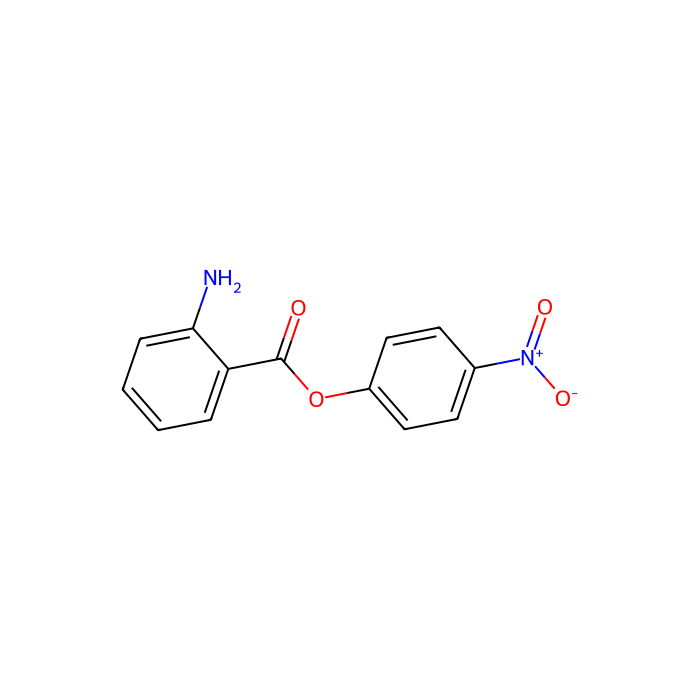
Brief overview: 4-Nitrophenyl anthranilate is the 4-nitrophenyl ester of anthranilic acid (2-aminobenzoic acid), an activated aryl ester bearing an ortho-amino group on the benzoyl ring and a para-nitro substituent on the phenyl leaving group.
Item-specific identifiers (from Product Data)
CAS: 19176-60-4
PubChem CID: 193539
InChIKey: Not specified for this item; refer to CoA/Spec Sheet. (Provided value not in standard format)
SMILES: Not specified for this item; refer to CoA/Spec Sheet.
Structural features (general/literature description)
Core scaffold: An o-aminobenzoate (anthranilate) linked via a carboxylic ester to a 4-nitrophenyl moiety.
Functional groups: Primary aniline (–NH2) ortho to an ester carbonyl (–CO2–Ar), and a para-nitrophenyl leaving group (–NO2 at the 4-position).
Ring systems: Two conjugated phenyl rings; one ring bears –NH2 and –CO2–, the other bears –NO2 and –O–.
2D description: The anthranilate ring contains adjacent –NH2 (at C2) and the ester linkage at the carboxyl carbon (C1). The ester oxygen connects to a para-nitrophenyl ring with a nitro group at the position para to the O– linkage.
This product is for research use only (per Product Data).
Synthetic Utility
Functional elements and reactivity (general)
Acyl donor: The aryl 4-nitrophenyl ester activates the anthranilate carbonyl toward nucleophilic acyl substitution, enabling direct amide bond formation with amines under mild conditions.
Ortho-amino effect: The neighboring –NH2 on the benzoyl ring can engage in hydrogen bonding and, upon further derivatization, can participate in cyclizations to benzoxazinones, quinazolinones, or related heterocycles (literature/general).
Applications in synthesis
Rapid access to anthranilamides from diverse amines (aliphatic, aromatic, heterocyclic), valuable for SAR exploration.
Modular assembly of o-amide frameworks followed by intramolecular cyclocondensations to furnish bicyclic scaffolds central to many agrochemical and medicinal targets.
Installation of isotopologues or labeled amines by aminolysis without carbodiimide coupling artifacts.
Advantages vs. acid chloride routes
Avoids HCl generation and harsh conditions characteristic of acid chlorides; often compatible with base-sensitive substrates.
The chromogenic leaving group facilitates real-time monitoring and endpoint determination.
Practical considerations
Use non-nucleophilic bases (DIPEA, Hünig’s base) to neutralize the phenol by-product.
Control moisture to minimize hydrolysis; include molecular sieves where appropriate.
Purification: Residual 4-nitrophenol can be removed by aqueous base wash (phenolate extraction) or by silica gel chromatography (nitrophenyl UV band aids tracking).
Item-specific reactivity parameters: Not specified for this item; rely on method development and literature precedents.
Target Specificity
Not applicable. This product is a small-molecule chemical reagent, not a biological affinity reagent (e.g., antibody, enzyme, or probe with defined biological targets).
Item-specific target/epitope/clone/isotype details: Not specified for this item; refer to CoA/Spec Sheet if any conjugates or derivatives are offered.
We use cookies to ensure the website functions properly and, where permitted, to improve your experience. You can manage your preferences at any time in Settings. Learn more in our Cookie Policy.
Shall we send you a message when we have discounts available?
Remind me later
Thank you! Please check your email inbox to confirm.
Products are supplied to verified businesses, institutions, and qualified professionals for research and development use only. Not for use in humans, animals, diagnosis, or therapy.