Determine the necessary mass, volume, or concentration for preparing a solution.
Taxonomy Tree
| Kingdom | Organic compounds |
|---|---|
| Superclass | Organoheterocyclic compounds |
| Classe | Azoles |
| Subclass | Pyrazoles |
| Intermediate Tree Nodes | Pyrazole carboxylic acids and derivatives |
| Direct Parent | Pyrazole-4-carboxamides |
| Alternative Parents | Vinylogous amides Heteroaromatic compounds Primary carboxylic acid amides Azacyclic compounds Organooxygen compounds Organonitrogen compounds Organic oxides Hydrocarbon derivatives |
| Molecular Framework | Aromatic heteromonocyclic compounds |
| Substituents | Pyrazole-4-carboxamide - Heteroaromatic compound - Vinylogous amide - Primary carboxylic acid amide - Carboxamide group - Azacycle - Carboxylic acid derivative - Organic nitrogen compound - Organic oxygen compound - Organic oxide - Hydrocarbon derivative - Organooxygen compound - Organonitrogen compound - Aromatic heteromonocyclic compound |
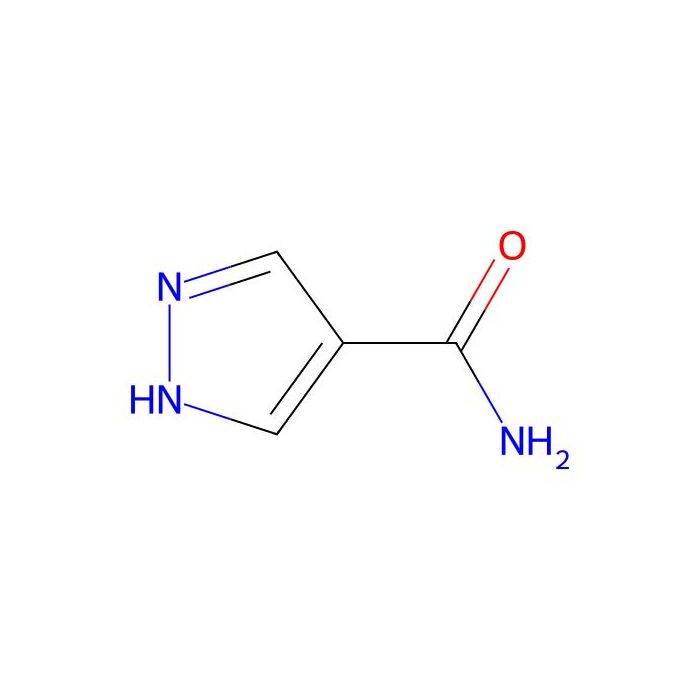
| Descrizione | This compound belongs to the class of organic compounds known as pyrazole-4-carboxamides. These are compounds containing a pyrazole ring that carries a carboxamide group at the 4-position. |
| External Descriptors | Not available |
| Sensibilità | Light sensitive |
|---|---|
| Peso molecolare | 111.1 |
| XLogP3 | -0.900 |
| Hydrogen Bond Donor Count | 2 |
| Hydrogen Bond Acceptor Count | 2 |
| Rotatable Bond Count | 1 |
| Exact Mass | 111.043 Da |
| Monoisotopic Mass | 111.043 Da |
| Topological Polar Surface Area | 71.800 Ų |
| Heavy Atom Count | 8 |
| Formal Charge | 0 |
| Complexity | 103.000 |
| Isotope Atom Count | 0 |
| Defined Atom Stereocenter Count | 0 |
| Undefined Atom Stereocenter Count | 0 |
| Defined Bond Stereocenter Count | 0 |
| Undefined Bond Stereocenter Count | 0 |
| The total count of all stereochemical bonds | 0 |
| Covalently-Bonded Unit Count | 1 |
H302:Harmful if swallowed
H315:Causes skin irritation
H319:Causes serious eye irritation
H335:May cause respiratory irritation
P261:Avoid breathing dust/fume/gas/mist/vapors/spray.
P264:Wash hands [and …] thoroughly after handling.
P270:Do not eat, drink or smoke when using this product.
P271:Use only outdoors or in a well-ventilated area.
P280:Wear protective gloves/protective clothing/eye protection/face protection.
P321:Specific treatment (see ... on this label).
P330:Rinse mouth.
P302+P352:IF ON SKIN: wash with plenty of water.
P304+P340:IF INHALED: Remove person to fresh air and keep comfortable for breathing.
P305+P351+P338:IF IN EYES: Rinse cautiously with water for several minutes. Remove contact lenses if present and easy to do - continue rinsing.
P362+P364:Take off contaminated clothing and wash it before reuse.
P405:Store locked up.
P403+P233:Store in a well-ventilated place. Keep container tightly closed.
P501:Dispose of contents/container to an approved waste disposal plant.
P264+P265:Wash hands [and …] thoroughly after handling. Do not touch eyes.
P301+P317:IF SWALLOWED: Get medical help.
P337+P317:If eye irritation persists: Get medical help.
P332+P317:If skin irritation occurs: Get medical help.
P319:Get medical help if you feel unwell.
No tested bioassay or analytical application protocols are specified for this item. For general small-molecule handling in discovery workflows:
These are general recommendations; adjust for your specific assay and consult the product’s CoA for identity/purity verification.
No item-specific biological testing data are provided for this product. The following information is general and literature-based for the pyrazole-carboxamide motif:
Note: These points are general observations from chemical biology literature and are not specific activity claims for this item. This product is for research use only.
This small organic heteroaromatic amide is not a conventional buffering agent. It lacks a suitable conjugate acid/base pair in the physiological pH range to provide practical buffering capacity.
Opportunities to improve sustainability focus on solvent and reagent choices when working with 4-pyrazolecarboxamide.
Comparison (general):
Trade-offs: Greener options may require process optimization (temperature, concentration, catalyst loading) to match yields/selectivity; perform small-scale scouting experiments.
Item-specific pharmacopeial status or excipient roles: Not specified for this item; refer to CoA/Spec Sheet.
General, non-clinical context:
Item-specific physico-chemical specifications: Not specified for this item; refer to CoA/Spec Sheet.
Literature/general properties for reference (verify for your batch before use):
Item-specific grade/purity and stabilizer information: Not specified for this item; refer to CoA/Spec Sheet for actual assay, related substances, and residual solvent profile.
General notes on quality for heteroaromatic building blocks:
This compound serves as a versatile heteroaryl amide building block. While no item-specific application data are provided, the following literature-based uses are common for pyrazole-4-carboxamide scaffolds:
General, literature-informed conditions for typical transformations (verify and optimize for your system):
Note: No item-specific reactivity testing data are provided; moisture control and careful base selection are crucial to direct chemoselectivity between ring N1 and amide N.
Item-specific hazard classification and statements: Not specified for this item; refer to SDS for authoritative safety data.
General safety guidance for heteroaromatic primary amides (informational only):
Guidance focuses on dissolving a small, polar, hydrogen-bonding heteroaromatic amide.
Brief overview: 4-Pyrazolecarboxamide is a small heteroaromatic amide based on the 1H-pyrazole scaffold bearing a carboxamide at the 4-position.
Key functional elements and their reactivity:
Representative transformations (literature):
Retrosynthetic value:
Not applicable. This product is a small-molecule building block and is not an antibody, enzyme, or affinity reagent. No target specificity information is provided for this item.