This compound belongs to the class of organic compounds known as phenol ethers. These are aromatic compounds containing an ether group substituted with a benzene ring.
External Descriptors
Not available
1. Djoumbou Feunang Y, Eisner R, Knox C, Chepelev L, Hastings J, Owen G, Fahy E, Steinbeck C, Subramanian S, Bolton E, Greiner R, and Wishart DS. ClassyFire: Automated Chemical Classification With A Comprehensive, Computable Taxonomy. Journal of Cheminformatics, 2016, 8:61.
Determine the necessary mass, volume, or concentration for preparing a solution.
Dilution Calculator
Determine the dilution needed to prepare a stock solution.
Reconstitution Calculator
Recensioni
Recensioni dei clienti
Application Protocols
No assay or kit protocols are specified for this small-molecule building block.
General handling for screening assays (literature practice)
Prepare a concentrated stock in DMSO (e.g., 10–100 mM) using sonication or mild warming if necessary.
Filter-sterilize stock (0.22 μm PTFE) if sterility is required for cell-based assays.
Dilute into assay buffer/media to desired concentration, maintaining low final DMSO (≤1–2%). Verify solubility and absence of precipitation at working pH.
Synthetic usage
For amide couplings or esterifications, see Reaction Conditions tab for representative setups.
Item-specific recommended dilutions or tested applications: Not specified for this item; refer to CoA/Spec Sheet.
Biological Roles
Item-specific (Product Data)
No biological/biochemical role is specified. Research use only.
General/literature perspective
This molecule is a small aromatic carboxylic acid with an ether linkage and a para-fluoro substituent. It is not a known metabolite or cofactor and has no established endogenous biological function.
Carboxylic acids of comparable structure can form salts at physiological pH values above the pKa, increasing aqueous solubility; however, biological activity is structure- and context-dependent and cannot be inferred without data.
The para-fluoro group often modulates lipophilicity and metabolic stability in medicinal chemistry scaffolds; aryl ethers can influence membrane permeability and plasma protein binding. These are general structure–property relationships rather than claims of activity for this specific compound.
Usage note
Any cellular or enzymatic assays employing this compound should include proper controls and concentration–response assessment. Stock solutions are commonly prepared in DMSO and diluted to minimal cosolvent levels in assay buffers.
Compliance
No medical, diagnostic, or therapeutic use is implied. For laboratory research use only, as stated in the Product Data.
Buffer Applications
This product is not a buffering reagent and is not typically used to prepare standard laboratory buffers.
Practical notes
As a monocarboxylic acid (pKa typically ~4.2–4.7, literature), it can form salts with alkali metals and becomes more water-soluble at basic pH; however, it does not provide significant buffering capacity across common biological pH ranges compared to dedicated buffers (e.g., acetate, phosphate, HEPES).
For aqueous manipulations (extractions, salt formation), sodium bicarbonate/carbonate solutions are commonly employed to transiently convert the acid to its water-soluble carboxylate; re-acidify to pH <2 with HCl to recover the free acid.
If buffer compatibility is required for an assay
Dissolve in DMSO and dilute into the desired buffer (e.g., PBS, HEPES) while keeping final DMSO low (≤1–2%). Verify solubility and lack of precipitation at the working pH.
Green Alternatives
While the compound itself is a target/building block rather than a solvent, greener choices can be made for its synthesis, purification, and transformations.
Greener solvent swaps (literature guidance)
Replace DCM with EtOAc or 2-MeTHF for extractions and reactions when feasible.
Use MeCN, 2-MeTHF, CPME, or propylene carbonate in place of DMF/NMP where coupling efficiency remains acceptable.
Crystallizations/recrystallizations: favor ethanol, isopropanol, or EtOAc over chlorinated solvents.
Coupling reagents and workups
Consider T3P (propylphosphonic anhydride) in EtOAc/2-MeTHF for amide formation; easier aqueous workup and lower hazard profile than carbodiimides with HOBt.
Water-compatible peptide couplings (e.g., EDCI in buffered aqueous–organic) may reduce solvent burdens.
Energy and waste minimization
Microwaves or flow reactors can reduce reaction times and improve selectivity for amidations/esterifications, cutting energy use.
Implement phase-separable catalysts or recyclable bases to reduce aqueous/organic waste.
Comparison snapshot (general)
DCM vs EtOAc: EtOAc is biodegradable with lower toxicity; DCM offers higher density and faster separations but with higher environmental/health concerns.
DMF vs 2-MeTHF: 2-MeTHF is biorenewable and easier to remove; DMF provides strong polarity but is a reproductive toxin.
Note
Selection must be validated for the specific transformation; yields, rates, and impurity profiles can shift with solvent changes.
Pharmaceutical Uses
Item-specific (Product Data)
No pharmacopeial grade or excipient status is specified. Research use only.
General (non-clinical) usage context
Aryl ether carboxylic acids such as 5-(4-fluorophenoxy)valeric acid are commonly employed as synthetic intermediates in medicinal chemistry programs for SAR exploration. They are converted to amides/esters or further elaborated through ring functionalization.
As a raw material, it may be used to access compound libraries; it is not an approved active ingredient nor an established pharmaceutical excipient based on available information.
Formulation considerations for research compounds
Free acid vs salt: alkali metal salts can improve aqueous solubility for in vitro work. Convert back to the free acid if neutral form is required for further synthesis.
Vehicle selection: DMSO, PEG400, or mixed cosolvent systems are typical for exploratory dosing in preclinical research; ensure compatibility with the intended route and institutional guidelines.
Compliance
No therapeutic or clinical claims are made. Not for human or veterinary use. For laboratory R&D only.
Physical Properties
Item-specific (Product Data)
Appearance: Not specified for this item; refer to CoA/Spec Sheet.
Grade/Purity: Not specified for this item; refer to CoA/Spec Sheet.
Storage Conditions: Room temperature (as provided)
Literature/computed (non-specification; typical values for closely related structures)
LogP/logD: aromatic ether carboxylic acids of this size often exhibit logP ~2–3 in neutral form; ionization above pH ~5 reduces logD markedly (literature trend)
Solubility profile (qualitative, literature):
Good solubility in polar aprotic organics (DMSO, DMF, NMP)
Moderately soluble in alcohols and chlorinated solvents; limited in nonpolar hydrocarbons
Low aqueous solubility at neutral pH; increases strongly in basic aqueous media as the carboxylate salt
General guidance and expectations
Form typically isolated as a crystalline solid or viscous oil depending on purity and hydration; exact physical state for this item is not specified.
Refractive index, melting point, boiling point, density, and UV cutoff: Not specified for this item; refer to CoA/Spec Sheet. If needed for method development, determine experimentally or consult primary literature for the exact isomer.
Quality and Grades
Item-specific (Product Data)
Grade/Purity: Not specified for this item; refer to CoA/Spec Sheet.
Guidance for interpreting grade (general)
If offered as “research grade,” typical implications are suitability for synthetic/analytical laboratory work but not certified for GMP use. Purity is usually reported on the CoA by GC/HPLC/NMR along with residual solvents.
For chromatographic or assay-critical applications, request UV-Vis profile and residual metal/anion specs if relevant. For coupling chemistry, low water content and absence of amine/acidic impurities can be important.
Stabilizers and additives
No stabilizer is indicated in the Product Data. If a stabilizer is present in a specific lot, it will be declared on the CoA/label. Absence/presence of stabilizers can affect downstream reactions (e.g., acid chloridation, esterification).
What is specific to this item
Storage at room temperature with normal shipping suggests routine stability under ambient lab conditions; nonetheless, verify lot-specific purity, water content, and residual solvents on the CoA for sensitive applications (amide couplings, medicinal chemistry screening).
Documentation
For specifications not listed here (purity assay, MP, water, peroxide, metals, UV cutoff): Not specified for this item; refer to CoA/Spec Sheet.
Reaction and Applications
Functional group leverage
Carboxylic acid: versatile handle for amide coupling (HATU, HBTU, EDCI/HOAt/HOBt alternatives), esterification (Fischer, Steglich/DMAP), acid chloride formation (SOCl2, oxalyl chloride), and activation to mixed anhydrides.
Aryl ether: generally stable under many conditions; serves as a lipophilic anchor. Ether cleavage typically requires harsh Lewis acids (e.g., BBr3) and may not be favored due to aliphatic oxygen linkage.
Para-fluoro aryl: C–F bond is robust; direct SNAr is disfavored without additional ring activation. However, halogen–lithium exchange (at low temperature) followed by electrophile trapping (e.g., borylation to give aryl boronates) is a literature route to diversify the aryl position.
Representative applications (literature/general)
Synthesis of phenoxyalkylamide libraries for SAR: coupling with amines under standard peptide-coupling conditions to generate amides and ureas (after Curtius pathways from acyl azides).
Prodrug/derivative formation: preparation of alkyl esters (e.g., methyl/ethyl) for property tuning; subsequent hydrolysis regenerates acid.
Salt formation: sodium/potassium carboxylates to enhance aqueous handling or crystallization.
Practical tips
Drying: If water-sensitive activations are planned, azeotrope with toluene/EtOAc or dry under high vacuum; use anhydrous solvents and molecular sieves where appropriate.
Acid chloridation: brief exposure to SOCl2 (0–25 °C) in anhydrous solvent; include a catalytic DMF drop to accelerate. Quench carefully and avoid excess heat to limit side reactions.
Couplings: Use base (DIPEA, NMM) and catalytic DMAP when appropriate; monitor by TLC or LC–MS. Carboxylate salts must be re-protonated prior to extraction into organics for isolation of the free acid.
Reaction Conditions
The following are general literature conditions applicable to aromatic ether–substituted aliphatic carboxylic acids and are not item-specific specifications.
Amide coupling
Reagents: HATU or EDCI (1.1–1.5 equiv), base (DIPEA 2–3 equiv), solvent (DMF, MeCN, or 2-MeTHF)
Temperature/time: 0–25 °C, 1–16 h; monitor by TLC/LC–MS
Typical isolated yields (literature): 70–95% for unhindered amines
Esterification
Fischer: ROH (excess), catalytic H2SO4 or p-TsOH, Dean–Stark (toluene) or neat alcohol; 50–110 °C, 2–24 h
Steglich: DCC (1.1 equiv), catalytic DMAP, CH2Cl2/EtOAc, 0–25 °C, 2–18 h
Acid chloride formation
SOCl2 (2–5 equiv) with catalytic DMF, reflux 0.5–2 h; remove excess under reduced pressure; use immediately in situ
Ether formation route (precursor synthesis)
Williamson etherification: p-fluorophenol + 5-bromovalerate (methyl/ethyl) with K2CO3/NaH, DMF/acetone, 25–60 °C, 2–16 h; subsequent ester hydrolysis (NaOH, MeOH/H2O) to free acid
Halogen–lithium exchange on aryl-F (advanced, literature)
Strong base (e.g., s-BuLi) at −78 °C in THF; trap with B(OMe)3 or electrophiles; requires rigorous anhydrous conditions and careful quench; yields are case-dependent
Workup/purification
Acid–base extraction exploiting carboxylate solubility in aqueous bicarbonate; silica gel chromatography with gradients of hexane/EtOAc or DCM/MeOH as needed.
Note: Optimize for the specific substrate and scale; no single set of conditions fits all substrates.
Safety and Handling
Item-specific (Product Data)
GHS Classification: Not specified for this item; refer to SDS.
Signal Word / H-Statements / Pictograms: Not specified for this item; refer to SDS.
Storage Conditions: Room temperature (store tightly closed)
Shipped in: Normal
General safety (literature/typical for small aromatic carboxylic acids)
Expected hazards: may cause skin/eye irritation; ingestion/inhalation of dusts/vapors should be avoided. Handle as a laboratory chemical under the institutional CHO program.
PPE: lab coat, safety glasses or goggles, and appropriate chemical-resistant gloves (e.g., nitrile). Use in a well-ventilated area or fume hood to avoid exposure.
Incompatibilities: strong oxidizers; strong bases/acids may cause degradation or salt formation; avoid reactive acylation agents unless intended.
First aid overview:
Skin/eye contact: rinse with water for ≥15 min; remove contaminated clothing; seek medical attention if irritation persists.
Inhalation: move to fresh air; seek medical advice if symptoms occur.
Ingestion: rinse mouth; do not induce vomiting; obtain medical attention.
Spill/cleanup: contain solids with inert absorbent, avoid dust generation, collect in suitable containers for disposal.
Special risks and notes
Not an aliphatic peroxide-forming ether; aryl ethers are significantly less prone to autoxidation. Nonetheless, keep containers closed and minimize prolonged air/heat exposure.
Always consult the product’s SDS for authoritative hazard classification and emergency procedures. Research use only.
Solvent Selection
This compound is an aromatic ether–substituted carboxylic acid with moderate hydrophobicity and an ionizable acid.
Polarity and miscibility (literature expectations)
Neutral form: moderately lipophilic; dissolves well in polar aprotic solvents (DMSO, DMF, NMP) and chlorinated organics; variable solubility in alcohols; poor in alkanes.
As carboxylate salt: markedly increased aqueous solubility in basic buffers (e.g., NaHCO3/Na2CO3) and water–miscible organics.
Practical choices by task
Stock solutions for screening: DMSO (10–100 mM typical), then dilute into assay buffer with attention to final DMSO ≤1–2%.
Preparative workups: dissolve in EtOAc/MTBE/DCM; extract as carboxylate into aq. NaHCO3 for purification, then re-acidify to recover acid.
Coupling reactions: DMF, DMAc, or MeCN commonly used; 2-MeTHF or CPME are viable greener options with modern coupling agents.
Comparison (general)
DMSO vs DMF: DMSO offers higher solvating power; DMF easier removal; both high-boilers.
EtOAc vs DCM: EtOAc is greener and often sufficient; DCM offers faster phase separation and higher density.
Notes
Exact solubility values for this item are not specified; verify empirically.
Avoid strong bases in protic solvents if esterification is undesired; neutralize after reactions to prevent hydrolysis of activated intermediates.
Storage and Reconstitution
Item-specific (Product Data)
Storage conditions: Room temperature
Shipped in: Normal
General guidance
Store in a tightly closed container, protected from moisture and strong light. If long-term storage is planned, consider desiccation and inert headspace to minimize hydrolysis/oxidation.
If the solid appears clumped or partially liquefied upon receipt, gently warm to ambient and triturate; this does not necessarily indicate degradation but check by HPLC/LC–MS.
Reconstitution/stock preparation (for research use)
Prepare concentrated stocks in dry DMSO, DMF, or other suitable solvent (10–100 mM typical). Record exact concentration by weight-in or quantitative NMR if needed.
For aqueous use, dissolve in minimal DMSO then dilute into buffer; or convert to the sodium/potassium salt by neutralizing with equimolar base in water/MeOH and use promptly.
Avoid repeated freeze–thaw of solutions; aliquot and store at −20 °C (DMSO) or as appropriate for the solvent system. Check stability periodically by LC–MS/HPLC.
Specifications not provided for this item (water content, residual solvents, melting point, etc.): Not specified for this item; refer to CoA/Spec Sheet.
Research Use Note: For research use only.
Structure and Identity
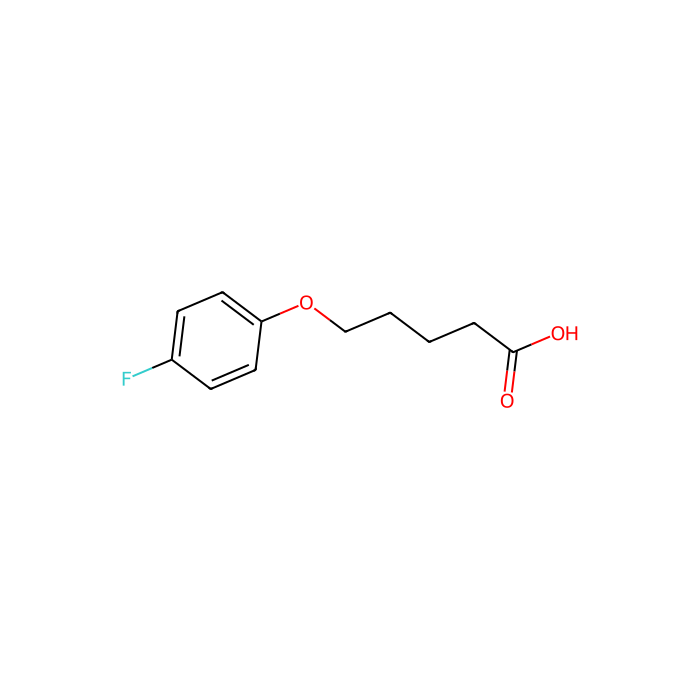
Brief description: 5-(4-Fluorophenoxy)valeric acid is an aryl ether–substituted aliphatic carboxylic acid featuring a para-fluoro substituted phenyl ring linked via an ether to a pentanoic acid chain.
One carboxylic acid (–CO2H) at the terminus of a pentyl chain
One ether linkage (–O–) connecting the aliphatic chain to the aromatic ring
One para-fluoro substituent on the phenyl ring (p-F–C6H4–)
No stereocenters; achiral
2D structure (described): A linear pentanoic acid chain (CO2H–CH2–CH2–CH2–CH2–) bound through an oxygen atom to the para-fluorophenyl ring (–O–C6H4–F at the 4-position relative to the ether). The ring bears F para to the ether oxygen.
General notes
The aryl ether linkage confers stability toward many bases and nucleophiles under mild conditions; the carboxylate imparts acidity and potential for salt formation, derivatization (amides/esters), and coupling chemistry.
Synthetic Utility
Carboxylic acid functionality
Activation to acid chlorides (SOCl2, (COCl)2) enables amide/ester formation and Curtius rearrangement routes via acyl azides (from the acid chloride or directly via DPPA/TMSN3).
Steglich esterification (DCC/DMAP) or T3P-mediated couplings provide mild conditions; EDCI with NHS/HOAt can generate activated esters for bioconjugation-like workflows.
Mixed anhydrides (e.g., pivaloyl anhydride) can improve selectivity in hindered aminations.
Aryl ether and para-fluoro handle
The aryl–F bond is resistant to many conditions; lithium–halogen exchange at low temperature (e.g., s-BuLi, −78 °C) followed by trapping (B(OMe)3, electrophiles) can diversify the ring (literature strategy; requires careful chemoselectivity control near the ether).
Direct SNAr at para-F is generally unfavorable without additional ring activation; alternative cross-coupling approaches may require prior halogen exchange or borylation.
Aliphatic chain considerations
The ω-ether substituent can influence conformational preferences and lipophilicity of derived amides/esters, useful for property tuning in lead optimization.
Oxidation at benzylic positions is not applicable; the chain lacks benzylic C–H.
Retrosynthetic value
Disconnection suggests assembling the ether (p-fluorophenol + 5-bromovaleric acid/ester under Williamson conditions), followed by hydrolysis to the free acid and downstream functionalizations (amide, ester, salt formation).
Target Specificity
Not applicable. This product is a small-molecule chemical building block, not a biologic or antibody. No antigen/epitope or species reactivity information applies.
We use cookies to ensure the website functions properly and, where permitted, to improve your experience. You can manage your preferences at any time in Settings. Learn more in our Cookie Policy.
Shall we send you a message when we have discounts available?
Remind me later
Thank you! Please check your email inbox to confirm.
Products are supplied to verified businesses, institutions, and qualified professionals for research and development use only. Not for use in humans, animals, diagnosis, or therapy.

 C2309623