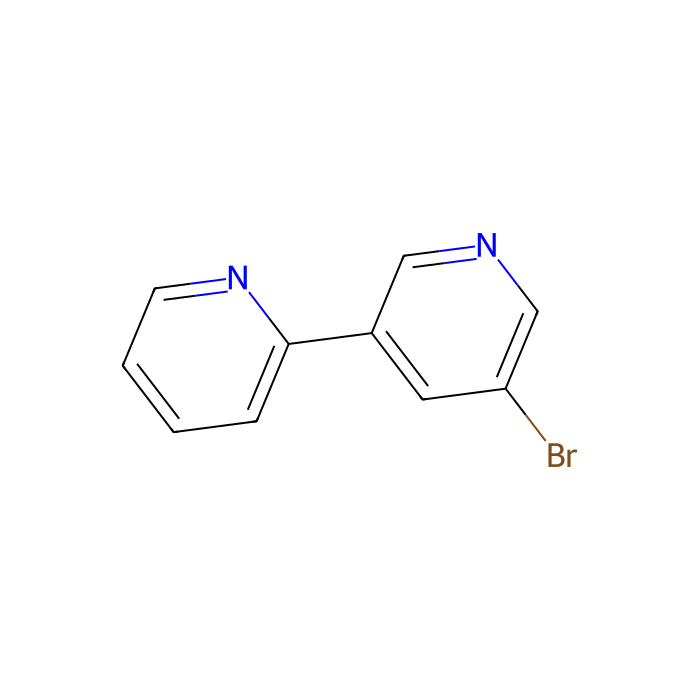
This compound belongs to the class of organic compounds known as bipyridines and oligopyridines. These are organic compounds containing two pyridine rings linked to each other.
External Descriptors
Not available
1. Djoumbou Feunang Y, Eisner R, Knox C, Chepelev L, Hastings J, Owen G, Fahy E, Steinbeck C, Subramanian S, Bolton E, Greiner R, and Wishart DS. ClassyFire: Automated Chemical Classification With A Comprehensive, Computable Taxonomy. Journal of Cheminformatics, 2016, 8:61.
Certificati (CoA, COO, BSE/TSE e tabella di analisi)
C of A & Other Certificates(BSE/TSE, COO):
Analytical Chart:
Proprietà chimiche e fisiche
Peso molecolare
235.080 g/mol
XLogP3
2.200
Hydrogen Bond Donor Count
0
Hydrogen Bond Acceptor Count
2
Rotatable Bond Count
1
Exact Mass
233.979 Da
Monoisotopic Mass
233.979 Da
Topological Polar Surface Area
25.800 Ų
Heavy Atom Count
13
Formal Charge
0
Complexity
163.000
Isotope Atom Count
0
Defined Atom Stereocenter Count
0
Undefined Atom Stereocenter Count
0
Defined Bond Stereocenter Count
0
Undefined Bond Stereocenter Count
0
The total count of all stereochemical bonds
0
Covalently-Bonded Unit Count
1
Calcolatori di soluzioni
Molarity Calculator
Determine the necessary mass, volume, or concentration for preparing a solution.
Dilution Calculator
Determine the dilution needed to prepare a stock solution.
Reconstitution Calculator
Recensioni
Recensioni dei clienti
Application Protocols
Not applicable.
No validated bioassay or immunoassay protocols are associated with this small-molecule building block. For synthetic applications, refer to the Reaction Conditions, Reaction & Applications, and Synthetic Utility sections for practical guidance.
Biological Roles
Applicability
This compound is a synthetic, halogenated bipyridine intended for research and materials/coordination chemistry. It has no established endogenous biological role.
Literature context (general)
Bipyridine frameworks are classic bidentate ligands for transition metals used to model metalloenzyme active sites and to construct redox/photoactive complexes (e.g., Ru(bpy) systems). The 2,3′-linkage and 5-bromo handle allow preparation of unsymmetrical ligands to tune metal-binding geometry, ligand field strength, and photophysical behavior.
In chemical biology, tailored bipyridines can act as metal chelators or components of photoinduced electron-transfer assemblies. Any such use of 5-bromo-2,3′-bipyridine would be as a precursor to a designed ligand rather than as a bioactive small molecule.
Restrictions
No medical, diagnostic, or therapeutic applications are implied. For research use only.
Buffer Applications
Not typically applicable.
5-Bromo-2,3′-bipyridine is a neutral, poorly water-soluble heteroaromatic and is not used as a buffer component. It lacks the appropriate acid/base pair and aqueous solubility required for buffering.
For aqueous work, dissolve product derivatives or metal complexes in suitable organic co-solvents (e.g., DMF, DMSO) before dilution into aqueous systems if needed for spectroscopic studies.
Green Alternatives
Greener solvent and catalyst choices (literature/general)
Replace high-boiling polar aprotics (DMF, NMP) with greener ethers (2-MeTHF, CPME) or aqueous micellar media for Suzuki couplings when compatible with substrates.
Consider ethanol/water or 2-MeTHF/water for Suzuki–Miyaura using robust Pd catalysts and K3PO4 or K2CO3, minimizing dipolar aprotics.
Use Ni-catalyzed cross-couplings (lower Pd footprint) where scope allows; supported catalysts (e.g., on silica or MOFs) can aid recovery/reuse.
Comparison (general; not product specs)
DMF vs 2-MeTHF: DMF offers superior solvation of inorganic bases and boron species but is problematic in EHS and workup. 2-MeTHF is bio-derived, lower toxicity, easier separation; sometimes requires higher catalyst loading.
Dioxane vs CPME: Dioxane has toxicity concerns; CPME is peroxide-resistant relative to THF and offers broad operational window with easier phase separations.
Conventional heating vs flow/microwave: Flow or microwave heating can shorten cycle times and reduce solvent volumes/energy use.
Waste minimization
Design convergent sequences: Use borylation then modular couplings to reduce protecting-group steps.
Employ recoverable bases (e.g., solid K3PO4) and aqueous workups that allow straightforward phase separations, decreasing solvent consumption.
Note
Verify substrate stability in greener media; heteroaromatic bases can coordinate catalysts differently in water-rich systems, sometimes necessitating ligand or base optimization.
Pharmaceutical Uses
Scope
This material is not an excipient and has no compendial pharmacopeia monograph. It is offered for research use only.
Relevance in pharmaceutical R&D (general)
Synthetic building block: The aryl bromide enables rapid library diversification via cross-coupling to generate heteroaryl scaffolds for SAR exploration.
Ligand precursor: Unsymmetrical bipyridines derived from this substrate can serve as ancillary ligands in metal-catalyzed transformations used in process chemistry (e.g., transfer hydrogenation, photoredox), albeit typically not carried forward into APIs.
Analytical/research: Potential intermediate or spike-in standard during method development for heteroaryl halide reactivity screens.
Notes
Any use in drug discovery remains at the research stage; no clinical or therapeutic claims are made or should be inferred.
Physical Properties
Item-specific (Product Data)
Appearance: Not specified for this item; refer to CoA/Spec Sheet.
Molecular weight: Not specified for this item; refer to CoA/Spec Sheet.
Literature/general values and expectations (for guidance only; not product specs)
Empirical formula and FW (literature for C10H7BrN2): approximately C10H7BrN2; formula weight ~235.08 g/mol. Verify against the item’s CoA.
Physical state: Typically a crystalline solid for halogenated bipyridines; color can range off-white to pale yellow depending on trace impurities (literature).
Solubility profile: Sparingly soluble in water; soluble in polar aprotic organics (DMF, DMSO, NMP) and moderately soluble in chlorinated solvents (DCM), ethers (THF), and aromatics (toluene) (literature).
LogP/logS: Heteroaromatic bromides generally exhibit moderate hydrophobicity (estimated cLogP ~1.5–2.5), enabling phase-transfer into organic media (literature/computational norms for related bipyridines). Actual value should be verified experimentally.
Melting/boiling points, density, refractive index, pKa: Not widely standardized in open sources for this exact isomer; Not specified for this item; refer to CoA/Spec Sheet.
Practical notes
For precise thermal properties (mp, onset of decomposition), consult the batch CoA. If using in melt-processing or thermal deposition workflows, perform a small-scale DSC/TGA to confirm stability under your conditions.
Quality and Grades
Item-specific (Product Data)
Grade/purity: Not specified for this item; refer to CoA/Spec Sheet.
Stabilizers/inhibitors: Not specified for this item; refer to CoA/Spec Sheet.
Guidance for professional use
Interpreting grade: For heteroaryl halides used in cross-coupling and materials assembly, key quality attributes typically include assay (HPLC/GC), residual halide isomers, metal content (if post-coupling is anticipated), and water content for air-/moisture-sensitive transformations.
UV/LC suitability: If planning to use this compound as a reference standard or in photophysical studies, low UV background and well-characterized impurity profiles are beneficial. Ask for an HPLC chromatogram and UV trace if needed.
Metal-sensitive contexts: Trace Pd, Cu, or Ni from prior processing can interfere with catalysis or device performance. If critical, specify low-metal grades and request ICP-MS data.
Solid-state form: Polymorph/solvate state can influence handling and dissolution kinetics. If crystallinity matters (e.g., for vapor deposition or crystallization-driven self-assembly), request XRPD/DSC data.
Documentation
Always confirm batch-specific specifications (assay, water, residual solvents, impurity profile) on the Certificate of Analysis for your lot. Where a specific value is not provided above, it remains: Not specified for this item; refer to CoA/Spec Sheet.
5-Bromo-2,3′-bipyridine is a versatile halogenated ligand precursor. The aryl bromide enables cross-coupling diversification, while the bipyridyl nitrogens support chelation to transition metals—useful in coordination polymers, MOFs, OLED complexes, and catalysis research.
Suzuki–Miyaura coupling: Install aryl, heteroaryl, or alkenyl fragments at C-5 using Pd(0/II) catalysts and boronic acids/esters. The 2,3′-linkage yields an unsymmetrical bidentate ligand after coupling.
Buchwald–Hartwig amination: Introduce anilines or alkyl amines at C-5 using Pd and bulky biaryl phosphine ligands; affords amino-bipyridines for further derivatization or metal-binding.
Sonogashira/Heck: Access ethynylated or alkenylated derivatives for extended conjugation—valuable in optoelectronic studies.
Halogen–lithium exchange: n-BuLi or t-BuLi at low temperature followed by electrophile trapping (e.g., DMF for formylation, B(OMe)3 for borylation), enabling late-stage diversification.
Direct borylation: Pd-catalyzed Miyaura borylation (B2pin2) delivers the pinacol boronate for subsequent iterative cross-couplings.
Applications enabled
Ligand design: Unsymmetrical bipyridines tune bite angle/electronics vs 2,2′-bipyridine, affecting metal-centered redox and photophysics.
Materials science: Building block for coordination networks and luminescent/charge-transport metal complexes; scaffold for surface-anchored chelators.
Practical tips
Dry solvents and bases improve cross-coupling reliability. Degas reaction media (freeze–pump–thaw or sparging) to maintain catalyst activity. Monitor for protodehalogenation; adjust base and temperature accordingly.
Reaction Conditions
General guidance from literature (not product specifications)
Suzuki–Miyaura coupling: Pd(PPh3)4 (1–3 mol%) or Pd-PEPPSI-type precatalysts; base K3PO4 or K2CO3 (2–3 equiv); solvent 1,4-dioxane/H2O, toluene/H2O, 2-MeTHF/H2O, or DMF; 60–100 °C; 2–12 h. Aryl/heteroaryl boronic acids/esters give moderate to high yields when protodehalogenation is minimized.
Buchwald–Hartwig amination: Pd2(dba)3 (1–2 mol%) with BrettPhos/XPhos (2–4 mol%) or precatalyst variants; NaOtBu or Cs2CO3; toluene or CPME/PhMe; 80–110 °C; 6–18 h. Electron-rich ligands help suppress N–N chelation to Pd.
Sonogashira coupling: Pd(PPh3)2Cl2 (1–2 mol%) with CuI (2–5 mol%); Et3N or i-Pr2NH; THF or 2-MeTHF; rt–60 °C; 2–8 h. Copper-free protocols (Pd only) can reduce Glaser homocoupling.
Miyaura borylation: Pd(dppf)Cl2 (2–5 mol%); B2pin2 (1.2–1.5 equiv); KOAc in dioxane or CPME; 70–90 °C; 4–10 h. Affords pinacol boronate suitable for iterative coupling.
Halogen–lithium exchange: n-BuLi (1.1–1.3 equiv) in anhydrous THF or Et2O at −78 to −40 °C; quench with electrophile (e.g., DMF). Strictly anhydrous conditions; rapid quench to avoid rearrangements.
Operational tips
Degas solvents (sparging or freeze–pump–thaw) for air-sensitive catalysis. Use dry glassware and inert atmosphere.
Monitor by LC–MS or GC–MS; aryl bromide disappearance is a reliable handle. Watch for side reactions: protodehalogenation, homocoupling, or N-bound catalyst inhibition—tune ligand/base accordingly.
For scale-up, consider flow to enhance heat/mass transfer and reduce Pd loading.
Safety and Handling
Item-specific (Product Data)
GHS classification, signal word, H-statements, pictograms: Not specified for this item; refer to SDS.
Research use note: For research use only.
Storage conditions: Room temperature (store tightly closed in a dry, well-ventilated place).
General safety guidance (literature/typical for halogenated heteroaromatics; defer to SDS for authoritative data)
Likely hazards: May cause skin/eye irritation and respiratory tract irritation upon dust generation. Avoid inhalation of dusts and contact with skin and eyes.
PPE: Wear appropriate laboratory PPE—lab coat, safety glasses or chemical splash goggles, and nitrile gloves. Use in a fume hood to control dust and vapors generated during reactions.
Handling: Minimize dust formation; use antistatic measures when weighing. Transfer under inert atmosphere if prolonged exposure to moisture could affect downstream metalation or cross-coupling performance.
Incompatibilities: Strong oxidizing agents; very strong bases or organometallics may cause exothermic reactions. While aryl bromides are generally stable, aggressive nucleophiles under forcing conditions can effect debromination or substitution.
First aid (overview): If on skin—wash with soap/water. If in eyes—rinse cautiously with water for several minutes; remove contact lenses if present/easy. If inhaled—move to fresh air. If ingested—rinse mouth; seek medical attention in all cases as per SDS.
Fire safety: Treat as a combustible organic solid. Use CO2, dry chemical, or foam extinguishers. Combustion may produce hydrogen bromide, nitrogen oxides, and carbon oxides—firefighters should wear SCBA.
Solvent Selection
Compound type and polarity (literature/general)
Class: Halogenated heteroaromatic (brominated bipyridine). Neutral, moderately polarizable with two Lewis-basic nitrogens.
Solubility/miscibility expectations: Poorly soluble in water; good to excellent solubility in polar aprotic solvents (DMF, DMAc, DMSO, NMP). Moderate solubility in EtOAc, THF, dioxane, chlorinated solvents (DCM, CHCl3), and aromatics (PhMe).
Typical solvent choices by application
Cross-coupling (Suzuki, Buchwald–Hartwig, Sonogashira): 1,4-dioxane/H2O, toluene, CPME, 2-MeTHF, THF, or DMF depending on base and catalyst system. Aqueous co-solvent improves boronate solubility in Suzuki.
Metalation/halogen–lithium exchange: Et2O or THF under cryogenic control (−78 to −40 °C) with careful quench; DMF as electrophile trap if formylation is desired.
Coordination chemistry: DMF, MeCN, or MeOH/CH2Cl2 mixtures to dissolve ligand prior to metal salt addition.
Materials processing: For solution processing of complexes/polymers derived from this ligand, chlorobenzenes or o-dichlorobenzene can aid solubility at elevated temperatures.
Selection tips
Choose polar aprotics to maximize rate in Pd/Ni-catalyzed reactions; switch to greener ethers (2-MeTHF, CPME) when possible to ease workup and improve sustainability.
Avoid protic solvents during strong-base chemistry; trace water can quench organolithiums and reduce coupling efficiency.
If crystallization is desired post-reaction, use an aromatic or ester solvent for dissolution and anti-solvent crash with hexanes or MTBE.
Storage and Reconstitution
Item-specific (Product Data)
Storage conditions: Room temperature.
Shipped in: Not specified for this item; refer to CoA/Spec Sheet.
Appearance/form: Not specified for this item; refer to CoA/Spec Sheet.
General guidance for this compound class
Container: Store in a tightly sealed amber glass bottle to limit light exposure and moisture ingress. Include a desiccant in secondary containment if ambient humidity is high.
Stability: Aryl bromides of this type are generally stable at room temperature under dry conditions. Avoid prolonged exposure to strong light and oxidants. No special stabilizers are typically required.
Handling for use: Warm to ambient if stored in cold conditions to avoid condensation. If weighing fine powders, use an antistatic spatula and dust control. For stock solutions (e.g., in DMSO, DMF, or 2-MeTHF), prepare under dry, inert atmosphere; store aliquots at 2–8 °C or −20 °C as appropriate and bring to room temperature before opening to avoid moisture uptake.
Reconstitution: If needed, dissolve in a suitable anhydrous organic solvent (DMF, DMSO, THF, toluene) to the desired concentration. Filter through a PTFE membrane (0.2 µm) to remove particulates prior to sensitive reactions or device fabrication.
Always refer to the product’s SDS and CoA for authoritative storage and handling instructions for your specific lot.
Core scaffold: A bipyridine consisting of two pyridine rings connected through a C–C bond between the 2-position of one ring and the 3′-position of the other (2,3′-bipyridine connectivity).
Functional groups: One ring is halogenated with a bromine substituent at the 5-position (relative to the ring nitrogen) on the 2-linked pyridine. The other ring is an unsubstituted 3′-pyridyl unit.
Heteroatoms: Two ring nitrogens (sp2, pyridinic), providing Lewis basic sites with distinct basicities due to the asymmetric 2,3′-linkage and the electron-withdrawing effect of the 5-bromo substituent.
2D description in words: A six-membered aromatic N-heterocycle (pyridine) bearing Br at the meta position to N, fused via a single bond at the ortho carbon to a second pyridine ring attached at its meta carbon; overall an unsymmetrical, halogenated, chelating heterobiaryl.
Notes
The 2,3′-linkage reduces planarity compared with 2,2′-bipyridine, modulating both ligand bite angle and electronics—relevant for coordination and materials applications (literature).
Synthetic Utility
Key reactive elements (general/literature)
Aryl bromide at C-5: Amenable to Pd/Ni-catalyzed cross-couplings (Suzuki, Buchwald–Hartwig, Sonogashira, Heck), radical processes (e.g., photoredox-mediated arylation), and lithium–halogen exchange.
Bipyridine nitrogens: Provide chelation for metal-binding; can be N-oxidized or quaternized for further tuning of electronics and solubility.
Strategic uses
Divergent synthesis: Convert the bromide to a boronate (Miyaura borylation) to enable iterative coupling with a broad range of partners, expediting library synthesis.
Formylation/acylation: Br/Li exchange followed by electrophiles (DMF, DMF–POCl3 for Vilsmeier-type formylation; acid chlorides/CO2 for acylation/carboxylation) furnishes handles for subsequent condensations.
C–H functionalization relay: Post-coupling, exploit directed ortho-metalation or C–H activation at positions proximal to N to elaborate the scaffold.
Ligand tailoring: Introduce donor/acceptor groups via the C-5 position to modulate donor strength, sterics, and bite angle in metal complexes; useful in catalysis and optoelectronics.
Practical considerations
Unsymmetry of the 2,3′-bipyridine affects coordination geometry; precomplexation to metals can bias reactivity in on-complex modifications.
Protecting groups are seldom needed; however, free bipyridine can bind catalysts—adjust ligand loadings in cross-couplings to mitigate competitive coordination.
Target Specificity
Not applicable.
This product is a small-molecule heteroaromatic building block, not a biological targeting reagent, antibody, or inhibitor with defined biomolecular specificity. No antigen/epitope or species reactivity data apply.
Domande frequenti
How should this product be stored?
Store at room temperature.
What is the purity of this product, and how is it determined?
This product is supplied at ≥98% purity, determined by HPLC. Lot-specific values are stated on the Certificate of Analysis.
What are the CAS number, molecular formula and molecular weight?
The CAS Number is 35989-02-7, the molecular formula is C10H7BrN2. InChIKey ZKOZNFNWADATLB-UHFFFAOYSA-N.
What documentation is provided?
Available product documentation, including Certificates of Analysis (COA), Safety Data Sheets (SDS), and specification sheets, is shown in the product document area. Document availability and access follow the current site policy.
We use cookies to ensure the website functions properly and, where permitted, to improve your experience. You can manage your preferences at any time in Settings. Learn more in our Cookie Policy.
Shall we send you a message when we have discounts available?
Remind me later
Thank you! Please check your email inbox to confirm.
Products are supplied to verified businesses, institutions, and qualified professionals for research and development use only. Not for use in humans, animals, diagnosis, or therapy.