Determine the necessary mass, volume, or concentration for preparing a solution.
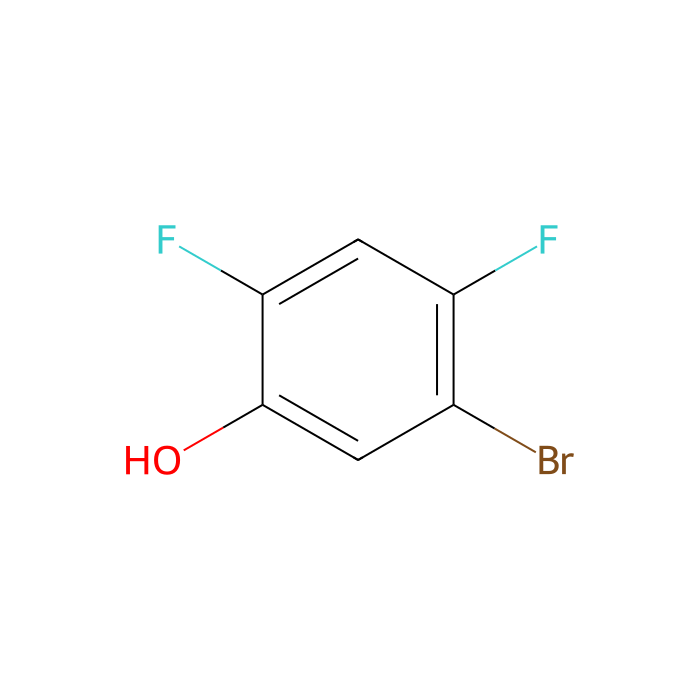
5-Bromo-2,4-difluorophenol - ≥96% , CAS No.355423-48-2
Disponibile su ordine
QUALITÀ & PUREZZA ≥96%
Storage
Room temperature
Shipped In
Normal

Taxonomy Tree
| Kingdom | Organic compounds |
|---|---|
| Superclass | Benzenoids |
| Classe | Phenols |
| Subclass | Halophenols |
| Intermediate Tree Nodes | Fluorophenols |
| Direct Parent | P-fluorophenols |
| Alternative Parents | O-fluorophenols M-bromophenols Fluorobenzenes Bromobenzenes 1-hydroxy-2-unsubstituted benzenoids Aryl fluorides Aryl bromides Organooxygen compounds Organofluorides Organobromides Hydrocarbon derivatives |
| Molecular Framework | Aromatic homomonocyclic compounds |
| Substituents | 4-fluorophenol - 3-bromophenol - 2-fluorophenol - 1-hydroxy-2-unsubstituted benzenoid - Bromobenzene - Fluorobenzene - Halobenzene - Aryl bromide - Aryl fluoride - Aryl halide - Monocyclic benzene moiety - Hydrocarbon derivative - Organic oxygen compound - Organooxygen compound - Organofluoride - Organobromide - Organohalogen compound - Aromatic homomonocyclic compound |
| Descrizione | This compound belongs to the class of organic compounds known as p-fluorophenols. These are fluorophenols carrying a iodine at the C4 position of the benzene ring. |
| External Descriptors | Not available |
| Peso molecolare | 208.99 |
|---|---|
| XLogP3 | 2.500 |
| Hydrogen Bond Donor Count | 1 |
| Hydrogen Bond Acceptor Count | 3 |
| Rotatable Bond Count | 0 |
| Exact Mass | 207.934 Da |
| Monoisotopic Mass | 207.934 Da |
| Topological Polar Surface Area | 20.200 Ų |
| Heavy Atom Count | 10 |
| Formal Charge | 0 |
| Complexity | 122.000 |
| Isotope Atom Count | 0 |
| Defined Atom Stereocenter Count | 0 |
| Undefined Atom Stereocenter Count | 0 |
| Defined Bond Stereocenter Count | 0 |
| Undefined Bond Stereocenter Count | 0 |
| The total count of all stereochemical bonds | 0 |
| Covalently-Bonded Unit Count | 1 |
H302:Harmful if swallowed
H312:Harmful in contact with skin
H315:Causes skin irritation
H319:Causes serious eye irritation
H332:Harmful if inhaled
H335:May cause respiratory irritation
P261:Avoid breathing dust/fume/gas/mist/vapors/spray.
P264:Wash hands [and …] thoroughly after handling.
P270:Do not eat, drink or smoke when using this product.
P271:Use only outdoors or in a well-ventilated area.
P280:Wear protective gloves/protective clothing/eye protection/face protection.
P321:Specific treatment (see ... on this label).
P330:Rinse mouth.
P302+P352:IF ON SKIN: wash with plenty of water.
P304+P340:IF INHALED: Remove person to fresh air and keep comfortable for breathing.
P305+P351+P338:IF IN EYES: Rinse cautiously with water for several minutes. Remove contact lenses if present and easy to do - continue rinsing.
P362+P364:Take off contaminated clothing and wash it before reuse.
P405:Store locked up.
P403+P233:Store in a well-ventilated place. Keep container tightly closed.
P501:Dispose of contents/container to an approved waste disposal plant.
P264+P265:Wash hands [and …] thoroughly after handling. Do not touch eyes.
P301+P317:IF SWALLOWED: Get medical help.
P317:Get emergency medical help.
P337+P317:If eye irritation persists: Get medical help.
P332+P317:If skin irritation occurs: Get medical help.
P319:Get medical help if you feel unwell.
Not applicable. This listing is not an assay reagent with validated protocols (e.g., WB, IHC, IF, FC). For synthetic use, refer to the Reaction Conditions and Synthetic Utility sections for general laboratory procedures. For any bioassay stock preparation, typical practice is to dissolve in DMSO to 10–100 mM and dilute into assay buffer with final DMSO ≤1–2%.
Product Data (item-specific): None provided. Research Use Note: For research use only.
General context (literature):
Practical notes:
This compound is a hydrophobic phenolic building block, not a buffering reagent.
Solvent/condition optimization (general guidance):
Ligand/metal economy:
Energy efficiency:
Comparison table (general; not product specs):
Safety/environmental notes:
Tradeoffs:
No excipient or clinical use is implied. For research use only.
General formulation/manufacturing context (literature):
Product Data (item-specific):
Literature/Computed (for reference; not specifications):
Not specified for this item; refer to CoA/Spec Sheet for any of the following if required for method development:
Product Data (item-specific):
Interpreting grades (general guidance):
Phenolic building block considerations (general):
Recommendations:
Role in synthesis:
Practical tips (general literature guidance):
Application arenas:
Manufacturer Applications: Not specified for this item; users commonly apply such scaffolds in cross-coupling libraries and phenolic ether/ester analogue generation.
The following are literature-style general conditions for common transformations of aryl bromide phenols; they are not product specifications. Optimize for your specific substrates.
Suzuki–Miyaura coupling (at Ar–Br):
Sonogashira coupling:
Miyaura borylation (to pinacol boronate):
Williamson ether synthesis (O-alkylation of phenol):
Triflation of phenol (to aryl triflate):
Workup/purification tips:
Product Data (item-specific):
General safety considerations (literature/typical for halogenated phenols; defer to SDS for authoritative guidance):
Waste: Collect halogenated organic waste per local regulations. Do not discharge to drains.
Research Use Note: For research use only.
This compound is an aryl bromide/phenol with two fluorine substituents; solubility and reactivity considerations guide solvent choice.
General solvent behavior (literature trends):
Selection by use case:
Comparison (general):
Always verify solvent compatibility with bases/catalysts planned for the transformation.
Product Data (item-specific):
General storage guidance (applicable to phenolic, halogenated aromatic solids):
Reconstitution/dissolution (if preparing stock solutions):
Shelf life: Not specified for this item; refer to CoA/Spec Sheet. Inspect periodically for solid-state changes (clumping, discoloration) and confirm purity by NMR/LC as required by your quality system.
Concise description: 5-Bromo-2,4-difluorophenol is a halogenated phenolic building block featuring an aryl bromide, two aryl fluorides, and a free phenolic hydroxyl.
Product Data (item-specific):
Literature/Computed (for reference only; not product specifications):
Notes:
Functional groups and reactivity:
Strategic value:
Downstream transformations:
Not applicable. This product is a small-molecule building block, not a biological targeting reagent (e.g., antibody, ligand with defined target specificity). No antigen/epitope, clone, isotype, or species reactivity information applies.