This compound belongs to the class of organic compounds known as benzoyl derivatives. These are organic compounds containing an acyl moiety of benzoic acid with the formula (C6H5CO-).
External Descriptors
Not available
1. Djoumbou Feunang Y, Eisner R, Knox C, Chepelev L, Hastings J, Owen G, Fahy E, Steinbeck C, Subramanian S, Bolton E, Greiner R, and Wishart DS. ClassyFire: Automated Chemical Classification With A Comprehensive, Computable Taxonomy. Journal of Cheminformatics, 2016, 8:61.
Determine the necessary mass, volume, or concentration for preparing a solution.
Dilution Calculator
Determine the dilution needed to prepare a stock solution.
Reconstitution Calculator
Recensioni
Recensioni dei clienti
Application Protocols
Not applicable. No WB/IHC/IF/FC or similar bioassay protocols are associated with this small-molecule building block. For synthetic applications, consult Reaction Conditions and Synthetic Utility for representative procedures and adapt to your specific transformation.
Biological Roles
This product is a synthetic aryl building block and does not have inherent biological roles or signaling functions assigned.
General context (literature):
Aryl aldehydes can be used as intermediates en route to ligands, probes, or pharmacophore fragments after further derivatization. The aldehyde can be converted to imines, oximes, or hydrazones that may serve in bioconjugation workflows.
The presence of orthogonal aryl iodide/bromide handles enables late-stage diversification to tune physicochemical properties of candidate molecules for biochemical screening.
No biological activity, targets, or pathways are claimed for the neat compound. For research use only.
Buffer Applications
Not typically applicable. 5-Bromo-2-iodobenzaldehyde is a non-ionic, poorly water-soluble organic building block and is not used to prepare aqueous buffers. If aqueous handling is required (e.g., for bioconjugation after derivatization), dissolve or pre-functionalize in a suitable organic co-solvent (e.g., DMSO) before dilution into buffered systems.
Green Alternatives
While the compound itself is a halogenated aryl building block (no direct “green” substitute for the functionality), greener choices can be made in its use, particularly solvent and catalyst selection.
Greener choices (literature/practice):
Solvents:
Prefer 2-MeTHF or CPME over THF/diethyl ether for extractions and C–C couplings (renewable origin, higher boiling point, lower peroxide tendency for CPME).
Use ethanol/water or toluene/water biphasic systems for Suzuki couplings when feasible.
Avoid chlorinated solvents (DCM/CHCl3) when alternatives (EtOAc, Me-THF) provide comparable performance.
Catalysts and bases:
Employ modern ligand systems enabling low Pd loadings (ppm level) or use nickel catalysis for aryl bromide activation to reduce precious metal usage.
Explore heterogeneous Pd/C under flow or supported catalysts to facilitate recovery.
Energy and workup:
Microwave or flow methods can shorten reaction times and reduce energy.
Choose crystallization or aqueous workups that minimize solvent volume and halogenated waste.
Comparison (general):
THF vs 2-MeTHF: similar polarity; 2-MeTHF is partly bio-based and less miscible with water, aiding separations.
DCM vs EtOAc: EtOAc is less toxic and biodegradable; may require larger volumes or different conditions.
Trade-offs must be balanced against reaction selectivity, rate, and isolation efficiency.
Pharmaceutical Uses
Not used as an excipient or direct formulation component.
General, non-clinical context (literature):
As a bifunctional aryl aldehyde, it may serve as a synthetic intermediate toward small-molecule candidates, linkers, or fragments during discovery chemistry. Any downstream use would involve further transformation and purification.
No pharmacopeial monograph is associated with this specific substance.
No therapeutic or clinical claims are made. For research and development use only.
Physical Properties
Item-specific specifications (bp, mp, density, UV cutoff, trace metals) are Not specified for this item; refer to CoA/Spec Sheet.
Literature/general expectations for this class of compounds (for planning only):
Physical state: Typically a crystalline solid or low-melting solid for dihalobenzaldehydes (literature trend).
Solubility (qualitative, literature):
Good solubility in chlorinated solvents (e.g., dichloromethane, chloroform), ethers (THF, MTBE), aromatic solvents (toluene), polar aprotic solvents (DMF, DMSO), and esters (EtOAc).
Very low solubility in water.
Partition behavior (literature expectation): High hydrophobicity due to Br/I substituents; logP expected to be elevated relative to benzaldehyde.
Acidity/basicity: Neutral molecule; aldehyde proton acidity pKa not typically used; undergoes typical carbonyl chemistry.
Volatility: Lower volatility than benzaldehyde due to heavy halogens (literature trend).
Provide exact numerical properties for your lot by consulting the CoA/Spec Sheet. All non-item-specific values above are general literature guidance for similar aryl dihalo-aldehydes.
Quality and Grades
Grade/Purity: Not specified for this item; refer to CoA/Spec Sheet for assay, impurity profile, and any stabilizers.
Appearance: Not specified for this item; refer to CoA/Spec Sheet.
How to interpret grades (general guidance):
Research/Chemical grade: Suitable for most synthetic and screening applications; typical assays ≥95% unless otherwise noted.
High-purity/synthetic grade: Tighter control of organic/metal impurities; valuable for cross-coupling and structure–activity studies.
HPLC/GC grade (if offered): Solvent-related designations for low UV background and residue; not typically applied to solid building blocks.
What to check on receipt:
Verify assay by NMR/GC/HPLC if critical; for cross-couplings with aryl iodides/bromides, trace Pd/Cu sensitivity is usually low, but residual moisture/air oxidation to the benzoic acid can impact performance.
Confirm absence of peroxides is not relevant; however, verify aldehyde integrity (no over-oxidation) via 1H NMR (distinct aldehyde singlet ~10 ppm) and IR (C=O ~1690–1720 cm−1 depending on substitution).
Research Use Note: For research use only.
Reaction and Applications
The 5-bromo-2-iodobenzaldehyde scaffold combines an electrophilic aldehyde with two orthogonally reactive aryl halides, enabling modular, sequential synthesis.
Orthogonal cross-coupling (literature):
Aryl iodide position (C2) couples faster than the aryl bromide (C5). Perform selective coupling at I first (Suzuki–Miyaura, Sonogashira, Buchwald–Hartwig, Heck), then couple at Br under more forcing conditions or with more active catalysts/ligands.
Example strategies: C2–Suzuki with aryl/alkenyl/alkyl boron reagents (Pd(PPh3)4 or Pd-precatalysts, K2CO3/Cs2CO3, dioxane/H2O), followed by C5–Suzuki using Pd2(dba)3/XPhos or SPhos.
Carbonyl transformations (literature):
Condensations: Formation of imines/Schiff bases with amines; Knoevenagel/Henry reactions with active methylenes/nitroalkanes.
Olefination: Wittig or HWE to install vinyl groups; Still–Gennari for E-selective variants.
Redox: Reduction to benzyl alcohol (NaBH4, DIBAL), or oxidation to benzoic acid analogs (e.g., via Pinnick or TEMPO/bleach on intermediate alcohol).
Protection: Formation of acetals (e.g., ethylene glycol, catalytic p-TsOH) to mask the aldehyde during cross-couplings.
Intramolecular elaborations (literature):
ortho-I facilitates directed ortho-metalation or lithium–halogen exchange for cyclizations; Br can serve as a handle for subsequent annulations.
Use cases:
Synthesis of densely functionalized biaryls, benzofused heterocycles, and medicinal chemistry scaffolds where stepwise diversification at C2 and C5 is desired.
These applications are literature-based general use cases for dihaloaryl aldehyde building blocks.
Reaction Conditions
General literature conditions for this scaffold class (optimize per substrate):
Suzuki–Miyaura at aryl iodide (C2):
Catalyst: Pd(PPh3)4 (1–2 mol%) or Pd2(dba)3 (1 mol%) with SPhos/XPhos.
Base: K2CO3 or Cs2CO3 (2–3 equiv).
Solvent: 1,4-dioxane/H2O (3:1) or toluene/H2O; 60–90 °C; 2–8 h.
Notes: Aldehyde tolerates base but may require acetal protection under prolonged heating.
Sonogashira at aryl iodide:
Catalyst: PdCl2(PPh3)2 (1–2 mol%) + CuI (2–5 mol%).
Base/Solvent: Et3N or i-Pr2NH in THF/DMF; rt–60 °C; 2–12 h.
Buchwald–Hartwig amination at aryl bromide (after I-coupling):
Catalyst: Pd2(dba)3 (1–2 mol%) + BrettPhos/SPhos; Base: NaOtBu or Cs2CO3.
Solvent: t-BuOH, toluene, or dioxane; 80–110 °C; 6–18 h.
Heck at aryl bromide:
Catalyst: Pd(OAc)2/PPh3; Base: Et3N; Solvent: DMF or NMP; 100–130 °C.
Aldehyde transformations:
Wittig: Ph3P=CHR in THF, 0 °C→rt; 1–6 h.
Reduction: NaBH4 in MeOH/EtOH, 0 °C→rt; quick addition minimizes over-reduction.
Acetalization: Ethylene glycol, catalytic p-TsOH in toluene, Dean–Stark; reflux.
These are representative literature conditions; adjust catalyst loading, temperature, and solvent to substrate and scale. Always monitor by TLC/LC-MS and confirm selectivity (I vs Br).
Safety and Handling
Hazard classification details (GHS, pictograms, H-statements, signal word) are Not specified for this item; refer to SDS.
General safety guidance for aryl aldehydes and halogenated aromatics (literature/practice):
Likely hazards: Irritation to skin/eyes/respiratory tract; harmful if swallowed; aldehydes can be sensitizers in some cases. Avoid inhalation of dust and vapors.
PPE: Wear lab coat, safety glasses or goggles, and appropriate chemical-resistant gloves (e.g., nitrile). Work in a fume hood.
Handling: Avoid prolonged exposure to air and light; aldehydes may oxidize to acids. Minimize moisture exposure to prevent hydrate formation and side reactions.
Storage: As per Product Data — store at room temperature, protected from light. Keep tightly closed under inert atmosphere or with desiccant when possible.
Incompatibilities: Strong oxidizers (may over-oxidize the aldehyde), strong bases (can induce aldol-type side reactions), strong reducing agents (reduce to benzyl alcohol), and strong nucleophiles.
First aid (overview; defer to SDS):
Skin/eye contact: Rinse with water for at least 15 minutes; remove contaminated clothing.
Inhalation: Move to fresh air; seek medical attention if symptoms persist.
Ingestion: Rinse mouth; do not induce vomiting; seek medical attention.
Waste: Collect halogenated organic waste separately per institutional and regulatory requirements.
Always consult the product SDS for authoritative, item-specific safety information. For research use only.
Solvent Selection
This compound is a moderately nonpolar, halogen-rich aryl aldehyde. It dissolves well in many organic solvents but is essentially insoluble in water (literature/general behavior).
Poor: Aliphatic hydrocarbons if very nonpolar (e.g., hexanes) unless aided by gentle warming.
Water: Negligible solubility.
Solvent choice by application:
Cross-coupling: Toluene, dioxane, THF, or DMF with appropriate base (e.g., K2CO3, Cs2CO3). Mixed aqueous/organic systems (toluene/H2O or dioxane/H2O) can improve transmetallation in Suzuki reactions.
Nucleophilic additions/condensations: Dry THF, toluene, or MeCN to control water content; DCM for acetalizations under acid catalysis.
Reductions/oxidations: Alcoholic solvents (MeOH/EtOH) for NaBH4 reductions; acetonitrile or buffered aqueous-organic media for selective oxidations (e.g., Pinnick conditions on the aldehyde’s oxidation product).
Practical tips:
Use anhydrous solvents for base- or moisture-sensitive transformations (e.g., Wittig, Horner–Wadsworth–Emmons).
Because the aryl iodide is highly reactive in Pd catalysis, coordinating solvents (DMF, DMAc) can accelerate couplings but may complicate workup; nonpolar solvents can aid crystallization.
Select solvent systems considering downstream isolation, safety, and green metrics (see Green Alternatives).
Storage and Reconstitution
Storage conditions (item-specific, from Product Data): Store at room temperature, protected from light. Ship at ambient temperature.
Container: Keep tightly closed in amber glass or otherwise light-protective packaging. Consider storing under inert gas and with a desiccant to limit oxidation/hydrolysis of the aldehyde (best practice; general guidance).
Stability: Aldehydes may slowly oxidize to the corresponding acid on air/light exposure; check integrity periodically by NMR/IR.
Reconstitution/solubility (general guidance):
Readily dissolves in DCM, CHCl3, THF, toluene, EtOAc, acetone, DMF, and DMSO. Warm gently if needed; avoid prolonged heating.
For moisture-sensitive reactions, use anhydrous, oxygen-free solvents and handle under inert atmosphere.
Handling tips:
If forming an acetal for protection, dry the substrate and solvent thoroughly.
After opening, recap promptly and purge headspace with nitrogen/argon when feasible.
For any lot-specific guidance (e.g., appearance, assay), consult the CoA/Spec Sheet. For research use only.
Structure and Identity
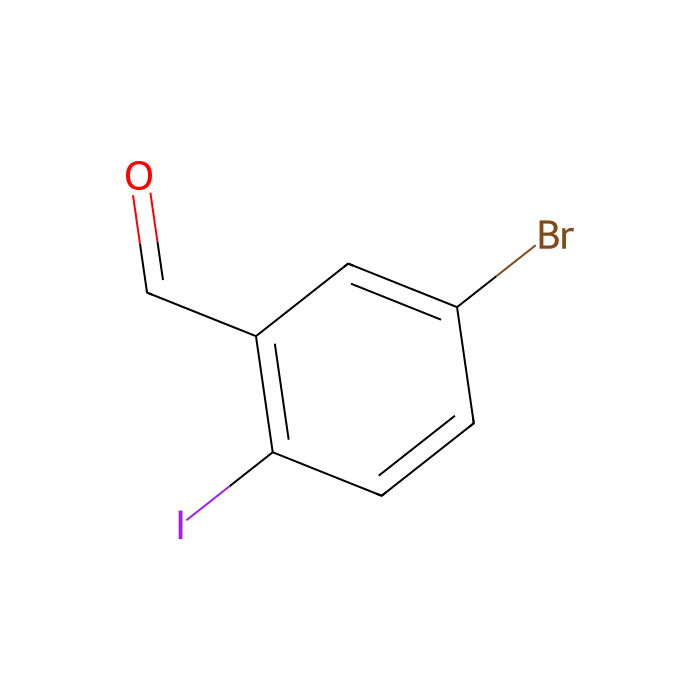
Brief overview: 5-Bromo-2-iodobenzaldehyde is a dihalogenated aryl aldehyde featuring an ortho-iodide and a meta-bromide relative to the formyl group. The combination of a reactive aryl iodide and a less reactive aryl bromide enables orthogonal cross-coupling strategies while the aldehyde enables carbonyl chemistry.
CAS: 689291-89-2 (item-specific)
CID: 21973861 (literature)
InChIKey: Not specified for this item; refer to CoA/Spec Sheet.
SMILES: Not specified for this item; refer to CoA/Spec Sheet.
Molecular formula: C7H4BrIO (literature, deduced from name)
Aromatic benzene ring bearing an aldehyde (–CHO) at C1.
Iodine substituent at C2 (ortho to –CHO) and bromine at C5 (meta to –CHO).
Functional groups: aryl iodide, aryl bromide, and aldehyde.
No stereocenters; planar aromatic core with a trigonal planar carbonyl carbon.
2D structure in words: A benzaldehyde ring with –CHO at position 1; moving clockwise, position 2 carries –I, and position 5 carries –Br; other ring positions are hydrogen.
Note: Identity fields not supplied in Product Data are provided as literature/computed information for general reference only.
Synthetic Utility
Key reactivity elements and how to leverage them (literature):
Aryl iodide (C–I): Highest oxidative addition rate among aryl halides; ideal for first-stage couplings (Suzuki, Sonogashira, Buchwald–Hartwig). Enables rapid installation of aryl, alkenyl, alkynyl, or amine substituents at C2.
Aryl bromide (C–Br): Moderately reactive; preserved through milder conditions to allow sequential functionalization at C5 with more active catalysts/ligands or elevated temperature.
Aldehyde (–CHO): Versatile handle for carbonyl chemistry—condensations (imines, oximes), reductions to benzyl alcohols, or olefinations (Wittig/HWE). Protectable as acetals during metal-catalyzed steps to suppress side reactions.
Strategic sequences:
Protect –CHO → couple at I → deprotect → functionalize –CHO (e.g., Wittig) → couple at Br.
Or, couple at I → acylate/convert –CHO to oxime/imine as a directing/protecting group → final coupling at Br.
Orthogonal handles support concise routes to polysubstituted biaryls, benzannulated heterocycles, and building blocks for SAR studies, with high regiocontrol dictated by the relative reactivity I > Br.
Target Specificity
Not applicable. This product is a small-molecule chemical building block and does not possess biological target specificity, antigen identity, clone, isotype, or species reactivity. See Synthetic Utility and Reaction & Applications for relevant use information.
Domande frequenti
What is the purity of this product?
This product is supplied at ≥98% purity (chemical assay). Lot-specific values are stated on the Certificate of Analysis.
How should this product be stored?
Store at room temperature, protected from light. The material is light-sensitive — keep it in its original opaque or amber container.
How is this product shipped?
This product ships under standard ambient conditions. No temperature-controlled packaging is required.
What are the CAS number, molecular formula and molecular weight?
The CAS Number is 689291-89-2, the molecular formula is C7H4BrIO, and the molecular weight is 310.9 g/mol. InChIKey MOELYMOGQIDKNW-UHFFFAOYSA-N.
What documentation is provided?
Available product documentation, including Certificates of Analysis (COA), Safety Data Sheets (SDS), and specification sheets, is shown in the product document area. Document availability and access follow the current site policy.
We use cookies to ensure the website functions properly and, where permitted, to improve your experience. You can manage your preferences at any time in Settings. Learn more in our Cookie Policy.
Shall we send you a message when we have discounts available?
Remind me later
Thank you! Please check your email inbox to confirm.
Products are supplied to verified businesses, institutions, and qualified professionals for research and development use only. Not for use in humans, animals, diagnosis, or therapy.

 C2322128