Determine the necessary mass, volume, or concentration for preparing a solution.
Dilution Calculator
Determine the dilution needed to prepare a stock solution.
Reconstitution Calculator
Recensioni
Recensioni dei clienti
Application Protocols
Not applicable. No biological assay protocols (WB, IHC, IF, FC) are associated with this small-molecule reagent.
Practical usage notes (general synthetic lab)
For solution handling, prepare stock solutions in dry MeCN, DCM, or EtOAc immediately before use.
For hydrolysis/coupling workflows, run parallel small-scale screens to select conditions (base vs acid hydrolysis; HATU vs T3P couplings) and assess by LC/MS.
Purify by flash chromatography using gradients of hexanes/EtOAc or DCM/MeOH as dictated by polarity; monitor at 254 nm.
Refer to your internal SOPs for reaction setup, workup, and purification.
Biological Roles
This catalog item is a synthetic heteroaromatic building block and does not have an established endogenous biological role.
General context (literature)
Pyrazine motifs appear in numerous bioactive small molecules due to their electron-deficient, H‑bond‑accepting character. However, the ethyl 5‑methoxypyrazine‑2‑carboxylate itself is primarily used as a precursor/intermediate in research synthesis.
Functional handles: the 2‑carboxylate vector provides a site for conjugation to amines (after hydrolysis to the acid) to yield amides; the 5‑methoxy can be diversified (O‑demethylation → O‑functionalization) to explore structure–property relationships.
Biochemical handling (general)
Neutral, moderately polar esters typically partition into organic phases and exhibit limited aqueous solubility; they can undergo esterase-mediated hydrolysis in biological systems, but this compound is sold for research and laboratory synthesis only and is not intended for biological administration.
Research use notice (from Product Data)
For research use only.
Any claims of biological activity, metabolism, or pharmacology should be generated from dedicated studies on derived compounds. No clinical/therapeutic assertions are made or implied.
Buffer Applications
Not typically applicable. This is a neutral, low–water-solubility heteroaromatic ester used as a synthetic building block rather than as a buffering reagent.
Practical note
If handling in aqueous systems (e.g., biphasic hydrolysis), select buffer solely to control reaction pH (e.g., acetate pH 4–5 for acid-catalyzed processes; carbonate pH 9–10 for base-catalyzed hydrolysis), recognizing the substrate has limited water solubility and may require co-solvents (MeCN, EtOH) or phase-transfer methods.
No item-specific buffer recipes or pKa values are provided; consult literature and conduct small-scale trials to optimize conditions.
Green Alternatives
While the compound itself is a target building block (not a solvent), greener choices relate to the reagents and solvents used with it.
Greener solvent swaps (general guidance)
Replace DCM with EtOAc, 2‑MeTHF, or CPME for workups and reactions when solubility allows.
Use MeCN sparingly; where possible, switch to ethanol or isopropanol for recrystallization and transesterification steps.
Avoid DMF/NMP for amidations by using green coupling media (EtOAc, 2‑MeTHF) or toluene with phase-transfer strategies.
Process considerations
Hydrolysis to acid: Favor aqueous ethanol or MeOH/water with catalytic acid, minimizing strong bases and high-boiling dipolar aprotics.
Couplings: Carbodiimide chemistry can be run in EtOAc or 2‑MeTHF; T3P in EtOAc provides lower E-factor and easy workup.
Workup/waste: Use brine minimization and solvent recovery; avoid excessive chlorinated solvent usage.
Comparison snapshot (general)
DCM vs EtOAc: EtOAc is biodegradable, lower toxicity; similar solvency for this substrate.
THF vs 2‑MeTHF: 2‑MeTHF offers higher biomass content, better phase-splitting, and lower peroxide tendency than THF.
DMF vs Cyrene or propylene carbonate: Greener dipolar aprotics; verify solubility and reaction compatibility first.
Item-specific environmental metrics (biobased content, LCI) are not provided; implement solvent selection guides (e.g., CHEM21, ACS GCI) during route design.
Pharmaceutical Uses
No pharmacopeial status or excipient role is provided for this item. It is offered for research use only as a synthetic intermediate/building block.
General formulation/manufacturing context (literature/guidance)
As a heteroaryl ester, it can serve as a precursor to heteroaryl carboxamides and acids frequently evaluated in medicinal chemistry programs.
The ethyl ester can function as a temporary protecting/solubilizing group during multi-step synthesis, later unmasked to the acid for salt formation or coupling.
Quality considerations for discovery-scale synthesis
Control residual solvents and potential hydrolysis/transesterification impurities via GC/HPLC.
Verify low levels of acidic/basic residues to prevent unintended ester cleavage during storage.
Regulatory note
Not intended for human or veterinary use. No therapeutic claims are made. For any cGMP or IND-enabling work, obtain appropriate quality documentation and perform full impurity profiling.
Item-specific pharmacopeial listings, if any, are not specified; refer to the CoA/Spec Sheet for available compliance statements.
Physical Properties
Item-specific specifications (measured values, cutoffs, and test limits) are not provided in the Product Data and should be verified against the CoA/Spec Sheet for this lot.
Item-specific values
Appearance: Not specified for this item; refer to CoA/Spec Sheet.
Molecular Weight (catalog field): Not specified for this item; refer to CoA/Spec Sheet.
Literature/typical properties for ethyl 5‑methoxypyrazine‑2‑carboxylate (for reference only)
Molecular formula: C8H10N2O3 (literature)
Molecular weight: ~182.18 g/mol (calculated)
Physical state: often a low-melting solid or high-boiling liquid depending on purity/crystallinity (literature, general)
Expected solubility: good in common organic solvents (EtOAc, DCM, MeOH, acetonitrile); low in water (literature, general for heteroaryl esters)
Acid/base: largely neutral; pyrazine nitrogens are weak bases; ester does not ionize under neutral conditions (general)
Computation/estimation notes (general)
Polarity: moderately polar due to heteroatoms (two ring nitrogens + ester + methoxy) yet overall neutral.
Hydrogen-bonding: H-bond acceptor rich; no donors.
If you require exact physical constants (mp/bp, density, refractive index, UV cutoff, water/peroxide/metal content), please request the current CoA/SDS. Do not rely on literature values for QC release.
Quality and Grades
Item-specific quality grade/purity: Not specified for this item; refer to CoA/Spec Sheet.
How to interpret common grades for this compound class (general guidance)
Research/technical grade: Suitable for routine synthesis and screening. May have broader impurity profile; confirm suitability for sensitive catalysis or medicinal chemistry via NMR/LC.
95–98% purity (typical for building blocks): Adequate for most coupling/amidation steps; check for hydrolysis byproducts (acid/alcohol) and O‑demethylated impurity (phenol) if reactions are base- or Lewis acid-mediated.
HPLC grade (solvents) is not applicable here; for solids/liquids like this ester, “GC” or “LC” assay and residual solvent/water specs on the CoA provide practical assurance.
Stabilizers/inhibitors
None indicated in Product Data. If a stabilizer is present in a specific lot, it will be listed on the CoA.
Recommended incoming QC (practical tips)
Verify identity by 1H/13C NMR (diagnostic: ethyl quartet/triplet, OMe singlet, aromatic pyrazine protons) and HRMS.
Check purity by HPLC/GC; monitor for hydrolysis (pyrazine-2-carboxylic acid derivative) and transesterification artifacts.
Water content and metal/peroxide limits: Not specified for this item; refer to CoA/Spec Sheet.
Reaction and Applications
As an electron-deficient pyrazine bearing an activating ester at C2 and a methoxy donor at C5, this reagent is a versatile heteroaryl building block for discovery and route-scouting.
Typical transformations (literature/general)
Hydrolysis to acid: Gives 5-methoxypyrazine-2-carboxylic acid; gateway to amide libraries via coupling (EDC/HATU/T3P). Acidic or basic hydrolysis depending on substrate compatibility.
Transesterification: Exchange of the ethyl group (e.g., to methyl, benzyl) using acid/base catalysis; useful for protecting-group strategy or solubility tuning.
Direct amidation via ester: Under activating conditions (e.g., Lewis acids, coupling catalysts, boronic acid co-catalysis), though typically less efficient than acid-coupling routes.
O‑Demethylation: Conversion of the 5‑methoxy to 5‑hydroxy (e.g., BBr3, AlCl3/thiols), enabling further derivatization (etherification, sulfonylation, carbamates).
Metalation on the pyrazine ring: Directed lithiation at C3/C6 has precedent in diazines using s‑BuLi/TMEDA at −78 °C, enabling electrophile trapping (formylation, halogenation) on closely related substrates.
Cross-coupling (after halogenation): Install Br/Cl at residual positions then use Suzuki/Negishi/Buchwald–Hartwig to elaborate heteroaryl frameworks.
Use cases in discovery chemistry (general)
Heteroaryl amide/ester SAR: Rapid access to analogs via hydrolysis/coupling.
Electronic tuning: Methoxy donation versus pyrazine ring withdrawal modulates pKa/logP, aiding property optimization.
Fragment incorporation: The 2‑carboxylate vector provides a reliable conjugation handle to linkers, pharmacophores, or materials ligands.
Always confirm reactivity on small scale; heteroaryl esters can display rate and selectivity shifts due to ring coordination and neighboring group effects.
Reaction Conditions
Guidance below reflects literature precedents and general practice for closely related heteroaryl esters; optimize for your specific system.
Hydrolysis to acid (general)
Basic: K2CO3 or NaOH (1–2 M) in MeOH/H2O or THF/H2O, 0–25 °C, 1–6 h; quench with acid then isolate acid by filtration/extraction.
Acidic: HCl (1–3 M) or H2SO4 in MeOH/H2O or dioxane/H2O, reflux 2–8 h; minimizes saponification of base-sensitive motifs.
Transesterification (Fischer)
ROH solvent (MeOH, iPrOH) with catalytic H2SO4 or p‑TsOH, 50–65 °C (MeOH) or reflux (higher alcohols), 2–16 h; remove alcohol to drive equilibrium.
Base-catalyzed: NaOMe/MeOH at 0–25 °C for methylation; monitor to avoid hydrolysis.
O‑Demethylation
BBr3 (1–3 equiv) in dry DCM, −78 → 0 °C, 1–3 h, quench with MeOH/H2O to afford the phenol; or AlCl3/EtSH in DCM, reflux, 3–6 h.
Reduction of ester
DIBAL‑H (1.2–1.5 equiv) in toluene or DCM, −78 °C to −40 °C, 1–2 h → aldehyde; warm leads to alcohol. Quench carefully with MeOH then Rochelle’s salt.
Coupling from the acid (post-hydrolysis)
HATU/DIPEA in DMF or 2‑MeTHF, 0–25 °C, 1–4 h; or T3P (50% in EtOAc) with amine, 25–60 °C.
Expected yields vary with substitution and conditions; monitor by LC/MS. In all cases, exclude moisture/air as needed to control side reactions on the pyrazine ring.
Safety and Handling
Item-specific safety fields from Product Data
GHS Classification: Not specified for this item; refer to SDS.
Signal word / H-statements / Pictograms: Not specified for this item; refer to SDS.
Storage conditions: Room temperature (per Product Data)
Shipping: Shipped under normal conditions (per Product Data)
General safety guidance for heteroaromatic esters (literature/good practice)
Hazards: May cause irritation to skin/eyes/respiratory tract. Avoid inhalation of dust/vapor and contact with skin/eyes. Combustible organic compound; keep away from ignition sources.
PPE: Use lab coat, safety glasses/goggles, and appropriate chemically resistant gloves (e.g., nitrile). Employ a fume hood for weighing, transfers, and reactions.
Handling: Minimize exposure; prevent aerosol formation. Use dedicated, clean glassware to avoid cross-contamination.
Incompatibilities: Strong oxidizers; strong bases/acids can promote hydrolysis/transesterification; moisture may accelerate hydrolysis over time.
First aid (overview): If on skin/eyes, rinse with water for several minutes; remove contaminated clothing. If inhaled, move to fresh air. If ingested, rinse mouth; do not induce vomiting; seek medical attention. Always follow institutional SOPs.
Fire safety: Use CO2, dry chemical, or foam. Thermal decomposition can release NOx/COx.
Always consult the product’s SDS for authoritative hazard classification, response statements, and exposure limits before use.
Solvent Selection
This molecule is a moderately polar, neutral heteroaromatic ester with multiple H‑bond acceptors. Solvent choice primarily affects solubility, hydrolytic stability, and reaction kinetics.
General miscibility/solubility (literature/guidance)
Low solubility: water (typical for neutral heteroaryl esters).
Selection guidance by task (general)
Storage/stock solutions: EtOAc, MeCN, or DCM for short-term; dry MeCN/THF for moisture-sensitive uses. For assay stocks, DMSO is convenient but avoid prolonged storage to limit transesterification.
Hydrolysis avoidance: Prefer aprotic, anhydrous media (DCM, toluene, MeCN) and exclude base/acid.
Nucleophilic substitutions/transesterification: Alcoholic solvents (MeOH, EtOH) with catalytic acid/base as needed.
Amidation after hydrolysis to the acid: Use polar aprotics (DMF, NMP, DCM) with coupling reagents.
Brief comparison (general)
EtOAc: greener, good solubility; may slowly hydrolyze ester in wet conditions.
MeCN: excellent solvency; low proticity; good for chromatography detection (UV-transparent).
2-MeTHF/CPME: greener ethers; good for moisture-sensitive steps; check solubility.
Item-specific solvent compatibility and UV cutoff are not specified for this product; consult the CoA/SDS and run a small-scale solubility screen for process selection.
Storage and Reconstitution
Item-specific conditions (from Product Data)
Storage: Room temperature.
Shipped: Under normal conditions.
Practical storage guidance (general for heteroaryl esters)
Keep container tightly closed in a dry, well-ventilated place. Protect from moisture and strong acids/bases to minimize hydrolysis or transesterification during storage.
For long-term storage, consider an inert atmosphere (argon/nitrogen) and desiccation. Store away from heat/ignition sources.
If preparing solutions, use anhydrous solvents (MeCN, DCM, EtOAc). Store solutions at 2–8 °C, protected from moisture, and use within a few days to limit degradation.
Reconstitution/handling
Solid/liquid state and appearance are not specified for this item; dissolve the material in a suitable dry organic solvent based on solubility trials.
Warm gently if crystallized; sonication can aid dissolution. Filter if necessary through PTFE syringe filters.
Always consult the CoA/SDS for lot-specific stability information and avoid repeated freeze–thaw of solutions.
Structure and Identity
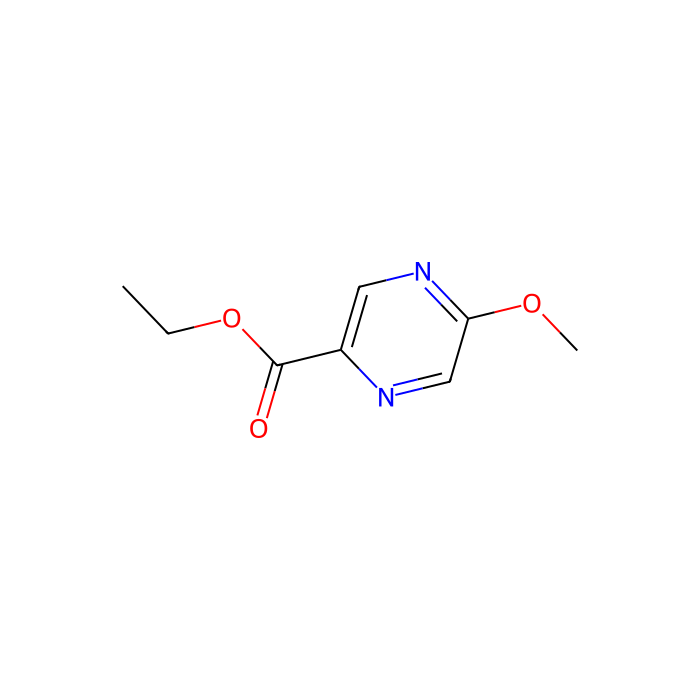
Research-grade heteroaromatic ester building block: ethyl 5‑methoxypyrazine‑2‑carboxylate (a methoxy‑substituted pyrazine bearing an ethyl ester at C2).
Item-specific identifiers (from Product Data)
SKU: E193830
CAS: 54013-05-7
InChIKey: Not specified for this item; refer to CoA/Spec Sheet.
SMILES: Not specified for this item; refer to CoA/Spec Sheet.
Literature/computed identity details (for reference; not item-specific specs)
Preferred IUPAC name (literature): ethyl 5-methoxypyrazine-2-carboxylate
2D description: an aromatic N,N-diazine ring; at one ring carbon (ortho to ring N) a –C(=O)OCH2CH3 group; at the para-to-that carbon a –OCH3 substituent.
Note: Structural strings and formula above are provided as literature guidance only; consult the product CoA/SDS for definitive identifiers of this catalog item.
Synthetic Utility
Key reactivity arises from the convergence of an electron-deficient pyrazine core with a manipulable 2‑carboxylate and a 5‑methoxy handle.
Ring: Electrophilic halogenation (after activation) or directed metallation enabling further diversification and cross-coupling.
Named methods and tactics (literature)
Amidations via HATU/EDC/T3P from the acid derivative are robust for parallel synthesis.
Transesterification (Fischer or NaOMe-catalyzed) tunes protecting group properties.
Chemoselective reductions: DIBAL at −78 °C can access aldehyde without over-reduction; follow by reductive amination or Wittig.
Retrosynthetic value
The molecule serves as a convergent node: acid/amine fragments can be coupled late-stage after hydrolysis; the methoxy vector allows orthogonal late-stage diversification of the heteroaryl core.
This combination of handles makes the compound suitable for rapid library generation and lead optimization workflows in heteroaryl series.
Target Specificity
Not applicable. This product is a small-molecule building block and is not an antibody, enzyme, or targeted biological reagent. No antigen/epitope, clone, isotype, or species reactivity information applies.
We use cookies to ensure the website functions properly and, where permitted, to improve your experience. You can manage your preferences at any time in Settings. Learn more in our Cookie Policy.
Shall we send you a message when we have discounts available?
Remind me later
Thank you! Please check your email inbox to confirm.
Products are supplied to verified businesses, institutions, and qualified professionals for research and development use only. Not for use in humans, animals, diagnosis, or therapy.

 G2312147