≥97% per flussi di lavoro cromatografici e analitici sensibili che richiedono un'interferenza minima della linea di base.
🌡
Stoccaggio e spedizione
Room temperature Spedizione Normal. Consultare il COA specifico del lotto per le specifiche esatte.
📋
Documenti di qualità
SDS, COA, scheda tecnica e scheda delle specifiche disponibili per il download. COA specifico del lotto accessibile tramite ricerca per numero di lotto.
📚
Prova documentale
Citato in 0 pubblicazioni peer-reviewed su cromatografia, sintesi organica e reazioni di accoppiamento incrociato.
This compound belongs to the class of organic compounds known as hydroquinolones. These are compounds containing a hydrogenated quinoline bearing a ketone group.
External Descriptors
Not available
1. Djoumbou Feunang Y, Eisner R, Knox C, Chepelev L, Hastings J, Owen G, Fahy E, Steinbeck C, Subramanian S, Bolton E, Greiner R, and Wishart DS. ClassyFire: Automated Chemical Classification With A Comprehensive, Computable Taxonomy. Journal of Cheminformatics, 2016, 8:61.
Determine the necessary mass, volume, or concentration for preparing a solution.
Dilution Calculator
Determine the dilution needed to prepare a stock solution.
Reconstitution Calculator
Recensioni
Recensioni dei clienti
Application Protocols
No manufacturer-tested application protocols are specified for this item.
General laboratory usage examples (non-binding guidance):
Stock solution preparation: Dissolve in anhydrous DMSO to 10–100 mM. Sonicate gently if needed. Filter through 0.2 µm PTFE before use in assays or HPLC sample prep.
O-Alkylation small-scale procedure: To a solution of the compound (1.0 eq) in dry MeCN, add K2CO3 (2.5 eq) and the alkyl bromide (1.3 eq). Stir at 40 C for 6 h under N2. Quench with water, extract with EtOAc, wash brine, dry (Na2SO4), and purify by silica gel chromatography (heptane/EtOAc).
LC method sketch: Column 100 × 2.1 mm, C18; mobile phase A = water + 0.1% formic acid, B = MeCN + 0.1% formic acid; gradient 10–95% B over 8 min; UV at 254 and 310 nm; MS in ESI+.
Always adapt to your specific scale and equipment, and validate conditions for your application. Refer to the SDS and CoA for safety and identity confirmation.
Biological Roles
Item-specific biological data: Not specified for this item.
General context (no medical/clinical claims):
Quinoline scaffolds occur in natural products and are widely used in chemical biology as reporter backbones and metal-sensing motifs due to strong UV absorption and tunable photophysics. While 8-hydroxyquinoline is a classical chelator, 4-hydroxyquinoline (and its 4-quinolinone tautomer) also display N,O donor sets capable of forming coordination complexes.
Physicochemical properties such as moderate lipophilicity, aromaticity, and hydrogen-bonding capacity make quinolinones useful as fragments or core motifs in ligand design and target engagement studies. The 6-ethoxy group can modulate electron density and solubility compared with the parent 4-hydroxyquinoline.
In biochemical assay development, quinolinone derivatives are sometimes used as UV-detectable handles or as scaffolds for fluorogenic dye synthesis. The phenolic/quinolinone tautomerism can influence pKa and binding modes in enzyme or receptor studies, though such effects are highly scaffold- and substituent-dependent.
Caution: Any biological or biochemical use should be confined to research settings. This product is labeled For research use only and is not intended for diagnostic or therapeutic applications.
Buffer Applications
Not a buffering reagent. 6-Ethoxy-4-hydroxyquinoline is a heteroaromatic solid, not typically used to prepare laboratory buffers or as a pH stabilizer.
Practical note:
If preparing assay solutions, dissolve first in an organic cosolvent (e.g., DMSO) before dilution into an aqueous buffer suitable for your biological system. Consider adding surfactants (e.g., 0.01–0.1% Tween 20) or cyclodextrins to aid solubilization if compatible with the assay.
Verify pH of the final solution, as dissolution of phenolic compounds can cause slight pH shifts in low-capacity buffers.
Green Alternatives
Context: As a solid heteroaromatic building block, the main sustainability levers are solvent choice and reagents used in its transformations, rather than the compound itself.
Replace DMF/DMSO in O-alkylations with safer alternatives when possible, e.g., propylene carbonate or acetonitrile; for extractions/purifications, prefer EtOAc/IPA over chlorinated solvents.
For metal-catalyzed steps on derivatives, consider 2-MeTHF or CPME as greener ethers versus THF/MTBE.
Compact comparison (general):
Polar aprotic: DMF (toxic, problematic) vs. acetonitrile (better EHS profile) vs. propylene carbonate (green, high bp; may require higher temps).
Chlorinated: CH2Cl2 (effective but undesirable) vs. EtOAc/toluene mixtures (safer) with method optimization.
Reagent choices:
Base: K2CO3/Cs2CO3 in MeCN/acetone often outperform NaH in terms of safety and waste.
Alkylation: Use alkyl sulfonates (mesylates) or green leaving groups where feasible; minimize excess alkyl halides.
Workup/waste minimization:
Favor crystallization over chromatography when possible. If chromatography is needed, use heptane/EtOAc systems rather than hexanes/CH2Cl2.
Note: The feasibility of greener substitutions depends on reactivity and solubility of this substrate and its targets; small-scale trials are recommended to confirm yield/selectivity.
Pharmaceutical Uses
Item-specific pharmacopeial status/excipient role: Not specified for this item.
General context (no therapeutic claims):
Quinolin-4-one/4-ol frameworks are common synthetic intermediates in discovery chemistry. 6-Ethoxy-4-hydroxyquinoline could serve as a building block for SAR exploration, prodrug design (via O-derivatization), or as a UV-active handle in impurity/reference standards.
Formulation relevance: As a small-molecule research intermediate, it is not typically formulated as an excipient. If used in in vitro dosing solutions, DMSO or PEG-containing vehicles are standard to ensure solubility and accurate dosing.
Regulatory: Absent explicit monograph alignment (USP/EP/JP), materials of this type are considered research-use only. Lot-specific CoA should be consulted for residual solvents and purity where material is used in GLP preclinical method development.
Physical Properties
Item-specific specs: Not specified for this item; refer to CoA/Spec Sheet for definitive values (mp, bp, density, UV cutoff, assay, water content, etc.).
Literature/general expectations for the 6-ethoxy-4-hydroxyquinoline scaffold (non-spec):
Appearance: typically a pale yellow to off-white crystalline solid for comparable quinolin-4-ol derivatives.
Tautomerism: exists in equilibrium between 4-hydroxyquinoline (enol) and 4-quinolinone (keto). In less polar media and at higher pH, the phenoxide/quinolinone forms become more significant.
Solubility: sparingly soluble in water; readily soluble in polar aprotic organics (DMSO, DMF, NMP) and moderately soluble in alcohols (MeOH, EtOH). Soluble in halogenated solvents (CH2Cl2, CHCl3) and aromatics (toluene) to varying degrees.
Acid–base behavior: phenolic pKa for 4-hydroxyquinolines commonly in the range ~8–10 (literature, compound-dependent). The ring nitrogen is weakly basic; keto–enol tautomerism influences apparent pKa.
Partitioning: quinolinol ethers often show moderate lipophilicity (cLogP roughly 1–2.5; literature/computed for related analogs). Actual value for this item not specified.
UV/Vis: extended aromatic system; strong UV absorbance in the 230–280 nm region and a secondary band near 310–340 nm is common for quinolin-4-ol/one systems (literature). Exact maxima not specified for this item.
Note: Use the item’s CoA/SDS for authoritative physical constants when planning analytical methods.
Quality and Grades
Item-specific grade/purity: Not specified for this item; refer to CoA/Spec Sheet for assay, related substances, and residual solvent limits.
How to interpret grades (general guidance):
Research/technical grade: suitable for most synthetic, screening, and method-development tasks. Purity is typically defined by HPLC/GC area %; residual solvents/metals may not be controlled to pharmacopeial levels.
High-purity/analytical grade: controls on UV absorbance, water, and specific impurities support use in spectroscopy or analytical reference applications.
Considerations for 6-ethoxy-4-hydroxyquinoline:
Tautomer-sensitive analytics: Reported purity may depend on detection wavelength; quinolinone/quinolinol tautomers can have different UV responses. Orthogonal methods (HPLC-UV at multiple wavelengths, LC–MS, 1H NMR) are recommended to confirm identity and purity.
Stabilizers: None are typically added to quinolinol solids; any stabilizer would be disclosed on the CoA. For this item, stabilizer content is not specified.
Trace metals/ions: Phenolic/quinolinone motifs can chelate metals; trace metal content may influence color or solubility. If metal-sensitive applications are anticipated (e.g., catalysis), request ICP data if available.
Verification: Rely on the product’s CoA for lot-specific assay, water (KF), residual solvents, and chromatographic purity. Do not assume pharmacopeial compliance unless explicitly stated.
Reaction and Applications
Use profile: 6-Ethoxy-4-hydroxyquinoline is a functionalized quinolin-4-ol (tautomeric quinolinone) useful as a heteroaromatic building block and a potential N,O-chelating motif in coordination chemistry.
O-Functionalization: Phenolic OH can be converted to ethers and esters. Typical conditions: base (K2CO3/Cs2CO3/NaH) in DMF/MeCN with alkyl halides or acyl chlorides/anhydrides. Mitsunobu alkylation is also viable when avoiding strong base.
Electrophilic substitution on the ring: The quinolinone tautomer directs electrophiles on the benzenoid portion; halogenation (NBS/NCS) and nitration (mild conditions) are reported for related 4-quinolinones.
Metal complexation: The 4-quinolinone (keto) form plus ring nitrogen can act as an N,O-bidentate ligand. Introducing the ethoxy at C6 adjusts donor strength and solubility relative to 4-hydroxyquinoline.
Cross-coupling from halogenated derivatives: If C5/C7 halogenated, Suzuki, Buchwald–Hartwig (for N-aryl on related motifs), or Sonogashira couplings proceed under Pd catalysis. The parent compound can serve as a precursor to such halogenations.
Directed lithiation/metalation: Deprotonation alpha to ring nitrogen (C2) is feasible in some quinolines under strong base (s-BuLi/LDA) at low temperature, enabling formylation or electrophile trapping on suitably protected analogs.
Applications:
Scaffold diversification for libraries in medicinal chemistry (no clinical claims).
Intermediate toward dyes/fluorophores where quinolinone cores contribute to UV/Vis properties.
Potential ligand precursor in catalysis and materials, leveraging N,O coordination.
Practical tips: Control tautomer state via solvent and base. Dry, oxygen-free conditions improve yields in base-promoted O-alkylations. Monitor by LC–MS due to strong UV chromophore.
Reaction Conditions
General conditions reported for related 4-hydroxyquinoline derivatives (illustrative, literature-based; optimize for this substrate):
O-Alkylation (install additional ethers at O4 or derivatize):
Base: K2CO3 (2–3 eq) or Cs2CO3 (1.5–2 eq)
Electrophile: primary alkyl bromide/iodide, mesylate, or benzyl halide (1.2–1.5 eq)
Solvent: MeCN, acetone, or DMF
Temperature/time: 20–60 C, 2–16 h
Notes: Minimize water; phase-transfer catalyst (TBAB) can accelerate in MeCN.
O-Acylation (to esters/carbamates):
Reagent: acyl chloride/anhydride (1.2–1.5 eq)
Base: pyridine, Et3N, or DMAP catalyst
Solvent: CH2Cl2, THF, or toluene
Temperature: 0 C to rt
Electrophilic halogenation on ring (for diversification):
Reagent: NBS/NCS (1.0–1.2 eq)
Solvent: AcOH or MeCN
Temperature: 0–25 C; monitor closely to avoid over-halogenation
Metal complex formation (N,O chelation):
Metal salts: Zn2+, Cu2+, Al3+, etc.
Solvent: EtOH/MeOH or MeCN with mild base to bias quinolinone form
Stoichiometry: 1:1 or 1:2 (ligand:metal), depending on geometry
Analytical method development:
LC–MS: ESI+ shows [M+H]+ expected near m/z 191 (literature expectation for C11H12NO2). Gradient 10–90% MeCN in water (0.1% FA) over 10 min often resolves parent and O-alkylated products.
These are starting points; confirm on small scale and consult primary literature for closely related substitution patterns.
Safety and Handling
GHS and hazard statements (item-specific): Not specified for this item; refer to the SDS for authoritative classification, pictograms, and H/P statements.
General safety guidance for quinolinol derivatives (informational):
Likely hazards: May cause skin/eye irritation and respiratory irritation if dust is generated. Avoid inhalation and contact. Some quinoline derivatives can be harmful if swallowed.
PPE: Wear lab coat, safety glasses, and appropriate impermeable gloves (e.g., nitrile). Handle solids in a fume hood to limit dust exposure.
First aid: If on skin/eyes, rinse with water for several minutes; remove contaminated clothing. If inhaled, move to fresh air. If ingested, rinse mouth; do not induce vomiting; seek medical attention. Always follow SDS instructions.
Storage incompatibilities: Keep away from strong oxidizers and strong bases/acids that may cause degradation or rapid salt formation. Avoid prolonged exposure to light and moisture which can affect phenolic compounds.
Fire safety: Organic solids can burn; use CO2, dry chemical, or foam extinguishers. Thermal decomposition may release nitrogen oxides and CO/CO2.
Waste: Collect in halogenated or non-halogenated organic waste stream consistent with solvent used. Do not discharge to drains.
Administrative controls: Clearly label as “For research use only.” Train personnel on handling aromatic heterocycles and consult the SDS before use.
Solvent Selection
Applicability: This is an aromatic heterocycle solid; solvent choice is relevant for dissolution, reactions on the phenolic/quinolinone motif, and analytical work.
General polarity/miscibility profile (literature/experience-based):
Good solvents: DMSO, DMF, NMP (excellent), CH2Cl2/CHCl3 (good), acetone/MeCN (moderate to good), EtOH/MeOH/i-PrOH (moderate), toluene (moderate upon heating).
Poor solvents: Water (sparingly soluble), hexanes (poor).
Selection tips by use-case:
Stock solutions for screening/assays: Prepare concentrated stocks in DMSO (e.g., 10–100 mM), then dilute into aqueous buffers with surfactant or cosolvent if needed. Filter through 0.2 µm PTFE if particulates persist.
O-alkylation/acylation: Use polar aprotic solvents (DMF, DMSO, acetone, MeCN) with a base (K2CO3, Cs2CO3). Avoid strongly protic media that suppress phenoxide formation.
Metalation/cross-coupling on halogenated analogs: Ether solvents (THF, 2-MeTHF) or toluene are typical. For this parent compound, DMF/DMSO suit nucleophilic substitutions at the O- position.
Crystallization/purification: Mixed solvent systems such as EtOAc/hexanes or toluene/EtOAc often work for quinoline derivatives. For polar impurities, switch to MeOH/Et2O or EtOAc/MTBE pairs.
Analytical solvents:
LC: MeCN/H2O with 0.1% formic acid or MeOH/H2O gradients generally give good peak shape; detection at 254–320 nm is typical for quinolinones (method development required).
NMR: CDCl3 often adequate; if hydrogen bonding broadens signals, use DMSO-d6 or acetone-d6.
Storage and Reconstitution
Item-specific:
Storage Conditions: Room temperature (from Product Data). Store tightly closed in a dry, well-ventilated place away from direct light.
Shipped In: Normal (ambient) conditions.
General guidance for this compound class:
Stability: Aromatic heterocycles and phenolic/quinolinone systems are generally stable as dry solids at ambient conditions. Protect from excessive humidity; consider desiccation if long-term storage is planned.
Container: Use amber glass with PTFE-lined cap to minimize light exposure and interaction with cap liners. Label as “For research use only.”
Reconstitution:
Solvents: DMSO, DMF, or ethanol typically afford clear stock solutions. Start at 10–50 mg/mL depending on application. Water solubility is low; use cosolvent strategies for aqueous systems.
Technique: Warm gently (25–40 C) and sonicate to assist dissolution. Filter through 0.2 µm PTFE for particle-free solutions.
Aliquoting: For repeated use, aliquot stock solutions and store at 2–8 C (short term) or −20 C (long term) to limit freeze–thaw cycles. Allow to reach room temperature before opening to avoid moisture condensation.
Note: No item-specific stability-indicating data (e.g., assay after storage, photostability) are provided here. For critical applications, perform a small-scale stability assessment under your storage conditions.
Structure and Identity
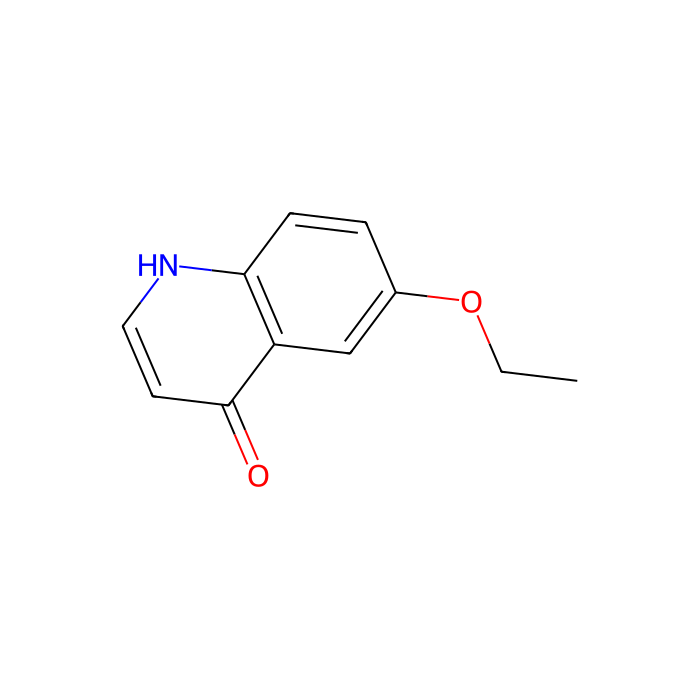
Overview: 6-Ethoxy-4-hydroxyquinoline is a substituted quinolin-4-ol (tautomerizable to 4-quinolinone) bearing an ethoxy group at the 6-position on the benzenoid ring.
Item-specific (from Product Data):
CAS: 303121-11-1
PubChem CID: 721192
InChIKey (as provided): 336609 (note: this string is not a standard-length InChIKey; full identifier is not specified for this item)
SMILES: Not specified for this item; refer to CoA/Spec Sheet.
Computed/Literature identifiers and composition (non-spec, for reference):
Expected molecular formula (by structure): C11H12N O2 (literature/structure-based)
Core scaffold: fused bicyclic heteroaromatic system (quinoline; benzene fused to pyridine) with one ring nitrogen at position 1.
Functional groups: phenolic OH at C4 (enol) in tautomeric equilibrium with the 4-quinolinone (keto) form; aryl ether substituent (ethoxy, –OCH2CH3) at C6.
Aromaticity: 10 π-electron system across the fused rings; the 4-hydroxy/4-oxo tautomer pair modulates electron density on the ring.
Donor/acceptor profile: one hydrogen-bond donor (phenol/enol) and two acceptors (ring N and carbonyl O in the quinolinone tautomer; ether O is also an acceptor). The phenolic oxygen is nucleophilic under basic conditions.
2D description in words: a quinoline ring with an OH at the 4-position on the pyridone ring and an –OCH2CH3 substituent ortho to the ring nitrogen on the benzenoid portion (6-position). No stereocenters present.
Synthetic Utility
Reactivity map of functional handles:
Phenolic OH at C4 (tautomeric to 4-quinolinone):
O-alkylation/acylation to install protecting groups, solubilizing substituents, or pro-moieties.
Conversion to carbonate/carbamate for further manipulation.
Ring nitrogen (N1): weakly basic; can be quaternized (N-oxide formation also feasible on quinolines, though preference depends on substitution and conditions).
Aromatic ring (benzenoid portion, positions 5,7,8): electrophilic substitution and, on halogenated derivatives, cross-coupling handles (Suzuki, Buchwald–Hartwig, Sonogashira) enable rapid diversification.
Ether at C6: generally inert under mild conditions; can be cleaved under strong Lewis/Brønsted acidic conditions or replaced via demethylation/ethoxy cleavage strategies if desired.
Retrosynthetic value:
Serves as a late-stage diversification node for libraries built on a quinolinone core, enabling parallel synthesis by O-functionalization.
Entry point to N,O-bidentate ligands after minimal modification (e.g., deprotection, dealkylation at O6 when required).
Enabling tactics:
Base selection: Cs2CO3 in MeCN or acetone often provides high-yield O-alkylation with minimal side reactions.
Protecting groups: Silyl ethers (TBS) or benzyl protection on O4 if harsh conditions are anticipated downstream.
Metalation: Directed ortho-lithiation adjacent to ring nitrogen (C2) under cryogenic conditions may enable formylations or halogenations on suitably protected analogs.
Analysis: The UV-active core aids TLC/UPLC monitoring; LC–MS [M+H]+ around 191 (literature expectation) simplifies tracking in reaction campaigns.
Target Specificity
Not applicable. This product is a small-molecule heteroaromatic building block, not a biological targeting agent or antibody. No antigen/epitope or species reactivity is defined.
For chemical biology uses, any target engagement is assay- and derivative-dependent and must be determined empirically.
Domande frequenti
How is this product shipped?
This product ships under standard ambient conditions. No temperature-controlled packaging is required.
What is the purity of this product?
This product is supplied at ≥97% purity (chemical assay). Lot-specific values are stated on the Certificate of Analysis.
How should this product be stored?
Store at room temperature.
What are the CAS number, molecular formula and molecular weight?
The CAS Number is 303121-11-1, the molecular formula is C11H11NO2, and the molecular weight is 189.21 g/mol. InChIKey SIECPAIJDHEXAF-UHFFFAOYSA-N.
What documentation is provided?
Available product documentation, including Certificates of Analysis (COA), Safety Data Sheets (SDS), and specification sheets, is shown in the product document area. Document availability and access follow the current site policy.
Utilizziamo i cookie per garantire il corretto funzionamento del sito web e, ove consentito, per migliorare la tua esperienza. Puoi gestire le tue preferenze in qualsiasi momento nelle Impostazioni. Per saperne di più, consulta la nostra Cookie Policy.
Desidera che le inviamo un messaggio quando avremo sconti disponibili?
Ricordamelo più tardi
Grazie! Controlli la sua casella di posta per confermare.
Products are supplied to verified businesses, institutions, and qualified professionals for research and development use only. Not for use in humans, animals, diagnosis, or therapy.

 G2312210