≥98% per flussi di lavoro cromatografici e analitici sensibili che richiedono un'interferenza minima della linea di base.
🌡
Stoccaggio e spedizione
Room temperature Spedizione Normal. Consultare il COA specifico del lotto per le specifiche esatte.
📋
Documenti di qualità
SDS, COA, scheda tecnica e scheda delle specifiche disponibili per il download. COA specifico del lotto accessibile tramite ricerca per numero di lotto.
📚
Prova documentale
Citato in 0 pubblicazioni peer-reviewed su cromatografia, sintesi organica e reazioni di accoppiamento incrociato.
This compound belongs to the class of organic compounds known as quinolines and derivatives. These are compounds containing a quinoline moiety, which consists of a benzene ring fused to a pyrimidine ring to form benzo[b]azabenzene.
External Descriptors
Not available
1. Djoumbou Feunang Y, Eisner R, Knox C, Chepelev L, Hastings J, Owen G, Fahy E, Steinbeck C, Subramanian S, Bolton E, Greiner R, and Wishart DS. ClassyFire: Automated Chemical Classification With A Comprehensive, Computable Taxonomy. Journal of Cheminformatics, 2016, 8:61.
Determine the necessary mass, volume, or concentration for preparing a solution.
Dilution Calculator
Determine the dilution needed to prepare a stock solution.
Reconstitution Calculator
Recensioni
Recensioni dei clienti
Application Protocols
Not applicable.
No tested biological application protocols (e.g., WB, IHC, IF, FC) or analytical kit procedures are provided for this item. For synthetic applications, refer to the Reaction Conditions and Synthetic Utility sections for literature-style guidance and adapt to your laboratory SOPs.
Biological Roles
Applicability note
No biological data are provided for this specific item. The discussion below reflects general information about quinoline scaffolds and should not be construed as biological performance claims for this product.
General context (literature)
Quinoline is a privileged heteroaromatic motif found in natural products (e.g., quinine/quinidine families) and widely used as a core in biochemical probe and inhibitor design due to its planarity, π-stacking ability, and basic ring nitrogen.
Electronic features: The ring nitrogen can be protonated under physiological conditions (pKa of the conjugate acid typically ~5), enabling pH-dependent binding to acidic sites and formation of salts that affect ADME properties in research compounds.
Substituent effects: Alkyl substitution at the benzene ring (such as 6-ethyl) tunes lipophilicity, membrane permeability, and metabolic liability (benzylic oxidation is a common biotransformation), which is often explored during SAR campaigns.
Coordination/fluorescence: Quinolines can coordinate to metal ions and exhibit UV fluorescence, attributes leveraged in biochemical sensors and imaging probes; N-oxidation or additional substituents are often used to modulate photophysical properties.
Use limitations
This product is supplied strictly for research use only, not for diagnostic, therapeutic, or in vivo applications. Any studies involving biological systems should include appropriate controls and comply with institutional safety and ethical standards.
Buffer Applications
Not typically applicable.
6-Ethylquinoline is a neutral organic heteroaromatic used as a synthetic building block or screening hit, not as a buffering agent. It does not provide a defined conjugate acid/base pair at physiological pH with buffering capacity comparable to standard buffers.
For aqueous handling, quinoline derivatives can be protonated with mineral acids to form water-soluble salts; however, such solutions are not standard buffers. Use established buffer systems (e.g., phosphate, acetate, HEPES) for pH control and consult the sections on Reaction & Applications and Synthetic Utility for relevant uses of this compound.
Green Alternatives
Context
6-Ethylquinoline is a target molecule rather than a solvent; “green alternatives” focus on greener syntheses and safer reagent choices during its preparation and use.
Greener synthetic considerations (literature)
C–H activation/alkylation: Transition-metal-catalyzed direct C–H ethylation of quinoline (e.g., via ethylboron reagents, ethylzinc, or ethylene hydrocarbonylation pathways) can reduce steps versus halogenation/Negishi routes, potentially lowering waste.
Benzylic oxidations: Replace stoichiometric Cr(VI)/Mn(VII) reagents with catalytic TEMPO/NaOCl, Oxone, or electrochemical oxidation in MeCN/H2O. These reduce hazardous metal waste and often occur at ambient temperature.
Radical halogenation: Substitute CCl4 with greener solvents such as cyclopentyl methyl ether (CPME) or acetonitrile; consider photoredox catalysis using blue LEDs to avoid azo initiators.
Hydrogenations: Use Pd/C or Raney Ni under low pressure H2 in ethanol or water/ethanol mixtures; consider transfer hydrogenation (isopropanol, Ru- or Ni-based catalysts) to avoid compressed gas.
Comparison snapshot (literature)
Traditional benzylic bromination (CCl4/AIBN, hv) vs. photoredox in MeCN/EtOAc: latter minimizes ozone-depleting solvents and may proceed at room temperature with catalytic loadings.
m-CPBA N-oxidation in DCM vs. urea–hydrogen peroxide in EtOH or water: peroxygen systems in protic media reduce halogenated solvent use.
Implementation tips
Evaluate LCI and PMI for your route; solvent dominates environmental footprint. Where possible, choose alcohols, esters, or CPME/2-MeTHF over chlorinated aromatics, and recover solvents by distillation.
Pharmaceutical Uses
Item-specific
No pharmacopeial or excipient status is provided for this item. It is sold for research use only.
General formulation/manufacturing context (literature)
Quinoline derivatives are common scaffolds in medicinal chemistry campaigns and may appear as intermediates or reference standards in process development. 6-Ethyl substitution modulates hydrophobicity and metabolic soft spots (benzylic oxidation), which can be strategically leveraged during lead optimization.
Salt formation: The basic ring nitrogen allows formation of quinolinium salts, which can improve crystallinity and handling for intermediates during process development. Typical counterions include halides, mesylate, or tosylate.
Analytical reference: Well-characterized substituted quinolines are used as system suitability standards for chromatographic method development in heteroaromatic space, given their UV activity and moderate retention in reversed-phase systems.
Limitations
No therapeutic, diagnostic, or clinical application is implied or supported for this specific product. Any use in pharmaceutical contexts should be confined to laboratory synthesis, reaction screening, or analytical method development with appropriate QA/QC documentation.
Physical Properties
Item-specific (from Product Data)
Appearance: Not specified for this item; refer to CoA/Spec Sheet.
Grade/Purity: Not specified for this item; refer to CoA/Spec Sheet.
Literature/Computed (for context; not item-specific specs)
Physical state: typically a colorless to pale yellow liquid for many lower-alkyl quinolines (literature, class analogy).
Acid–base: weakly basic heteroaromatic; conjugate acid pKa typically ~4.9–5.2 for quinoline derivatives; 6-alkyl substitution has minor effect (literature ranges).
Lipophilicity: logP for quinoline ~2.7–2.8; 6-ethyl likely higher (~3.0–3.3, literature estimates using fragment methods).
Boiling point: higher than quinoline (bp ~238 °C); ethyl substitution commonly raises bp into the ~255–270 °C range for C2-alkyl analogs (literature trend; specific value not confirmed for this isomer).
Melting point: expected below ambient (many alkylquinolines are liquids at room temperature; literature trend).
Solubility: low in water; miscible with most organic solvents including alcohols, ethers, chlorinated solvents, aromatics (literature, class behavior).
UV–Vis: strong π→π* absorption in the near-UV, typical maxima in 230–330 nm region for quinoline chromophore (literature).
Notes
Treat all literature values as guidance only. For specifications used in QC or method development, rely on the item’s CoA/Spec Sheet and SDS.
Quality and Grades
Item-specific (from Product Data)
Grade/Purity: Not specified for this item; refer to CoA/Spec Sheet.
Guidance on grades and implications (general)
Research grade vs. analytical grades: When grade is unspecified, assume research-use material suited for synthesis, screening, and method development. For trace-analysis or chromatographic reference use, verify impurity profile and UV baseline from the CoA.
Purity reporting: For heteroaromatic liquids, purity is commonly established by GC/HPLC area percent and 1H NMR. Water and residual solvent content may be provided by Karl Fischer and GC headspace. If your application is moisture- or peroxide-sensitive, verify relevant limits on the CoA (not specified for this item).
Stabilizers/additives: None specified for this item. If your workflow is sensitive to acids/bases, verify that no acid scavengers or inhibitors are present.
Identity confirmation: CAS 19655-60-8 corresponds to 6-ethyl substitution on the quinoline core. Confirm by NMR (diagnostic benzylic methylene ~2.7–3.1 ppm, aromatic pattern of quinoline) and HRMS. For positional isomer purity (e.g., 5- vs 6- vs 7-ethyl), 2D NMR or NOE can be helpful.
Recommendation
For regulated or quantitative work, request the current CoA/Spec Sheet for exact purity, residual solvents, and any elementals/UV cutoffs that may impact analytical methods.
Reaction and Applications
Overview (literature; general guidance)
6-Ethylquinoline is a position-defined quinoline derivative useful as a scaffold in heteroaromatic chemistry, SAR exploration, and as a precursor to quinolinium salts or N-oxides. The benzylic ethyl side chain is particularly amenable to selective functionalization.
Representative transformations
Benzylic functionalization: Radical bromination (NBS/AIBN, hv) to 6-(1-bromoethyl)quinoline, enabling subsequent SN1/SN2 or cross-coupling via conversion to boronates. Oxidation (e.g., SeO2, MnO2, TEMPO/bleach, or KMnO4) can provide 6-acetylquinoline or 6-quinolinecarboxylic acid depending on conditions.
N-chemistry: Quaternization with alkyl halides or Meerwein reagents yields 6-ethylquinolinium salts (phase-transfer catalysts or ionic-liquid precursors). N-oxidation with m-CPBA gives the N-oxide, a directing group for C–H activation at C-8.
Hydrogenation: Catalytic hydrogenation of the quinoline core affords partially or fully saturated amines (e.g., tetrahydro- or decahydro scaffolds) valuable in chiral resolution studies and ligand synthesis (literature).
Lithiation/metalation: Though direct lithiation of quinoline is difficult, N-oxide or quinolinium activation strategies enable regioselective metalation and subsequent functionalization.
Applications
Discovery chemistry: The 6-ethyl substituent modulates electronics and lipophilicity, aiding lead-optimization series that probe quinoline ring SAR.
Coordination chemistry/materials: The ring nitrogen coordinates to metals; derivatization leads to ligands, dyes, and charge-transport materials. The benzylic position can be elaborated to donor–acceptor systems.
Practical tips
Avoid strong acids during benzylic radical steps to prevent salt formation. Control light/initiator dosage to minimize over-bromination. For oxidations, buffer pH to steer ketone vs acid outcomes.
Reaction Conditions
General literature guidance (illustrative; verify in your lab)
Benzylic bromination: NBS (1.1–1.5 equiv), AIBN (5–10 mol%), solvent toluene or acetonitrile, 80–100 °C or hv (blue LED), 2–6 h. Typical isolated yields 60–85% when over-bromination is minimized.
Benzylic oxidation to ketone: SeO2 (0.5–1.0 equiv) in toluene or dioxane, 80–110 °C, 4–16 h; or TEMPO (5–10 mol%), NaOCl (1.5–2.0 equiv) in MeCN/H2O, 0–25 °C, pH 8–9, 1–3 h. Yields often 55–80% depending on substrate and conditions.
N-oxidation: m-CPBA (1.1–1.5 equiv) in DCM, 0–25 °C, 1–3 h; workup with Na2CO3. Typical yields 70–95% for quinoline N-oxides.
Quaternization: MeI or EtOTf (1.1–1.5 equiv) in MeCN or acetone, 25–60 °C, 2–12 h; yields typically >80% for clean substrates.
Hydrogenation of the ring: Pd/C (5–10 wt%), H2 (1–5 bar), EtOH or EtOAc, 25–50 °C, 6–24 h; partial saturation favored by lower pressure/temperature. Work under appropriate hydrogen safety protocols.
Operational notes
Acid/base control: Free base can form salts; maintain neutral to slightly basic conditions to keep solubility in organic media unless a salt is desired.
Light/oxygen: Radical steps benefit from deoxygenation; photoredox steps use 450 nm LEDs with Ir(ppy)3 or organic dyes at 0.5–2 mol%.
Analytics: Monitor by GC or HPLC-UV around 254–320 nm; benzylic modifications cause diagnostic shifts in retention. Confirm regioselectivity by HMBC/NOESY.
Disclaimer
Conditions above are literature-type examples for quinoline derivatives and should be optimized for your specific setup.
Safety and Handling
Item-specific (from Product Data)
GHS Classification, Signal Word, H-Statements, and Pictograms: Not specified for this item; refer to SDS.
Storage Conditions: Room temperature (as provided).
Shipped In: Normal.
Research Use Note: For research use only.
General safety guidance for quinoline derivatives (literature; not item-specific)
Hazard profile: Nitrogen heteroaromatics may be irritating to skin, eyes, and respiratory tract; ingestion or inhalation can be harmful. Avoid aerosol formation and prolonged exposure. Some aza-arenes show aquatic toxicity—prevent release to the environment.
PPE: Use lab coat, safety glasses/goggles, and appropriate chemically resistant gloves (e.g., nitrile). Employ a fume hood to minimize inhalation exposure.
Incompatibilities: Strong oxidizers (risk of exothermic reaction); strong acids can form salts; strong bases may promote side-chain reactions. Avoid reactive halogenating agents unless conducting controlled syntheses.
First aid overview: If inhaled—move to fresh air; seek medical advice if symptoms persist. Skin/eye contact—rinse with water for at least 15 minutes; remove contaminated clothing; obtain medical attention as needed. If swallowed—rinse mouth; do not induce vomiting; seek medical attention.
Fire safety: Treat as combustible organic liquid. Use CO2, dry chemical, or foam. Vapors may be irritating; combustion may produce NOx.
Authoritative data
Always consult the SDS provided with the shipment for definitive hazard classification, exposure limits, spill response, and disposal instructions.
Solvent Selection
Applicability note
6-Ethylquinoline is a heteroaromatic building block, not a routine process solvent. Solvent selection below refers to its use as a solute/reactant.
General solvent guidance (literature)
Polarity/solubility: As a moderately lipophilic aza-arene, it dissolves well in nonpolar to mid-polar organics: toluene, chlorinated solvents (DCM, CHCl3), ethers (THF, MTBE), and polar aprotics (DMF, DMSO, NMP). Water solubility is low.
Acid–base behavior: The ring nitrogen can be protonated; dissolution in dilute acids forms water-soluble salts, useful for extractions or salt switches.
Spectroscopy: For NMR, CDCl3 or DMSO-d6 typically give clean spectra; benzylic signals may broaden under acid–base impurities—ensure base-free deuterated solvent when needed.
When to choose specific solvents
Electrophilic or radical side-chain functionalization: Use nonpolar solvents like CCl4, CCl2CH2Cl, or toluene; radical brominations often in CCl4/toluene with AIBN or photolysis (literature; verify safety and regulations for CCl4 alternatives).
Oxidations of the benzylic side chain: Acetic acid, aqueous-organic biphasic media, or neat oxidants (KMnO4 in pyridine-free systems) are common; greener options include Oxone in MeCN/H2O.
N-oxidation and quaternization: DCM or CH2Cl2/MeCN for m-CPBA oxidations; MeCN or acetone for quaternization with alkyl halides.
Comparison note
Relative to more polar quinolinium salts, the free base offers broader solubility in organic media and is preferred for neutral, nonaqueous transformations.
Storage and Reconstitution
Item-specific (from Product Data)
Storage Conditions: Room temperature.
Shipped In: Normal.
General guidance
Container: Store in a tightly closed, chemically compatible container (amber glass recommended) to limit light exposure and adsorption losses.
Atmosphere: Typically stable in air; for long-term storage, keep headspace minimal and optionally blanket with inert gas to preserve purity of benzylic positions.
Moisture: Quinoline bases are generally non-hygroscopic, but avoid water ingress to prevent unintended salt formation and to maintain consistent assay.
Temperature excursions: Room temperature storage is acceptable; avoid prolonged heating above 40–50 °C to prevent discoloration or slow oxidation.
Reconstitution/handling: If received as a solidified material at low ambient temperatures, warm gently to room temperature and swirl to homogenize. For solution preparation, use dry, oxygen-free solvents when performing sensitive reactions (e.g., lithiation, radical steps). Filter through PTFE syringe filters if particulate is observed.
Stability checks: Periodically confirm identity/purity by GC/HPLC and 1H NMR if the material is held for extended periods.
Authoritative references
For definitive guidance on shelf life and compatibility, consult the product’s CoA and SDS.
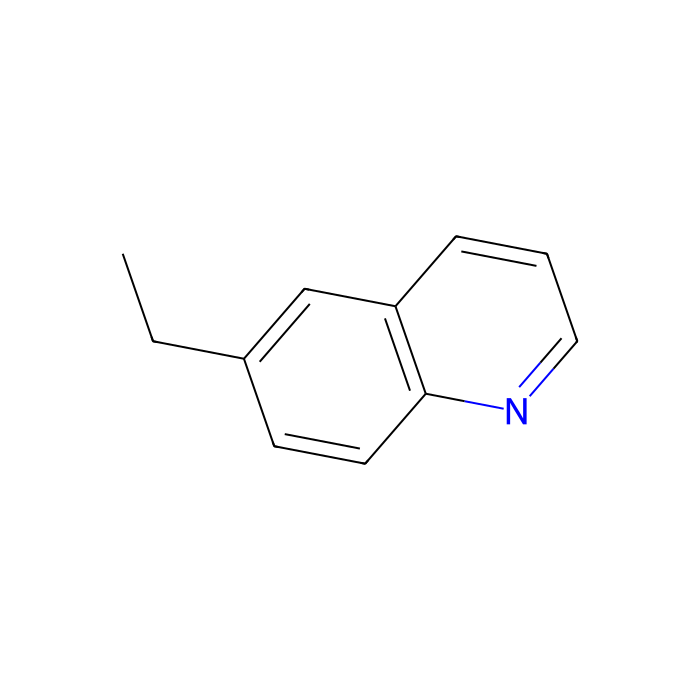
Structure and Identity
Item-specific (from Product Data)
SKU: E349907
Product Name: 6-Ethylquinoline
CAS: 19655-60-8
InChIKey: Not specified for this item; refer to CoA/Spec Sheet.
SMILES: Not specified for this item; refer to CoA/Spec Sheet.
Molecular Formula: Not specified for this item; refer to CoA/Spec Sheet.
Molecular Weight: Not specified for this item; refer to CoA/Spec Sheet.
Literature/Computed (for context; not item-specific specs)
Example SMILES (literature): CCc1ccc2ncccc2c1 (ethyl substituent on the benzene ring at the 6-position of quinoline)
Core structural features: a fused bicyclic aromatic system comprising a benzene ring fused to a pyridine (aza-arenium) ring; one ring nitrogen at the ring-junction carbon adjacent to the N (quinoline scaffold). The ethyl group resides at the 6-position on the benzene portion of quinoline, making the side chain benzylic.
2D structural description
The structure can be described as a planar, fused bicyclic aromatic nucleus (quinoline) with a two-carbon ethyl substituent para to the ring junction on the benzene ring (position 6). The ring nitrogen contributes to basicity and coordination ability, while the benzylic ethyl side chain provides a handle for side-chain functionalization (e.g., oxidation or radical halogenation). No stereocenters are present, and the compound is expected to exist as a single constitutional isomer with typical quinoline aromaticity.
Synthetic Utility
Reactivity overview (literature)
Functional groups: Aromatic aza-heterocycle (quinoline) with a benzylic ethyl substituent. Key handles: ring nitrogen (basic/ligating), benzylic C–H bonds (activated for radical and oxidative transformations), and aromatic positions addressable via directed C–H activation.
Key transformations
Benzylic editing: NBS/AIBN or photoredox bromination; oxidation to ketone/acid; hydroformylation-like homologation via radical pathways. Conversion to alcohols, azides, or thioethers via bromide intermediates.
Nitrogen-centered chemistry: Quinolinium salt formation for phase-transfer or ionic-liquid building blocks; N-oxide as a transient directing group for C–H activation at C-8 (e.g., Pd- or Rh-catalyzed arylation/alkylation).
Hydrogenation/transfer hydrogenation: Partial or full saturation provides access to tetrahydro-/decalin-like amines with different basicity and 3D shape useful for ligand libraries.
Cross-coupling from benzylic derivatives: After benzylic halogenation, engage in Suzuki (via benzylic boronate), Negishi, or Kumada couplings to elaborate side chains.
Retrosynthetic notes
Access from quinoline via regioselective C–H ethylation (e.g., Friedel–Crafts-type alkylations under superacidic conditions or metal-catalyzed C–H functionalization). Alternatively, start from 6-bromoquinoline and perform Pd-catalyzed ethylation (Negishi with Et2Zn or Suzuki with an ethylboron reagent).
Practical considerations
Control regioselectivity: The 6-position is on the benzene ring; directing strategies or pre-functionalization commonly required. Monitor for over-oxidation at the benzylic site during late-stage oxidations.
Target Specificity
Not applicable.
This product is a small-molecule heteroaromatic building block, not a biological targeting agent or antibody. No target, epitope, isotype, or species reactivity data are provided for this item.
Domande frequenti
What is the purity of this product?
This product is supplied at ≥98% purity (chemical assay). Lot-specific values are stated on the Certificate of Analysis.
How should this product be stored?
Store at room temperature.
How is this product shipped?
This product ships under standard ambient conditions. No temperature-controlled packaging is required.
What are the CAS number, molecular formula and molecular weight?
The CAS Number is 19655-60-8, the molecular formula is C11H11N, and the molecular weight is 157.21 g/mol. InChIKey VDOYSQQOKJDYDR-UHFFFAOYSA-N.
What documentation is provided?
Available product documentation, including Certificates of Analysis (COA), Safety Data Sheets (SDS), and specification sheets, is shown in the product document area. Document availability and access follow the current site policy.
Utilizziamo i cookie per garantire il corretto funzionamento del sito web e, ove consentito, per migliorare la tua esperienza. Puoi gestire le tue preferenze in qualsiasi momento nelle Impostazioni. Per saperne di più, consulta la nostra Cookie Policy.
Desidera che le inviamo un messaggio quando avremo sconti disponibili?
Ricordamelo più tardi
Grazie! Controlli la sua casella di posta per confermare.
Products are supplied to verified businesses, institutions, and qualified professionals for research and development use only. Not for use in humans, animals, diagnosis, or therapy.

 E2627635