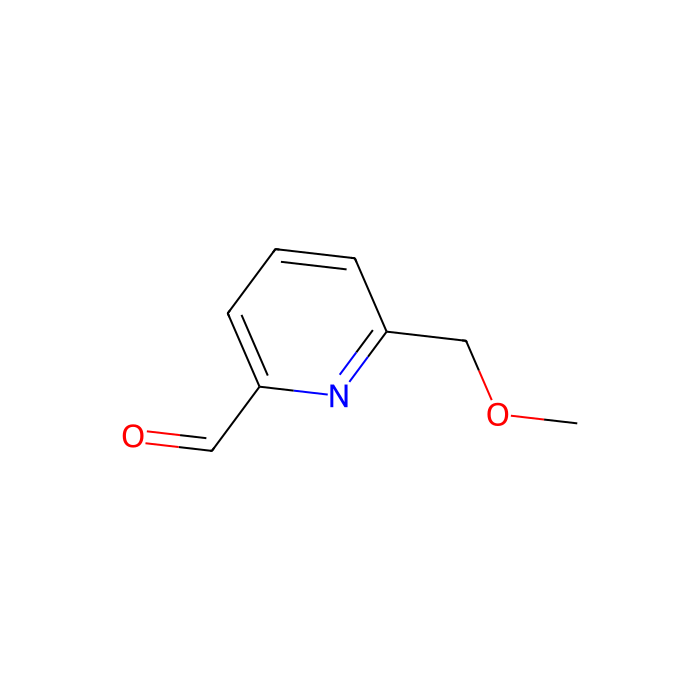
This compound belongs to the class of organic compounds known as pyridine carboxaldehydes. These are aromatic compounds containing a pyridine ring which bears a carboxaldehyde group.
External Descriptors
Not available
1. Djoumbou Feunang Y, Eisner R, Knox C, Chepelev L, Hastings J, Owen G, Fahy E, Steinbeck C, Subramanian S, Bolton E, Greiner R, and Wishart DS. ClassyFire: Automated Chemical Classification With A Comprehensive, Computable Taxonomy. Journal of Cheminformatics, 2016, 8:61.
Certificati (CoA, COO, BSE/TSE e tabella di analisi)
C of A & Other Certificates(BSE/TSE, COO):
Analytical Chart:
Proprietà chimiche e fisiche
Peso molecolare
151.160 g/mol
XLogP3
0.300
Hydrogen Bond Donor Count
0
Hydrogen Bond Acceptor Count
3
Rotatable Bond Count
3
Exact Mass
151.063 Da
Monoisotopic Mass
151.063 Da
Topological Polar Surface Area
39.200 Ų
Heavy Atom Count
11
Formal Charge
0
Complexity
127.000
Isotope Atom Count
0
Defined Atom Stereocenter Count
0
Undefined Atom Stereocenter Count
0
Defined Bond Stereocenter Count
0
Undefined Bond Stereocenter Count
0
The total count of all stereochemical bonds
0
Covalently-Bonded Unit Count
1
Calcolatori di soluzioni
Molarity Calculator
Determine the necessary mass, volume, or concentration for preparing a solution.
Dilution Calculator
Determine the dilution needed to prepare a stock solution.
Reconstitution Calculator
Recensioni
Recensioni dei clienti
Application Protocols
No validated bioassay or immunoassay protocols are provided for this small-molecule building block.
For synthetic use, consider these general, literature-based protocol outlines (non-item-specific):
Reductive amination screen: Combine aldehyde (1.0 eq) and amine (1.1 eq) in MeOH with AcOH (0.5 eq), stir 30–60 min at rt, then add NaBH3CN (1.2 eq) in portions at pH 6–7; stir 2–12 h. Work up and purify by silica gel chromatography.
Wittig coupling: Generate ylide from phosphonium salt with n-BuLi in THF at −78°C, add aldehyde solution dropwise, warm to 0–25°C, quench, and isolate alkene.
Grignard addition: Add RMgX (1.1–1.5 eq) in THF at −78 to 0°C to a solution of the aldehyde; quench with saturated NH4Cl, extract, and purify.
These outlines are starting points only. Optimize stoichiometry, solvent, and temperature for your transformation, and consult primary literature.
Biological Roles
Item-specific biological/biochemical roles: Not specified for this item; refer to CoA/Spec Sheet.
General context (literature; no medical/clinical claims)
This substance is a synthetic heteroaromatic aldehyde. It is not known as an endogenous metabolite or cofactor.
Related 2-formylpyridines are often used to generate imines/Schiff bases and oximes that serve as ligands in bioinorganic model complexes (e.g., mimicking metal-binding sites), but the parent aldehyde has no intrinsic biological role.
The pyridine ring is a privileged motif in medicinal chemistry scaffolds; derivatization of the aldehyde (e.g., to imines, secondary alcohols, or heterocycles) can yield libraries for biochemical screening, yet such uses remain purely research-oriented.
Reactivity considerations for biological assays:
Aldehyde electrophilicity can lead to nonspecific covalent adducts with primary amines (e.g., lysine ε-NH2) in proteins during in vitro experiments; control conditions accordingly.
The pyridine nitrogen can be protonated under physiological pH, altering partitioning; however, the compound itself is not suitable as a buffer or excipient.
Conclusion: treat as a reactive synthetic intermediate for chemical biology workflows if needed, but it lacks a defined physiological function.
Buffer Applications
This compound is a reactive aldehyde building block and is not used as a buffering agent or pH calibrant.
Buffer roles: Not applicable.
Practical note: If used in biochemical assays, prepare solutions in compatible organic cosolvents (e.g., DMSO) and add to buffered systems cautiously to avoid imine formation with buffer amines (e.g., Tris) or biomolecules. Phosphate or acetate buffers (amine-free) are typically preferred if an aqueous buffer is required in the presence of aldehydes.
Green Alternatives
Scope: Green considerations focus on solvent and reagent choices when using this heteroaromatic aldehyde; the molecule itself is a specific building block and is not typically replaced by a “green equivalent.”
Greener solvent choices (literature guidance)
Prefer ethyl acetate, 2-methyltetrahydrofuran (2-MeTHF), cyclopentyl methyl ether (CPME), or toluene over dichloromethane when feasible for condensations and olefinations.
For reductive amination, ethanol or isopropanol can substitute for methanol/MeCN in many cases, reducing toxicity.
For polar aprotic needs, dimethyl carbonate or propylene carbonate may substitute for DMF/DMAc in certain reactions, noting viscosity and base solubility tradeoffs.
Comparison (general)
DCM vs EtOAc/2-MeTHF: EtOAc/2-MeTHF reduce chlorinated waste; 2-MeTHF supports strong-base chemistry and has favorable peroxide profile vs THF but still requires monitoring.
THF vs 2-MeTHF/CPME: ethers from bio-based sources (2-MeTHF) can improve sustainability and facilitate separations; CPME has low peroxide formation and broad biphasic behavior.
DMF/DMSO vs greener carbonates: carbonates are less problematic in waste streams but may limit solubility/reactivity; evaluate case-by-case.
Reagent choices
Reductive amination: use NaBH(OAc)3 or catalytic hydrogenation (H2/Pd) in alcohols instead of NaBH3CN where cyanide handling is a concern.
Aldehyde protection: prefer acetals formed under catalytic acid in green solvents (EtOH) rather than halogenated media.
Note: Validate substitutions by small-scale trials; kinetics and selectivity can shift with solvent polarity and coordination to the pyridyl nitrogen.
Pharmaceutical Uses
Item-specific pharmaceutical/formulation use: Not specified for this item; refer to CoA/Spec Sheet.
General, non-clinical context (literature)
Role: heteroaromatic aldehyde intermediate for the preparation of candidate molecules; not an excipient.
Typical applications in process R&D:
Reductive amination or imine coupling to generate 2-pyridyl-containing scaffolds
Olefination to introduce alkenyl pyridines
Cyclizations to build fused N-heterocycles
Regulatory note: Building blocks like this are generally not compendial (no USP/Ph.Eur. monograph). Any use in GMP settings requires full impurity profiling, residual solvent control (ICH Q3C), and verification of identity/purity for each lot.
Handling in pharmaceutics labs: aldehyde functionality may be incompatible with amine-containing excipients and can undergo oxidation; protect from air/moisture and validate stability in the chosen solvent system.
No therapeutic or clinical claims are made; this product is for research and laboratory synthesis only.
Physical Properties
Item-specific specifications
Appearance: Not specified for this item; refer to CoA/Spec Sheet.
Purity/grade: Not specified for this item; refer to CoA/Spec Sheet.
Literature/computed (non-item-specific; for general guidance only)
Approx. formula: C8H9NO2; approx. MW ~151.16 g/mol (calculated from structure)
Phase at ambient: expected to be a low-melting solid or high-boiling liquid depending on purity and polymorphism (literature expectation for heteroaromatic aldehydes of similar MW)
Boiling point, melting point, density, refractive index, UV cutoff, water/peroxide/metal limits: Not specified for this item; refer to CoA/Spec Sheet. No robust literature consensus identified.
Solubility (qualitative, literature):
Good solubility in polar aprotic organic solvents (e.g., acetonitrile, DMF, DMSO) and chlorinated/aromatic solvents (DCM, toluene)
Limited aqueous solubility anticipated due to heteroaromatic core and ether side chain; aldehyde can hydrate slightly in water
Acidity/basicity (literature):
Aldehyde has no pKa in the protic sense; pyridine nitrogen is weakly basic (conjugate acid pKa typically ~5.2 for pyridine; ring substitution can shift slightly)
Partitioning (qualitative):
Moderately polar; expected logP in the low-to-mid range for substituted pyridyl aldehydes, favoring organic phase in biphasic systems
Always consult the product CoA for exact, item-specific physical data prior to process design.
Quality and Grades
Item-specific grade/purity: Not specified for this item; refer to CoA/Spec Sheet.
Stabilizers/inhibitors: Not specified for this item; refer to CoA/Spec Sheet.
General guidance (literature/industry practice)
Research-grade heteroaromatic aldehydes are commonly supplied at high purity suitable for synthesis and analytical characterization. If low UV background is required (e.g., analytical HPLC), request HPLC-grade solvents and verify aldehyde UV profile on CoA.
Aldehydes can oxidize during storage; suppliers may specify peroxide or acid content and aldehyde assay by GC/LC or NMR. If your workflow is water- or base-sensitive (e.g., Wittig, enamine formation), verify residual water and acid numbers on the CoA.
Trace metal content matters for metal-catalyzed couplings/condensations involving the pyridyl directing group. If catalysis is sensitive, request a low-metal specification or purify prior to use.
For photochemical or coordination studies, confirm isomeric purity and absence of over-oxidation impurities (picolinic acid derivatives) via HPLC and 1H/13C NMR.
Recommendations
On receipt, perform quick identity/purity checks (1H NMR: aldehyde proton typically ~9.8–10.2 ppm for 2-pyridyl aldehydes; IR: C=O ~1680–1710 cm–1, literature) and confirm water content if required for moisture-sensitive reactions.
If your application is chromatographic or spectroscopic, request and review the lot-specific CoA for absorbance profile and impurity thresholds.
Reaction and Applications
As a 2-formylpyridine bearing a 6-(methoxymethyl) substituent, this compound serves as a versatile electrophilic building block and ligand precursor.
Representative transformations (literature)
Imine/Schiff base formation and reductive amination: rapid condensation with primary amines (e.g., for 2,2′-bipyridyl-like ligand frameworks); reduce with NaBH3CN, NaBH(OAc)3, or catalytic hydrogenation.
Nucleophilic additions to the aldehyde: Grignard and organolithium reagents to give secondary alcohols; cyanohydrin formation; addition of stabilized enolates.
Olefination: Wittig, Horner–Wadsworth–Emmons, or Julia–Kocienski to access 2-alkenylpyridines with defined geometry (E/Z control via base/ylide choice).
Condensations: Knoevenagel with malononitrile/cyanoacetates; Povarov and related annulations after imine preformation.
Heterocycle construction: intramolecular cyclizations and annulations leveraging the pyridyl directing group; access to fused N-heteroaromatics.
Coordination chemistry: the 2-pyridyl imine/oxime derivatives act as bidentate N,N or N,O ligands for catalytic complexes (e.g., Cu, Ni, Fe), enabled by ortho-formyl functionality.
Practical tips
Keep conditions anhydrous for base- or ylide-mediated reactions; aldehydes are water-sensitive and prone to self-condensation.
The pyridine N can coordinate bases/catalysts; buffering with mild acids (AcOH) or protecting N by transient quaternization can modulate reactivity/selectivity.
Methoxymethyl side chain is generally inert but can be transformed (e.g., O-dealkylation, oxidative cleavage) to introduce further functionality.
Applications expand on manufacturer’s research-use intent and are intended for lab-scale synthesis only.
Reaction Conditions
General, literature-based guidance for 2-pyridyl aldehydes (not item-specific; optimize per substrate):
Imine formation and reductive amination
Conditions: aldehyde + primary amine (1.0–1.2 eq) with 3 Å molecular sieves or Dean–Stark; catalytic AcOH; solvent MeOH, EtOH, i-PrOH, toluene, or MeCN.
Temperature/time: 20–60°C, 0.5–12 h. Reduce in situ with NaBH3CN (MeOH, pH ~6), NaBH(OAc)3 (DCE/MeCN), or H2/Pd-C (EtOH) to give secondary amines in good yields.
Wittig/Horner–Wadsworth–Emmons olefination
Base: n-BuLi, NaHMDS, or K2CO3 depending on ylide/phosphonate; solvents THF, toluene, or DCM.
Temperature: −78°C to rt; typical 1–6 h. E/Z control via ylide stability and solvent polarity.
Grignard/organolithium additions
Reagents: RMgX or RLi (1.1–1.5 eq) in Et2O or THF.
Temperature: −78 to 0°C; quench with NH4Cl. Caution: pyridine N can coordinate; slow addition and temperature control improve chemoselectivity.
Knoevenagel condensation
Partners: malononitrile, ethyl cyanoacetate; base piperidine or ammonium acetate.
Solvent: EtOH, toluene (Dean–Stark), or MeCN; 20–80°C, 1–8 h.
Protection of the aldehyde
Acetalization: ethylene glycol or methanol under catalytic TsOH or camphorsulfonic acid; solvents toluene or EtOH; remove water azeotropically when needed.
Workup/purification
Minimize exposure to strong base on silica; neutralize with 0.1% AcOH in eluents if tailing occurs.
Monitor by TLC (UV-active) and 1H NMR; aldehyde proton typically appears ~9.8–10.2 ppm (literature).
Note: These are literature norms; validate and adjust for your specific substrate, scale, and safety constraints.
Safety and Handling
Item-specific hazard information
Signal word / H-statements / GHS classification / Pictograms: Not specified for this item; refer to SDS.
General laboratory safety guidance for heteroaromatic aldehydes (literature/Best Practice)
Likely hazards: may cause skin/eye irritation and respiratory tract irritation; harmful if swallowed; aldehydes can be sensitizers in some cases. Avoid inhalation and contact.
PPE: lab coat, safety glasses or chemical splash goggles, appropriate chemically resistant gloves (e.g., nitrile). Use in a fume hood.
Handling notes:
Keep containers tightly closed; minimize exposure to air and moisture to limit oxidation (to the corresponding carboxylic acid) and potential polymerization.
Inert gas blanket (N2/Ar) recommended for long-term storage or when heating.
Avoid strong bases, strong oxidizers, and strong nucleophiles; aldehyde is electrophilic and can undergo unintended condensation.
First aid (overview; defer to SDS):
Inhalation: move to fresh air; seek medical attention if symptoms persist.
Skin/eyes: rinse with water for at least 15 minutes; remove contaminated clothing; obtain medical advice.
Ingestion: rinse mouth; do not induce vomiting; seek medical attention.
Fire and stability:
Combustible organic; use CO2, dry chemical, or foam. Thermal decomposition can produce CO/CO2 and NOx.
Store away from ignition sources; ground/bond when dispensing flammable solvents used with this compound.
Always consult the product-specific SDS for definitive hazard classification and emergency measures.
Solvent Selection
Applicability: This is a moderately polar heteroaromatic aldehyde and building block, not a mobile-phase additive or buffer component. Solvent choice pertains to dissolving/processing it and optimizing reactions.
General solubility/miscibility profile (literature)
Poorly soluble: water (aldehyde hydration possible but limited)
Selection guidance by task
Synthesis (condensations, additions):
Polar aprotics (MeCN, THF, 2-MeTHF, CPME, dioxane) balance aldehyde reactivity and solubility of bases/nucleophiles.
Reductive amination: MeOH/EtOH/i-PrOH or MeCN with buffered conditions; avoid strong base to limit aldol/self-condensation.
Wittig/Still–Gennari: toluene, THF, or DCM depending on ylide; rigorously anhydrous conditions.
Purification: normal-phase silica with EtOAc/hexanes or DCM/MeOH gradients; protect aldehyde from prolonged basic silica exposure to avoid acetalization/condensation.
Crystallization: toluene/hexanes or EtOAc/hexanes mixtures may be screened; outcome depends on substituent pattern and lot purity.
Comparative notes
Versus unsubstituted picolinaldehyde: the methoxymethyl group increases organic solubility and reduces volatility, often easing handling while preserving electrophilicity at C=O.
Avoid highly nucleophilic solvents (e.g., neat primary alcohols under acid) when aldehyde integrity must be preserved; these can form acetals/hemiacetals.
Storage and Reconstitution
Item-specific
Storage conditions: Room temperature (per Product Data). Protect from air and moisture where possible.
Shipped in: Normal conditions (per Product Data).
Physical form, stabilizers, and reconstitution needs: Not specified for this item; refer to CoA/Spec Sheet.
General best practices for aldehydes
Store in amber, tightly sealed containers under inert gas (N2/Ar) to limit oxidation to the corresponding acid.
If long-term storage is planned, consider refrigeration (2–8°C) as a precaution, unless crystallization/solidification complicates handling; verify stability on your lot.
Avoid prolonged exposure to basic vapors or amines; aldehydes can undergo undesired condensation.
For solution storage, prepare stock solutions in dry, oxygen-free solvents (e.g., toluene, Et2O, THF, MeCN) and keep at low temperature; check periodically by TLC/NMR for degradation.
No reconstitution is typically required; if solid, dissolve in a compatible dry organic solvent just before use. If material has partially oxidized, purify (e.g., quick silica plug) to remove acid impurities before sensitive reactions.
Always consult the lot-specific CoA/SDS for definitive storage and handling guidance.
Structure and Identity
Brief overview: 6-(Methoxymethyl)picolinaldehyde is a pyridine-2-carboxaldehyde (picolinaldehyde) bearing a methoxymethyl substituent at the 6-position, combining a heteroaromatic ring with an aldehyde electrophile and an ether side chain.
Item-specific IDs (from Product Data)
CAS: 890904-66-2
PubChem CID: 28950164
InChIKey: 448343 (as provided)
SKU: M195626
Storage: Room temperature; shipped under normal conditions
Molecular formula: Not specified for this item; refer to CoA/Spec Sheet. Calculated (literature): C8H9NO2
Molecular weight: Not specified for this item; refer to CoA/Spec Sheet. Calculated (literature): ~151.16 g/mol
Structural features (general/interpretive)
Core: 6-substituted pyridine ring (sp2 N-heteroaromatic)
Functional groups: aldehyde (–CHO) at the 2-position; methoxymethyl ether (–CH2–O–CH3) at the 6-position
Electronic character: ring nitrogen and formyl group create a conjugated, moderately electron-deficient aromatic system; aldehyde is a strong electrophile; pyridine N can coordinate metals
Stereochemistry: none (achiral)
Connectivity (2D description)
Pyridine N at position 1; formyl group at C-2 ortho to N; methoxymethyl substituent at C-6 ortho to N on the opposite side of the ring
Line notations (literature)
Example SMILES (literature, for reference): O=CC1=NC=CC(COC)=C1
Example InChI (literature): not specified here; consult public databases for the exact string
Note: When needed for regulatory or analytical purposes, rely on the product-specific CoA/SDS for definitive identifiers and specifications.
Synthetic Utility
Functional-group synopsis
Aldehyde (–CHO): electrophile for carbon–carbon and carbon–heteroatom bond formations (imines, acetals, cyanohydrins, 1,2-additions, olefinations).
Pyridine N: weak base and Lewis base; coordinates metals, enabling directed metalation, C–H activation, and ligand design from imine/oxime derivatives.
Methoxymethyl substituent: ether side chain that can be further elaborated (e.g., deprotect to hydroxymethyl, oxidize to aldehyde/acid) to generate 6-substituted derivatives.
Strategic uses (literature)
Ligand precursors: condensation with diamines to form tetradentate Schiff bases for Cu/Ni/Fe complexes.
Diversification node: orthogonal reactivity enables selective modification at C=O (e.g., reductive amination) without perturbing the pyridine ring; subsequent N-oxidation or N-alkylation further tunes electronics.
Retrosynthetic value: provides an “ortho-formyl” handle on pyridine, which is otherwise difficult to install; useful for assembling quinazolinones, dihydropyrido-fused systems, and 2-alkenyl/2-alkyl pyridines.
Cross-coupling adjacency: although the ring lacks a halogen, aldehyde-to-vinyl intermediates can be halogenated and engaged in Suzuki/Heck; alternatively, directed ortho-metalation (DoM) adjacent to N enables subsequent electrophile trapping.
Selectivity considerations
The 2-formyl group is ortho to N; intramolecular H-bonding and coordination to reagents/catalysts can influence reactivity and stereocontrol in additions/olefinations.
Protect aldehyde as an acetal during strongly basic metalation or lithiation steps to prevent side reactions.
Target Specificity
Not applicable. This product is a small-molecule chemical building block, not a biological macromolecule or affinity reagent. No antigen/epitope, clone, isotype, or species reactivity applies.
We use cookies to ensure the website functions properly and, where permitted, to improve your experience. You can manage your preferences at any time in Settings. Learn more in our Cookie Policy.
Shall we send you a message when we have discounts available?
Remind me later
Thank you! Please check your email inbox to confirm.
Products are supplied to verified businesses, institutions, and qualified professionals for research and development use only. Not for use in humans, animals, diagnosis, or therapy.