≥97% for sensitive chromatographic and analytical workflows requiring minimal baseline interference.
🌡
Storage & shipping
Store at 2-8°C,Protected from light,Argon charged Ships Wet ice Check lot-specific COA for exact specifications.
📋
Quality documents
SDS, COA, datasheet, and spec sheet available for download. Lot-specific COA accessible via lot number lookup.
📚
Literature proof
Cited in 0 peer-reviewed publications across chromatography, organic synthesis, and cross-coupling reactions.
Panoramica
Description
Reactant for:Enantioselective synthesis of polycyclic coumarins via in situ formed primary amine-imine-catalyzed asymmetric Michael addition to cyclic enonesPreparation of dicoumarol analogs as inhibitors of human NAD(P)H quinone oxidoreductase-1 (NQO1) as agents active against human pancreatic and colon cancer cellsImidazolidinecarboxylic acid-catalyzed asymmetric Michael reaction with unsaturated ketones in a highly atom-economic catalytic one-step formation of optically active warfarin anticoagulantAsymmetric synthesis of functionalized α-keto esters and their hemiketal and hemiaminal derivatives via direct Michael addition with unsaturated α-keto esters catalyzed by bisoxazoline-copper(II) complexes
This compound belongs to the class of organic compounds known as 4-hydroxycoumarins. These are coumarins that contain one or more hydroxyl groups attached to C4-position the coumarin skeleton.
External Descriptors
Not available
1. Djoumbou Feunang Y, Eisner R, Knox C, Chepelev L, Hastings J, Owen G, Fahy E, Steinbeck C, Subramanian S, Bolton E, Greiner R, and Wishart DS. ClassyFire: Automated Chemical Classification With A Comprehensive, Computable Taxonomy. Journal of Cheminformatics, 2016, 8:61.
Determine the necessary mass, volume, or concentration for preparing a solution.
Dilution Calculator
Determine the dilution needed to prepare a stock solution.
Reconstitution Calculator
Recensioni
Recensioni dei clienti
Application Protocols
No tested bioassay or immunoassay protocols are provided for this small-molecule product.
General lab use suggestions (non-validated)
Prepare concentrated stocks in dry DMSO (e.g., 10–100 mM), protect from light, and dilute into working media immediately before use.
For spectroscopic work, record solvent blank and consider inner-filter effects due to strong UV absorbance.
Refer to primary literature or develop method-specific protocols appropriate to your application.
Biological Roles
No biological testing data are provided for this item; the following is general context for the coumarin scaffold.
Coumarin core
Widely occurring in plants as secondary metabolites; exhibits characteristic UV absorption and potential fluorescence, useful as a spectroscopic reporter in biochemical assays (non-clinical context).
4-Hydroxycoumarin chemistry
The 4-hydroxycoumarin motif is known to participate in strong hydrogen bonding and metal coordination via the enolized 1,3-dicarbonyl system, enabling use as a ligand in coordination chemistry and as a building block for probes.
Effect of fluorination at C-7 (general, literature)
Aryl fluorination can influence lipophilicity, metabolic stability, and photophysical behavior. In fluorinated coumarins, changes in absorption/emission and acidity are often observed, which can be exploited to tune fluorescence or sensor response in research settings.
Lab relevance
As a small-molecule chromophore with a phenolic handle, 7-fluoro-4-hydroxycoumarin can be derivatized into conjugates for target binding studies, enzyme assay reporters, or as a reference standard for analytical method development.
Note: No claims are made regarding biological activity, safety, or efficacy. This product is for research use only.
Buffer Applications
This compound is not a buffering reagent. It lacks a suitable conjugate acid/base pair with a practical buffering range in aqueous media, and its water solubility at neutral pH is limited.
Practical note: For aqueous work, limited dissolution can be achieved by preparing a basic stock (phenolate) in carbonate or Tris buffer, but this is intended for solubilization rather than pH control. Consider standard buffers (phosphate, Tris, HEPES) for pH maintenance.
Green Alternatives
Greenness considerations for working with 7-fluoro-4-hydroxycoumarin primarily involve solvent and base selection, since the substrate is a specialized aromatic lactone not readily replaced by a different core.
Preferable solvent choices (literature guidance)
Replace DMF/DMSO where feasible with ethanol, isopropanol, 2-MeTHF, propylene carbonate, or ethyl acetate, balancing solubility and reactivity.
For condensations (C-3 functionalization), EtOH or water/EtOH with organocatalysts (e.g., L-proline, ammonium acetate) can offer reduced toxicity vs polar aprotics.
Bases and catalysts
Use K2CO3, Na2CO3, or organic superbases (DBU, TBD) catalytically in greener solvents instead of strong alkoxides in DMF. Aqueous carbonate can be effective when solubility permits (phenolate formation enhances dissolution).
Workup/waste minimization
Exploit the product’s crystallinity to use antisolvent precipitation rather than chromatographic purification where possible.
Apply microwave or flow methods to reduce reaction times and energy consumption.
Comparison snapshot (qualitative)
DMF/DMSO: excellent solubility/reactivity; difficult waste. 2-MeTHF/EtOAc/EtOH: lower toxicity/biodegradability; may require higher temperatures or longer times.
Note: The specific substitution pattern (7-F) is often essential for target properties; “greener substitutes” typically refer to the reaction medium and conditions, not to changing the substrate itself.
Pharmaceutical Uses
No pharmacopeial grade or excipient status is provided for this item. The following outlines general, non-clinical uses in pharmaceutical R&D and manufacturing contexts.
Item-specific status
Grade/Purity: Not specified for this item; refer to CoA/Spec Sheet.
Research Use Only. Not for human or veterinary use.
Typical roles in pharma labs (general)
Synthetic intermediate: Starting point for libraries of 3-substituted 4-hydroxycoumarins; fluorination at C-7 can modulate physicochemical properties for SAR exploration.
Reference/impurity standard: The defined scaffold can serve as a reference standard in stability-indicating methods or impurity profiling of fluorinated coumarin derivatives.
Fluorescent tag precursor: Derivatization at O-4 (carbonates/carbamates/ethers) enables preparation of fluorescent reporters for assay development.
Analytical considerations
Strong UV absorbance supports LC–UV detection; fluorescence can enable sensitive LC–FLD or spectrofluorimetric assays (optics must be optimized to the specific derivative/solvent).
No therapeutic claims are made; any application in dosage forms would require separate qualification and regulatory assessment.
Physical Properties
Item-specific physical constants are not provided in the Product Data. The following are literature/general values intended for planning only (not specifications of this item):
Aggregated state/appearance: Not specified for this item; refer to CoA/Spec Sheet.
Melting point: Typically solid coumarin derivatives melt >150 °C; specific MP for 7-fluoro-4-hydroxycoumarin is literature-dependent and should be confirmed from primary sources (not specified here).
Boiling point: Not generally applicable (thermally labile lactone; decomposes before boiling under ambient pressure) — literature guidance only.
Density: Not specified for this item; refer to CoA/Spec Sheet.
Solubility (literature, qualitative):
Water: Sparingly soluble (phenolic lactone, limited ionization at neutral pH).
Polar organics: Soluble in DMSO, DMF, NMP; moderate in MeOH/EtOH/acetone/acetonitrile; low in nonpolar hydrocarbons.
Acid–base (literature): Phenolic pKa for 4-hydroxycoumarins typically ~4.5–5.0; fluorination at C-7 can slightly increase acidity (exact value substrate- and solvent-dependent).
Partitioning (literature): cLogP for 4-hydroxycoumarin cores is modest (~1–2); fluorination may increase lipophilicity marginally.
UV–Vis/fluorescence (literature, qualitative): Coumarin chromophore shows strong π→π* absorption in the near-UV (ca. 300–340 nm; solvent-dependent) and can exhibit blue fluorescence; substitution pattern modulates maxima and quantum yield.
Note: For any numerical property required for QC or method development, please consult the CoA/Spec Sheet for this lot.
Quality and Grades
Item-specific grade/purity and appearance: Not specified for this item; refer to CoA/Spec Sheet.
How to interpret grade (general guidance)
If provided as Research or Analytical Grade, material is intended for laboratory applications, not for human or animal use.
Where applicable, higher-purity grades target reduced residual solvents, low non-volatile residue, and tighter assay limits. Chromatography-grade materials prioritize low UV background and fluorescence impurities.
Impurities and stabilizers
No stabilizers are indicated in the Product Data for this item. If present in a future lot, stabilizers will be disclosed on the CoA/SDS and may influence reactivity (e.g., phenolic inhibitors affecting radical processes).
Trace inorganic/organic impurities, water content, and spectral purity should be confirmed from the CoA for your lot when developing analytical methods.
Recommended QC checks on receipt (practical tips)
Record lot number and date; verify container is argon charged and light-protected as specified.
Assess identity by NMR/HRMS/IR/UPLC as needed; coumarin cores give diagnostic 1H signals (H-3 vinylic, aromatic multiplets) and strong IR bands for lactone C=O (~1720–1750 cm⁻¹) and phenolic O–H (broad).
Evaluate assay and impurity profile by HPLC-UV/FLD; coumarins have strong UV response near 310–330 nm (method-dependent).
Reaction and Applications
This scaffold is a versatile synthon for constructing functionalized coumarins and conjugates.
Representative transformations (literature)
C-3 functionalization via active methine: The 4-hydroxycoumarin core behaves like a 1,3-dicarbonyl equivalent. Under base catalysis (e.g., piperidine, ammonium acetate, K2CO3), it condenses with aldehydes/α,β-unsaturated ketones to give 3-alkylidene or 3-alkyl derivatives (Knoevenagel-type/Michael addition sequences). The 7-fluoro substituent modulates electronics without blocking C-3 reactivity.
O-alkylation/acylation at O-4: Deprotonation (NaH, K2CO3) in polar aprotic solvents (DMF, acetone, ACN) enables selective O-alkylation to furnish 4-alkoxy coumarins; acyl chlorides/anhydrides give O-acyl derivatives (often reversible under basic conditions).
Electrophilic substitution on the ring: The coumarin ring supports regioselective halogenation or nitration under controlled conditions; the F at C-7 slightly deactivates and can steer regioselectivity.
Metal-mediated couplings after prior functionalization: Although aryl–F is a poor leaving group in cross-coupling, prior halogenation (Br/I) at other positions allows Suzuki/Heck/Sonogashira elaboration.
Conjugation/labeling: Phenolic OH can be leveraged to install linkers (carbonates, carbamates, ethers) for polymer conjugates or fluorescence standards.
Application contexts (non-clinical)
Tool compound for photophysics/fluorescence studies of fluorinated coumarins.
Intermediate for synthesizing 3-substituted 4-hydroxycoumarins used in materials, coordination chemistry, and ligand libraries.
Practical notes
Maintain dry, oxygen-poor conditions to limit side reactions (e.g., oxidative dimerization).
Deprotonation is facilitated in polar aprotic media; monitor by TLC/LC–MS at UV 310–330 nm.
Protect from light during extended reactions to reduce photoreactions.
Reaction Conditions
The following representative conditions are drawn from the coumarin literature and are provided for planning; they are not specifications for this item.
Solvent: Ethanol or ethanol/toluene; sometimes acetic acid as promoter.
Temperature/time: Reflux 1–6 h (microwave: 100–140 °C, 10–30 min).
Outcome: Formation of 3-alkylidene/3-alkyl products; isolated yields commonly moderate to high (50–90%) depending on substrate.
O-alkylation at O-4
Base: K2CO3 (2–3 eq) or NaH (1.1–1.5 eq) under inert atmosphere.
Electrophile: Alkyl bromides/iodides; dialkyl sulfates for methyl/ethyl ethers.
Solvent: Acetone, ACN, or DMF; 0–25 °C (NaH) or reflux (K2CO3) for 1–12 h.
Notes: Lower temperatures favor O-alkylation; stronger bases or higher temperatures can increase C-alkylation.
O-acylation
Reagents: Acyl chloride (1.1–1.5 eq), base (pyridine, Et3N).
Solvent: DCM or ACN; 0–25 °C, 0.5–4 h.
Purification and analysis
Coumarins are UV-active at ~310–330 nm; use RP-HPLC or normal-phase chromatography (EtOAc/hexanes or MeOH/DCM). Many products crystallize, enabling recrystallization.
General precautions
Maintain inert atmosphere and protect from light (amber glass, foil). Avoid strong aqueous base at elevated temperature to limit lactone hydrolysis.
Safety and Handling
GHS/SDS
Signal word / Hazard statements / Pictograms / Classification: Not specified for this item; refer to SDS for authoritative information.
For research use only.
Handling guidance (general best practice for phenolic lactones and aromatic fluorides)
Work in a chemical fume hood; avoid inhalation of dust and contact with skin/eyes.
Wear appropriate PPE: lab coat, safety glasses, and suitable gloves (e.g., nitrile). For weighing fine powders, consider dust mask or particulate respirator as per your risk assessment.
Prevent prolonged exposure to light; coumarins can be photosensitive.
Storage and incompatibilities
Follow item-specific storage: Store at 2–8 °C, protected from light, argon charged (from Product Data). Shipments are on wet ice.
Keep container tightly closed under inert gas to minimize oxidation/photodegradation.
Avoid strong bases/acids for prolonged periods (can trigger hydrolysis or salt formation), and strong oxidizers.
First aid (general)
Skin/eye contact: Rinse with water for several minutes; remove contaminated clothing; seek medical attention as needed.
Inhalation: Move to fresh air; obtain medical advice if symptoms persist.
Ingestion: Rinse mouth; do not induce vomiting; seek medical attention.
Always consult the SDS for your specific lot before use; SDS supersedes this general guidance.
Solvent Selection
7-Fluoro-4-hydroxycoumarin is a moderately polar, aromatic phenolic lactone.
Polarity/miscibility (literature, qualitative)
Good solvents: DMSO, DMF, NMP; soluble at typical stock concentrations (10–100 mM).
Moderate solvents: Methanol, ethanol, acetone, acetonitrile (warming/sonication may assist dissolution).
Poor solvents: Aliphatic hydrocarbons and nonpolar ethers.
Water: Sparingly soluble at neutral pH; solubility increases in basic aqueous media due to phenolate formation.
Selection guidance by application
Analytical stocks: DMSO is preferred for concentrated parent stocks due to solubility and stability; dilute into MeOH/ACN:water for LC methods.
Synthesis: Polar aprotic solvents (DMF/DMSO/acetone/ACN) favor O-alkylation and nucleophilic substitution on the 4-hydroxy anion. Alcoholic solvents (EtOH/MeOH) are common for base-catalyzed condensations at C-3.
Photophysical studies: Dry, spectroscopic-grade solvents (MeOH, ACN, DCM) with controlled water content help obtain reproducible absorbance/fluorescence.
When to choose alternatives
If aqueous systems are mandatory, use mild base (e.g., Tris or carbonate buffer) to form the phenolate and increase solubility; monitor for hydrolysis of the lactone over time.
For greener choices, consider EtOH, Me-THF, propylene carbonate depending on the transformation; see Green Alternatives tab for tradeoffs.
Practical tips
Filter warm solutions through 0.2 µm PTFE before use to remove particulates.
Protect solutions from light (amber vials) and air; purge headspace with argon or nitrogen.
Storage and Reconstitution
Item-specific storage (from Product Data)
Store at 2–8 °C, protected from light, argon charged.
Coumarin derivatives can undergo slow photodegradation and oxidation; light protection and an inert atmosphere help preserve purity.
Avoid prolonged exposure to strong base/acids in solution to minimize hydrolysis or side reactions.
Reconstitution and stock solutions (practical tips)
For analytical or screening use, dissolve in anhydrous DMSO to 10–100 mM; mix gently and, if needed, warm to 30–40 °C or sonicate briefly.
Filter solutions (0.2 µm PTFE) if particulates remain.
For aqueous use, pre-dissolve in a miscible organic solvent (DMSO, MeOH) or form the phenolate with a mild base, then dilute into buffer just before use.
Aliquoting and storage of solutions
Prepare single-use aliquots in amber vials, flush with argon, and store at 2–8 °C (short term, days) or −20 °C (longer term, weeks to months), subject to your stability data.
Avoid repeated freeze–thaw cycles; discard if discoloration or precipitate indicates degradation.
Always consult the CoA/SDS for lot-specific stability and handling details.
Structure and Identity
A fluorinated 4-hydroxycoumarin scaffold useful as a heteroaromatic building block and photophysical probe precursor.
Item-specific identifiers (from Product Data)
Product Name: 7-Fluoro-4-hydroxycoumarin
CAS: 2145-27-9
CID: 54694570
InChIKey: 91302 (as provided)
SMILES: Not specified for this item; refer to CoA/Spec Sheet.
Literature/computed identifiers and composition (for reference; not item specifications)
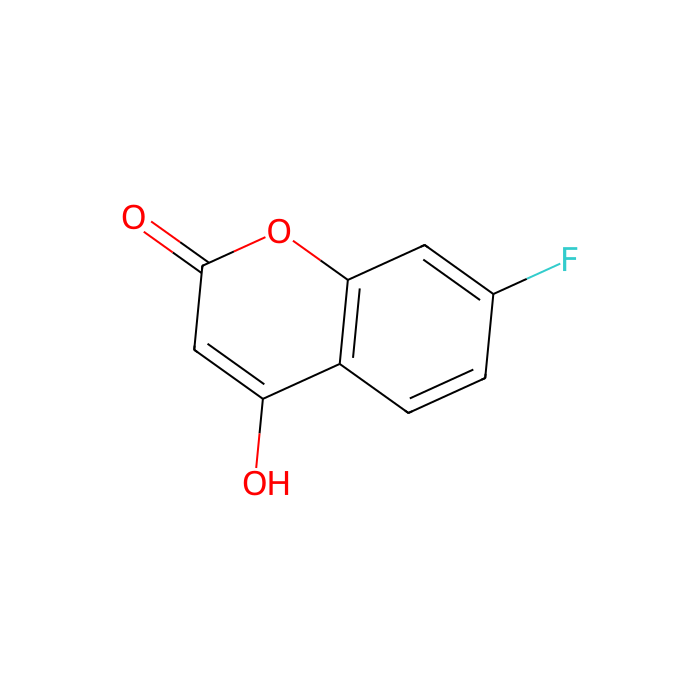
Common systematic name (literature): 7-Fluoro-4-hydroxy-2H-1-benzopyran-2-one (7-fluoro-4-hydroxychromen-2-one)
Molecular formula (literature): C9H5FO3
Relative molecular mass (literature): ~180.13 g/mol
Structural features (general chemistry description)
Functional groups: Phenolic OH at C-4 conjugated to the lactone carbonyl (keto–enol tautomerism), and an aryl–F substituent at the 7-position on the benzene ring.
Electronic characteristics: The 4-hydroxy group engages in strong intramolecular H-bonding and resonance with the 2-one, enabling acidity at C-3 (active methine) and facilitating C–C bond formation at that position. The 7-fluoro substituent is weakly deactivating and can fine-tune ring electronics and photophysics.
2D description (in words): A bicyclic aromatic lactone where a six-membered benzene ring bearing F at position 7 is fused to a heterocyclic α-pyrone ring; the α-pyrone carries a phenolic OH at C-4 opposite the lactone carbonyl.
The 7-fluoro-4-hydroxycoumarin framework merges a tunable aryl–F substituent with a 1,3-dicarbonyl-like enolizable system.
Reactive elements and strategies (literature)
C-3 as nucleophilic site: Under base, the C-3 position (adjacent to the lactone carbonyls) forms a resonance-stabilized carbanion. This enables:
Knoevenagel-type condensations with aldehydes to give 3-alkylidenes.
Michael additions to enones, furnishing 3-alkyl derivatives after tautomerization.
O-4 as nucleophile: Phenolate formation (K2CO3, NaH) allows O-alkylation (alkyl halides, sulfate esters) and O-acylation (acyl chlorides, anhydrides) to control electronics/solubility.
Ring functionalization: Electrophilic halogenation/nitration proceeds with regioselectivity influenced by the 7-F substituent. Directed ortho metalation is uncommon on coumarins but can be achieved on suitably protected derivatives.
Cross-coupling after prefunctionalization: Introduction of Br/I at selected positions (e.g., 6- or 8-) enables Suzuki/Heck/Sonogashira to access highly substituted coumarins; the 7-F typically remains inert under these conditions, serving as a spectator group.
Retrosynthetic value
Serves as a divergent node: from a single fluorinated core, access libraries via C-3 bond formation and O-4 derivatization, decoupling steric/electronic effects for SAR.
Practical notes
Control base strength to steer O- vs C-alkylation; polar aprotic media favor O-alkylation.
Monitor reactions by LC–MS; parent ion ~m/z 181 [M+H]+ (literature, for guidance only).
Protect from light during synthesis to minimize side reactions.
Target Specificity
This product is a small-molecule chemical and not a biological affinity reagent. No target, antigen, clone, or species reactivity information applies.
Item-specific data: Not applicable.
For assays involving binding or inhibition studies, users should determine specificity empirically for their system.
Utilizziamo i cookie per garantire il corretto funzionamento del sito web e, ove consentito, per migliorare la tua esperienza. Puoi gestire le tue preferenze in qualsiasi momento nelle Impostazioni. Per saperne di più, consulta la nostra Cookie Policy.
Desidera che le inviamo un messaggio quando avremo sconti disponibili?
Ricordamelo più tardi
Grazie! Controlli la sua casella di posta per confermare.
Products are supplied to verified businesses, institutions, and qualified professionals for research and development use only. Not for use in humans, animals, diagnosis, or therapy.

 H2330331