7-Hydroxycoumarin glucuronide sodium salt | 7-Hydroxy coumarin glucuronide (sodium salt) | A-D-Glucuronide Sodium Salt | MFCD00674902 | 7-Hydroxy Coumarin beta-D-Glucuronide Sodium Salt | 7-Hydroxycoumarin glucuronide sodium salt is known as a 7-hydroxy c
≥98% for sensitive chromatographic and analytical workflows requiring minimal baseline interference.
🌡
Storage & shipping
Store at 2-8°C,Argon charged Ships Wet ice Check lot-specific COA for exact specifications.
📋
Quality documents
SDS, COA, datasheet, and spec sheet available for download. Lot-specific COA accessible via lot number lookup.
📚
Literature proof
Cited in 0 peer-reviewed publications across chromatography, organic synthesis, and cross-coupling reactions.
Panoramica
7-Hydroxycoumarin glucuronide sodium salt is a labelled metabolite of Coumarin and 7-hydroxycoumarin phase II. 7-Hydroxycoumarin glucuronide sodium salt can be used as a standard for the analysis of 7-hydroxy coumarin metabolism. 7-Hydroxycoumarin glucuronide sodium salt was one of the eventually formed metabolites following a 1 hour incubation experiment with individual probe substrates, such as Chlorzoxazone and 7-hydroxycoumarin. The measured concentration of formed 7-Hydroxycoumarin glucuronide sodium salt can be indicative of the presence of UGT enzyme after exposure of HepaRG to the original probe substrate. 7-Hydroxycoumarin glucuronide sodium salt was undetectable in an LC-MS/MS analysis test in AR-CALUX.
Application:
7-Hydroxycoumarin glucuronide sodium salt can be used as a standard for the analysis of 7-hydroxycoumarin metabolites;Phase II (UDP-GT) metabolite of 7-hydroxycoumarin;Useful as a pharmacokinetic standard in metabolic studies.
Specifications
Sinonimi
7-Hydroxycoumarin glucuronide sodium salt | 7-Hydroxy coumarin glucuronide (sodium salt) | A-D-Glucuronide Sodium Salt | MFCD00674902 | 7-Hydroxy Coumarin beta-D-Glucuronide Sodium Salt | 7-Hydroxycoumarin glucuronide sodium salt is known as a 7-hydroxy c
Specifiche e purezza
≥98%
Condizioni di conservazione di stoccaggio
Store at 2-8°C,Argon charged
Spedito in
Wet ice
Questo prodotto richiede spedizione a catena fredda. I servizi di terra e altri servizi economici non sono disponibili.
This compound belongs to the class of organic compounds known as coumarin glycosides. These are aromatic compounds containing a carbohydrate moiety glycosidically bound to a coumarin moiety.
External Descriptors
Not available
1. Djoumbou Feunang Y, Eisner R, Knox C, Chepelev L, Hastings J, Owen G, Fahy E, Steinbeck C, Subramanian S, Bolton E, Greiner R, and Wishart DS. ClassyFire: Automated Chemical Classification With A Comprehensive, Computable Taxonomy. Journal of Cheminformatics, 2016, 8:61.
Determine the necessary mass, volume, or concentration for preparing a solution.
Dilution Calculator
Determine the dilution needed to prepare a stock solution.
Reconstitution Calculator
Recensioni
Recensioni dei clienti
Application Protocols
Examples below are provided as literature-style guidance and should be optimized per laboratory setup. They are not validated specifications for this item.
A) β-Glucuronidase activity assay (fluorescence):
Reagents: 50 mM sodium acetate buffer pH 5.5; enzyme (β-glucuronidase, e.g., from E. coli); 7-hydroxycoumarin glucuronide sodium salt.
Setup (96-well): Add 90 µL buffer + 10 µL substrate (final 10 µM). Equilibrate at 37 °C. Initiate with enzyme to desired U/mL.
Read: Kinetic mode, Ex 360 nm/Em 455 nm, 30–60 min. Include no-enzyme and no-substrate controls; calibrate with known umbelliferone standards.
B) LC–MS calibration curve (metabolite standard):
Stock: Prepare ~1 mM in water (verify solubility); serially dilute in 0.1% formic acid in water.
Notes: Use matrix-matched standards for quantitative bioanalysis; include at least 6 levels spanning expected concentrations.
C) Solution stability check:
Conditions: Incubate aliquots at pH 6.0, 7.4, and 8.0 at 25 and 37 °C.
Sampling: 0, 1, 2, 4, 8, 24 h; analyze by HPLC with fluorescence or MS to monitor aglycone release.
Adjust concentrations, pathlengths, and gain to avoid inner-filter effects and detector saturation.
Biological Roles
Literature context (not product specifications or claims):
Phase II metabolism: 7-Hydroxycoumarin is a prototypical UGT substrate. Conjugation with D-glucuronic acid via UDP-glucuronic acid yields the O-glucuronide, markedly enhancing water solubility and facilitating renal/biliary excretion.
Transport and disposition: The anionic glucuronide can interact with organic anion transporters (OATs/MRPs) in biological systems (reported for many glucuronides; specific transporter profiles vary by substrate).
Enzymatic cleavage:β-Glucuronidase present in microbes and mammalian tissues can hydrolyze O-glucuronides, regenerating the aglycone (umbelliferone) and D-glucuronic acid; this underpins assay use.
Fluorescence reporting: The aglycone umbelliferone exhibits strong blue fluorescence, making the glucuronide a pro-fluorophore that becomes highly emissive upon enzymatic cleavage.
Model metabolite: Serves as a reference metabolite in studies of xenobiotic glucuronidation, enterohepatic cycling, and deconjugation processes.
Note: These roles describe typical biochemical behavior of umbelliferone and its glucuronide in research contexts. No medical or clinical claims are made; for research use only.
Buffer Applications
This product is not used as a buffering agent. It is an analyte/substrate employed within buffers.
Practical notes (literature/practice):
Choose neutral buffers (e.g., 50 mM phosphate, pH 6.8–7.4; 50 mM HEPES, pH 7.2–7.6) for preparing stocks and running assays to limit non-enzymatic hydrolysis.
For β-glucuronidase assays, mildly acidic buffers (e.g., acetate pH 4.5–6.0) are sometimes used to match enzyme optima; include appropriate blanks/controls to account for any background cleavage.
Green Alternatives
As a water-soluble analyte and enzymology standard, this compound already supports aqueous, solvent-minimizing workflows.
Greener practice suggestions (literature/practice):
Aqueous-only preparations: Prepare and use water/buffer stocks instead of DMSO-based stocks to avoid aprotic solvent waste and potential enzyme inhibition.
Benign buffers: Favor phosphate, HEPES, or acetate at moderate ionic strength; avoid excessive organic modifiers in fluorescence assays.
Room-temperature reactions: Many enzymatic and hydrolysis assays proceed at ambient to 37 °C, reducing heating needs.
Miniaturization: Use microplate formats (96/384-well) to cut reagent consumption and waste.
Waste segregation: Collect minimal volumes of aqueous waste; avoid adding halogenated solvents unless required for extraction.
Comparison to alternatives (literature):
7-Hydroxycoumarin glucuronide vs 4-methylumbelliferyl-β-D-glucuronide (4-MUG):
4-MUG is a widely used fluorogenic substrate with very high sensitivity; however, it often requires DMSO stocks due to lower aqueous solubility compared with sodium glucuronides.
The sodium salt of 7-hydroxycoumarin glucuronide offers excellent water solubility, enabling fully aqueous handling and improved green metrics.
Trade-offs:
The released fluorophore’s quantum yield and excitation profile may differ from 4-MU; select the substrate that best matches available optics while maintaining an aqueous, low-solvent protocol.
Pharmaceutical Uses
No therapeutic or clinical uses are claimed. Research use only.
Relevant roles in pharmaceutical R&D and manufacturing (literature/practice):
Reference standard for analytical methods in drug metabolism and bioanalysis (e.g., LC–MS quantitation of glucuronide metabolites).
System suitability and recovery controls for sample deconjugation workflows using β-glucuronidase.
In vitro UGT screening: Benchmark substrate/metabolite pair for qualifying UDP-glucuronosyltransferase activity in microsomes, S9, or recombinant systems.
Stability studies: Model compound for evaluating hydrolysis kinetics in formulation-relevant pH ranges.
Regulatory notes:
Pharmacopeial monographs for this specific glucuronide are not commonly available; users should establish internal reference material characterization (purity assignment, identity confirmation, and storage conditions) as per lab SOPs.
Physical Properties
Item-specific physicochemical specifications (mp, bp, UV cut-off, metals, water, etc.): Not specified for this item; refer to CoA/Spec Sheet.
Literature/general properties for guidance only (not product specifications):
Physical state/appearance: Typically an off-white to pale solid; may be hygroscopic (literature, common for sodium glucuronides).
Molecular weight: ~360.25 g/mol (literature, see Structure & Identity).
Acid/base character: Carboxylate sodium salt; behaves as a strong electrolyte in water. The phenolic aglycone is masked by glycosidic linkage.
Solubility:High in water and aqueous buffers; sparing to low in most anhydrous organic solvents (literature trend for ionic glucuronides).
Partitioning: Expected low logP/negative logD in neutral water due to ionic carboxylate (literature expectation).
UV/fluorescence behavior: The conjugate itself shows weak fluorescence; enzymatic or chemical hydrolysis releases 7-hydroxycoumarin (umbelliferone), which is strongly fluorescent (Ex ~325–365 nm, Em ~450–460 nm; literature values).
Thermal stability: Organic glucuronides can decompose or hydrolyze upon prolonged heating; gentle drying and refrigerated storage are recommended (literature guidance).
Note: Exact numerical values (mp, solubility limits, extinction coefficients, refractive index, water content) are not specified for this item; consult the CoA/SDS for definitive data.
Quality and Grades
Grade/Purity: Not specified for this item; refer to CoA/Spec Sheet.
Interpretation and implications (general guidance):
For enzyme assays or bioanalytical applications, users typically require high chemical purity and low inorganic residue to minimize background fluorescence and matrix effects. Verify by HPLC/UPLC purity and NMR where applicable.
If using as a reference standard (e.g., in metabolism studies or LC–MS method development), confirm identity via HRMS and document traceability (e.g., to a certified lot with assigned purity).
Absence of a stated stabilizer suggests the neat solid; however, some glucuronides benefit from inert-atmosphere packaging to limit hydrolysis/oxidation—consistent with this item being argon charged.
If low-UV or LC–MS suitability is critical, check the CoA for any UV-absorbing impurities and confirm residual solvent levels.
Recommended user QC (best practice):
Record appearance on receipt; verify lot-specific purity by HPLC and identity by MS/NMR as needed for regulated workflows.
Assess solution stability in intended buffer by short-term stress (pH/temperature) and monitor for aglycone formation (umbelliferone) via fluorescence or LC–MS.
Reaction and Applications
This material is primarily used as a biochemical probe/standard rather than as a synthetic reagent.
β-Glucuronidase substrate/standard: Upon enzymatic hydrolysis of the O-glucuronide, 7-hydroxycoumarin (umbelliferone) is released, producing strong blue fluorescence (Ex ~325–365 nm, Em ~450–460 nm). Useful for monitoring β-glucuronidase activity, optimizing enzyme conditions, or validating sample deconjugation steps.
UGT metabolism studies: Serves as an authentic phase II metabolite of umbelliferone; applied as a calibration standard in LC–MS workflows assessing UDP-glucuronosyltransferase (UGT) activity and glucuronidation kinetics.
Method development: Reference material for solid-phase extraction (SPE) recovery optimization and matrix deconjugation validation in biological fluids.
Practical notes:
For kinetic assays, avoid buffers below pH ~5.5 to minimize non-enzymatic hydrolysis. Maintain ionic strength typical of enzyme buffers (50–150 mM).
Fluorescence readouts require appropriate bandpass settings and inner-filter minimization; include blanks without enzyme to correct for background.
For LC–MS quantitation, consider stable-isotope internal standards if available; otherwise, use matrix-matched calibration.
Related reactions (literature):
Acid/base-catalyzed hydrolysis of O-glucuronides.
Enzymatic cleavage by bacterial or mammalian β-glucuronidase to yield umbelliferone and D-glucuronic acid.
Reaction Conditions
Guidance below summarizes typical literature conditions for common uses; these are not product specifications.
Enzymatic hydrolysis by β-glucuronidase (to release umbelliferone):
Buffer: 50 mM acetate or phosphate, pH 5.0–6.5 (optimum depends on enzyme source)
Temperature: 30–37 °C
Substrate concentration: 1–200 µM (optimize to stay below Km and within linear fluorescence range)
Enzyme loading: e.g., 10–1000 U/L depending on source/activity
Time: 10–120 min with time-course sampling
Readout: Fluorescence Ex 325–365 nm, Em 450–460 nm; include blanks without enzyme
UGT-mediated formation (from umbelliferone):
System: Liver microsomes/S9 or recombinant UGTs
Cofactors: 2–5 mM UDPGA; 5 mM MgCl2; optional alamethicin activation
Analysis: LC–MS/MS with negative ESI for the glucuronide anion
Non-enzymatic stability checks:
pH range: 5–8 for minimal degradation; avoid <pH 4 and >pH 9 for extended periods
Storage solutions: Keep chilled and protected from light; analyze promptly to limit hydrolysis.
Safety and Handling
Authoritative safety information must be taken from the product SDS.
Item-specific hazard classification (GHS, signal word, H/P statements, pictograms): Not specified for this item; refer to SDS.
General handling guidance for glucuronide sodium salts (literature/practice):
Expected hazards: Low acute toxicity but may cause skin/eye/respiratory irritation as a fine organic powder. Avoid inhalation and contact.
PPE: Lab coat, safety glasses, and nitrile gloves. Work in a fume hood or well-ventilated area when handling powders.
Storage incompatibilities: Avoid strong oxidizers. Strong acids can liberate the free glucuronic acid form and promote hydrolysis; strong bases can cleave glycosidic or lactone bonds upon heating or prolonged exposure.
Special risks: Glycosidic linkages are susceptible to acid-catalyzed hydrolysis; moisture and CO2 uptake may occur due to ionic nature. Product is supplied argon charged and should be kept tightly closed to minimize oxidative or hydrolytic degradation.
First aid overview: In case of contact, rinse affected area with water for ≥15 min; remove contaminated clothing. If inhaled, move to fresh air. If ingested, rinse mouth with water. Seek medical attention if symptoms persist. Defer to SDS for detailed measures.
Spill response: Avoid dust generation; collect by gentle sweeping or HEPA vacuum, then wipe with damp disposable towels. Dispose according to local regulations for laboratory chemical waste.
Solvent Selection
This compound is an ionic organic salt (sodium carboxylate) and is best handled in aqueous media.
Primary solvent: Water and aqueous buffers (e.g., phosphate, acetate, HEPES). Rapid dissolution is expected.
pH considerations: Glycosidic bonds are susceptible to acid-catalyzed hydrolysis; maintain pH ~6–8 for storage/handling unless intentional hydrolysis is desired. Very basic conditions can also promote degradation over time.
Co-solvents: If organic content is needed (e.g., for chromatography make-up), use small percentages of MeOH or ACN. DMSO stocks are generally unnecessary and may complicate enzymology; prefer water.
Miscibility profile (literature):
Water: miscible, high solubility
Alcohols (MeOH, EtOH): moderate to good (reduced versus water)
Aprotic solvents (ACN, DMF, DMSO): variable; ionic nature limits solubility without water
Versus the aglycone (umbelliferone): the glucuronide is far more water soluble and far less fluorescent; the aglycone favors organic solvents but is less suitable for aqueous enzymatic systems.
Practical tips:
Prepare fresh aqueous stocks for assays; filter (0.22 µm) if needed.
Avoid strong acids in solution unless hydrolysis is intended; use neutral buffers for storage.
Storage and Reconstitution
Item-specific instructions:
Storage Conditions (provided): Store at 2–8 °C, argon charged.
Shipped In (provided):Wet ice.
Appearance: Not specified for this item; refer to CoA/Spec Sheet.
General guidance (supplemental; not a specification):
Container: Keep tightly sealed under inert gas to limit moisture/CO2 uptake and hydrolysis.
Light protection: Store in amber vials or protect from light to minimize photodegradation of the coumarin core.
Reconstitution: Prefer ultrapure water or neutral buffer (e.g., 10–50 mM phosphate, pH 7.0). Start at 1–10 mM stock, adjusting to solubility and assay needs.
Filtration: If required, sterile-filter through 0.22 µm PTFE/PES.
Aliquoting: Prepare single-use aliquots; avoid repeated freeze–thaw of solutions. For longer storage of solutions, freeze at −20 to −80 °C and verify stability empirically (monitor for umbelliferone formation).
Shelf life: Not specified for this item; refer to CoA/Spec Sheet.
Research Use Note: For research use only. Consult the CoA and SDS for lot-specific stability and safety information before use.
Structure and Identity
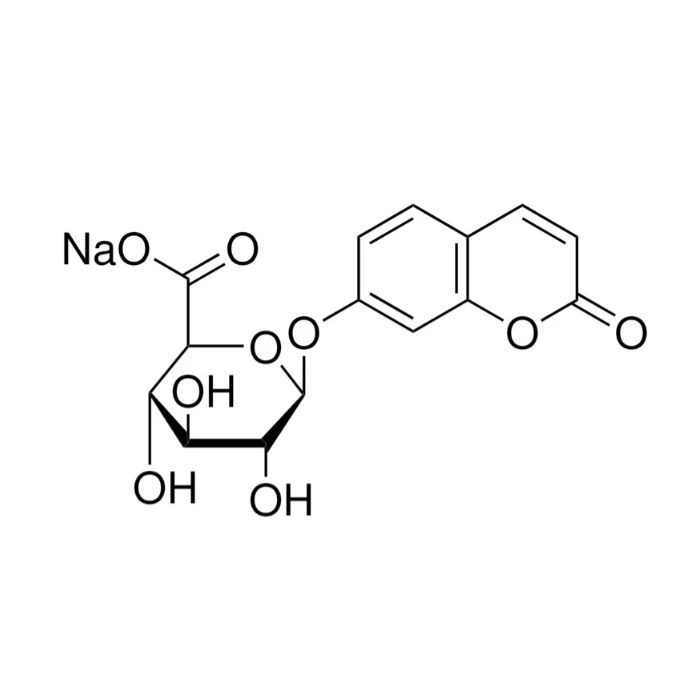
A glucuronide conjugate of the fluorescent coumarin aglycone umbelliferone (7-hydroxycoumarin), supplied as the sodium salt of the glucuronic acid carboxylate.
Product Name (SKU): 7-Hydroxycoumarin glucuronide sodium salt (H338882)
CAS: 168286-98-4
PubChem CID: 23675380
InChIKey (as provided): 338215
SMILES: Not specified for this item; refer to CoA/Spec Sheet.
Molecular formula: C15H13O9Na (literature, typical for the sodium salt of umbelliferone β-D-glucuronide)
Molecular weight: ~360.25 g/mol (literature, derived from formula above)
Structural features (general description):
Core scaffold: Coumarin (1-benzopyran-2-one) ring system bearing a 7-hydroxy substituent.
Conjugation: The phenolic oxygen at C-7 is O-glycosidically linked to β-D-glucuronic acid; the carboxylate of glucuronic acid is present as the sodium salt.
Functional groups: Lactone (coumarin), aryl ether (O-glycosidic bond), secondary alcohols on sugar, and a carboxylate (as Na+ salt).
Stereochemistry: The glucuronic acid moiety is typically β-D configuration at the anomeric center (literature).
2D structure in words (literature): A benzopyran-2-one ring with a para-oriented phenolic oxygen (position 7) forming an O-glycosidic bond to the anomeric carbon of a D-glucuronic acid ring; the sugar bears multiple axial/equatorial hydroxyls and a carboxylate (sodium) at C-6.
Synthetic Utility
While primarily a biochemical standard, limited synthetic or preparative utilities exist (literature/practice):
Pro-fluorophore precursor: Controlled hydrolysis (enzymatic or chemical) yields 7-hydroxycoumarin (umbelliferone) in aqueous media, useful for calibration of fluorescence detection systems.
Glycoconjugate model: Serves as a model O-glycoside for studying protecting-group-free manipulations, hydrolysis kinetics, and stability trends of aryl O-glucuronides.
Analytical derivatization: The glucuronide can be used to benchmark derivatization or enzymatic deconjugation steps preceding GC/LC analyses of phenolic metabolites.
Considerations:
The lactone ring of the coumarin can undergo base-catalyzed opening under strong alkaline conditions; preserve integrity by neutral pH handling.
Use aqueous-compatible purification (e.g., reversed-phase SPE/HPLC) if processing solutions; avoid strong acids that promote unwanted hydrolysis.
Target Specificity
This product is a small-molecule metabolite standard, not a biological binding reagent or antibody. No antigen/epitope, species reactivity, clone, or isotype are applicable.
Domande frequenti
What is the purity of this product?
This product is supplied at ≥98% purity (chemical assay). Lot-specific values are stated on the Certificate of Analysis.
How should this product be stored?
Store at 2–8 °C under argon. It is supplied under an argon blanket; reseal under inert gas after each use.
How is this product shipped?
This product ships chilled on wet ice. Unpack on arrival and transfer it to the storage condition stated above.
What are the CAS number, molecular formula and molecular weight?
The CAS Number is 168286-98-4, the molecular formula is C15H13NaO9, and the molecular weight is 360.25 g/mol. InChIKey SKHLGBDGEPDEME-KSOKONAESA-M.
What documentation is provided?
Available product documentation, including Certificates of Analysis (COA), Safety Data Sheets (SDS), and specification sheets, is shown in the product document area. Document availability and access follow the current site policy.
We use cookies to ensure the website functions properly and, where permitted, to improve your experience. You can manage your preferences at any time in Settings. Learn more in our Cookie Policy.
Shall we send you a message when we have discounts available?
Remind me later
Thank you! Please check your email inbox to confirm.
Products are supplied to verified businesses, institutions, and qualified professionals for research and development use only. Not for use in humans, animals, diagnosis, or therapy.

 A2623070