MW 40000 Da for sensitive chromatographic and analytical workflows requiring minimal baseline interference.
🌡
Storage & shipping
Protected from light,Store at -20°C,Argon charged Ships Ice chest + Ice pads Check lot-specific COA for exact specifications.
📋
Quality documents
SDS, COA, datasheet, and spec sheet available for download. Lot-specific COA accessible via lot number lookup.
📚
Literature proof
Cited in 0 peer-reviewed publications across chromatography, organic synthesis, and cross-coupling reactions.
Panoramica
8 arm PEG derivatives have multiple reactive groups that can be used to modify proteins, peptides and other materials via their functional groups. PEGylation can increase solubility and stability and reduce immunogenicity of peptides and proteins. It can also suppress the non-specific binding of charged molecules to the modified surfaces. .
Specifications
Specifiche e purezza
MW 40000 Da
Condizioni di conservazione di stoccaggio
Protected from light,Store at -20°C,Argon charged
Spedito in
Ice chest + Ice pads
Questo prodotto richiede spedizione a catena fredda. I servizi di terra e altri servizi economici non sono disponibili.
Documentazione
📋 Safety Data Sheet (SDS)
Comprehensive hazard, handling, storage, and regulatory compliance document.
Determine the necessary mass, volume, or concentration for preparing a solution.
Dilution Calculator
Determine the dilution needed to prepare a stock solution.
Reconstitution Calculator
Recensioni
Recensioni dei clienti
Application Protocols
No item-specific, validated protocols are provided in the Product Data. The following is a general, literature-based outline for amine coupling with 8‑Arm PEG NHS (for research use only):
Stock preparation: In a dry glovebox or under argon, dissolve 8‑Arm PEG NHS in anhydrous DMSO or DMF to 50–100 mg/mL. Aliquot and keep cold.
Partner solution: Prepare the amine-containing substrate in buffer (50–100 mM carbonate, pH 8.3, or PBS/HEPES pH 7.4–8.0). Avoid Tris/glycine.
Coupling: Add PEG‑NHS stock last to the stirred partner solution to a final organic content ≤20% v/v. Aim for 1.1–1.5 eq NHS per amine (adjust by CoA MW and functionality). React 10–60 min at RT.
Quench: Add ethanolamine (10–50 mM) or Tris to consume unreacted NHS groups. Incubate 10–15 min.
Purify: Remove small-molecule byproducts by dialysis/UF or size-exclusion as appropriate. Verify coupling by TNBS assay for residual amines, SEC, or spectroscopy.
Users must optimize concentrations, times, and stoichiometry for their specific systems. Always consult the SDS and CoA before use.
Biological Roles
Item-specific biological roles: Not applicable (research reagent).
General notes (literature) about PEG-based materials:
Poly(ethylene glycol) is regarded as biologically inert, hydrophilic, and protein-resistant; star-shaped PEGs are widely used to reduce nonspecific interactions and to impart “stealth” hydration shells on surfaces and macromolecules.
8‑Arm PEG NHS serves as a crosslinker to covalently attach to primary amines on biomolecules (e.g., lysine residues) and amine-functionalized polymers, enabling formation of hydrogels and conjugates for in vitro biochemical studies.
Network architecture: the 8‑arm topology can yield higher crosslinking density than linear or 4‑arm PEGs at the same functionality per mass, allowing finer tuning of mesh size and diffusivity—parameters pertinent to enzymology assays and controlled diffusion studies in model systems.
Degradation: the amide linkages formed are generally hydrolytically stable under physiological pH, while the PEG backbone is non-degradable under most biological conditions unless specific cleavable linkers are engineered between PEG and payload.
No clinical or therapeutic claims are made. Use is limited to research and laboratory experiments, as indicated by the Product Data (Research Use Only).
Buffer Applications
This product is a reactive crosslinker rather than a buffer component per se; however, buffer choice critically affects its performance in amine coupling.
General buffer guidelines for PEG‑NHS (literature):
Effective pH range: 7.2–8.5. Higher pH accelerates amine nucleophilicity but also increases NHS hydrolysis.
Recommended buffers: carbonate/bicarbonate (50–100 mM, pH 8.3), phosphate-buffered saline (PBS, pH 7.2–7.8), HEPES (50 mM, pH 7.4–8.0). Maintain ionic strength (0.1–0.3 M NaCl) for protein solubility if applicable.
Avoid: amine-containing buffers (Tris, glycine), primary amine additives (e.g., ethanolamine), and high concentrations of competing nucleophiles.
Implementation tips:
Pre-dissolve 8‑Arm PEG NHS in dry DMSO/DMF; add to the buffered amine solution with vigorous mixing.
Work at room temperature; keep reaction times short (10–60 min) for delicate biomolecules; quench residual NHS with ethanolamine or Tris after desired coupling.
For hydrogel casting, adjust solids content (e.g., 2–15 wt% total macromers) to tune gelation time and modulus; rapidly transfer to molds as gelation may begin within minutes in carbonate buffer.
All buffer recipes and conditions should be optimized empirically for the specific substrate and desired crosslink density.
Green Alternatives
Perspective on greener practice (general literature; not item-specific):
Strategy 1: Greener solvents and workflows
Favor water-rich media with minimal anhydrous aprotic solvents by using rapid addition and mixing at pH 7.5–8.3, keeping DMSO/DMF ≤10–20% v/v.
Employ on-demand preparation of small aliquots to reduce waste from hydrolyzed material.
Strategy 2: Alternative coupling chemistries
8‑Arm PEG‑Maleimide: enables thiol-specific conjugation in aqueous buffers at pH ~6.5–7.5, avoiding excess base; selective for cysteines but requires thiol partners and is oxygen-sensitive (thiol oxidation).
8‑Arm PEG‑Azide/Alkyne: copper-catalyzed or copper-free click reactions proceed efficiently in water or mixed media; can be orthogonal and reduce side reactions with biomolecules. Tradeoff: requires additional functionalization and, for CuAAC, copper handling.
In situ EDC/NHS activation of carboxylate-terminated PEGs: allows aqueous activation but still generates NHS byproducts and requires pH control; shorter shelf life of activated intermediates.
DMTMM-mediated amide formation: water-tolerant carbodiimide alternative, avoiding NHS; can proceed in saline buffers, but leaves different byproducts and may require purification.
Maleimide: selective for thiols; less hydrolysis at neutral pH; substrate-limited.
Click handles (azide/DBCO): bioorthogonal, often aqueous; requires prefunctionalization and, sometimes, metal catalysts.
Select the route that minimizes hazardous solvents and maximizes selectivity for your substrate.
Pharmaceutical Uses
Item-specific pharmacopeial status and use: Not specified for this item; refer to CoA/Spec Sheet.
General formulation and manufacturing context (no therapeutic claims):
PEG-based crosslinkers like 8‑Arm PEG NHS are used in the research and development of hydrogel matrices, depot systems, and device coatings as process aids or excipient-like materials, enabling covalent network formation with amine-bearing polymers and surfaces.
Surface passivation: star‑PEG coatings reduce protein adsorption and cell adhesion on device prototypes, aiding analytical reproducibility during preclinical method development.
Conjugation scaffolds: serve as multi-functional carriers for analytical standards or process development tools to study conjugation stoichiometry and release profiles.
Considerations for translational workflows: residual solvents (DMF/DMSO), extractables/leachables, endotoxin/bioburden, and trace metal content are critical parameters—control strategies must be implemented early if moving toward regulated applications.
No pharmacopeial monograph is implied. This product is designated for research use only and is not intended for human or animal use in drug products.
Physical Properties
Item-specific values from Product Data:
Appearance: Not specified for this item; refer to CoA/Spec Sheet.
Molecular Weight: Not specified for this item; refer to CoA/Spec Sheet.
General properties for 8-arm PEG-NHS reagents (literature/typical, not item-specific):
Physical state: typically a white to off-white solid (powder or brittle foam), amorphous.
Solubility: highly soluble in polar aprotic solvents (anhydrous DMSO, DMF, NMP); soluble to miscible in water and aqueous buffers prior to significant hydrolysis; limited solubility in alcohols increases hydrolysis risk; insoluble in nonpolar hydrocarbons.
Hygroscopicity/Moisture sensitivity: PEG is hygroscopic; NHS esters hydrolyze in the presence of water. Solutions and solids must be kept dry to preserve activity.
Hydrolytic stability (qualitative): NHS esters hydrolyze faster at higher pH and temperature; half-lives range from minutes (pH ≥8.5 in water) to hours (pH 7–8) depending on arm length/linker and solvent. Hydrolysis yields the corresponding carboxylate/alcohol and NHS, reducing coupling efficiency.
pKa/logP: not meaningful for a polydisperse, multifunctional PEG; behavior is that of a neutral, highly hydrophilic macromolecule bearing electrophilic termini.
Viscosity: solutions can become viscous at higher concentrations due to polymer chain entanglement; warming slightly (≤30 °C) can aid dissolution in dry aprotic solvents.
Always verify lot-specific Mn (per arm and total), degree of functionalization (f ≈ 8), and residual solvent/content by CoA.
Quality and Grades
Item-specific grade/purity from Product Data:
Grade/Purity: Not specified for this item; refer to CoA/Spec Sheet.
How to interpret quality for multifunctional PEG NHS reagents (general guidance):
Key quality markers: average molecular weight (Mn) and dispersity (Đ), degree of functionalization (target f = 8; often reported as ≥95–98% of arms active), residual solvents, inorganic salts, and low-mass impurities (free NHS, linker fragments).
Functional assay: many suppliers report an “NHS content” or active ester titer via amine consumption or hydroxylamine assays; higher values correlate with better coupling efficiency and reproducibility.
UV/Chromatography: HPLC/SEC profiles can show low-mass impurities and polymer distribution; MALDI-TOF may be provided to illustrate mass envelopes (interpret cautiously for PEGs).
Stabilization: some lots are packaged under inert gas with desiccant to suppress hydrolysis (as reflected in this item’s Product Data: Argon charged). No stabilizers are typically added to NHS-PEGs to avoid side reactions.
Documentation: request CoA for exact Mn (per arm and total), degree of NHS substitution, water content (KF), and residual solvents. Use the CoA to calculate stoichiometry in conjugations.
Suitability: choose tighter dispersity and higher functionalization for precise hydrogel mechanics, surface passivation, and quantitative bioconjugation workflows.
Reaction and Applications
Item-specific applications from Product Data: Not provided.
General reactions and uses for 8‑Arm PEG NHS (literature):
Primary amine coupling: NHS esters react with primary amines to form amide bonds, releasing NHS. This underpins protein (lysine) conjugation, small-molecule attachment, and polymer–polymer crosslinking.
Hydrogel formation: 8-arm architecture enables multi-point crosslinking of multi-amine macromers (e.g., gelatin, poly(lysine), chitosan derivatives) to yield 3D PEG networks with tunable modulus and mesh size.
Surface modification: covalent PEGylation of amine-functional surfaces (amines on silica, polymers, or self-assembled monolayers) to create antifouling coatings.
Carrier fabrication: synthesis of star-PEG scaffolds bearing diverse payloads after amide formation, useful as test platforms in drug delivery research and nanomaterials.
Practical notes:
pH window: 7.2–8.5 (carbonate, phosphate, HEPES) balances amine nucleophilicity and NHS stability. Avoid Tris and other amine buffers.
Stoichiometry: for crosslinking, equivalence of NHS groups to available amines governs gelation kinetics; a slight excess of NHS (1.1–1.5 eq per amine) compensates hydrolysis.
Kinetics: coupling is typically complete within minutes to hours at room temperature; elevated temperature accelerates both reaction and hydrolysis.
Additives: catalysts are generally unnecessary; tertiary amines are avoided to prevent competing reactions.
Workup: unreacted NHS hydrolysis byproducts are water-soluble and can be removed by dialysis for macromolecular products.
Reaction Conditions
The following are general, literature-based conditions for amine coupling with 8‑Arm PEG NHS; they are not item-specific specifications.
Typical conditions:
Solvent: dry DMSO or DMF stock (10–100 mg/mL); add to aqueous buffer (PBS, HEPES, or 50–100 mM carbonate) at pH 7.4–8.5. Keep organic co‑solvent ≤20% v/v for biomolecules.
Temperature: 20–25 °C (room temperature). Lower temperatures slow hydrolysis for sensitive substrates; mild warming (≤30 °C) can aid dissolution in organic media.
Stoichiometry: 1.1–1.5 equivalents of NHS groups per primary amine to offset hydrolysis; for hydrogel crosslinking, target stoichiometric balance of reactive groups to control gelation time and modulus.
Time: minutes to 2 h for small-molecule/biopolymer coupling; hydrogels often begin setting within 1–10 min at pH ~8.3.
Atmosphere: inert (argon or nitrogen) during stock preparation and handling to reduce moisture ingress.
Quench: after desired conversion, add ethanolamine (10–50 mM) or Tris buffer to consume residual NHS esters.
Analytical monitoring:
TNBS or fluorescamine assays to quantify residual primary amines.
SEC/GPC or rheology to confirm network formation; MALDI or LC-MS for model conjugates (where applicable).
Purification:
Dialysis (MWCO chosen to retain conjugate), ultrafiltration, or precipitation into non-solvents (acetone/ether) for synthetic polymers. Remove NHS byproduct and low-mass species thoroughly.
Safety and Handling
Item-specific hazard classifications from Product Data:
Signal Word / H-Statements / GHS Classification / Pictograms: Not specified for this item; consult the SDS.
General safety considerations for NHS-activated PEGs (literature/best practice; defer to SDS):
Hazards: NHS esters are electrophilic and can cause skin/eye irritation; moisture sensitivity can generate heat upon dissolution in water. PEG backbones are generally of low acute toxicity, but dust may cause mechanical irritation.
PPE: lab coat, nitrile gloves (change regularly), safety glasses or splash goggles; handle powders in a fume hood to minimize dust inhalation and moisture exposure.
Handling: work under dry, inert atmosphere (argon or nitrogen). Avoid contact with water, alcohols, strong bases, and amines unless performing the intended coupling. Use anhydrous solvents, oven-dried glassware, and desiccators.
Incompatibilities: aqueous bases (accelerate hydrolysis), primary/secondary amines (consume NHS groups), strong nucleophiles, and prolonged exposure to light/heat.
First aid (overview): rinse eyes/skin with copious water upon contact; remove contaminated clothing; seek medical attention if irritation persists. If inhaled, move to fresh air.
Waste: quench residual reactive ester with dilute aqueous ethanolamine or Tris buffer before disposal; collect according to institutional and local regulations.
Always consult the Aladdin SDS for definitive hazard, exposure limits, and emergency procedures.
Solvent Selection
This product is a multifunctional reagent, not a solvent. Solvent choice is critical for dissolving and reacting 8‑Arm PEG NHS.
General solvent guidance (literature):
Preferred anhydrous aprotic solvents: DMSO, DMF, NMP. These provide excellent solubility and slow hydrolysis compared with water. Purge headspace with inert gas and use molecular sieves when practical.
Aqueous media: permissible for bioconjugation/hydrogel formation; use buffered pH 7.2–8.5 and work quickly to minimize hydrolysis. Pre-dissolve in dry DMSO/DMF and add to the aqueous phase last.
Avoid: alcohols (accelerate transesterification/hydrolysis), strong bases, and amine-containing buffers (Tris, glycine) during activation/coupling, as they consume NHS groups.
Comparative notes:
DMSO vs DMF: DMSO offers higher water tolerance and biocompatibility; DMF can give lower viscosity at equal wt% for high-Mn PEGs. Both should be anhydrous.
Water-only workflows: offer greener profiles but require rapid mixing and excess amine to outcompete hydrolysis; temperature control is important.
Practical tips:
Prepare fresh stock solutions (10–100 mg/mL) in dry DMSO/DMF; use within a few hours.
For aqueous coupling, add PEG‑NHS last to the buffered amine solution while stirring; target final organic co-solvent ≤20% v/v to protect biomolecule integrity.
Storage and Reconstitution
Item-specific storage/shipping from Product Data:
Storage Conditions: Protected from light; Store at −20 °C; Argon charged.
Shipped In: Ice chest + Ice pads.
General best practices for this class of reagents (literature):
Protect from moisture at all times. Keep containers tightly closed with desiccant; minimize headspace or backfill with inert gas after each use.
Aliquoting: Upon first opening, promptly divide into single-use aliquots in dry vials under inert atmosphere to avoid repeated freeze–thaw and moisture ingress.
Reconstitution: Dissolve immediately before use in anhydrous DMSO or DMF. For aqueous applications, prepare a concentrated anhydrous stock and add to buffer just prior to reaction.
Working solutions: Use within the same day; NHS activity decays via hydrolysis, especially in water or humid air. Discard solutions showing reduced performance.
Thawing: Warm to room temperature in a desiccator before opening to prevent condensation. Reseal under argon/nitrogen promptly after dispensing.
Do not rely on long-term storage of partially used containers. For exact shelf life and re-test intervals, refer to the lot-specific CoA and follow institutional best practices.
Structure and Identity
Item-specific identifiers from Product Data:
CAS: Not specified for this item; refer to CoA/Spec Sheet.
Molecular Formula: Not specified for this item; refer to CoA/Spec Sheet.
Molecular Weight: Not specified for this item; refer to CoA/Spec Sheet.
SMILES / InChI / InChIKey: Not applicable for polydisperse PEG polymers; not specified for this item; refer to CoA/Spec Sheet.
General structural description (literature):
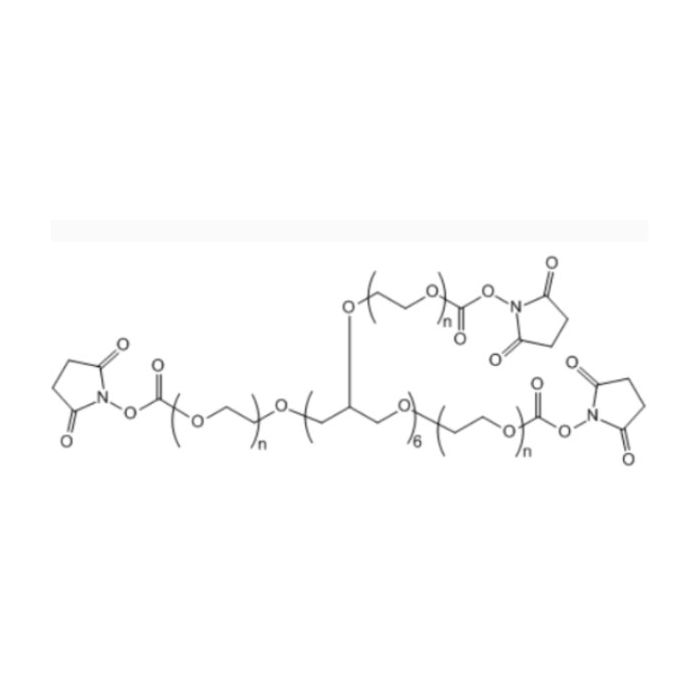
8-Arm PEG NHS is a star-shaped, multifunctional polyethylene glycol in which a central core (commonly a polyol such as pentaerythritol, dipentaerythritol, or a dendritic scaffold) is covalently linked to eight PEG chains.
Each PEG arm terminates in an N-hydroxysuccinimide (NHS) activated ester, typically a succinimidyl carbonate or succinimidyl ester connected via a short linker to the terminal PEG hydroxyl. The activated ester enables rapid coupling to primary amines to form stable amide linkages.
Functional groups (per arm): repeating ethylene oxide units [–CH2–CH2–O–]n (neutral, hydrophilic) and one terminal NHS-activated ester (electrophile). The core provides the 8-fold symmetry (no defined stereochemistry on the polymer repeat units).
2D verbal depiction: a central node branching to eight flexible PEG chains; each chain ends with a carbonyl-activated NHS succinimide ring (five-membered imide), rendering each terminus reactive toward nucleophilic amines under mildly basic conditions.
Notes:
Exact average molecular weight (Mn/Mw), arm length (n), and dispersity (Đ) are manufacturer- and lot-specific and should be taken from the CoA.
Synthetic Utility
General synthetic value (literature):
Multivalency: eight NHS termini enable high crosslink density in a single step, facilitating star–star, star–linear, or star–biomolecule network formation through amide linkages.
Orthogonal builds: post‑coupling, remaining arms can be strategically reacted to create asymmetric, heterofunctional constructs by stepwise protection/deprotection of amines on the partner substrate.
Scaffold for dendritic growth: iterative cycles of amine coupling allow installation of peptides, dyes, or ligands with controlled average valency for analytical or material science studies.
Surface chemistry: reacts with self-assembled monolayers bearing terminal amines (e.g., APTES-treated silica or amine-terminated SAMs) to yield robust PEG brushes and reduce fouling.
Retrosynthetic logic: 8‑Arm PEG NHS can be viewed as the activated derivative of 8‑Arm PEG‑OH. In situ conversion to the corresponding amide linkages bypasses carbodiimide coupling on the target substrate, simplifying workflows and avoiding urea byproducts on sensitive biomolecules.
Key cautions:
Competing hydrolysis and amine consumption necessitate controlled addition and stoichiometry. Excess base or nucleophiles degrade efficiency.
For precise architectures, verify degree of functionalization and use modest excesses with real‑time monitoring (e.g., TNBS assay for free amines on the partner).
Target Specificity
Not applicable. This product is a chemical crosslinker/polymer reagent, not a biological targeting reagent or antibody. No antigen/epitope/isotype information applies.
We use cookies to ensure the website functions properly and, where permitted, to improve your experience. You can manage your preferences at any time in Settings. Learn more in our Cookie Policy.
Shall we send you a message when we have discounts available?
Remind me later
Thank you! Please check your email inbox to confirm.
Products are supplied to verified businesses, institutions, and qualified professionals for research and development use only. Not for use in humans, animals, diagnosis, or therapy.

 G2504131