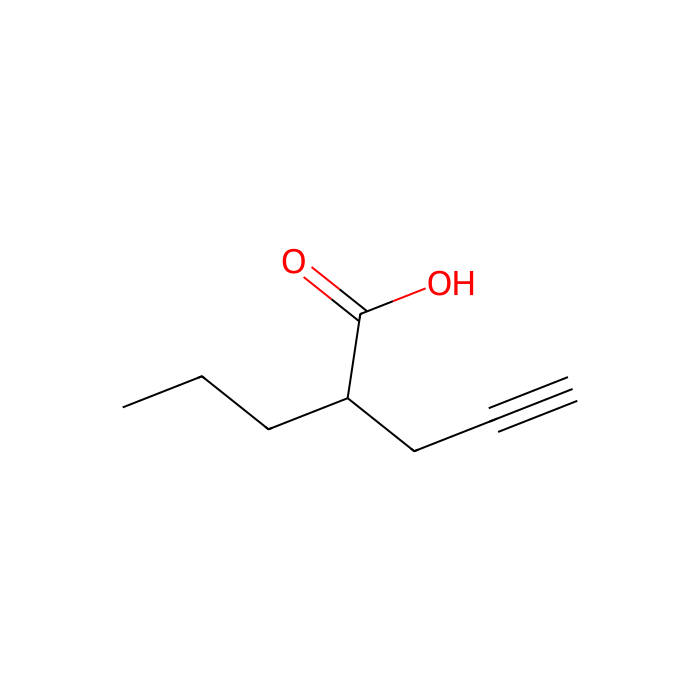
This compound belongs to the class of organic compounds known as methyl-branched fatty acids. These are fatty acids with an acyl chain that has a methyl branch. Usually, they are saturated and contain only one or more methyl group. However, branches other than methyl may be present.
External Descriptors
Not available
1. Djoumbou Feunang Y, Eisner R, Knox C, Chepelev L, Hastings J, Owen G, Fahy E, Steinbeck C, Subramanian S, Bolton E, Greiner R, and Wishart DS. ClassyFire: Automated Chemical Classification With A Comprehensive, Computable Taxonomy. Journal of Cheminformatics, 2016, 8:61.
Certificati (CoA, COO, BSE/TSE e tabella di analisi)
C of A & Other Certificates(BSE/TSE, COO):
Analytical Chart:
Proprietà chimiche e fisiche
Solubilità
Soluble in ethanol to 100 mM and in DMSO to 100 mM
Peso molecolare
140.180 g/mol
XLogP3
1.800
Hydrogen Bond Donor Count
1
Hydrogen Bond Acceptor Count
2
Rotatable Bond Count
4
Exact Mass
140.084 Da
Monoisotopic Mass
140.084 Da
Topological Polar Surface Area
37.300 Ų
Heavy Atom Count
10
Formal Charge
0
Complexity
152.000
Isotope Atom Count
0
Defined Atom Stereocenter Count
0
Undefined Atom Stereocenter Count
1
Defined Bond Stereocenter Count
0
Undefined Bond Stereocenter Count
0
The total count of all stereochemical bonds
0
Covalently-Bonded Unit Count
1
Calcolatori di soluzioni
Molarity Calculator
Determine the necessary mass, volume, or concentration for preparing a solution.
Dilution Calculator
Determine the dilution needed to prepare a stock solution.
Reconstitution Calculator
Recensioni
Recensioni dei clienti
Application Protocols
No tested application protocols are provided for ABS 205.
General handling protocol for small-molecule testing (for guidance only):
Stock preparation: Bring vial to room temperature in a desiccator. Open briefly to minimize moisture ingress. Prepare 10–50 mM stock in dry DMSO; vortex and sonicate gently if needed. Record exact concentration by weight and solvent density or by quantitative NMR if accuracy is critical.
Storage of stocks: Aliquot into low-bind, amber screw-cap vials; store at −20°C or −80°C to minimize freeze–thaw. Avoid repeated freeze–thaw; use single-use aliquots.
Working solutions: Dilute stock into assay buffer immediately before use, ensuring final DMSO ≤0.5–1.0% v/v unless your assay permits more. Inspect for precipitation.
Controls: Include vehicle controls (same DMSO%), positive and negative controls where applicable. Run at least triplicate technical replicates and duplicate biological replicates.
Data integrity: Confirm compound identity and purity prior to key experiments by LC–MS and 1H NMR.
These steps are offered as general best practices and are not product specifications.
Biological Roles
No biological pathway, target, or mechanistic data are provided for ABS 205 in the product information.
General considerations for library compounds in biological research (not specific to this item):
Potential roles: May serve as a chemical probe candidate to interrogate signaling pathways, enzyme activities, ion channels, or transporters—pending confirmation of identity, potency, and selectivity from independent studies.
ADME/physchem: Basic descriptors (cLogP, TPSA, HBD/HBA, MW) strongly influence permeability, solubility, and nonspecific binding. These cannot be computed here without the structure; obtain the structure to assess developability.
Assay interference: Some scaffolds act as PAINS or redox cyclers. Screen with orthogonal readouts and counter-screens (e.g., aggregators with detergent sensitivity; fluorescence quenchers/emitters with spectral controls).
Stability: Evaluate chemical and metabolic stability (microsomes/S9) if the compound advances in hit validation.
Note: All uses are for research only. No medical or clinical claims are made or implied for this product. Consult the latest literature associated with the CAS/CID once structural details are confirmed.
Buffer Applications
This product is a small-molecule library compound and is not itself a buffering agent.
Practical guidance for using small molecules in buffered assays (general):
Stock solutions: Prepare in DMSO (10–50 mM) or another suitable organic solvent. Immediately before the assay, dilute into the buffer (e.g., PBS, HEPES, Tris) to the desired final concentration, keeping the co-solvent ≤0.5–1.0% v/v unless your system tolerates more.
Order of addition: Add solvent last and pre-warm buffers to minimize localized supersaturation and precipitation.
Adsorption: Hydrophobic compounds can adsorb to plastics. Use low-bind tubes/plates or pre-block with 0.01–0.1% nonionic surfactant when compatible.
pH considerations: If the compound is ionizable, apparent solubility and activity may vary with pH. Without pKa data for this item, empirical testing across pH 6.5–8.0 is advisable.
Filtration: If sterility is needed, filter final working solutions through 0.22 μm PVDF/PTFE, provided the compound is not retained.
For exact buffer recipes and compatibility, rely on the requirements of your biological assay system.
Green Alternatives
Because structure and solvent preferences for ABS 205 are not provided, green chemistry guidance focuses on solvent and process choices rather than compound substitution.
General greener choices for handling small molecules:
Stock preparation: Prefer water or aqueous ethanol where chemically feasible. If not, DMSO is widely used but has environmental burdens; ethanol or isopropanol may be greener alternatives for moderately polar/lipophilic compounds.
Workup and purification: Replace dichloromethane with ethyl acetate or MTBE; replace THF with 2-MeTHF or CPME when moisture sensitivity allows.
Reaction media: Consider propylene carbonate, Cyrene, or PEG-200/400 for polar transformations; use acetate esters or alcohols for esterifications/extractions when performance is comparable.
Illustrative comparison (general; not item-specific):
2-MeTHF vs THF: Similar ether solvation; 2-MeTHF is biorenewable, forms fewer peroxides, and is easier to separate from water.
EtOAc vs DCM: EtOAc is less toxic, biodegradable, and has a higher permissible exposure limit.
CPME vs toluene: CPME offers broad utility and lower peroxide formation than many ethers.
Implementation tips:
Evaluate solubility and reaction rates in greener media with small-scale scouting experiments.
Track PMI/E-factor and solvent recyclability; distill and reuse where feasible.
Document any solvent substitutions in methods to ensure reproducibility across labs.
Pharmaceutical Uses
No pharmacopeial status, excipient role, or formulation designation is provided for ABS 205.
General R&D context (non-clinical; research use only):
Early formulation screening: If exploring preclinical enabling studies, assess kinetic solubility in biorelevant media (FaSSIF/FeSSIF simulants), pH 1–8 buffers, and common cosolvent systems (DMSO → PEG400 → EtOH/propylene glycol/water).
Solid-state characterization: Determine polymorph/amorphous state by PXRD/DSC/TGA, especially if scaling synthesis or performing stability studies.
Compatibility: Evaluate adsorption to container closures and interaction with common excipients (HPMC, PVP, captisol) to inform prototype formulations.
Regulatory: This product is supplied strictly for research use. It is not approved for human or veterinary use, diagnostics, or as an API/excipient.
Item-specific details such as compendial monographs, residual solvent limits, and impurity profiles are not provided; request a CoA/specification sheet if needed for QA review.
Physical Properties
The product data for ABS 205 do not include physicochemical specifications. Do not treat any value below as a specification for this specific lot.
Item-specific specs:
Appearance: Not specified for this item; refer to CoA/Spec Sheet.
Molecular weight: Not specified for this item; refer to CoA/Spec Sheet.
Melting/boiling point, density, refractive index, UV cutoff, water/peroxide/metal limits: Not specified for this item; refer to CoA/Spec Sheet.
Solubility: Not specified for this item; refer to CoA/Spec Sheet.
General guidance for small-molecule library members (literature/general):
Stock solutions are commonly prepared at 10–50 mM in anhydrous DMSO due to broad solubilizing power and assay compatibility.
Aqueous working dilutions are typically made into assay buffers immediately before use to minimize precipitation; inclusion of ≤1% DMSO (v/v) is commonly tolerated in many biochemical and cell-based assays (confirm for your system).
If the compound is putatively hydrophobic (logP >2, literature), consider co-solvents (DMSO → DMF → acetonitrile/ethanol) or surfactant-containing buffers for bioassays.
Recommendations:
Determine solubility empirically by tiered solvent screening (water, PBS, MeOH, EtOH, ACN, DMF, DMSO) and confirm by analytical HPLC/UPLC.
If UV–Vis or fluorescence readouts are used, record baseline spectra of solvent-only controls to account for any solvent/background absorbance.
Always consult the current CoA/SDS for lot-specific details.
Quality and Grades
Item-specific quality information (grade, purity, stabilizers) was not provided in the product data.
Grade/purity: Not specified for this item; refer to CoA/Spec Sheet.
Stabilizers/inhibitors: Not specified for this item; refer to CoA/Spec Sheet.
General guidance on grades (for context; not specific to this item):
Screening/library grade: Typically suitable for discovery biology and primary screening where structural identity and baseline purity are verified; UV-absorbing impurities are possible and should be controlled in sensitive assays.
Analytical/Reference grade: Higher purity with tighter limits on water, residual solvents, and UV impurities; used for bioassay standards and quantitation.
HPLC grade (for solvents) or LC–MS grade: Low non-volatile residue and low UV background; relevant when compound will be analyzed directly by LC–UV/MS.
Best practices:
Request the CoA for exact assay purity (e.g., HPLC area %, NMR qNMR), residual solvents, and water (Karl Fischer) if critical to your application.
If the compound tends to degrade, stabilizers (e.g., acid, base, antioxidant) may be indicated on the CoA; account for their presence in sensitive assays.
For SAR and screening, confirm identity/purity upon receipt by LC–MS and 1H NMR, especially before generating concentration–response data.
Reaction and Applications
Manufacturer-provided application text is not available for this entry.
Context for small-molecule library members (general guidance):
Discovery screening: Use as a discrete entity in biochemical, cell-based, or phenotypic assays to probe pathways and prioritize scaffolds for follow-up chemistry.
Chemical biology: Potential use as a tool compound candidate in target deconvolution workflows (chemoproteomics, thermal shift, CETSA), contingent on availability of structural information and reactive handles.
Analytical reference: Can serve as a retention time or method-development probe in LC–MS if UV/ionization characteristics are suitable.
If synthetic use is intended (structure-dependent):
Without a disclosed structure, no reaction-class guidance is possible for this item. Upon obtaining the structure (via CoA or database), choose conditions aligned with the dominant functional groups (e.g., cross-coupling for aryl halides, amidation for carboxylates, nucleophilic substitutions for activated electrophiles).
Best practices:
Confirm identity/purity by orthogonal methods before assays.
Determine stability in assay media (pH 6–8, 37°C) and against redox/light exposure if relevant.
Employ appropriate controls (vehicle, positive, negative) and perform concentration–response with at least 10–12 points to accurately estimate IC50/EC50 where applicable.
Reaction Conditions
No reaction class or condition set can be recommended specifically for ABS 205 without structural information. The following are general literature-guided ranges for common transformations; these are NOT specifications for this item.
General ranges (examples; literature):
Cross-coupling (Suzuki): Pd(0/II) 0.5–2 mol%, base (K2CO3, K3PO4), 50–100°C, 2–16 h, dioxane/H2O, toluene/H2O, or MeOH/H2O.
Amide coupling (HATU/DIPEA): DMF or NMP, 0–25°C, 0.5–4 h; monitor for O→N acyl transfer in hydroxamates.
Reductive amination: NaBH3CN or H2/Pd, MeOH/THF, pH 5–6 (AcOH), 0–25°C, 1–16 h.
SNAr: Polar aprotic solvent (DMF/DMSO), base (Cs2CO3, K2CO3), 25–120°C depending on activation.
Hydrogenation: H2 (1–10 bar), Pd/C or Raney Ni, MeOH/EtOH/EtOAc, 25–60°C, 1–24 h.
Good practice:
Perform microscale scouting to establish solubility, stability, and reactivity before scale-up.
Track conversions by LC–MS/UPLC and confirm absence of side reactions unique to your scaffold.
Control water content in hygroscopic solvents (Karl Fischer) when moisture-sensitive steps are used.
Obtain the structure and functional-group map before selecting conditions.
Safety and Handling
Authoritative safety information must be taken from the product SDS. The following are general precautions because hazard data were not provided.
Item-specific safety data:
GHS classification: Not specified for this item; refer to SDS.
Signal word / H-statements / pictograms: Not specified for this item; refer to SDS.
Handling guidance (general laboratory practice):
Use in a chemical fume hood. Avoid inhalation of dust/aerosols and contact with skin/eyes.
PPE: lab coat, safety glasses or face shield, and appropriate chemical-resistant gloves (e.g., nitrile). For weighed solids or powders, consider a particulate respirator as required by your institution.
Storage: Store at 2–8°C (per product data). Keep container tightly closed. Protect from moisture; protect from light if the compound is light-sensitive (unknown—store in amber secondary containment when feasible).
Incompatibilities: Unknown for this item. As general practice, segregate from strong oxidizers, strong acids/bases, and reducing agents until compatibility is known.
Spill/accident: Contain with inert absorbent, collect in chemical waste. Wash area with suitable solvent and detergent. For skin/eye contact, rinse with water for ≥15 minutes; seek medical attention.
Waste disposal: Dispose of in accordance with institutional, local, and national regulations as organic chemical waste.
Note: If the compound is an amine, thiol, nitro, or halogenated aromatic, special hazards may apply. Confirm classification on the SDS before scale-up or heating.
Solvent Selection
Item-specific solubility data are not provided. The following framework supports rapid solvent selection for small-molecule library compounds.
General polarity and miscibility strategy (general guidance):
Start with anhydrous DMSO for primary stocks (10–50 mM). DMSO dissolves many heteroaromatic and polyfunctional scaffolds and is miscible with water for assay dilution.
If DMSO is insufficient or undesirable: test DMF and acetonitrile. For moderately lipophilic compounds, ethanol or isopropanol can be effective co-solvents for aqueous buffers.
For highly lipophilic entities, consider MTBE, ethyl acetate, toluene, or cyclopentyl methyl ether (CPME) for synthetic steps; for bioassays, formulate with minimal organic content and surfactants (e.g., 0.01–0.1% Tween-20) as permitted by the assay.
Small comparison (general):
DMSO: maximal solubilization; assay-compatible at ≤0.5–1% v/v. Hygroscopic; can affect membrane integrity at higher %.
DMF/ACN: strong solvents; ACN is lower boiling and easier to remove than DMF.
EtOH/IPA: greener and protic; may impact enzyme or cell assays at similar %.
Practical tips:
Filter sterilize stock solutions (0.22 μm PTFE) if microbial contamination is a concern and the compound is solvent-stable.
Record exact solvent lot and water content for reproducibility in bioassays and crystallizations.
Confirm absence of precipitation after dilution into the working buffer by visual check and analytical chromatography.
Storage and Reconstitution
Item-specific conditions provided:
Storage: Store at 2–8°C (per product data).
Shipping: Shipped on wet ice (per product data).
Additional guidance (general best practices; not specifications):
Upon receipt: Allow container to equilibrate to room temperature in a desiccator before opening to prevent condensation.
Solid vs solution: If supplied as a solid, store tightly closed with desiccant. If supplied in solution, verify solvent and concentration on the label/CoA and keep tightly capped to minimize evaporation and hydrolysis.
Reconstitution: If no solvent is specified, prepare a concentrated stock (e.g., 10–50 mM) in dry DMSO. If DMSO is undesirable, trial DMF, ACN, EtOH, or buffer with minimal co-solvent. Document exact solvent, concentration, and date.
Aliquoting: Dispense into single-use, amber vials or tubes to avoid repeated freeze–thaw and light exposure. Label with lot, concentration, solvent, and preparation date.
Stability monitoring: Periodically assess by LC–MS/HPLC for degradation, especially after >3 months of storage or repeated temperature cycling.
Note: Because detailed specifications (purity, stabilizers, hygroscopicity, light sensitivity) are not provided for this item, consult the CoA/SDS for any lot-specific storage cautions before long-term storage or scale-up use.
Research Use Only: For research use only; not for human or veterinary use.
Structure and Identity
Item-specific identity data for this catalog entry are limited. The following reflect what is provided for SKU A275764.
Product name: ABS 205 (catalog library compound)
CAS: 24102-11-2 (as provided)
PubChem CID: 119085 (as provided)
InChIKey: 191156 (as provided)
SMILES: Not specified for this item; refer to CoA/Spec Sheet.
Molecular formula: Not specified for this item; refer to CoA/Spec Sheet.
Molecular weight: Not specified for this item; refer to CoA/Spec Sheet.
Structural features (general guidance):
Detailed 2D/3D structure, functional groups, and stereochemical description are not supplied in the product data. For precise structural interpretation, please consult the Certificate of Analysis (CoA), specification sheet, or authoritative databases using the CAS and/or CID listed above.
Notes for researchers:
Verify identity against a trusted source (e.g., NMR, LC–MS, HRMS, or comparison to database spectral data) prior to structure-activity work.
If SMILES/InChI are required for informatics or inventory systems, request the most recent CoA or contact Technical Support to obtain vendor-provided structure files.
Synthetic Utility
Structural information required to propose specific reactions or transformations for ABS 205 is not provided in the product data. Consequently, the following guidance is general and should not be construed as item-specific.
General approaches depending on common functional groups (examples; literature/general):
Aryl halides: amenable to cross-coupling (Suzuki–Miyaura, Buchwald–Hartwig, Sonogashira) under Pd/Ni catalysis.
Carboxylic acids/derivatives: coupling to amines (amide formation) via EDCI/HOBt, HATU, or acid chlorides; esterifications under Fischer or Steglich conditions.
Amines/alcohols: protection–deprotection strategies (Boc, Fmoc, Cbz; TBDMS, TIPS) and subsequent nucleophilic substitutions or oxidations.
Heteroaryl electrophiles: SNAr with amines/thiols on activated systems.
Action items:
Obtain the exact structure (CoA or database) before planning any synthetic elaboration.
Match reaction conditions to the molecule’s functional-group tolerance, oxidation state, and protecting group needs.
Confirm purity and identity of intermediates and final products by LC–MS, NMR, and HRMS.
Target Specificity
Target, epitope, species reactivity, clone, and isotype information do not apply to this small-molecule library compound, and no biochemical target annotations are provided in the product data.
Target/epitope: Not specified for this item; refer to literature associated with the verified structure if available.
Selectivity: Not specified for this item; requires experimental profiling (e.g., broad kinase panel, receptor binding, enzyme assays) once the identity is confirmed.
If employing ABS 205 as a putative probe in discovery research, perform target deconvolution using orthogonal methods (thermal shift/CETSA, DARTS, chemoproteomics) and validate with independent chemical matter.
Utilizziamo i cookie per garantire il corretto funzionamento del sito web e, ove consentito, per migliorare la tua esperienza. Puoi gestire le tue preferenze in qualsiasi momento nelle Impostazioni. Per saperne di più, consulta la nostra Cookie Policy.
Desidera che le inviamo un messaggio quando avremo sconti disponibili?
Ricordamelo più tardi
Grazie! Controlli la sua casella di posta per confermare.
Products are supplied to verified businesses, institutions, and qualified professionals for research and development use only. Not for use in humans, animals, diagnosis, or therapy.