QUALITÀ & PUREZZAMoligand™?Moligand™ — Aladdin's line of ligands and bioactive small molecules. Use for receptor, pathway, and binding studies needing defined small-molecule tools.≥99%
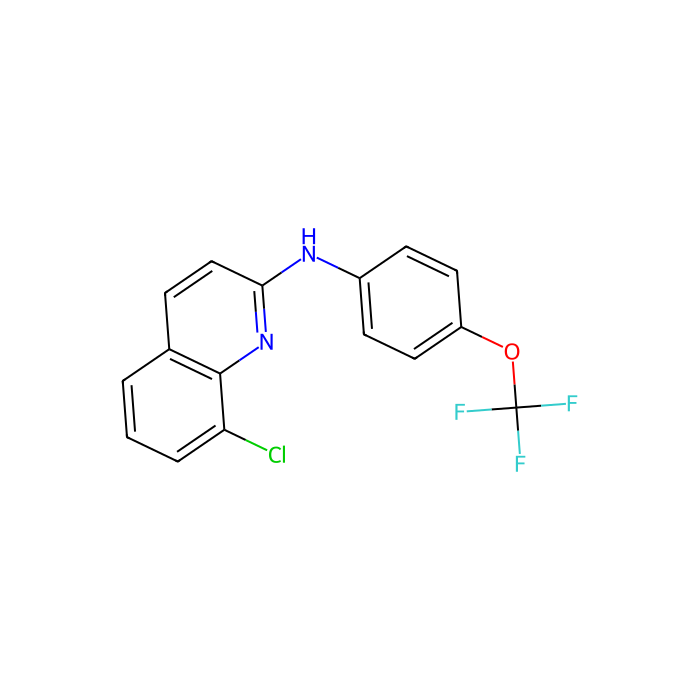
ABX464 ABX464 (SPL-464) is a novel anti-HIV molecule that inhibits HIV-1 replication in stimulated peripheral blood mononuclear cells (PBMCs) from 5 different donors with IC50 ranging between 0.1 μM and 0.5 μM.
ABX464 (SPL-464) is a novel anti-HIV molecule that inhibits HIV-1 replication in stimulated peripheral blood mononuclear cells (PBMCs) from 5 different donors with IC50 ranging between 0.1 μM and 0.5 μM.
Condizioni di conservazione di stoccaggio
Store at -20°C
Spedito in
Ice chest + Ice pads
Questo prodotto richiede spedizione a catena fredda. I servizi di terra e altri servizi economici non sono disponibili.
This compound belongs to the class of organic compounds known as aminoquinolines and derivatives. These are organic compounds containing an amino group attached to a quinoline ring system.
External Descriptors
Not available
1. Djoumbou Feunang Y, Eisner R, Knox C, Chepelev L, Hastings J, Owen G, Fahy E, Steinbeck C, Subramanian S, Bolton E, Greiner R, and Wishart DS. ClassyFire: Automated Chemical Classification With A Comprehensive, Computable Taxonomy. Journal of Cheminformatics, 2016, 8:61.
Determine the necessary mass, volume, or concentration for preparing a solution.
Dilution Calculator
Determine the dilution needed to prepare a stock solution.
Reconstitution Calculator
Recensioni
Recensioni dei clienti
Application Protocols
Product-specific tested applications and recommended dilutions: Not specified for this item; refer to CoA/Spec Sheet.
General assay workflow suggestions (for small-molecule screening compounds)
Stock preparation: dissolve in anhydrous DMSO to 10–50 mM; vortex and sonicate if needed; prepare single-use aliquots; store at −20°C.
Plate-based assays: perform serial dilutions in DMSO, back-dilute into assay buffer/media to reach final DMSO ≤0.1–0.5% v/v; include vehicle and positive/negative controls; incubate per assay kinetics; measure endpoint or real-time readouts.
Data quality: include inter-plate controls, Z′ factor assessment, and replicate concentration–response curves; monitor compound interference (auto-fluorescence, redox cycling, PAINS alerts) with appropriate counterscreens.
Documentation: record batch/lot, exact solvent content, and time-from-dilution to assay to ensure reproducibility.
Biological Roles
Item-specific biological target/role: Not specified for this item; refer to CoA/Spec Sheet.
Literature/general context (for orientation only; not a product claim)
ABX464 is reported in the literature as a small-molecule probe investigated for modulation of host RNA-processing pathways. Publications describe cellular studies examining gene expression changes following exposure, often using DMSO stocks and micromolar dosing ranges. Users should consult primary sources for mechanistic details and verify target engagement in their own systems.
Practical considerations for biological experiments
Confirm cytotoxicity windows across relevant cell lines prior to mechanistic profiling; include vehicle controls and time-course sampling.
Employ orthogonal readouts (qPCR/RNA-seq, proteomics, imaging) to corroborate pathway-level conclusions.
Buffer Applications
This product is a small-molecule research ligand and is not itself a buffering agent. No dedicated buffer system or pKa/pH range is specified for this item.
Practical handling (general)
When preparing assay solutions, dilute DMSO stocks into an appropriate biological buffer (e.g., PBS, HBSS, culture medium) while maintaining constant final DMSO concentration across controls.
If precipitation is observed, adjust ionic strength, add a small amount of nonionic surfactant, or use stepwise dilution from a higher-organic intermediate.
Green Alternatives
Context
For bioactive screening compounds, the main environmental footprint arises from solvent choice for stock preparation, assay dilution, and cleaning rather than the compound itself.
Greener solvent strategies (general guidance)
Prefer aqueous buffers with minimal DMSO (≤0.1–0.5% v/v) in final assay media when compatible with solubility.
Explore alternative co-solvents with improved green metrics where feasible: propylene carbonate or Cyrene for certain dissolutions; ethanol over isopropanol/acetone for lower toxicity—subject to compound stability and assay tolerance.
Implement microscale workflows to reduce solvent volumes (acoustic dispensing, nanoliter pin tools) and adopt sealed plates to limit VOC emissions.
Comparison (general; not product-specific)
DMSO (benchmark): excellent solvency/biocompatibility; moderate EHS profile; miscible with water.
Ethanol: renewable and lower toxicity; limited solvency for some polyheteroaromatics.
Propylene carbonate: low volatility, greener profile; high polarity may impact some assays; limited miscibility with nonpolar media.
Waste minimization
Segregate halogenated vs non-halogenated solvent waste streams.
Use pre-aliquoted, single-use vials to avoid repeated thaw/evaporation cycles that generate waste and variability.
Pharmaceutical Uses
Item-specific pharmacopeial/excipient status: Not specified for this item; refer to CoA/Spec Sheet.
Context
Supplied strictly for research use only (as stated). Not for human or veterinary use, not for diagnostic or therapeutic application.
Formulation considerations for research models (general guidance)
For in vitro work: DMSO stocks diluted into media; keep final DMSO consistent and ≤0.1–0.5% v/v when possible.
For non-clinical in vivo method development (if applicable to your institution’s approvals): common vehicles include 5–10% DMSO with aqueous solubilizers (e.g., 10–40% PEG300/400, 10% Solutol HS15, or 10% captisol), or lipid-based carriers. Confirm stability and avoid precipitation at dosing temperature. Follow institutional and regulatory guidelines.
Physical Properties
Item-specific specifications (this product)
Appearance: Not specified for this item; refer to CoA/Spec Sheet.
Melting point, boiling point, density, refractive index, solubility profile, logP, pKa: Not specified for this item; refer to CoA/Spec Sheet.
Practical handling note (general)
Library bioactives of this class are commonly supplied as solids or films for dissolution in polar aprotic solvents (e.g., DMSO) for stock solutions; confirm with the CoA.
Literature/general expectations (do not treat as specifications)
Many drug-like heteroaromatics show limited aqueous solubility at neutral pH and are prepared as 10–50 mM DMSO stocks, then diluted into assay buffers containing carrier proteins or surfactants to mitigate precipitation. Always verify with small-scale solubility tests and analytical monitoring (e.g., UV/Vis clarity check, HPLC).
Quality and Grades
Grade supplied: Moligand™ (as provided in Product Data)
What Moligand™ implies (general description; not a specification)
Moligand™ is used by Aladdin Scientific to denote small-molecule ligands suitable for discovery research, screening, and probe development. Typically emphasizes identity confirmation and suitability for biochemical or cell-based assays.
Item-specific quality attributes
Purity and analytical thresholds (e.g., HPLC area %, residual solvents, water, metals, stabilizers, UV cutoffs): Not specified for this item; refer to CoA/Spec Sheet.
Any salt form or solvate state: Not specified for this item; refer to CoA/Spec Sheet.
Practical implications
For screening: verify batch-specific purity and identity (HPLC/LC–MS, NMR as needed) to ensure consistent SAR data.
For biophysical work (SPR/ITC/DSF): low-UV impurity content and counterion identity can be critical; review CoA and consider additional polishing if required.
For cell assays: confirm endotoxin is not a concern for your application (not typically specified for small molecules).
Reaction and Applications
This item is offered as a bioactive small-molecule ligand for research screening rather than as a synthetic reagent. As such, it is not typically deployed to drive chemical transformations like coupling, oxidation, or reductions.
Research applications (general, literature-informed; not product-specific claims)
Small molecules of this class are used in target engagement studies, phenotypic screening, transcriptomic profiling, and mechanism-of-action elucidation in cell or biochemical assays.
Common experimental modalities include dose–response IC50/EC50 determination, thermal shift assays (DSF), surface plasmon resonance (SPR), isothermal titration calorimetry (ITC), CETSA, and cellular target engagement (e.g., NanoBRET), subject to solubility and fluorescence overlap constraints.
Practical assay guidance
Validate compound identity and purity by LC–MS/HPLC prior to screening to prevent SAR artifacts.
Control for DMSO concentration across plates; include vehicle controls and, where available, literature comparator ligands.
Assess aggregation risk (detergent sensitivity, dynamic light scattering) at micromolar concentrations to avoid false positives in enzyme assays.
Reaction Conditions
Not typically applicable. This product is a bioactive small molecule supplied for screening and assay research rather than for use as a reagent or catalyst in chemical synthesis.
If chemical modification is intended (user-driven medicinal chemistry), establish baseline stability studies first (general guidance):
Solvent screening for stability (DMSO, MeCN, MeOH, buffer pH 2–10) over 24–72 h at room temperature and 37°C; analyze by LC–MS.
Photostability test under ambient and protected-from-light conditions.
Oxidative stability in the presence of air and trace peroxide in common solvents; add antioxidants if warranted.
Solid-state stability across humidity and temperature to inform storage and handling.
Safety and Handling
GHS and hazard statements (this product)
Signal word: Not specified for this item; refer to SDS.
H-statements/GHS classification/pictograms: Not specified for this item; refer to SDS.
General laboratory precautions (advisory; defer to SDS)
Handle in a chemical fume hood, avoid inhalation/ingestion/skin contact.
Recommended PPE: lab coat, safety glasses, and appropriate chemically resistant gloves (e.g., nitrile). Wash thoroughly after handling.
Avoid dust/aerosol generation. Use dedicated, clean tools for weighing microgram-to-milligram quantities to minimize cross-contamination of screening libraries.
Incompatibilities and stability (general guidance)
Protect from moisture and light unless the CoA indicates otherwise. Store tightly closed under inert atmosphere if long-term storage is anticipated for sensitive heteroaromatics.
Avoid strong oxidizers and strong acids/bases unless stability is known.
First-aid overview (general)
Skin/eye contact: rinse with water for at least 15 minutes; remove contaminated clothing.
Inhalation: move to fresh air; seek medical attention if symptoms persist.
Ingestion: rinse mouth; do not induce vomiting; seek medical attention.
Always consult the product-specific SDS for authoritative hazard classifications and response measures.
Solvent Selection
Item-specific solubility data: Not specified for this item; refer to CoA/Spec Sheet.
General selection guidance for drug-like heteroaromatics (literature/practice)
Primary stock solvent: DMSO is the default due to broad solvency and assay compatibility at ≤0.1–0.5% v/v final concentration.
Secondary co-solvents: DMF, NMP, ethanol, or isopropanol can be used to pre-dissolve before aqueous dilution; verify biocompatibility for the intended assay.
Aqueous vehicles: PBS or assay buffer supplemented with 0.01–0.1% nonionic surfactant (e.g., Tween 80 or Pluronic F-68) and/or carrier protein (0.1–0.5% BSA) can reduce aggregation/precipitation.
Practical tips
Prepare concentrated stocks (e.g., 10–50 mM) in anhydrous DMSO with sonication if needed; filter stocks (0.22 µm PTFE) only if chemically stable.
Avoid repeated freeze–thaw of DMSO stocks; dispense single-use aliquots.
Check for precipitation upon dilution by visual inspection and, ideally, by light scattering or HPLC.
Comparison (general)
DMSO vs DMF: DMSO offers better biocompatibility; DMF can be harsher to cells but may dissolve some recalcitrant solids.
Ethanol/isopropanol: more biocompatible in some systems but lower solvency for polyheteroaromatics.
Storage and Reconstitution
Storage (from Product Data)
Store at −20°C.
Shipped in ice chest with ice pads to maintain a cold chain.
Stability/shelf-life: Not specified for this item; refer to CoA/Spec Sheet.
Reconstitution (general guidance for small-molecule bioactives)
Bring vial to room temperature in a desiccator before opening to avoid condensation.
Dissolve in anhydrous DMSO to prepare a concentrated stock (e.g., 10–50 mM) unless the CoA specifies an alternative solvent.
If insoluble, warm gently (≤40°C) and/or sonicate briefly. Do not overheat. Avoid basic aqueous media unless stability is confirmed.
Filter sterilization (0.22 µm PTFE) can be considered if required for cell culture; confirm no adsorption losses.
Aliquoting and freeze–thaw
Dispense single-use aliquots to avoid repeated freeze–thaw. Store aliquots at −20°C in tightly sealed, inert-atmosphere vials.
Protect from light and moisture as a precaution unless otherwise specified by the CoA.
Research Use Only notice
For research use only. Not for human or veterinary use.
Structure and Identity
Item-specific identifiers (from Product Data)
SKU: A412163
Product name: ABX464
CAS: 1258453-75-6
PubChem CID: 49846599
InChIKey: 271630 (as provided)
SMILES: Not specified for this item; refer to CoA/Spec Sheet.
Molecular formula: Not specified for this item; refer to CoA/Spec Sheet.
Molecular weight: Not specified for this item; refer to CoA/Spec Sheet.
Structural description
Structural features, ring systems, stereochemistry: Not specified for this item; refer to CoA/Spec Sheet.
Literature/context (general information)
ABX464 is widely referenced in the literature as a small-molecule heteroaromatic scaffold (bioactive screening compound). Specific atom connectivity and stereochemical features should be confirmed from primary references or spectral data before use in structure–activity or analytical work.
Synthetic Utility
This compound is offered as a finished bioactive small molecule and is not typically used as a synthetic building block.
Without a disclosed functional group map for this item, strategic derivatization, protection, or cross-coupling guidance cannot be provided. For any medicinal chemistry follow-up, obtain full structural information, then consider:
Vector analysis to identify positions amenable to modification without disrupting core binding motifs.
Installation/removal of solubilizing handles (tertiary amines, sulfonamides) guided by calculated pKa/logP and permeability data.
Preparation of photoaffinity or biotinylated probes via linkers attached at solvent-exposed vectors (after mapping by SAR or crystallography).
For robust route design, consult primary literature and confirm stability under standard transformations before attempting scale-up.
Target Specificity
Item-specific target/affinity, selectivity panel data, and kinetics: Not specified for this item; refer to CoA/Spec Sheet.
General note
For target deconvolution, consider chemoproteomics, CETSA, CRISPR knockdown/knockout sensitivity profiling, or transcriptional signatures. Orthogonal confirmation is recommended for any putative target identified in the literature.
Hai bisogno di aiuto per scegliere la qualità?
La nostra guida alla selezione delle qualità copre purezza, stato dello stabilizzatore e idoneità all'applicazione per tutte le varianti del nostro catalogo.
Utilizziamo i cookie per garantire il corretto funzionamento del sito web e, ove consentito, per migliorare la tua esperienza. Puoi gestire le tue preferenze in qualsiasi momento nelle Impostazioni. Per saperne di più, consulta la nostra Cookie Policy.
Desidera che le inviamo un messaggio quando avremo sconti disponibili?
Ricordamelo più tardi
Grazie! Controlli la sua casella di posta per confermare.
Products are supplied to verified businesses, institutions, and qualified professionals for research and development use only. Not for use in humans, animals, diagnosis, or therapy.

 I2615156