Determine the necessary mass, volume, or concentration for preparing a solution.
Dilution Calculator
Determine the dilution needed to prepare a stock solution.
Reconstitution Calculator
Recensioni
Recensioni dei clienti
Application Protocols
No assay-specific, item-validated protocols are provided in the Product Data. General approaches for using acenaphthene as an analytical standard include:
GC/GC–MS calibration (general):
Prepare a gravimetric stock solution in isooctane or hexane.
Serially dilute to prepare multi-level calibration standards spanning the expected concentration range.
Include internal standards (e.g., deuterated PAHs where applicable) and run solvent blanks to check for carryover.
HPLC–FLD/UV (general):
Dissolve in acetonitrile (optionally with ≤10% toluene as cosolvent) to ensure solubility.
Use gradient water–acetonitrile elution for PAH separations; optimize excitation/emission for acenaphthene’s fluorescence if using FLD.
Recovery/spike studies:
Spike known amounts into matrix extracts post-cleanup to assess recovery and matrix effects.
Important: Concentration, matrix, and uncertainty for this specific item are Not specified for this item; refer to CoA/Spec Sheet. Adjust the above steps to align with the certified values and solvent system supplied.
Biological Roles
Item-specific biological data are not provided. The following is general background for acenaphthene as a chemical entity (not clinical/medical guidance):
Acenaphthene is not a natural metabolite; it is a petrogenic/pyrogenic PAH associated with fossil fuel processing and incomplete combustion.
In environmental microbiology, certain bacteria and fungi can cometabolize acenaphthene via monooxygenation and ring-cleavage pathways, often proceeding through dihydrodiol or quinone-type intermediates (e.g., acenaphthenequinone), though rates are typically slower than for lighter PAHs like naphthalene.
Due to hydrophobicity (log Kow ~4), acenaphthene partitions strongly into organic phases and sediments and can bioaccumulate in aquatic organisms; however, it generally exhibits lower persistence than higher-ring PAHs.
In biophysical studies, acenaphthene’s fluorescence has been used as a hydrophobic probe in micellar and polymer systems (non-biological matrices) to report on microenvironment polarity and rigidity.
For any work involving biological matrices (e.g., tissues, serum, sediments):
Use validated extraction/cleanup protocols (SPE, GPC, silica/alumina fractionation) to mitigate matrix effects before chromatographic analysis.
Observe appropriate biosafety and chemical safety practices; dispose of contaminated materials in accordance with local regulations.
Buffer Applications
Not typically applicable. Acenaphthene is a nonpolar hydrocarbon with negligible aqueous solubility and no acid/base functionality; it is not used to prepare aqueous buffers. For analytical applications, focus on organic solvent systems and sample preparation strategies described in Solvent Selection and Reaction & Applications.
Green Alternatives
While acenaphthene itself is a persistent hydrophobic PAH, users can improve the overall greenness of analytical workflows by careful solvent selection and waste minimization.
Greener solvent choices for standard preparation (comparison; literature-guided):
Hexane/isooctane vs. toluene/DCM:
Hexane/Isooctane: lower toxicity than chlorinated solvents; GC-compatible; however, n-hexane has neurotoxicity concerns—consider isooctane or cyclohexane as safer aliphatic alternatives.
Toluene: effective solubilizer but with higher toxicity/vapor exposure burden; consider cyclohexane as a less toxic aromatic substitute when fluorescence/solubility permit.
DCM/CHCl3: excellent solvents but higher environmental/health hazards; avoid when possible for routine dilutions.
Small comparison table (general):
Isooctane: good GC compatibility; relatively lower acute toxicity; moderate solubility for acenaphthene.
Cyclohexane: good for spectroscopy; lower photochemical background; moderate solubility.
Acetonitrile: preferred for HPLC; miscible with water; ensure complete dissolution (may need small aromatic cosolvent).
Process improvements:
Prepare concentrated master stocks and perform on-demand micro-dilutions to reduce solvent volumes and waste.
Use microscale vials and low-dead-volume syringes to minimize losses.
Implement solvent recycling where feasible and segregate halogenated from non-halogenated waste.
Note: Always balance greener choices with method requirements (detector compatibility, solubility, and stability).
Pharmaceutical Uses
Not typically applicable. Acenaphthene is not used as a pharmaceutical excipient or processing aid. It may appear as an environmental contaminant in certain matrices but is not formulated for therapeutic products. For regulated analytical contexts, use the item as a reference standard only and consult the CoA for identity/purity information.
Physical Properties
Item-specific specifications are not provided in the Product Data. The following are typical literature values for neat acenaphthene; verify applicability against the item’s CoA/Spec Sheet.
Appearance: Not specified for this item; refer to CoA/Spec Sheet. (Literature: white to off-white crystalline solid.)
Melting point (literature): ~93–96 °C
Boiling point (literature): ~277–280 °C (at 1 atm)
Density (literature): ~1.23–1.25 g/cm³ (20–25 °C)
Vapor pressure (literature): low; on the order of 10⁻³–10⁻² Pa at 25 °C (very low volatility)
Water solubility (literature): very low; a few mg/L at 20–25 °C
Solubility in organic solvents (literature): good in nonpolar/aromatic solvents (toluene, xylene, hexane, isooctane), chlorinated solvents (DCM, chloroform), and moderate in acetone and acetonitrile; limited in alcohols.
Log Kow (literature): ~3.8–4.1 (hydrophobic)
pKa: not applicable (non-ionizable hydrocarbon)
Refractive index: not applicable to solid; not typically reported.
Notes for practitioners:
Due to hydrophobicity and crystallinity, dissolution is faster with gentle warming and sonication in aromatic or chlorinated solvents.
For analytical standards, choose solvents compatible with the intended platform (e.g., hexane/isooctane for GC; acetonitrile or acetonitrile/toluene for HPLC/FLD), and verify stability and blank background.
Quality and Grades
Grade/Purity: Not specified for this item; refer to CoA/Spec Sheet.
Designation: “Standard” indicates the product is intended for analytical/reference use (e.g., calibration, system suitability, spike/recovery), but certification status (e.g., neat RM vs. CRM, purity assay basis, uncertainty) is not provided here.
What “Standard” typically implies (general guidance):
Identity verified by one or more orthogonal techniques (e.g., GC/GC–MS, HPLC, NMR).
Purity suitable for calibration work; may be provided as a neat solid or as a gravimetrically prepared solution/ampoule. Exact concentration, solvent matrix, and uncertainty must be confirmed on the CoA.
Chromatography considerations (general):
For GC/GC–MS PAH work, very low background in the selected solvent (hexane, isooctane, or toluene) and minimal non-volatile residue are desirable.
For HPLC–FLD/UV, low impurity fluorescence/UV background and absence of stabilizers that interfere with detection are important.
Action items for users:
Verify: form (neat vs. solution), purity/concentration, and permissible uncertainty on the CoA before use in regulated or quantitative work.
If trace-level work is planned, assess blank contribution from solvents, vials, and any matrix components by running procedural blanks.
Reaction and Applications
Primary use-case: Acenaphthene Standard is intended for analytical calibration and system suitability, especially in environmental PAH determinations (air particulates, soil/sediment extracts, petroleum products) by GC–MS, GC–FID, or HPLC–FLD/UV.
Analytical applications (general):
Calibration curves, check standards, and spike/recovery studies in EPA- or ISO-oriented PAH methods (matrix-specific validation recommended).
Retention index/reference compound for GC method development across PAH series.
Fluorescence studies (steady-state and time-resolved) due to strong blue fluorescence.
Chemical reactivity/use (literature context):
Benzylic functionalization: the saturated bridge permits radical halogenation (e.g., NBS) and oxidation to acenaphthenequinone.
Electrophilic substitution on the aromatic framework (nitration, sulfonation, Friedel–Crafts) occurs but is directed by the fused ring topology; 5-position is commonly reactive.
Oxidation to acenaphthenequinone (a useful organic intermediate/dye precursor) with nitric acid or dichromate-based systems.
Practical notes for standard preparation:
Use high-purity solvents (residual PAH-free) and baked glassware to minimize background.
Prepare gravimetric stocks (e.g., 1000 mg/L) and serially dilute; verify concentration by GC–MS response factors if regulatory traceability is required.
Store working solutions cold and in amber glass to mitigate photodegradation.
Reaction Conditions
General literature conditions involving acenaphthene (for context; optimize per your system and consult primary sources):
Benzylic bromination (literature): NBS (1.1–1.5 eq) with radical initiator (AIBN or benzoyl peroxide) in CCl4, C6H6, or chlorobenzene; reflux 2–6 h; affords mono- or dibrominated benzylic products. Safer modern variants use PhCN or solvent-free conditions with photochemical initiation.
Oxidation to acenaphthenequinone (literature):
HNO3 (conc.) under controlled temperature (0–25 °C) and slow addition; workup with aqueous base; typical yields 50–80% depending on conditions.
Dichromate/acetic acid or permanganate in refluxing solvent (e.g., acetic acid, t-BuOH/H2O); monitor to avoid over-oxidation.
Nitration (literature): Mixed acid (HNO3/H2SO4) at 0–5 °C to control regioselectivity; quench into ice; subsequent neutralization and recrystallization.
Lithiation (literature): s-BuLi (1.1–2.0 eq) in THF or ether at −78 to −40 °C, often with TMEDA; electrophile trapping (CO2, halides). Strictly anhydrous and oxygen-free conditions required.
Analytical preparation notes:
Stock standards: commonly 100–1000 mg/L in isooctane, hexane, toluene, or acetonitrile (verify concentration/solvent on CoA if provided as solution).
Stability: store solutions cold and protected from light; periodic requalification by GC–MS response factor comparison is recommended for quantitative work.
These conditions are provided as general guidance from the literature and may not reflect the specific form or certification of this catalog item.
Safety and Handling
GHS classification and specific hazard statements for this catalog item are not provided.
GHS classification/status: Not specified for this item; refer to SDS.
Signal word / H- and P-statements: Not specified for this item; refer to SDS.
General safety profile for acenaphthene (literature/inference for PAHs; always confirm in SDS):
Combustible solid; may cause skin/eye irritation and respiratory discomfort upon dust/fume exposure.
Harmful to aquatic life with long lasting effects; avoid environmental release.
Safe handling practices:
Engineering controls: use in a fume hood to minimize inhalation of dusts or solvent vapors when preparing standards.
PPE: lab coat, safety glasses, and appropriate chemical-resistant gloves (e.g., nitrile). Avoid skin contact and ingestion.
Incompatibilities: strong oxidizers (risk of exothermic reaction/oxidation), strong nitrating mixtures; avoid open flames and ignition sources.
Spill response: avoid dust generation; collect solids by gentle sweeping or HEPA vacuum; for solutions, absorb with inert material. Dispose per local regulations.
First aid (overview; defer to SDS): move exposed person to fresh air; rinse skin/eyes with water for ≥15 min; seek medical advice if irritation persists; if ingested, rinse mouth—do not induce vomiting unless directed by medical personnel.
Storage and transport (item-specific):
Storage: Store at 2–8 °C (per Product Data). Keep tightly closed in a dry, well-ventilated area, protected from light and incompatible reagents.
Shipping: Shipped on wet ice via FedEx DG Service (per Product Data).
Solvent Selection
Acenaphthene is a hydrophobic PAH. Solvent selection should balance solubility, detector compatibility, and safety.
Polarity class: nonpolar aromatic hydrocarbon.
Dielectric constant (proxy by solvent choice): favors low- to medium-polarity organic media.
Miscibility profile (general):
Insoluble/very low solubility in water.
Readily soluble in toluene, xylene, chlorinated solvents (DCM, CHCl3), and aliphatic hydrocarbons (hexane, isooctane).
Moderate solubility in acetone and acetonitrile; limited in alcohols (MeOH, EtOH).
Typical choices by application:
GC/GC–MS: hexane, isooctane, or toluene; choose isooctane when higher boiling diluent is preferred to reduce evaporative loss.
HPLC–FLD/UV: acetonitrile or acetonitrile:toluene mixtures; avoid high methanol fractions due to lower solubility and potential fluorescence quenching differences.
Spectroscopy/photophysics: cyclohexane or toluene to exploit strong fluorescence with minimal background.
Comparison (general):
Hexane/isooctane: low polarity, GC-friendly, low UV background; lower solubility than toluene but adequate for µg–mg/mL levels.
Toluene: excellent solubility and fluorescence transparency; higher boiling point and stronger odor; less ideal for LC–MS.
Acetonitrile: LC-friendly, miscible with water; ensure complete dissolution (may need a small toluene cosolvent).
Practical tips:
Warm gently (30–40 °C) and sonicate to accelerate dissolution; filter through PTFE if particulates persist.
Avoid plasticizers: use glassware for stock preparation to minimize adsorption of hydrophobic PAHs.
Storage and Reconstitution
Item-specific storage conditions are provided; other details should be confirmed on the CoA/SDS.
Storage temperature (per Product Data): Store at 2–8 °C.
Shipping (per Product Data): Shipped on wet ice via FedEx DG Service.
Container care: Keep tightly capped in amber glass; minimize headspace to reduce volatilization and oxidative effects. Store in a dry, well-ventilated place away from oxidizers and strong acids.
If supplied as a neat solid (general guidance):
Allow vial to equilibrate to room temperature in a desiccator before opening to prevent moisture condensation.
For stock solutions, dissolve an accurately weighed portion in a compatible solvent (e.g., isooctane, hexane, toluene, or acetonitrile). Use Class A glassware and gravimetric preparation for quantitative work.
If supplied as a solution standard (general guidance):
Check the CoA for solvent, nominal concentration, and uncertainty; mix gently before opening.
After opening, aliquot into smaller amber vials to minimize repeated freeze–thaw and headspace exposure.
Stability notes (general):
Protect from light; store cold to limit slow oxidation or volatilization. Periodically verify concentration/purity for long-term stocks by GC–MS or HPLC.
Any unspecified parameters (e.g., exact purity, concentration, stabilizers): Not specified for this item; refer to CoA/Spec Sheet.
Structure and Identity
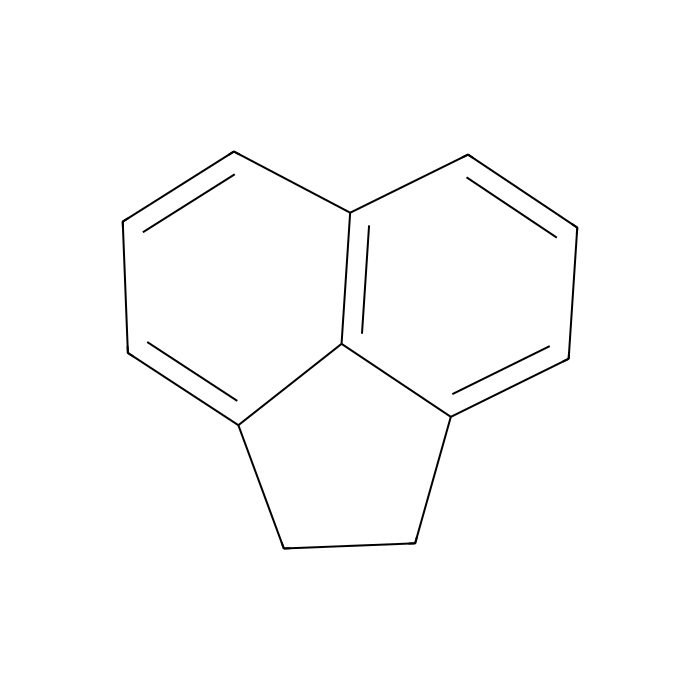
Acenaphthene is a polycyclic aromatic hydrocarbon (PAH) consisting of a naphthalene core fused with a saturated five-membered ring (two benzylic CH2 groups bridging the 1,8-positions).
SKU: A128206
Product Name: Acenaphthene Standard
CAS: 83-32-9
PubChem CID: 6734
Molecular formula (literature): C12H10
Molecular weight (literature): 154.21 g/mol
InChIKey: Not specified for this item; refer to CoA/Spec Sheet.
SMILES: Not specified for this item; refer to CoA/Spec Sheet.
Structural features (general chemistry description):
Two fused aromatic rings (naphthalene) plus a saturated cyclopenta bridge, yielding a rigid, bicyclic PAH framework.
Contains two benzylic methylene positions (–CH2–) that are activated toward radical substitution and oxidation.
Planarity is disrupted relative to naphthalene due to the saturated bridge, which reduces aromaticity in the five-membered ring segment.
2D structure in words (general):
Visualize a naphthalene; then connect carbons 1 and 8 with a –CH2–CH2– tether to form a five-membered ring fused across the peri positions. No heteroatoms; no stereocenters; overall nonpolar hydrocarbon.
Synthetic Utility
Although the product is intended as an analytical standard, acenaphthene’s structure offers useful reactivity in synthetic organic chemistry (literature context):
Benzylic functionalization: The saturated bridge (–CH2–CH2–) provides activated benzylic positions amenable to radical bromination (e.g., NBS/AIBN) or oxidation (e.g., Cr(VI), nitric acid) to access acenaphthenyl halides or acenaphthenequinone.
Electrophilic aromatic substitution: Nitration, sulfonation, and Friedel–Crafts acylation/alkylation proceed with regioselectivity influenced by the rigid fused system; the 5-position is commonly targeted.
Oxidation to acenaphthenequinone: A valuable intermediate for dyes, ligands, and building blocks; subsequent transformations include imine/oxime formation and Diels–Alder adducts.
Organometallic derivatization: Directed lithiation at benzylic or peri positions under strong base (e.g., s-BuLi/TMEDA) enables further elaboration, though care must be taken to control over-lithiation and avoid polymerization.
Applications stemming from these transformations:
Synthesis of peri-annulated aromatics and heteroacenes by stepwise oxidation, halogenation, and cross-coupling.
Preparation of fluorescence/electronic materials where the rigid PAH core imparts desirable photophysical properties.
Note: These are literature utilities; they do not imply the catalog item’s grade is suitable for preparative synthesis without verification of purity and absence of stabilizers.
Target Specificity
Not applicable. This product is a small-molecule hydrocarbon standard and does not have antibody/antigen target specificity, clone, isotype, or species reactivity attributes.
Utilizziamo i cookie per garantire il corretto funzionamento del sito web e, ove consentito, per migliorare la tua esperienza. Puoi gestire le tue preferenze in qualsiasi momento nelle Impostazioni. Per saperne di più, consulta la nostra Cookie Policy.
Desidera che le inviamo un messaggio quando avremo sconti disponibili?
Ricordamelo più tardi
Grazie! Controlli la sua casella di posta per confermare.
Products are supplied to verified businesses, institutions, and qualified professionals for research and development use only. Not for use in humans, animals, diagnosis, or therapy.

 I2321126