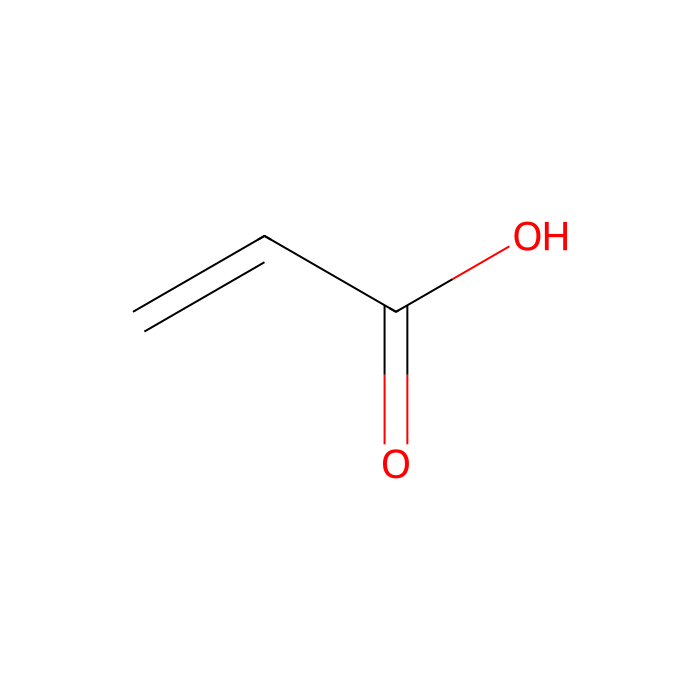
Acrylic acid - analytical standard, ≥99.7%(GC) , CAS No.79-10-7

CAS: 79-10-7 Cat. No.: A103525 Formula: C3H4O2 Peso molecolare: 72.06 Beilstein Registry Number: 635743 Numero EC: 201-177-9
Disponibile su ordine
QUALITÀ & PUREZZA Analytical standard ? Analytical standard — certified-purity material for quantitative calibration. Use to prepare calibration standards and validate analytical methods. ≥99.7%(GC)
Synonyms
Glacial acrylic acid|XPA|2-Propenoic acid|ACRYLIC ACID [IARC]|RCRA waste number U008|Carbopol 934 (TN)|Carbopol 940 (TN)|Jurimer AC 10P|Versicol E 7|Viscon 103|ACRYLIC ACID (IARC)|Aron A 10H|Acroleic acid|Araldite GT 7004 acrylate|Carbopol 934p|Carbopol 941 (TN)|ACRYLIC ACID [INCI]|Acrysol AC 5|Aqueous acrylic acid|OLD 01|ACRYLIC ACID (13C3)|Carbopol 910 (TN)|RCRA waste no. U008|C3:1n-1|Acrysol A 3|Good-rite K 702|ACRYLIC ACID [HSDB]|Acrylic acid, glacial|PAA-25|Versicol K 11|Acrylic acid resin|Kyselina akrylova [Czech]|R968|Acrysol lmw-20X|Good-rite WS 801|Primal Ase 60|prop-2-enoic acid|Versicol E15|Acrylic acid, inhibited|Carbomer 910 (USAN)|Synthemul 90-588|Versicol E9|Acrysol WS-24|Carbomer 940 (NF)|Good-rite K 37|WS 24|Acido acrilio [Spanish]|Acrysol ase-75|Good-rite K 732|Carboset 515|Vinylformic acid|Carbopol 940|Propenoate|Viscalex HV 30|Carbomer 934P (NF)|WS 801|Dow Latex 354|PA 11M|Carbopol 1342 (TN)|Carbopol 934P (TN)|Jurimer AC 10H|P-11H|ACRYLIC ACID|Carbomer 934 (NF)|Carboset Resin No. 515|Dispex C40|UN 2218 (Salt/Mix)|ACRYLIC ACID [MI]|Acrysol A-1|ACRYLATE|Acrysol A 5|Joncryl 678|Kyselina akrylova|Acrysol A 1|Acide acrylique|Acrylic resin|Aron|Nalfloc 636|Propenoic acid|allenediol|Cyguard 266|Propene acid|Acide acrylique [French]|Acido acrilio|Carbomer 941 (NF)|Revacryl A 191|Revacryl A191|Versicol S 25|ACRLYLIC ACID
Storage
Protected from light,Room temperature,Argon charged
Shipped In
FedEx DG Service
★
Dimensione
Germania (EU)
USA*
Prezzo
Qtà
5g
A103525-5g
6 Disponibile
Disponibile ≥10

24,21€

27,68€
Salva 3,47 € (12.54%)
25g
A103525-25g
—
4 Disponibile
86,69€
Enter a quantity for the sizes you want to add.

Panoramica

Usually used in preparing monodispersed poly (N-isopropylacryamide) (PNIPAM)/AAc microgels.And also used primarily as an intermediate in the production of acrylates.

Specifiche

Sinonimi
Glacial acrylic acid | XPA | 2-Propenoic acid | ACRYLIC ACID [IARC] | RCRA waste number U008 | Carbopol 934 (TN) | Carbopol 940 (TN) | Jurimer AC 10P | Versicol E 7 | Viscon 103 | ACRYLIC ACID (IARC) | Aron A 10H | Acroleic acid | Araldite GT 7004 acrylate | Carbopol 934p | Carbopol 941 (TN) | ACRYLIC ACID [INCI] | Acrysol AC 5 | Aqueous Mostra altro
Specifiche e purezza
analytical standard, ≥99.7%(GC)
Condizioni di conservazione di stoccaggio
Protected from light,Room temperature,Argon charged
Spedito in
FedEx DG Service
Grado
Standard analitico
Purezza
≥99.7%(GC)
Nomi e identificatori
Pubchem Sid
SMILES
C=CC(=O)O
IUPAC Name
prop-2-enoic acid
InChIKey
NIXOWILDQLNWCW-UHFFFAOYSA-N
InChI
1S/C3H4O2/c1-2-3(4)5/h2H,1H2,(H,4,5)
Isomeri SMILES
C=CC(=O)O
WGK Germania
1
RTECS
AS4375000
Numero UN
2218
Gruppo di imballaggio
II
Peso molecolare
72.06
Beilstein
635743
Reaxys
635743
Reaxys-RN_link_address
https://www.reaxys.com/reaxys/secured/hopinto.do?context=S&query=IDE.XRN=635743&ln=

Dati avanzati

Taxonomic Classification

Taxonomy Tree

KingdomOrganic compounds
SuperclassOrganic acids and derivatives
ClasseCarboxylic acids and derivatives
SubclassAcrylic acids and derivatives
Intermediate Tree Nodes Not available
Direct ParentAcrylic acids
Alternative Parents Monocarboxylic acids and derivatives  Carboxylic acids  Organic oxides  Hydrocarbon derivatives  Carbonyl compounds  
Molecular FrameworkAliphatic acyclic compounds
Substituents Acrylic acid - Monocarboxylic acid or derivatives - Carboxylic acid - Organic oxygen compound - Organic oxide - Hydrocarbon derivative - Organooxygen compound - Carbonyl group - Aliphatic acyclic compound
DescrizioneThis compound belongs to the class of organic compounds known as acrylic acids. These are organic compounds containing acrylic acid CH2=CHCO2H.
External Descriptors Unsaturated fatty acids
Struttura 3D
Modello di struttura chimica interattiva


Obiettivi associati (umani)
CHAT Tchem Choline acetylase (63 Activities)
Activity TypeRelationActivity valueUnitsAction TypeJournalPubMed IddoiAssay Aladdin ID
EHMT2 Tchem Histone-lysine N-methyltransferase, H3 lysine-9 specific 3 (93046 Activities)
Activity TypeRelationActivity valueUnitsAction TypeJournalPubMed IddoiAssay Aladdin ID
LMNA Tbio Prelamin-A/C (36751 Activities)
Activity TypeRelationActivity valueUnitsAction TypeJournalPubMed IddoiAssay Aladdin ID
Obiettivi associati (non umani)
Hdac6 Histone deacetylase 6 (222 Activities)
Activity TypeRelationActivity valueUnitsAction TypeJournalPubMed IddoiAssay Aladdin ID
Mus musculus (284745 Activities)
Activity TypeRelationActivity valueUnitsAction TypeJournalPubMed IddoiAssay Aladdin ID
Meccanismi d'azione
Certificati (CoA, COO, BSE/TSE e tabella di analisi)
C of A & Other Certificates(BSE/TSE, COO):
Analytical Chart:

Find and download the COA for your product by matching the lot number on the packaging.

10 results found

Lot NumberCertificate TypeDataOggetto
L2515110L2515110Certificate of AnalysisJul 13, 2026 A103525
L2515108L2515108Certificate of AnalysisDec 19, 2025 A103525
K2422150K2422150Certificate of AnalysisSep 10, 2025 A103525
H2521159H2521159Certificate of AnalysisAug 25, 2025 A103525
H2521160H2521160Certificate of AnalysisAug 25, 2025 A103525
L2306040L2306040Certificate of AnalysisNov 17, 2023 A103525
L2306041L2306041Certificate of AnalysisNov 17, 2023 A103525
C2323083C2323083Certificate of AnalysisMar 14, 2023 A103525
L2122043L2122043Certificate of AnalysisOct 20, 2022 A103525
L2110237L2110237Certificate of AnalysisSep 15, 2022 A103525
Proprietà chimiche e fisiche
SensibilitàLight sensitive;Hygroscopic;Air sensitive
Indice di rifrazione1.4192-1.4212
Punto di infiammabilità (°F)119.3 °F - closed cup
Punto di infiammabilità (°C)48.5 °C - closed cup
Punto di ebollizione (°C)139°C
Punto di fusione (°C)13°C
Peso molecolare72.06
XLogP30.300
Hydrogen Bond Donor Count1
Hydrogen Bond Acceptor Count2
Rotatable Bond Count1
Exact Mass72.0211 Da
Monoisotopic Mass72.0211 Da
Topological Polar Surface Area37.300 Ų
Heavy Atom Count5
Formal Charge0
Complexity55.900
Isotope Atom Count0
Defined Atom Stereocenter Count0
Undefined Atom Stereocenter Count0
Defined Bond Stereocenter Count0
Undefined Bond Stereocenter Count0
The total count of all stereochemical bonds0
Covalently-Bonded Unit Count1
Sicurezza e pericoli (GHS)
Pictogrammi
GHS02,   GHS05,   GHS06,   GHS07,   GHS09
Segnale
Danger
Indicazioni di pericolo

H226:Flammable liquid and vapor

H302:Harmful if swallowed

H314:Causes severe skin burns and eye damage

H335:May cause respiratory irritation

H400:Very toxic to aquatic life

H411:Toxic to aquatic life with long lasting effects

H311+H331:Toxic in contact with skin or if inhaled.

Precauzioni

P210:Keep away from heat, hot surface, sparks, open flames and other ignition sources. - No smoking.

P233:Keep container tightly closed.

P240:Ground/bond container and receiving equipment.

P241:Use explosion-proof [electrical/ventilating/lighting/.../] equipment.

P242:Use only non-sparking tools.

P243:Take precautionary measures against static discharge.

P261:Avoid breathing dust/fume/gas/mist/vapors/spray.

P264:Wash hands [and …] thoroughly after handling.

P270:Do not eat, drink or smoke when using this product.

P271:Use only outdoors or in a well-ventilated area.

P273:Avoid release to the environment.

P280:Wear protective gloves/protective clothing/eye protection/face protection.

P391:Collect spillage.

P301+P330+P331:IF SWALLOWED: Rinse mouth. Do NOT induce vomiting.

P303+P361+P353:IF ON SKIN (or hair): Take off Immediately all contaminated clothing. Rinse SKIN with water [or shower].

P361+P364:Take off immediately all contaminated clothing and wash it before reuse.

P370+P378:In case of fire: Use ... to extinguish.

P405:Store locked up.

P403+P233:Store in a well-ventilated place. Keep container tightly closed.

P403+P235:Store in a well-ventilated place. Keep cool.

P501:Dispose of contents/container to an approved waste disposal plant.

P301+P312+P330:IF SWALLOWED: Call a POISON CENTER/ doctor if you feel unwell. Rinse mouth.

P304+P340+P310:IF INHALED: Remove person to fresh air and keep comfortable for breathing. Immediately call a POISON CENTER/ doctor.

P305+P351+P338+P310:IF IN EYES: Rinse cautiously with water for several minutes. If contact lenses are worn and can be easily removed, remove Contact lenses. Continue rinsing. Immediately call an emergency center/doctor.

WGK Germania
1
RTECS
AS4375000
Reaxys
635743
Reaxys-RN_link_address
https://www.reaxys.com/reaxys/secured/hopinto.do?context=S&query=IDE.XRN=635743&ln=
Classe
3 (8)
Indice Merck
130
RIDADR
UN 2218 3(8) / PGII
Domande frequenti e articoli
How to Choose the Correct Reference Material Quality Grade?
Materials Can “Switch”: How Smart Polymers Respond to Temperature, pH, and Light (with Experimental Selection Tips & Product Navigation)
How Organic Acids “Stabilize a System”: Selection Logic via the pH Window, Salt Forms, and Metal-Ion Management (with a navigation guide to Tables A–E)
Application and Selection Guide for Alkyd Resin Coatings: Advantages, Limitations, Formulation Control, and Modification Directions
Structural and Performance Design of Acrylic Resins for Coatings: Monomer Composition, Key Parameters, and Film Formation/Curing Mechanisms
When Should You Choose Silicone Resin? Selection Comparison with Epoxy, Acrylic, Polyurethane, Fluororesin, and Other Coating Resins
Vinyl Acetate-Acrylic Emulsion (Vinyl Acrylic Emulsion): A Cost-Performance Balance Solution for Architectural Coatings
Vinyl Ester Resin Systems: Structural Features, Curing Mechanism, and Key Application Considerations
VC/VAc Resins and Their Modification: An Analysis of VC/VAc Vinyl Resins for Coatings and Inks
How to Select Vinyl-Related Resins: Building Formulation Judgment Based on Substrate, Performance Targets, and Failure Risks
Waterborne Resin Technology Explained: Waterborne Forms, Performance Balance, and a Technology Map
Guide to Common Waterborne Resin Types and Application-Based Selection: How to Choose Acrylics, PUD, Waterborne Epoxy, Waterborne Alkyd, VAE, and Related Chemicals
From Water to Film: Film-Formation Mechanisms and Performance Development of Waterborne Emulsions and Dispersions
Diagnosis of Coating Performance Issues and Selection of Resin Modification Routes
Structural Design Logic of Common Resin Modification Technologies: Molecular Chain Structure, Functional Groups, Phase Structure, Crosslinked Networks, and Hybrid/Functional Design
Resin Polarity in Coating Formulations: From Molecular Structure to Dissolution, Compatibility, Interfacial Interactions, and Formulation Design
From Structure to Rheology: How Carbomer Forms Gel Structures and Enables Thickening, Suspension, and Auxiliary Emulsion Stabilization
Structure–Performance Relationship of Polyquaterniums in Hair and Personal Care Formulations: Smoothing Conditioning, Antistatic Performance, Film Formation, and Deposition Behavior
Key Variable in the Long-Term Stability of Waterborne Pigment Concentrates: How Dispersant Molecular Weight Distribution (MWD) Affects Pigment Dispersion, Surface Adsorption-Layer Formation, and Storage Stability
Citations of This Product
Calcolatori di soluzioni
Recensioni

Recensioni dei clienti

Desidera che le inviamo un messaggio quando avremo sconti disponibili?

Ricordamelo più tardi

Grazie! Controlli la sua casella di posta per confermare.

Ops! Le notifiche sono disabilitate.