ACY-738 - Moligand™, ≥99% , Inhibitor of histone deacetylase 1;Inhibitor of histone deacetylase 2;Inhibitor of histone deacetylase 3;Inhibitor of histone deacetylase 6, CAS No.1375465-91-0, Inhibitor of histone deacetylase 1;Inhibitor of histone deacetylase 2;Inhibitor of histone deacetylase 3;Inhibitor of histone deacetylase 6
ACY-738 - Moligand™, ≥99% , Inhibitor of histone deacetylase 1;Inhibitor of histone deacetylase 2;Inhibitor of histone deacetylase 3;Inhibitor of histone deacetylase 6, CAS No.1375465-91-0, Inhibitor of histone deacetylase 1;Inhibitor of histone deacetylase 2;Inhibitor of histone deacetylase 3;Inhibitor of histone deacetylase 6
QUALITÀ & PUREZZAMoligand™?Moligand™ — Aladdin's line of ligands and bioactive small molecules. Use for receptor, pathway, and binding studies needing defined small-molecule tools.≥99%
ACY-738 inhibitsHDAC6with low nanomolar potency (IC50=1.7 nM) and a selectivity of 60- to 1500-fold over class I HDACs.
Targets
HDAC6 (Cell-free) 1.7 nM
In vivo
ACY-738 induces dramatic increases in α-tubulin acetylation in brain and stimulate mouse exploratory behaviors in novel, but not familiar environments. ACY-738 has the antidepressant-like properties. Elimination of ACY-738 from plasma is rapid, with plasmatic half-life of 12\u2009min and concentration below 10\u2009ng/ml after 2\u2009h. ACY-738 rapidly distributes to the brain leading to a total drug exposure in CNS comparable to that of peripheral tissues. ACY-738 decreases several characteristics of SLE (Systemic lupus erythematosus) in NZB/W mice by dictating B cell development in the bone marrow. ACY-738 treatment increases the percentage of B cells in early developmental stages, while decreasing the percentage of cells in late pre-B cell fraction F. ACY-738 regulation of BM B cell development could be due to regulation developmental checkpoints known to be dysfunctional during SLE.
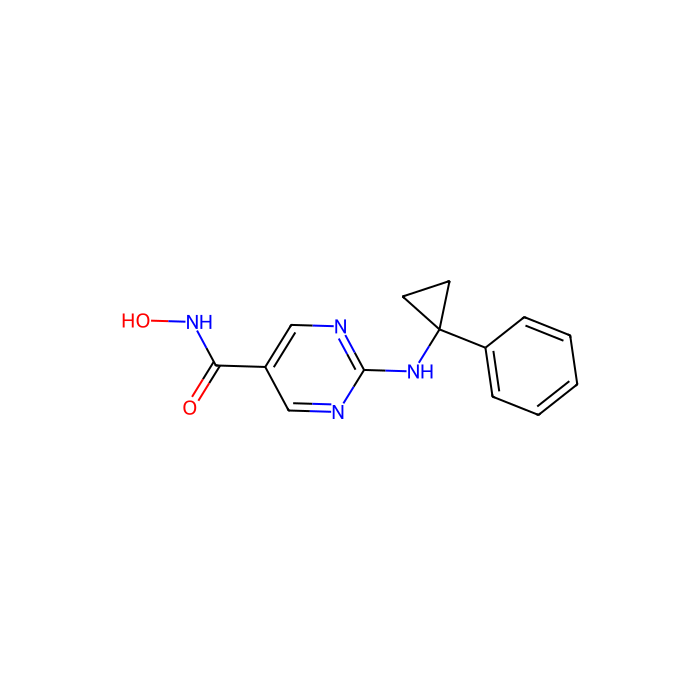
This compound belongs to the class of organic compounds known as pyrimidinecarboxamides. These are compounds containing a pyrimidine ring which bears a carboxamide.
External Descriptors
Not available
1. Djoumbou Feunang Y, Eisner R, Knox C, Chepelev L, Hastings J, Owen G, Fahy E, Steinbeck C, Subramanian S, Bolton E, Greiner R, and Wishart DS. ClassyFire: Automated Chemical Classification With A Comprehensive, Computable Taxonomy. Journal of Cheminformatics, 2016, 8:61.
Determine the necessary mass, volume, or concentration for preparing a solution.
Dilution Calculator
Determine the dilution needed to prepare a stock solution.
Reconstitution Calculator
Recensioni
Recensioni dei clienti
Application Protocols
Item-specific tested applications, recommended dilutions, or positive controls: Not specified for this item; refer to CoA/Spec Sheet.
Note: While general assay practices are outlined in other sections, Aladdin provides no validated application protocol for this specific item beyond research-use guidance.
Biological Roles
Item-specific biological roles: Not specified for this item; refer to CoA/Spec Sheet.
Literature/general context for ACY-738-like molecules:
Reported as a selective inhibitor of histone deacetylase 6 (HDAC6), a cytosolic deacetylase that targets α-tubulin, HSP90, and other non-histone proteins.
Inhibition of HDAC6 typically increases acetylation of α-tubulin, impacting microtubule stability and intracellular transport processes. Downstream cellular consequences can include altered aggresome formation, autophagic flux modulation, and stress response signaling.
In biochemical pathways, selective HDAC6 inhibition offers a tool for dissecting deacetylase-dependent steps separate from nuclear histone deacetylation (e.g., HDAC1/2/3), facilitating isoform-selective studies.
In cell systems, common readouts include: Western blot for Ac-α-tubulin (K40), immunofluorescence of microtubule acetylation patterns, and chaperone function assays for HSP90 client stabilization. Always validate against orthogonal probes and genetic controls (siRNA/CRISPR) to confirm on-target effects.
Cautions (general):
Off-target interactions can occur at elevated concentrations; full isoform profiling and chemoproteomics can help delineate specificity.
Avoid extrapolation to in vivo or clinical outcomes; this product is for research use only.
Buffer Applications
Not typically applicable. ACY-738 is a bioactive small molecule and not a buffering agent.
Practical note for assay buffers (general):
Use established assay buffers for HDAC enzymes (e.g., HEPES, Tris with appropriate salts, pH 7.4–8.0) and maintain a constant, low percentage of DMSO across samples and controls.
Avoid high concentrations of detergents unless validated, as they can affect enzyme activity and compound aggregation behavior.
Green Alternatives
Applicability note: ACY-738 is a research ligand, not a process solvent or bulk reagent. “Green alternatives” are therefore best considered in terms of greener handling vehicles and assay formats rather than alternatives to the molecule itself.
Solvent/vehicle considerations (general):
Prefer minimal DMSO percentages (≤0.5% v/v) in aqueous assays to reduce solvent load; validate biological performance at the lowest feasible DMSO.
Where possible, use PBS or HEPES-based buffers without non-essential organic co-solvents. If co-solvent is necessary, benchmark DMSO versus bio-friendly co-solvents (e.g., polyethylene glycol 400 at very low levels) recognizing potential biological effects.
Operational greening:
Microvolume screening (384/1536-well plates) to reduce per-experiment mass of compound and solvent waste.
Employ sealed plates and low-evaporation lids to minimize VOC emissions.
Replace halogenated cleaning solvents with alcohol/water systems where compatible with the analyte.
End-of-life and waste:
Segregate DMSO-organic waste for appropriate disposal. Use sorbent materials with lower environmental impact for spill management.
Trade-offs (balanced view):
Reducing DMSO can mitigate environmental and biological confounders but may introduce solubility/precipitation risks; confirm homogeneity and maintain consistent solvent across controls.
Pharmaceutical Uses
Item-specific pharmacopeial status, excipient use, or formulation role: Not specified for this item; refer to CoA/Spec Sheet.
Research-use context (general):
Employed as a reference or tool compound in preclinical research for HDAC6-related biology, assay development, and analytical method qualification (e.g., LC–MS retention benchmarks, stability-indicating methods) within discovery laboratories.
Any discussion of therapeutic application is outside scope; this material is supplied strictly for research use only.
Formulation notes for laboratory studies (general):
For in vitro work, prepare concentrated DMSO stocks and dilute into cell media or enzyme buffers to the desired final concentration, keeping vehicle consistent across controls.
For exploratory in vivo method development (if institutionally approved), consult internal safety committees and develop suitable vehicles based on solubility and stability data; this product listing does not provide such specifications.
Physical Properties
Item-specific specifications: Not specified for this item; refer to CoA/Spec Sheet.
Typical properties for HDAC-inhibitor small molecules (literature/general — not item specifications):
Physical state: usually off-white to light yellow solids for analogous hydroxamate-based inhibitors.
Solubility: many HDAC inhibitors are sparingly soluble in water but readily soluble in polar aprotic organics (DMSO, DMF). Working stocks are commonly prepared in anhydrous DMSO (10–50 mM) and diluted into assay buffer to low final DMSO percentages (≤0.5–1%).
pKa/logP: values depend strongly on the exact scaffold; HDAC6-selective compounds often show moderate-to-high lipophilicity to enable cell permeability. For ACY-738, consult primary literature or the CoA for definitive values.
UV characteristics: HDAC ligands with aromatic caps typically exhibit π→π* absorption in the near-UV; confirm λmax and extinction coefficient experimentally prior to quantitative UV assays.
Practical notes (general):
When preparing concentrated DMSO stocks, warm gently (room temperature) and vortex/sonicate to ensure homogeneity. Filter through 0.22 µm PTFE if particulate persists.
Avoid repeated freeze–thaw of DMSO stocks; aliquot upon first dissolution to maintain integrity.
For kinetic solubility in aqueous buffers, determine precipitation limits by turbidity or nephelometry before high-throughput screening.
Moligand™ is positioned for discovery and screening workflows, emphasizing identity, purity, and consistency suited for small-molecule library and target-engagement studies.
What this typically implies (general explanatory notes):
Purity control by HPLC/UPLC suited for biochemical/cellular assays; low levels of non-volatile residues and synthetic byproducts to minimize assay interference.
Identity verification via NMR and MS; batch traceability and documentation to support hit-to-lead efforts.
Packaging designed to reduce adventitious moisture and oxidation; aliquot-friendly formats.
How to use this information:
For SAR and quantitation-sensitive assays, request the lot-specific CoA detailing analytical methods, purity basis, and residual solvent content.
If low-UV absorbance is required (e.g., for HPLC detectors at 210–230 nm), verify UV impurity profile and late-eluting residues.
Item-specific notes:
Appearance: Not specified for this item; refer to CoA/Spec Sheet.
Stabilizers/additives: Not specified for this item; refer to CoA/Spec Sheet.
Metal limits, water/peroxide content, or UV cutoff: Not specified for this item; refer to CoA/Spec Sheet.
Reaction and Applications
This product is primarily a bioactive small molecule for research applications rather than a synthetic reagent.
Research applications (literature/general for ACY-738-like probes):
HDAC6 inhibition studies: quantifying increased acetylation of α-tubulin or other cytosolic substrates by Western blot/ELISA/immunofluorescence.
Enzymology: determination of IC50/Ki against HDAC isoforms using fluorogenic or colorimetric deacetylase assays; profiling across HDAC panels for selectivity.
Chemical biology: target engagement (CETSA, NanoBRET) and phenotypic assays involving microtubule dynamics, aggresome formation, and proteostasis pathways.
Neuroscience models (in vitro): exploring consequences of HDAC6 modulation on axonal transport or neurite outgrowth, subject to institutional approvals. No clinical or therapeutic claims are implied.
Practical assay tips (general):
Prepare concentrated DMSO stocks, then serially dilute to maintain constant DMSO across wells (commonly 0.1–0.5% v/v).
Confirm compound integrity by LC–MS after assay incubation if prolonged exposures or elevated temperatures are used.
Include counterscreens for pan-assay interference (PAINS) and aggregation (e.g., detergent sensitivity, dynamic light scattering) as appropriate.
Not a coupling/catalysis reagent: For organic synthesis workflows, select more appropriate reagents; refer instead to the Synthetic Utility section for high-level chemical features.
Reaction Conditions
Not a synthetic reagent; conventional “reaction conditions” are not typically applicable.
Assay preparation conditions (general, for HDAC inhibitor evaluation):
Stock solutions: 10–50 mM in anhydrous DMSO; store aliquots at −20 °C. Warm to room temperature and vortex before use.
Biochemical HDAC assays: HEPES or Tris buffer (pH 7.4–8.0), salts (e.g., NaCl 100–150 mM), reducing agent as required by assay kit, 25–37 °C incubation. Determine IC50 across a 10-point 3-fold dilution series with constant DMSO.
Cellular assays: Treat cells with serial dilutions (e.g., 0.01–10 µM) for 2–24 h; quantify acetylated α-tubulin by Western blot/IF. Include toxicity/viability counterscreens (e.g., CellTiter-Glo) and vehicle controls.
Stability checks: Post-incubation LC–MS on selected wells to ensure compound persistence under assay conditions.
Reporting guidance:
Clearly state final DMSO concentration, incubation temperature/time, and plate type. Include positive control HDAC6 inhibitor and negative controls.
Note: Values above are general literature practices and do not constitute item-specific specifications; optimize per your system.
Safety and Handling
GHS classification, signal word, pictograms, and H-statements: Not specified for this item; refer to SDS.
General laboratory precautions (professional guidance; not a substitute for SDS):
Use in a chemical fume hood; avoid inhalation and skin/eye contact. Wear appropriate PPE: lab coat, nitrile gloves, and splash-rated eye protection.
Wash thoroughly after handling; avoid ingestion and environmental release. Collect waste as halogen-free organic solid/liquid per institutional procedures.
Potential hazard considerations (literature/general for hydroxamate-like HDAC inhibitors):
May cause skin/eye irritation and respiratory tract irritation if dusted/aerosolized.
Some hydroxamates can exhibit light or hydrolytic sensitivity; minimize exposure to strong acids/bases and prolonged light.
Incompatibilities and stability (general):
Avoid strong oxidants and strong acids/bases. Store away from moisture. For solutions, prefer anhydrous DMSO or DMF and protect from light (amber vials) if the chromophore is UV-active.
First-aid overview (consult SDS for specifics):
Skin: Remove contaminated clothing, wash with soap and water. Seek medical attention if irritation persists.
Eyes: Rinse cautiously with water for several minutes; remove contact lenses if easy to do; continue rinsing.
Inhalation: Move to fresh air; seek medical attention if symptoms occur.
Ingestion: Rinse mouth; do not induce vomiting; seek medical attention.
Spill response (small-scale):
Cover solids with inert absorbent, collect mechanically. For solutions, absorb with vermiculite or pads. Dispose as hazardous waste.
Solvent Selection
Intended context: ACY-738 is supplied as a research-grade small molecule rather than used as a reaction solvent. Solvent selection here pertains to dissolution for assays and handling.
Recommended solvents (general practice for screening compounds):
DMSO (anhydrous) — primary choice for stock solutions (e.g., 10–50 mM). Excellent solvating power; miscible with aqueous buffers upon dilution.
DMF or NMP — alternatives for difficult solubilization; typically back-diluted into buffer. Verify cell compatibility at very low final percentages.
Aqueous buffers — direct dissolution is often limited for hydrophobic ligands; consider co-solvent strategies (≤0.5–1% DMSO) and gentle warming.
Polarity/miscibility profile (general for HDAC inhibitors):
Moderate-to-high lipophilicity; expect poor water solubility and high solubility in polar aprotic organics. Avoid alcohol-rich vehicles if hydrolysis is a concern.
Practical guidance:
Determine kinetic and thermodynamic solubility experimentally in the specific assay matrix (protein content, detergents, pH, ionic strength can shift apparent solubility).
Use surfactant-free buffers for biochemical HDAC assays unless otherwise validated; certain detergents can alter enzyme activity or compound aggregation.
Filter sterilize only if necessary; check for adsorption to membranes. Use low-binding plastics/glass to reduce loss of compound at low nM levels.
Comparison notes (general):
DMSO vs DMF: DMSO is broadly assay-compatible and less volatile; DMF may be preferable when DMSO interferes spectrally or with cell physiology but requires tighter exposure limits.
Storage and Reconstitution
Storage conditions (from Product Data): Store at −20 °C.
Shipping (from Product Data): Shipped in an ice chest with ice pads.
Appearance: Not specified for this item; refer to CoA/Spec Sheet.
Reconstitution: Not specified for this item; refer to CoA/Spec Sheet.
General handling guidance (not item-specific):
Upon receipt, allow the sealed container to equilibrate to room temperature in a desiccator before opening to prevent moisture condensation.
If supplied as a solid, prepare single-use DMSO aliquots (e.g., 10–50 mM), store at −20 °C or below in amber vials; avoid repeated freeze–thaw cycles.
If supplied in solution, keep tightly capped, minimize headspace, and store as instructed; use within the indicated retest period on the CoA.
Protect from light if the compound contains UV-absorbing chromophores. Verify stability in chosen solvent by periodic LC–MS/HPLC.
Structure and Identity
Item-specific identifiers (from Product Data)
SKU: A414096 (ACY-738)
CAS: 1375465-91-0
PubChem CID: 57381425
InChIKey: 200254 (as provided)
SMILES: Not specified for this item; refer to CoA/Spec Sheet.
Molecular formula: Not specified for this item; refer to CoA/Spec Sheet.
Molecular weight: Not specified for this item; refer to CoA/Spec Sheet.
Structural features (literature/general):
ACY-738 is reported in the literature as a small-molecule histone deacetylase (HDAC) inhibitor with strong preference for HDAC6.
Typical HDAC6-selective chemotypes feature a hydroxamate zinc-binding group (ZBG), a hydrophobic linker, and an aromatic “cap” region; ACY-series molecules commonly follow this topology. Exact substitution pattern for ACY-738 should be verified from primary references/CoA.
2D description (general, literature-informed):
Linear/branched scaffold bearing an O–C(=O)–N–O (hydroxamate) motif (if applicable), connected via a lipophilic spacer to an aryl/heteroaryl cap. No stereocenters are typically required for HDAC6 selectivity in these series. Confirm the presence/absence of stereocenters against the certificate of analysis.
Identity confirmation (recommendations):
Verify by 1H/13C NMR, LC–MS (ESI), HRMS, and purity by HPLC/UPLC. Compare retention time and MS fragments with a qualified reference standard.
For screening libraries, orthogonal ID checks (qNMR + HRMS) are advisable prior to critical assays.
Synthetic Utility
Primary use: ACY-738 is offered as a ready-to-use ligand/probe for biological studies, not as a building block. Synthetic transformations using ACY-738 as a reagent are not typical.
Functional group considerations (literature/general for ACY-series HDAC inhibitors):
If a hydroxamate ZBG is present, it is generally unreactive under mild conditions but susceptible to hydrolysis under strong acid/base and to certain acylation/derivatization conditions; thus, derivatization for probe development (e.g., biotinylation, photoaffinity tags) often proceeds via cap or linker modifications on precursor scaffolds rather than direct transformation of the final inhibitor.
Aromatic/heteroaromatic cap motifs can, in principle, undergo cross-coupling on precursor halides prior to ZBG installation. Final API-like molecules are usually end-stage deprotections.
Retrosynthetic value (general):
Access to ACY-analog chemotypes typically follows modular assembly: cap aryl unit (via Suzuki/Negishi), hydrophobic linker introduction, then hydroxamate formation from esters/acid chlorides or via activated carboxylates.
Practical note:
If chemical modification of ACY-738 is desired (e.g., to create an immobilized affinity probe), consult primary literature for site-tolerant positions; perform small-scale feasibility studies to verify retention of HDAC6 potency/selectivity.
Target Specificity
Item-specific target, isoform selectivity, or binding constants: Not specified for this item; refer to CoA/Spec Sheet and primary literature.
General literature note:
ACY-738 has been described as an HDAC6-preferring small molecule in the ACY series; confirm selectivity profile (HDAC1–11) and binding/functional potency (IC50/Ki) from peer-reviewed sources before critical experiments.
Recommendation:
Perform in-house panel profiling or orthogonal target-engagement assays (e.g., CETSA, NanoBRET) to verify on-target activity in your biological context.
Hai bisogno di aiuto per scegliere la qualità?
La nostra guida alla selezione delle qualità copre purezza, stato dello stabilizzatore e idoneità all'applicazione per tutte le varianti del nostro catalogo.
Utilizziamo i cookie per garantire il corretto funzionamento del sito web e, ove consentito, per migliorare la tua esperienza. Puoi gestire le tue preferenze in qualsiasi momento nelle Impostazioni. Per saperne di più, consulta la nostra Cookie Policy.
Desidera che le inviamo un messaggio quando avremo sconti disponibili?
Ricordamelo più tardi
Grazie! Controlli la sua casella di posta per confermare.
Products are supplied to verified businesses, institutions, and qualified professionals for research and development use only. Not for use in humans, animals, diagnosis, or therapy.
 I2206156
