≥99% for sensitive chromatographic and analytical workflows requiring minimal baseline interference.
🌡
Storage & shipping
Store at -20°C Ships Ice chest + Ice pads Check lot-specific COA for exact specifications.
📋
Quality documents
SDS, COA, datasheet, and spec sheet available for download. Lot-specific COA accessible via lot number lookup.
📚
Literature proof
Cited in 0 peer-reviewed publications across chromatography, organic synthesis, and cross-coupling reactions.
Panoramica
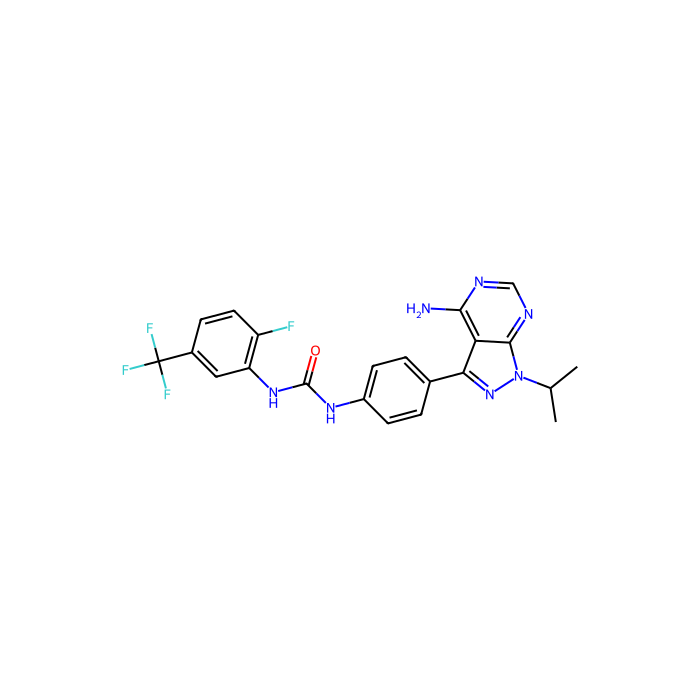
AD80, a multi kinase inhibitor, has strong activity on human RET (c-RET), BRAF, S6K and SRC, but weak activity on mTOR than ad57 or ad58. Its IC50 value for RET (c-RET) is 4 nm.
AD80 and AD81 inhibits RET, RAF, SRC and S6K, with greatly reduced mTOR activity relative to AD57 and AD58.AD80 is optimal for Ras–Erk pathway inhibition. AD80 is a polypharmacological agent with an optimal balance of activity against Ret, Raf, Src, Tor a
Condizioni di conservazione di stoccaggio
Store at -20°C
Spedito in
Ice chest + Ice pads
Questo prodotto richiede spedizione a catena fredda. I servizi di terra e altri servizi economici non sono disponibili.
Tipo di azione
INHIBITOR
Nota
Wherever possible, you should prepare and use solutions on the same day. However, if you need to make up stock solutions in advance, we recommend that you store the solution as aliquots in tightly sealed vials at -20°C. Generally, these will be useable for up to one month. Before use, and prior to opening the vial we recommend that you allow your product to equilibrate to room temperature for at least 1 hour. Need more advice on solubility, usage and handling? Please visit our frequently asked questions (FAQ) page for more details.
This compound belongs to the class of organic compounds known as phenylpyrazoles. These are compounds containing a phenylpyrazole skeleton, which consists of a pyrazole bound to a phenyl group.
External Descriptors
Not available
1. Djoumbou Feunang Y, Eisner R, Knox C, Chepelev L, Hastings J, Owen G, Fahy E, Steinbeck C, Subramanian S, Bolton E, Greiner R, and Wishart DS. ClassyFire: Automated Chemical Classification With A Comprehensive, Computable Taxonomy. Journal of Cheminformatics, 2016, 8:61.
Determine the necessary mass, volume, or concentration for preparing a solution.
Dilution Calculator
Determine the dilution needed to prepare a stock solution.
Reconstitution Calculator
Recensioni
Recensioni dei clienti
Application Protocols
No manufacturer-validated protocols are provided for this specific item. The following are general, literature-style procedures for small-molecule kinase probes. Adjust to your system and do not treat as product specifications.
Preparation of 10 mM stock solution:
Warm vial to room temperature in a desiccator. Add anhydrous DMSO to achieve 10 mM. Vortex until fully dissolved. If necessary, sonicate briefly (≤5 min). Aliquot into low-bind microtubes, flush headspace with inert gas, and store at −20°C.
Biochemical kinase assay (generic):
Prepare serial dilutions (e.g., 10-point, 3-fold) in assay buffer with constant DMSO (0.1–0.5% v/v). Incubate inhibitor with kinase and substrate at ATP ≈ Km,ATP. Read activity (radiometric, fluorescence, or luminescence). Fit dose–response to obtain IC50 with appropriate controls.
Cellular target engagement (generic):
Treat cells with a dilution series for 1–4 h. Lyse and quantify phospho-biomarkers (e.g., pERK, pS6) by immunoblot or ELISA. Normalize to total protein and vehicle controls.
Solubility/precipitation check:
After final dilution, visually inspect wells and, if available, use light scattering or nephelometry to confirm the absence of precipitate.
Ensure all protocols are validated locally and aligned with institutional safety policies.
Biological Roles
Scope: Research use only. The following reflects general literature for AD80 as a chemical biology tool; it is not a statement of item-specific specifications or clinical performance.
Mechanism class (literature): ATP-competitive, multi-kinase inhibitor reported to engage components of RAF/RET/S6K pathways among others, yielding a broad but rational polypharmacology profile useful for pathway interrogation.
Use in systems biology: Facilitates mapping of signaling network rewiring and feedback by jointly modulating upstream and downstream kinase nodes.
Target engagement assessment: Typically monitored via biochemical kinase activity assays and cellular phospho-protein readouts (e.g., pERK, pS6, pAKT) using immunoblot or high-content methods.
Selectivity context: Literature reports indicate activity across a curated kinase panel. Exact Kd/IC50 values are assay-dependent; consult primary references or perform in-house profiling under your conditions.
Resistance and adaptation studies: Tool for probing compensatory signaling and evaluating combination strategies at the pathway level.
Caution: Biological potency and selectivity are sensitive to assay format (ATP concentration, substrate choice), cell context (expression levels, feedback), and compound handling (solubility, adsorption). Always reproduce key findings under your laboratory’s conditions.
Buffer Applications
Not typically applicable. AD80 is a bioactive small molecule rather than a buffering agent. For experimental use, it is diluted into pre-selected biological buffers (e.g., HEPES, PBS) appropriate to the assay.
Practical tip (general): Prepare concentrated DMSO stocks, then dilute into your working buffer while maintaining final vehicle levels (commonly ≤0.1–0.5% v/v) and verifying absence of precipitation.
Green Alternatives
As a bioactive screening compound, AD80 is not a process solvent or reagent with direct greener substitutes. Nevertheless, greener handling practices can reduce environmental impact.
Greener practices (general guidance):
Minimize DMSO volumes by using higher-concentration master stocks and acoustic/low-volume dispensing to reduce solvent waste.
Favor aqueous assay buffers and microtiter formats compatible with sub‑microliter DMSO dosing to keep final organic content ≤0.1% v/v.
Choose low-adsorption polypropylene plates to avoid excessive re-dosing and compound waste.
Implement closed-caption storage (sealed, inert gas) to extend shelf life and reduce discarded material.
Comparison of vehicle choices (literature-based):
DMSO: High solvating power; relatively benign but not readily biodegradable; aim to collect as hazardous waste for proper disposal.
Ethanol: Renewable feedstock; higher cytotoxicity at equivalent v/v in many cell systems; lower solvency for many heteroaromatics.
For scale-up synthetic routes to AD80 (outside the scope of this catalog item), consider solvent selection guides (CHEM21/ACS GCI) to replace high-impact solvents and adopt catalytic, step-economical strategies.
Pharmaceutical Uses
This catalog item is supplied strictly for laboratory research use. No pharmacopeial grade or excipient status is provided in the product data.
Formulation role: Not specified for this item; refer to CoA/Spec Sheet if any excipient information is provided.
Regulatory status: Not intended for human or veterinary use; not a drug substance or excipient in this context.
If you require GMP or clinical-grade materials, contact your quality unit to define specifications (identity, purity, residual solvents, elemental impurities, solid form, microbiological limits) and sourcing pathways distinct from this research-grade listing.
Physical Properties
Item-specific data provided: none beyond identifiers.
Appearance: Not specified for this item; refer to CoA/Spec Sheet.
Melting point: Not specified for this item; refer to CoA/Spec Sheet.
Boiling point: Not applicable for a high–molecular weight, likely nonvolatile solid; item-specific value not specified.
Density: Not specified for this item; refer to CoA/Spec Sheet.
Solubility: Not specified for this item; refer to CoA/Spec Sheet.
LogP/logD: Not specified for this item; refer to CoA/Spec Sheet.
Refractive index: Not applicable to solids; not specified.
General/literature expectations (do not treat as product specifications):
Many ATP-competitive kinase inhibitors are supplied as crystalline or amorphous solids with limited aqueous solubility and good solubility in DMSO and other polar aprotic solvents. If preparing biological solutions, a concentrated DMSO stock (e.g., 10–50 mM) is commonly used, then diluted into assay buffer keeping final DMSO ≤0.1–0.5% v/v to limit vehicle effects. Determine the exact solubility of this batch experimentally.
Hygroscopicity and polymorphism can affect apparent melting behavior; confirm by DSC/TGA where critical.
Important: For any quantitative property required for your method validation, consult the CoA/SDS for this lot or determine empirically under your specific conditions.
Quality and Grades
Grade/purity: Not specified for this item; refer to CoA/Spec Sheet.
Guidance on interpreting grades (general information):
Research/screening compounds are typically supplied at high chemical purity (often ≥95% by HPLC/LC–MS) to support reproducible bioassay results. Confirm the actual purity, counterion state, and residual solvent content on the item’s CoA.
Spectral identity: Look for 1H/13C NMR, LC–MS, and HPLC chromatogram on the CoA to verify identity and purity. When working at low nanomolar potencies, even small impurity levels can influence assay outcomes.
Counterion/form: Many kinase inhibitors are provided as the free base or as a defined salt (e.g., HCl) to improve handling. Verify the exact form; it affects molecular weight, solubility, and dosing calculations.
Stabilizers: None specified. If present in other lots, stabilizers are typically used to suppress oxidation or photodegradation; document any additives for regulatory or screening records.
Recommendation: Prior to critical assays, perform incoming QC (orthogonal LC–MS method, purity check at multiple wavelengths, and confirmatory NMR when feasible). Document storage history to maintain data integrity.
Reaction and Applications
This product is not primarily used as a synthetic reagent or solvent. Its main value is as a research tool compound in chemical biology and kinase signaling studies.
Research applications (literature/general):
Used as a small-molecule probe in enzymology to study ATP-dependent kinase catalysis and to map signaling pathway responses to multi-kinase inhibition.
Employed in target validation and pathway deconvolution experiments, including chemical genetics, phenotypic screening, and dose–response profiling.
Utilized in combination studies to explore pathway redundancy and feedback, often requiring careful vehicle controls and time-course designs to capture transient phosphorylation changes.
Practical tips:
Prepare concentrated DMSO stocks (e.g., 10 mM) under low light; aliquot to minimize freeze–thaw. Validate absence of precipitation after dilution into assay buffer (visual inspection and light scattering).
For biochemical assays, include 0.01–0.05% nonionic surfactant in buffers to reduce compound adsorption to plastics and improve reproducibility at low nanomolar concentrations.
Confirm target engagement using orthogonal readouts (e.g., biochemical IC50 vs. cellular phospho-biomarker EC50). Apply appropriate controls for ATP competition by running assays near the kinase Km,ATP.
Note: All uses are for laboratory research only. No clinical or diagnostic applications are supported.
Reaction Conditions
Not applicable as a reaction solvent or general reagent. No item-specific reaction condition data are provided.
Assay handling conditions (general guidance for small-molecule probes; not product specifications):
Stock preparation: Dissolve in anhydrous DMSO to a convenient concentration (e.g., 10–50 mM), vortex and sonicate briefly if needed. Filter through 0.2 µm PTFE for particulate removal when required.
Storage of working solutions: Keep chilled and protected from light during use. Limit exposure at room temperature to reduce degradation risk.
Cellular assays: Titrate over multiple logs (e.g., 10-point, 3-fold serial dilutions) with constant vehicle across wells. Include vehicle-only controls and positive control inhibitors for benchmarking.
Biochemical kinase assays: Run at or near Km,ATP to obtain meaningful IC50 values for ATP-competitive inhibitors; report assay ATP concentration alongside results.
Safety and Handling
Authoritative safety data for this item have not been provided in the product data.
GHS classification: Not specified for this item; refer to SDS.
Signal word / hazard statements / pictograms: Not specified for this item; refer to SDS.
General laboratory precautions (good practice; not a substitute for SDS):
Wear appropriate PPE: lab coat, safety glasses, and compatible gloves (e.g., nitrile). Handle powders in a fume hood or ventilated enclosure to minimize inhalation and dust exposure.
Avoid skin/eye contact and inhalation. Wash thoroughly after handling. Prevent environmental release; collect waste as hazardous organic chemical waste.
Incompatibilities: Strong oxidizers and acids/bases may degrade heteroaromatic inhibitors; segregate accordingly. Avoid elevated temperatures and moisture that may cause hydrolysis.
First aid (general): If inhaled—move to fresh air; if on skin—wash with soap/water; if in eyes—rinse with water for several minutes; if ingested—rinse mouth. Seek medical attention as needed. Provide the SDS to responders.
Spill response: Avoid dust formation. Cover with inert absorbent, collect into suitable container for disposal.
Always consult the item-specific SDS for definitive hazard classification, exposure controls, and emergency measures before use.
Solvent Selection
Applicability: AD80 is a small-molecule tool compound typically used in biochemical and cell-based assays rather than as a reaction solvent.
General/literature guidance for preparing solutions (not product specs):
Primary stock solvent: DMSO is commonly used due to excellent solvating power for heteroaromatic inhibitors and compatibility with most biochemical assays at ≤0.1–0.5% v/v.
Secondary co-solvents: If higher concentrations are required, small fractions of DMF, NMP, or ethanol can be used as intermediates prior to buffer dilution. Validate assay tolerance to these vehicles.
Aqueous buffers: Use biologically relevant buffers (e.g., HEPES, PBS) with surfactant (0.01–0.05% Tween-20) or protein (0.1% BSA) if needed to minimize nonspecific adsorption at sub-micromolar levels.
Filtration: Low-binding PTFE or PVDF syringe filters are typically compatible with DMSO solutions. Avoid cellulose esters with high DMSO content.
Quick comparison (literature-based, typical for kinase inhibitors):
DMSO: maximal solubility and stability; broad assay compatibility.
Ethanol: moderate solubility; higher cytotoxicity at comparable % v/v.
Aqueous only: often insufficient for concentrated stocks; risk of precipitation upon dilution.
Confirm solubility and stability empirically for your lot and application.
Storage and Reconstitution
Item-specific conditions (from product data):
Storage temperature: Store at −20°C.
Shipping: Ice chest + ice pads.
Additional handling guidance (general best practice; not product specifications):
Protect from light and moisture. Upon receipt, allow the sealed container to equilibrate to room temperature in a desiccator before opening to minimize condensation.
For long-term storage, keep material in a tightly sealed, inert‑atmosphere container. Consider aliquoting to minimize freeze–thaw cycles.
Reconstitution (general guidance):
Solvent choice: DMSO is commonly used for bioactive heteroaromatic inhibitors. Confirm solubility for this lot empirically.
Procedure: Add a measured volume of anhydrous DMSO to prepare a convenient stock (e.g., 10–50 mM). Mix thoroughly until homogeneous. If necessary, briefly sonicate and/or warm gently to room temperature. Avoid prolonged heating.
Working solutions: Dilute stock into assay buffer immediately before use, keeping final vehicle low (typically ≤0.1–0.5% v/v). Discard solutions showing turbidity or precipitate.
Always defer to the item-specific CoA/SDS for definitive guidance on storage stability, shelf life, and safe handling.
Structure and Identity
Brief overview: AD80 is a research‑grade, small‑molecule tool compound commonly used in kinase biology and chemical biology screens.
Product name: AD80 (research use only)
SKU: A275119
CAS: 1384071-99-1 (product data)
PubChem CID: 71578106 (product data)
InChIKey: 57036 (product data; truncated/incomplete as provided)
Molecular formula: Not specified for this item; refer to CoA/Spec Sheet.
Molecular weight: Not specified for this item; refer to CoA/Spec Sheet.
SMILES: Not specified for this item; refer to CoA/Spec Sheet.
Structural features (general/literature):
AD80 is reported in the literature as a heteroaromatic, ATP-competitive kinase inhibitor scaffold with multiple ring systems and heteroatoms enabling hinge-binding and solvent-exposed substituents. Exact atom connectivity and stereochemistry should be confirmed from a primary structure source (e.g., PubChem CID 71578106) before structure-based modeling or docking.
2D description (general guidance):
Expect a planar/near-planar polycyclic heteroaromatic core bearing H-bond donor/acceptor functionality consistent with kinase hinge interactions, plus peripheral substituents modulating kinase selectivity and physicochemical properties. Verify the definitive 2D structure from the cited registry identifiers before computational or synthetic work.
Synthetic Utility
Not a general synthetic building block or reagent. AD80 is typically used as a final small-molecule probe in bioassays.
General note: If derivatization is of interest (e.g., for target-ID probes or SAR exploration), consult primary literature or structural databases (PubChem CID 71578106) to identify positions amenable to modification (e.g., solvent-exposed vectors) and to plan linker attachment for affinity or photoaffinity tags. Conduct full recharacterization of any analogs generated.
Target Specificity
No item-specific target panel is provided in the product data.
AD80 is described as a multi-kinase inhibitor with activity reported against several serine/threonine and tyrosine kinases, frequently including components of RAF/RET/S6K signaling axes in profiling studies. The precise potency ranking depends on assay format and conditions.
Selectivity profiling should be performed under your laboratory’s assay conditions (kinase panel breadth, ATP concentration, substrate selection). Consider both biochemical Kd/IC50 and cellular target engagement (e.g., phospho-biomarkers) to establish functional selectivity.
Recommendation: For critical decisions, generate an in-house mini‑panel (10–30 kinases representing key clades) and confirm hit pathways via orthogonal readouts.
Utilizziamo i cookie per garantire il corretto funzionamento del sito web e, ove consentito, per migliorare la tua esperienza. Puoi gestire le tue preferenze in qualsiasi momento nelle Impostazioni. Per saperne di più, consulta la nostra Cookie Policy.
Desidera che le inviamo un messaggio quando avremo sconti disponibili?
Ricordamelo più tardi
Grazie! Controlli la sua casella di posta per confermare.
Products are supplied to verified businesses, institutions, and qualified professionals for research and development use only. Not for use in humans, animals, diagnosis, or therapy.

 H2218090