Determine the necessary mass, volume, or concentration for preparing a solution.
| Activity Type | Activity Value -log(M) | Mechanism of Action | Activity Reference | Publications (PubMed IDs) |
|---|

Moligand™, 10mM in DMSO Moligand™ per flussi di lavoro cromatografici e analitici sensibili che richiedono un'interferenza minima della linea di base.
Store at -80°C Spedizione Dry ice packs + Cold packs. Consultare il COA specifico del lotto per le specifiche esatte.
SDS, COA, scheda tecnica e scheda delle specifiche disponibili per il download. COA specifico del lotto accessibile tramite ricerca per numero di lotto.
Citato in 2 pubblicazioni peer-reviewed su cromatografia, sintesi organica e reazioni di accoppiamento incrociato.
Information
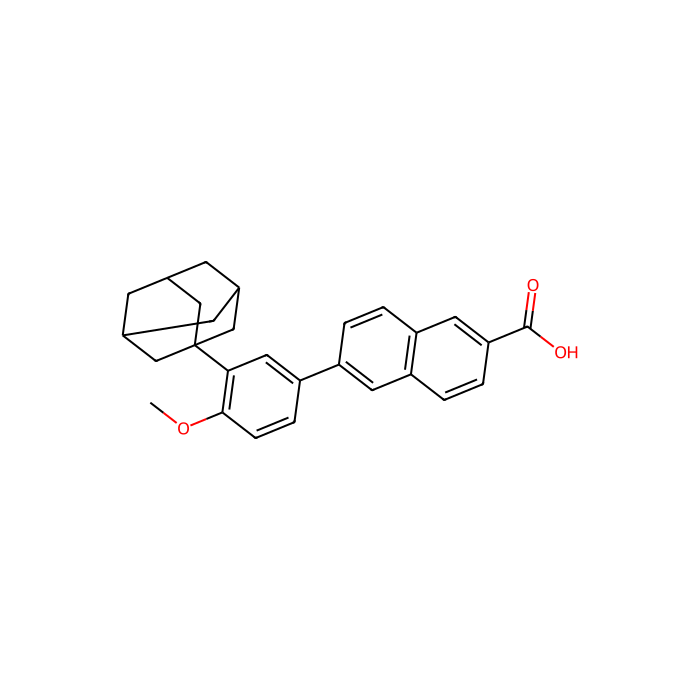
Adapalene Adapalene (CD-271) is a dual RAR and RXR agonist, used in the treatment of acne.
In vitro
Adapalene binds to retinoic acid receptors found predominantly in the terminal differentiation zone of epidermis and is more active than tretinoin in modulating cellular differentiation. Adapalene shows greatest affinity for the subtype PARγ, found predominantly in the epidermis. Adapalene is more active than indomethacin, betamethasone valerate, tretinoin, isotretinoin or etretinate in inhibiting lipoxygease activity, but it has little activity against cyclo-oxygenase. Adapalene time- and dose-dependently suppresses DNA synthesis and induces apoptosis in Colon carcinoma cell lines CC-531, HT-29 and LOVO as well as human foreskin fibroblasts. Adapalene shows significantly more effective antiproliferative and proapoptotic effects than 9-cis-retinoic acid (CRA), showing remarkable effects even at 10 μM. Adapalene disrupts DeltaPsi(m) and induces caspase-3 activity in responsive tumor cells.
In vivo
Adapalene produces a dose-related reduction in the number of epidermal comedones and an increase in comedo profile and epidermal thickness in the rhino mice. Adapalene results in a decreased expression of TLR-2 and IL-10 in explants of normal skin and explants of acne. Adapalene can modulate the epidermal immune system by increasing the CD1d expression and by decreasing the IL-10 expression by keratinocytes, and these modulations can increase the interactions between dendritic cells and T lymphocytes and could strengthen the antimicrobial activity against Propionibacterium acnes.
Cell Data
cell lines:
Concentrations:
Incubation Time:
Powder Purity:≥99%
Documento completo su pericoli, manipolazione, stoccaggio e conformità normativa.
<<<<<<< HEAD Scarica SDS → ======= Scarica SDS → >>>>>>> release248-p3Dati di qualità specifici del lotto. Inserisci il numero di lotto per recuperare il COA esatto.
Cerca COA →Riepilogo di riferimento rapido delle specifiche e applicazioni del prodotto.
Visualizza scheda tecnica →Attributi di qualità completi e criteri di accettazione per questa qualità.
Visualizza scheda delle specifiche →| Activity Type | Activity Value -log(M) | Mechanism of Action | Activity Reference | Publications (PubMed IDs) |
|---|
| Activity Type | Activity Value -log(M) | Mechanism of Action | Activity Reference | Publications (PubMed IDs) |
|---|
| Activity Type | Activity Value -log(M) | Mechanism of Action | Activity Reference | Publications (PubMed IDs) |
|---|
| Activity Type | Activity Value -log(M) | Mechanism of Action | Activity Reference | Publications (PubMed IDs) |
|---|
| Punto di fusione (°C) | 301℃ |
|---|
La nostra guida alla selezione delle qualità copre purezza, stato dello stabilizzatore e idoneità all'applicazione per tutte le varianti del nostro catalogo.
Visualizza la guida alle qualità Moligand™ →