Determine the necessary mass, volume, or concentration for preparing a solution.
| Activity Type | Activity Value -log(M) | Mechanism of Action | Activity Reference | Publications (PubMed IDs) |
|---|

Information
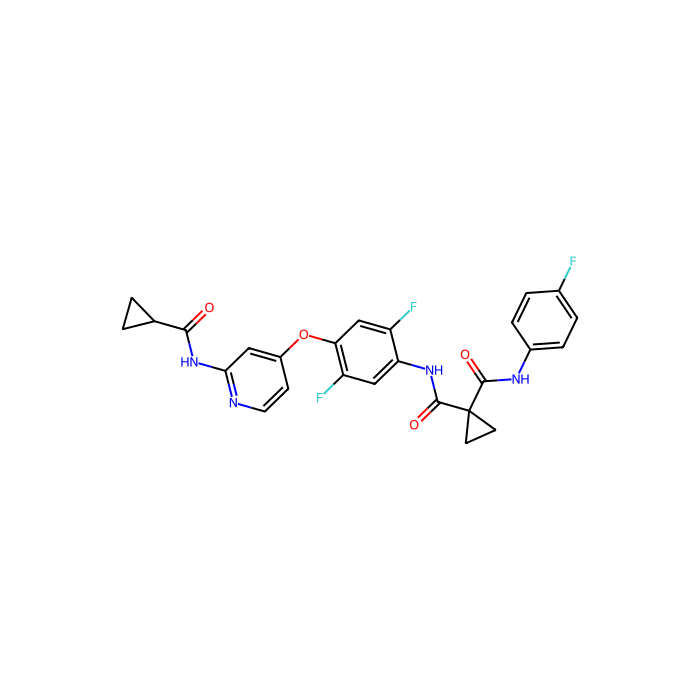
Altiratinib (DCC-2701) is a potent single-digit nanomolar inhibitor ofTRK, Met (c-Met), TIE2, and VEGFR2 kinaseswith IC50 vaules of 0.9 nM, 4.6 nM, and 0.8 nM for TRKA, B, and C, respectively. It inhibits Met (c-Met) and Met (c-Met) mutant with IC50 values in the range of 0.3-6 nM.
Targets
MET Y1230C (Cell-free assay); TrkA (Cell-free assay); TrkC (Cell-free assay); MET Y1230C (Cell-free assay); MET D1228N (Cell-free assay) 31650,0.37 nM; 0.85 nM; 0.85 nM; 1.2 nM; 1.3 nM
In vitro
Altiratinib is >10-fold selective for MET versus FMS and KIT, and >50-fold selective for MET versus ABL1, FYN, HER1 (EGFR), p38α (MAPK14), PDGFRα, PDGFRβ, RET, and SRC. Altiratinib exhibits IC50s of 0.69 nmol/L in K562 cells, 1.2 nmol/L in SK-N-SH cells for inhibition of NGF-stimulated TRKA phosphorylation. Altiratinib inhibits constitutive TRKA phosphorylation with an IC50 of 1.4 nmol/L in KM-12 cells. Altiratinib inhibits HGF-stimulated MET phosphorylation in HUVECs, exhibiting an IC50 of 2.3 nmol/L. In ANG1-stimulated HUVECs and EA.hy926 cells, altiratinib exhibits IC50 values of 1.0 nmol/L and 2.6 nmol/L, respectively, for inhibition of TIE2 phosphorylation. In VEGF-stimulated HUVECs, altiratinib inhibits VEGFR2 phosphorylation with an IC50 of 4.7 nmol/L. Altiratinib potently inhibits cellular proliferation in MET-amplified EBC-1 and MKN-45 cells, as well as TPM3-TRKA fusion KM-12 cells, but only weakly inhibits other cancer cell lines, including proliferation of M-NFS-60 (IC50, 770 nmol/L); A375, BT-474, HCT-116, PC-3, SK-MEL-28, U87, and A549 cells (IC50s > 1,000 nmol/L).
Cell Research(from reference)
Cell lines:EBC-1, M-NFS-60, SK-MEL-28, MKN-45, MV-4-11, A375, HCT-116, BT-474, KM-12, PC-3, and U-87-MG cells
Incubation Time:72 h
Taxonomy Tree
| Kingdom | Organic compounds |
|---|---|
| Superclass | Organic oxygen compounds |
| Classe | Organooxygen compounds |
| Subclass | Ethers |
| Intermediate Tree Nodes | Not available |
| Direct Parent | Diarylethers |
| Alternative Parents | Anilides Phenoxy compounds Phenol ethers N-arylamides Fluorobenzenes Aryl fluorides Cyclopropanecarboxylic acids and derivatives Pyridines and derivatives Imidolactams Heteroaromatic compounds Secondary carboxylic acid amides Azacyclic compounds Hydrocarbon derivatives Carbonyl compounds Organofluorides Organic oxides |
| Molecular Framework | Aromatic heteromonocyclic compounds |
| Substituents | Diaryl ether - Anilide - Phenol ether - N-arylamide - Phenoxy compound - Fluorobenzene - Halobenzene - Aryl halide - Monocyclic benzene moiety - Imidolactam - Benzenoid - Aryl fluoride - Cyclopropanecarboxylic acid or derivatives - Pyridine - Heteroaromatic compound - Carboxamide group - Secondary carboxylic acid amide - Carboxylic acid derivative - Organoheterocyclic compound - Azacycle - Organonitrogen compound - Organic nitrogen compound - Hydrocarbon derivative - Organic oxide - Carbonyl group - Organohalogen compound - Organofluoride - Aromatic heteromonocyclic compound |
| Descrizione | This compound belongs to the class of organic compounds known as diarylethers. These are organic compounds containing the dialkyl ether functional group, with the formula ROR', where R and R' are aryl groups. |
| External Descriptors | Not available |
| Activity Type | Activity Value -log(M) | Mechanism of Action | Activity Reference | Publications (PubMed IDs) |
|---|
| Activity Type | Activity Value -log(M) | Mechanism of Action | Activity Reference | Publications (PubMed IDs) |
|---|
| Activity Type | Activity Value -log(M) | Mechanism of Action | Activity Reference | Publications (PubMed IDs) |
|---|
| Activity Type | Activity Value -log(M) | Mechanism of Action | Activity Reference | Publications (PubMed IDs) |
|---|
| Activity Type | Activity Value -log(M) | Mechanism of Action | Activity Reference | Publications (PubMed IDs) |
|---|
| Activity Type | Activity Value -log(M) | Mechanism of Action | Activity Reference | Publications (PubMed IDs) |
|---|
| Activity Type | Relation | Activity value | Units | Action Type | Journal | PubMed Id | doi | Assay Aladdin ID |
|---|
| Activity Type | Relation | Activity value | Units | Action Type | Journal | PubMed Id | doi | Assay Aladdin ID |
|---|
| Activity Type | Relation | Activity value | Units | Action Type | Journal | PubMed Id | doi | Assay Aladdin ID |
|---|
| Activity Type | Relation | Activity value | Units | Action Type | Journal | PubMed Id | doi | Assay Aladdin ID |
|---|
| Activity Type | Relation | Activity value | Units | Action Type | Journal | PubMed Id | doi | Assay Aladdin ID |
|---|
| Activity Type | Relation | Activity value | Units | Action Type | Journal | PubMed Id | doi | Assay Aladdin ID |
|---|
| Activity Type | Relation | Activity value | Units | Action Type | Journal | PubMed Id | doi | Assay Aladdin ID |
|---|
| Activity Type | Relation | Activity value | Units | Action Type | Journal | PubMed Id | doi | Assay Aladdin ID |
|---|
| Activity Type | Relation | Activity value | Units | Action Type | Journal | PubMed Id | doi | Assay Aladdin ID |
|---|
| Activity Type | Relation | Activity value | Units | Action Type | Journal | PubMed Id | doi | Assay Aladdin ID |
|---|
| Activity Type | Relation | Activity value | Units | Action Type | Journal | PubMed Id | doi | Assay Aladdin ID |
|---|
| Activity Type | Relation | Activity value | Units | Action Type | Journal | PubMed Id | doi | Assay Aladdin ID |
|---|
Find and download the COA for your product by matching the lot number on the packaging.
| Lot Number | Certificate Type | Data | Oggetto |
|---|---|---|---|
 I2622134 | Certificate of Analysis | Sep 29, 2026 | A413439 |
| G2206024 | Certificate of Analysis | Apr 07, 2025 | A413439 |
| G2206025 | Certificate of Analysis | Apr 07, 2025 | A413439 |
| G2206046 | Certificate of Analysis | Apr 07, 2025 | A413439 |
| Solubilità | Solubility (25°C) In vitro DMSO: 100 mg/mL (195.9 mM); Water: Insoluble; Ethanol: Insoluble; |
|---|---|
| DMSO (mg/mL) Solubilità massima | 100 |
| DMSO (mM) Solubilità massima | 195.901735689378 |
| Acqua (mg/mL) Solubilità massima | <1 |
| Peso molecolare | 510.5 |
| XLogP3 | 4.300 |
| Hydrogen Bond Donor Count | 3 |
| Hydrogen Bond Acceptor Count | 8 |
| Rotatable Bond Count | 8 |
| Exact Mass | 510.151 Da |
| Monoisotopic Mass | 510.151 Da |
| Topological Polar Surface Area | 109.000 Ų |
| Heavy Atom Count | 37 |
| Formal Charge | 0 |
| Complexity | 863.000 |
| Isotope Atom Count | 0 |
| Defined Atom Stereocenter Count | 0 |
| Undefined Atom Stereocenter Count | 0 |
| Defined Bond Stereocenter Count | 0 |
| Undefined Bond Stereocenter Count | 0 |
| The total count of all stereochemical bonds | 0 |
| Covalently-Bonded Unit Count | 1 |
H302:Harmful if swallowed
H315:Causes skin irritation
H319:Causes serious eye irritation
H335:May cause respiratory irritation
P261:Avoid breathing dust/fume/gas/mist/vapors/spray.
P305+P351+P338:IF IN EYES: Rinse cautiously with water for several minutes. Remove contact lenses if present and easy to do - continue rinsing.
La nostra guida alla selezione delle qualità copre purezza, stato dello stabilizzatore e idoneità all'applicazione per tutte le varianti del nostro catalogo.
Visualizza la guida alle qualità Moligand™ →