per flussi di lavoro cromatografici e analitici sensibili che richiedono un'interferenza minima della linea di base.
🌡
Stoccaggio e spedizione
Store at 2-8°C Spedizione Wet ice. Consultare il COA specifico del lotto per le specifiche esatte.
📋
Documenti di qualità
SDS, COA, scheda tecnica e scheda delle specifiche disponibili per il download. COA specifico del lotto accessibile tramite ricerca per numero di lotto.
📚
Prova documentale
Citato in 0 pubblicazioni peer-reviewed su cromatografia, sintesi organica e reazioni di accoppiamento incrociato.
Specifiche
Condizioni di conservazione di stoccaggio
Store at 2-8°C
Spedito in
Wet ice
Questo prodotto richiede spedizione a catena fredda. I servizi di terra e altri servizi economici non sono disponibili.
Nomi e identificatori
Sorrisi canonici
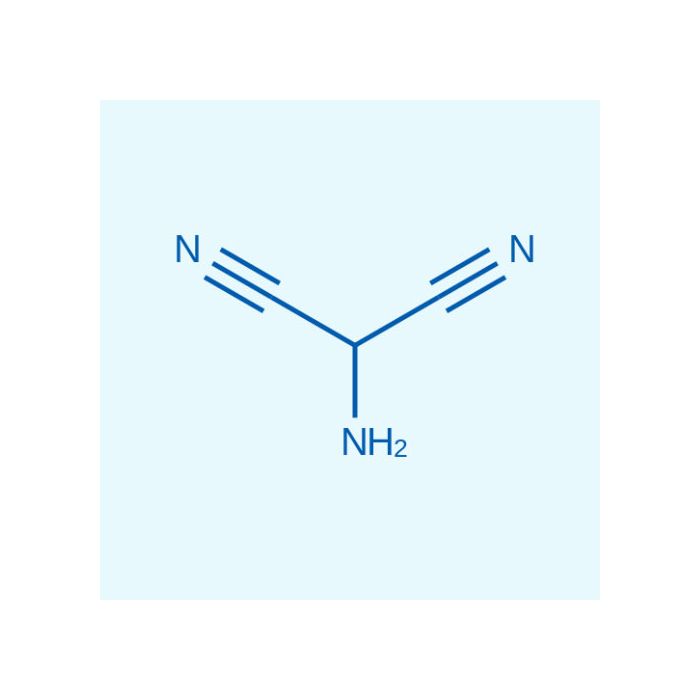
C(#N)C(C#N)N
IUPAC Name
2-aminopropanedinitrile
InChIKey
GXDKXRIMUVUELI-UHFFFAOYSA-N
INCHI
1S/C3H3N3/c4-1-3(6)2-5/h3H,6H2
Peso molecolare
81.08
Documentazione
📋 Scheda di dati di sicurezza (SDS)
Documento completo su pericoli, manipolazione, stoccaggio e conformità normativa.
This compound belongs to the class of organic compounds known as alpha-aminonitriles. These are organonitrogen compounds that contain an amino group located on the carbon at the position alpha to a carbonitrile group. They have the general formula RC(NH2)C#N, where the amine group can be substituted.
External Descriptors
Not available
1. Djoumbou Feunang Y, Eisner R, Knox C, Chepelev L, Hastings J, Owen G, Fahy E, Steinbeck C, Subramanian S, Bolton E, Greiner R, and Wishart DS. ClassyFire: Automated Chemical Classification With A Comprehensive, Computable Taxonomy. Journal of Cheminformatics, 2016, 8:61.
Certificati (CoA, COO, BSE/TSE e tabella di analisi)
C of A & Other Certificates(BSE/TSE, COO):
Analytical Chart:
Proprietà chimiche e fisiche
Peso molecolare
81.080 g/mol
XLogP3
-0.900
Hydrogen Bond Donor Count
1
Hydrogen Bond Acceptor Count
3
Rotatable Bond Count
0
Exact Mass
81.0327 Da
Monoisotopic Mass
81.0327 Da
Topological Polar Surface Area
73.600 Ų
Heavy Atom Count
6
Formal Charge
0
Complexity
103.000
Isotope Atom Count
0
Defined Atom Stereocenter Count
0
Undefined Atom Stereocenter Count
0
Defined Bond Stereocenter Count
0
Undefined Bond Stereocenter Count
0
The total count of all stereochemical bonds
0
Covalently-Bonded Unit Count
1
Calcolatori di soluzioni
Molarity Calculator
Determine the necessary mass, volume, or concentration for preparing a solution.
Dilution Calculator
Determine the dilution needed to prepare a stock solution.
Reconstitution Calculator
Recensioni
Recensioni dei clienti
Application Protocols
Not applicable. No validated bioassay protocols (e.g., WB, IHC, IF, FC) apply to this small-molecule reagent. For synthetic protocols, refer to the Reaction Conditions and Synthetic Utility sections and adapt to your substrates and scale.
Biological Roles
This product is supplied strictly for research use in chemical laboratories. No medical or clinical applications are supported.
Literature context (biochemistry/prebiotic chemistry; non-clinical):
Aminomalononitrile is noted as a transient intermediate in the oligomerization of hydrogen cyanide (HCN) chemistry and can lead to diaminomaleonitrile (DAMN), a precursor invoked in prebiotic syntheses of N-heteroaromatics (e.g., purine-like scaffolds). Such roles are mechanistic/chemical and not biological functions in extant organisms.
In bioconjugation-like settings, the primary amine can, in principle, form imines (Schiff bases) with aldehydes under physiological-type conditions, but hydrolytic lability and potential toxicity of nitrile-containing fragments generally preclude biological use.
Takeaway for users: Treat aminomalononitrile as a model compound for chemical evolution studies or as a synthetic building block. Do not introduce into biological systems, cultures, or in vivo models. Follow institutional approvals and risk assessments for any work mimicking biochemical conditions.
Buffer Applications
Aminomalononitrile is not a buffering agent and is not typically used to prepare biological or analytical buffers. Its primary amine could engage in acid–base equilibria, but the presence of two nitriles and potential hydrolysis/polymerization make it unsuitable for robust buffering systems.
For pH control in reactions involving aminomalononitrile, use established buffer systems (e.g., acetate, phosphate, citrate) or non-nucleophilic organic bases/acids, ensuring compatibility with nitriles. Avoid strongly acidic or basic aqueous buffers if hydrolysis is a concern.
Green Alternatives
While aminomalononitrile is a reagent rather than a solvent, greener choices can be made in how it is handled and deployed.
Safer form and delivery:
Consider stabilized salt forms (e.g., p-toluenesulfonate, literature) to reduce volatility and improve handling safety. Trade-off: counterion introduces mass and may influence solubility; base is needed to free the amine in situ.
Greener solvent choices (for common transformations; literature):
Prefer bio-based ethanol or 2-propanol for condensations and cyclizations when feasible.
MeCN is effective but petro-derived; if possible, replace with 2-MeTHF or CPME as co-solvents for water removal, noting solubility limitations for polar salts.
Energy and work-up considerations:
Run at ambient temperature with catalytic acid/base when possible; apply Dean–Stark or molecular sieves instead of azeotropes with hazardous solvents.
Choose aqueous work-ups that avoid strong acids/bases to limit hydrolysis byproducts and cyanide-associated waste.
Comparison (illustrative; literature-based):
Ethanol: renewable, good for imine formation; easy removal; sometimes slower kinetics vs MeCN.
MeCN: cleaner profiles, low water; less green; excellent control over moisture-sensitive steps.
2-MeTHF/CPME: greener ethers; may need co-solvent to dissolve the polar reagent; flammability and peroxide management considerations.
Waste minimization: Plan telescoped sequences (e.g., in situ imine formation followed by cyclization) to reduce isolations and solvent usage.
Pharmaceutical Uses
No therapeutic or clinical uses are claimed or supported. For research and process development only.
Role as an intermediate: Aminomalononitrile can serve as a C3 aminonitrile synthon for assembling heteroaromatic cores (e.g., diaminopyrimidines, imidazoles) that may appear in medicinally relevant scaffolds. Its value is upstream in route scouting or library generation rather than as an excipient.
Regulatory status: No pharmacopeial monograph known for the free base. Any use in GMP contexts would require internal specification setting, impurity profiling, and validated methods (identity, assay, residual solvents, elemental impurities) aligned with ICH guidance. Counterion selection (if using a salt) may affect regulatory evaluation.
Practical considerations:
Ensure thorough removal or transformation of nitriles where required by safety assessments.
Salt forms may aid isolation and purification during route development. Confirm compatibility of counterions and any quench/work-up steps with downstream unit operations.
Physical Properties
Item-specific properties (specs):
Appearance: Not specified for this item; refer to CoA/Spec Sheet.
Grade/Purity: Not specified for this item; refer to CoA/Spec Sheet.
Storage/Shipping (Product Data):
Storage Conditions: Store at 2-8°C
Shipped In: Wet ice
Literature and computed reference values (non-spec):
Typical formula and mass (free base): C3H3N3; MW ≈ 81.07 g/mol (literature)
Acid–base behavior: primary amine expected pKaH (conjugate acid) in the range ~5–7 due to strong inductive withdrawal by two nitriles (literature, approximate). Neutral amine is significantly less basic than aliphatic amines.
Polarity and solubility (qualitative, literature):
Polar, H-bond donor (1) and acceptor (>1). Often soluble in polar protic and aprotic media (MeOH, EtOH, MeCN, DMF, DMSO); stability in water may be limited by hydrolysis or polymerization under certain conditions.
Boiling/Melting points: Not widely reported for the free base due to instability; many users employ stabilized salts. No item-specific BP/MP available here.
LogP: Expected low/negative (literature qualitative) due to nitriles and amine; exact value not specified.
Refractive index, density, UV cutoff: Not specified for this item; refer to CoA/Spec Sheet.
Important: Treat all literature values as general context only. For exact, lot-specific physical data (including water content, residual solvents, and assay), consult the item CoA/Spec Sheet.
Quality and Grades
Grade/Purity (Product Data): Not specified for this item; refer to CoA/Spec Sheet.
Guidance on grades and implications (general):
Analytical/Reagent grade: Typically controlled for assay and common impurities (water, residual solvents, inorganic salts). For amine–nitrile building blocks, trace moisture and protic impurities materially affect reactivity and polymerization propensity.
Synthesis grade: Suitable for routine transformations; may have broader impurity limits. Adequate for exploratory heterocyclizations or multicomponent reactions when yields are robust to minor impurities.
High-purity/Low-UV grade: Beneficial for kinetic/photochemical studies or LC monitoring; controlled UV absorbance background in relevant ranges.
Stabilizers and salt forms:
Many labs prefer stabilized salt forms of aminomalononitrile (e.g., p-toluenesulfonate) for safer handling and improved shelf life. If your application tolerates the counterion, the salt can offer better batch-to-batch consistency and reduced volatility/odor versus the free base. Verify the supplied form on the CoA/Spec Sheet before process design.
Quality control recommendations:
For moisture/acid-sensitive uses: Karl Fischer moisture and titratable acidity/alkalinity checks are recommended.
Identity: 1H NMR (diagnostic methine near 4–5 ppm in polar solvents), 13C NMR (nitrile carbons ~114–120 ppm), IR (C≡N stretch ~2220–2260 cm−1; literature), and HRMS. If salt form is used, confirm counterion by 1H NMR and ion chromatography.
Always rely on the lot-specific CoA/Spec Sheet for definitive specifications.
Reaction and Applications
Aminomalononitrile serves as a compact, highly activated synthon combining a nucleophilic primary amine with two electron-withdrawing nitriles. This juxtaposition enables rich reactivity patterns useful to synthetic and prebiotic chemistries (literature context below).
Condensation and cyclization chemistry (literature):
Cyclocondensation with aldehydes/1,2-dicarbonyls to furnish aminoimidazoles and imidazolines; acid or base catalysis in EtOH/MeCN at ambient to reflux temperatures.
Assembly of 2,4-diaminopyrimidine cores via condensation with formamidines or equivalent C–N donors, often under ethanolic reflux or in DMF.
Formation of diaminomaleonitrile (DAMN) and related oligomers under controlled oxidative or base-mediated conditions; these motifs are gateways to higher N-heteroaromatics in prebiotic paradigms.
Nitrile transformations (literature):
Stepwise or tandem conversions to amidines, amides, or carboxylic acids via partial/complete nitrile hydrolysis (catalyzed by acids/bases or metal salts).
Cycloaddition and annulation strategies leveraging the pair of nitriles as electrophilic handles (e.g., with nucleophiles or 1,3-dinucleophiles) to access imidazoles, triazines, and pyrimidines.
Multicomponent reactions (literature):
Participation in Strecker-type or Mannich-like manifolds where the amine first forms an imine/iminium followed by intramolecular capture.
Practical tips:
Control moisture and pH to steer between imine formation and undesired hydrolysis/polymerization.
Use buffered conditions or molecular sieves for water removal in condensations.
If handling challenges arise, consider using a stabilized salt form (e.g., p-toluenesulfonate) and liberating the free base in situ with a non-nucleophilic base.
Applications: heterocycle library synthesis, method development in nitrile chemistry, and model systems in origin-of-life studies (research use only).
Reaction Conditions
General literature guidance (non-spec; optimize for your system):
Imidazole formation from aminomalononitrile and aldehydes:
Solvent: EtOH, i-PrOH, or DMF when solubility is limiting.
Base: Mild (e.g., Et3N, DIPEA) or neutral conditions; avoid strong base to limit nitrile hydrolysis.
Temperature: 60–110°C; 4–16 h.
Notes: Sequential addition (imine first, then N-source) can improve selectivity.
Nitrile hydrolysis to amide/amidine derivatives:
Reagents: Aqueous mineral acid (H2SO4, HCl) or base (NaOH), or metal-catalyzed hydration (e.g., Pt, Ru catalysts; literature).
Solvent: H2O/MeCN or neat aqueous; monitor carefully to avoid over-hydrolysis or polymerization.
Temperature: 25–80°C.
Reductive routes:
Reagents: BH3·THF or catalytic hydrogenation (Pd/C) under mild H2 pressure for partial/complete nitrile reduction (substrate-dependent).
Solvent: THF, EtOH, or MeOH; ensure compatibility with amine.
Work-up tips:
Quench under controlled pH to avoid liberating cyanide species.
Use brine and rapid extractions; dry organic layers thoroughly.
If salts are formed, adjust pH to partition appropriately and avoid emulsions.
Safety and Handling
Item-specific hazard information:
Signal Word: Not specified for this item; refer to SDS.
H-Statements: Not specified for this item; refer to SDS.
GHS Classification/Pictograms: Not specified for this item; refer to SDS.
General safety considerations (literature/good practice; defer to SDS):
Primary hazards: Contains a primary amine and two nitriles. Literature notes that α-aminodinitriles can undergo hydrolysis and, in strongly acidic or basic aqueous media, may generate species associated with cyanide chemistry. Avoid contact with strong acids/bases and moisture during handling. Work in a fume hood.
PPE: Lab coat, nitrile gloves (change frequently), splash goggles. Use a chemical-resistant apron and face shield for larger-scale operations.
Incompatibilities: Strong acids/bases, strong oxidants, and aqueous conditions that promote hydrolysis/polymerization. Avoid prolonged heating.
Handling: Minimize exposure to air and moisture. Keep containers tightly closed; consider inert atmosphere handling for the free base. Weigh quickly and transfer with dry tools.
First aid (overview; follow SDS/site policy):
Inhalation: Move to fresh air; seek medical attention.
Skin/eye contact: Immediate decontamination with copious water for ≥15 minutes; remove contaminated clothing; obtain medical evaluation.
Ingestion: Do not induce vomiting; rinse mouth; get urgent medical help.
Spill/cleanup: Contain, avoid dust, collect with inert absorbent, dispose as hazardous waste. Prevent entry into drains.
Fire: Use dry chemical, CO2, or alcohol-resistant foam. Combustion may produce nitrogen oxides and hydrogen cyanide; firefighters should use SCBA.
Always consult the Aladdin SDS for authoritative hazard and response guidance.
Solvent Selection
Aminomalononitrile is a polar, bifunctional aminonitrile. Solvent choice impacts both stability and chemoselectivity.
Polarity/Miscibility (literature, general):
Readily handled in polar aprotic solvents (MeCN, DMF, DMSO) and polar protic alcohols (MeOH, EtOH). Water may promote hydrolysis or side reactions under acidic/basic conditions; neutral, low-moisture conditions are preferred.
Stability considerations:
Avoid strongly acidic or basic aqueous media during storage or work-up to limit hydrolysis/polymerization.
For moisture-sensitive steps, use anhydrous MeCN or dry alcohols; perform under inert gas.
Typical use scenarios:
Condensations with aldehydes/ketones: EtOH, i-PrOH, or MeCN, often with catalytic acid/base and dehydrating conditions.
Cyclocondensations to imidazoles, diaminopyrimidines: EtOH or DMF at reflux or mild heating to balance solubility and reaction rate.
Comparison and selection tips (literature):
EtOH vs MeCN: EtOH is greener and can facilitate imine formation; MeCN provides higher nitrile stability and lower water content, often yielding cleaner profiles.
DMF/DMSO: Excellent solvation and rate acceleration but challenging removal; reserve for difficult substrates.
Nonpolar solvents (toluene, EtOAc): Generally poor solubility; may be used for azeotropic water removal with co-solvents.
Recommendation: Begin screens with absolute EtOH (green, protic) and anhydrous MeCN (aprotic), then escalate to DMF/DMSO only if required. Validate solvent effects on your specific substrate set.
Storage and Reconstitution
Item-specific storage and shipping (Product Data):
Storage Conditions: Store at 2-8°C
Shipped In: Wet ice
General guidance (literature/good practice; not item-specific specs):
Container: Tightly sealed amber glass vial or bottle to limit light and moisture ingress. Consider storing under inert gas (N2/Ar), especially for the free base.
Moisture control: Include desiccant in secondary containment. Open only in a low-humidity environment; recap promptly.
Stability: Aminomalononitrile and related aminodinitriles can be sensitive to hydrolysis/polymerization in humid or strongly acidic/basic environments. Avoid repeated warming/cooling cycles; aliquot for frequent use.
Reconstitution/solution preparation: Prepare fresh solutions in dry solvents (EtOH, MeCN, DMF, DMSO). Filter if necessary through PTFE. For salt forms, confirm counterion solubility and, if required, liberate the free base in situ with a non-nucleophilic base (e.g., DIPEA) immediately before use.
Freeze–thaw: If low-temperature storage of solutions is necessary, keep at ≤−20°C in moisture-tight vials; avoid multiple freeze–thaw cycles by aliquoting.
Always consult the CoA/Spec Sheet for form, assay, and any stabilizer information, and the SDS for definitive safety and handling instructions. Research use only.
Structure and Identity
Aminomalononitrile is a small, bifunctional C3 nitrile–amine building block commonly encountered as a prebiotic-chemistry intermediate and as a versatile nitrile donor in heterocycle synthesis.
Item-specific identifiers (Product Data):
CAS: 5181-05-5
InChIKey: 113897 (as provided)
SMILES: Not specified for this item; refer to CoA/Spec Sheet.
Molecular Formula: Not specified for this item; refer to CoA/Spec Sheet.
Molecular Weight: Not specified for this item; refer to CoA/Spec Sheet.
Literature structural identity (for reference only; not item-specific specs):
Commonly referenced neutral free base structure: H2N–CH(CN)2 (often described as α-aminomalononitrile)
Typical literature molecular formula: C3H3N3; formula mass ≈ 81.07 g/mol (literature)
2D structural features (literature):
One sp3 stereogenic center at the methine carbon bearing NH2 and two nitrile groups (formal prochiral center; racemization expected unless enantioenriched).
Two strongly electron-withdrawing nitriles (–C≡N) flanking a central carbon; one primary amine (–NH2).
Descriptive 2D structure in words (literature):
A central methine carbon bonded to two nitrile carbons and one amino group; each nitrile is linear (C≡N), and the amine is pyramidalized and nucleophilic. The juxtaposition of a basic amine with two activating nitriles creates a highly functionalized, ambident synthon that can undergo cyclocondensations and further nitrile transformations.
Note: Several stabilized salt forms (e.g., p-toluenesulfonate) are widely used in practice; confirm which form is supplied by consulting the CoA/Spec Sheet.
Synthetic Utility
Key functional groups and reactivity (literature):
Primary amine (nucleophilic; can form imines/iminium ions with carbonyls).
Two nitriles (strongly electron-withdrawing; can be hydrolyzed, reduced, or engaged in cyclizations; activate adjacent methine carbon for further transformations).
Named/representative transformations:
Cyclocondensation to aminoimidazoles from aminomalononitrile and aldehydes/1,2-dicarbonyls (often ethanol or MeCN, catalytic acid/base, ambient to reflux).
Assembly of 2,4-diaminopyrimidines via coupling with C–N donors (e.g., guanidine equivalents or amidines), exploiting the dual nitriles as electrophilic inputs.
Stepwise nitrile modifications: partial hydrolysis to amidines/amides; full hydrolysis to dicarboxamide/acid derivatives; reduction to diamines (e.g., with BH3 or catalytic hydrogenation) followed by intramolecular closures.
Prebiotic oligomerizations: conversion to diaminomaleonitrile (DAMN), a versatile intermediate leading to higher N-heteroaromatics.
Retrosynthetic value:
Serves as a compact synthon for embedding a masked 1,3-diamino fragment into heteroaromatic targets. The amine establishes C–N connectivity early (via imine), while nitriles survive and later unveil amidines/amides or participate in annulations.
Practical notes:
Control of pH and water activity is crucial to favor condensation over hydrolysis.
Using salt forms may tame reactivity and aid dosing; free base can be generated in situ with non-nucleophilic bases (e.g., DIPEA) in anhydrous media.
Target Specificity
Not applicable. This product is a small-molecule chemical reagent, not a biological targeting agent. No antigen/epitope, species reactivity, clone, or isotype information applies.
Utilizziamo i cookie per garantire il corretto funzionamento del sito web e, ove consentito, per migliorare la tua esperienza. Puoi gestire le tue preferenze in qualsiasi momento nelle Impostazioni. Per saperne di più, consulta la nostra Cookie Policy.
Desidera che le inviamo un messaggio quando avremo sconti disponibili?
Ricordamelo più tardi
Grazie! Controlli la sua casella di posta per confermare.
Products are supplied to verified businesses, institutions, and qualified professionals for research and development use only. Not for use in humans, animals, diagnosis, or therapy.