Determine the necessary mass, volume, or concentration for preparing a solution.
| Activity Type | Activity Value -log(M) | Mechanism of Action | Activity Reference | Publications (PubMed IDs) |
|---|

Information
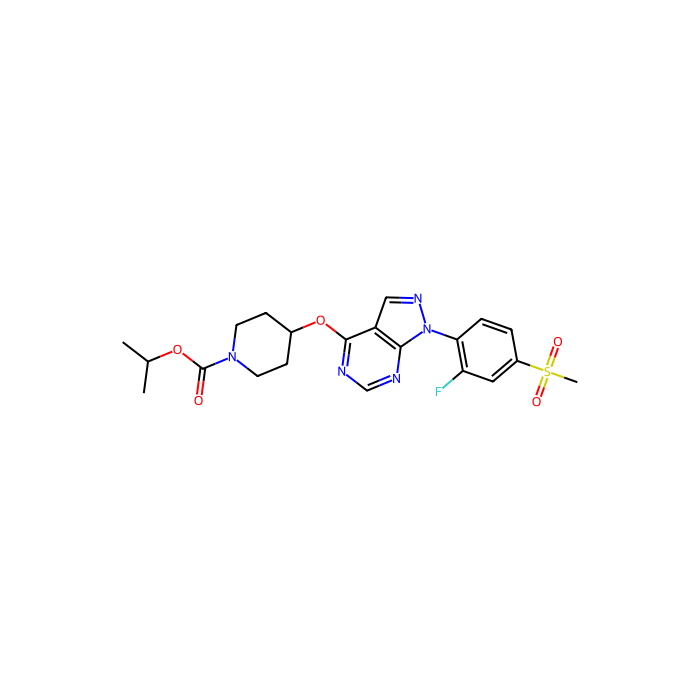
APD668 APD668 (JNJ28630368) is a potent GPR119 agonist with EC50s of 2.7 and 33 nM for human and rat forms, respectively.
Targets
human GPR119 ; rat GPR119 2.7 nM(EC50); 33 nM(EC50)
In vitro
APD668 is shown to increase adenylate cyclase activation in HEK293 cells transfected with human GPR119 (but not in non-transfected cells) in a concentration-dependent manner with an EC50 of 23 nM. APD668 also enhanced insulin release from both rat and human isolated pancreatic islets in a glucose-dependent manner. In a standard panel of around 80 known receptors and ion channels, APD668 did not show any binding in excess of 50% of control to any other proteins at concentrations up to 10 μM.
In vivo
Chronic treatment with APD668 showed that blood glucose and glycated hemoglobin (HbA1c) levels could be significantly reduced in Zucker Diabetic Fatty (ZDF) rats over several weeks of dosing. APD668 is highly bound to plasma proteins of male and female cynomolgus monkeys and humans (P99%), but was less extensively bound to male (93.0%) and female (96.6%) rats. In pharmacokinetic assessments across multiple species using single oral doses of APD668, absorption was rapid to moderate (Tmax 62 h) in mice, Sprague-Dawley (SD) rats, and monkeys, but slower in dogs (Tmax = 6 h) and showed a dose-dependent increase in rats and monkeys. In general, exposure was dose-dependent at lower doses and appeared to plateau at doses greater than 300 mg/kg. Exposure was greater in female rats compared with males. Absolute oral bioavailability was moderate to good in mice, rats, and monkeys (44–79%), but was lower in dogs (22%). The volume of distribution (Vdss) values were somewhat variable ranging from 0.1 L/kg in monkey to 2.6 L/kg in rats. Elimination, based on mean T1/2 after intravenous (iv) dosing, was rapid to moderate in mice, rats, dogs, and monkeys (0.8-3.9 h). The pharmacokinetic profile of APD668 in Zucker fa/fa rats was somewhat different from that in SD rats. After oral administration, the tmax and T1/2 were longer, and the AUC and the oral bioavailability were greater in the Zucker compared with the SD rats. Following iv administration, the Zucker rats also had larger AUC values, longer T1/2 values and greater Vdss values.
Taxonomy Tree
| Kingdom | Organic compounds |
|---|---|
| Superclass | Organoheterocyclic compounds |
| Classe | Azoles |
| Subclass | Pyrazoles |
| Intermediate Tree Nodes | Not available |
| Direct Parent | Phenylpyrazoles |
| Alternative Parents | Pyrazolo[3,4-d]pyrimidines Piperidinecarboxylic acids Benzenesulfonyl compounds Alkyl aryl ethers Fluorobenzenes Pyrimidines and pyrimidine derivatives Aryl fluorides Sulfones Carbamate esters Heteroaromatic compounds Azacyclic compounds Carbonyl compounds Organonitrogen compounds Organofluorides Organic oxides Hydrocarbon derivatives |
| Molecular Framework | Aromatic heteropolycyclic compounds |
| Substituents | Phenylpyrazole - Piperidinecarboxylic acid - Pyrazolo[3,4-d]pyrimidine - Pyrazolopyrimidine - Benzenesulfonyl group - Alkyl aryl ether - Fluorobenzene - Halobenzene - Benzenoid - Pyrimidine - Piperidine - Aryl halide - Monocyclic benzene moiety - Aryl fluoride - Carbamic acid ester - Sulfonyl - Sulfone - Heteroaromatic compound - Azacycle - Ether - Hydrocarbon derivative - Organofluoride - Organohalogen compound - Organonitrogen compound - Organooxygen compound - Carbonyl group - Organosulfur compound - Organic nitrogen compound - Organic oxygen compound - Organic oxide - Aromatic heteropolycyclic compound |
| Descrizione | This compound belongs to the class of organic compounds known as phenylpyrazoles. These are compounds containing a phenylpyrazole skeleton, which consists of a pyrazole bound to a phenyl group. |
| External Descriptors | Not available |
| Activity Type | Activity Value -log(M) | Mechanism of Action | Activity Reference | Publications (PubMed IDs) |
|---|
| Activity Type | Activity Value -log(M) | Mechanism of Action | Activity Reference | Publications (PubMed IDs) |
|---|
| Activity Type | Activity Value -log(M) | Mechanism of Action | Activity Reference | Publications (PubMed IDs) |
|---|
| Activity Type | Relation | Activity value | Units | Action Type | Journal | PubMed Id | doi | Assay Aladdin ID |
|---|
| Activity Type | Relation | Activity value | Units | Action Type | Journal | PubMed Id | doi | Assay Aladdin ID |
|---|
| Activity Type | Relation | Activity value | Units | Action Type | Journal | PubMed Id | doi | Assay Aladdin ID |
|---|
| Activity Type | Relation | Activity value | Units | Action Type | Journal | PubMed Id | doi | Assay Aladdin ID |
|---|
| Activity Type | Relation | Activity value | Units | Action Type | Journal | PubMed Id | doi | Assay Aladdin ID |
|---|
| Activity Type | Relation | Activity value | Units | Action Type | Journal | PubMed Id | doi | Assay Aladdin ID |
|---|
| Activity Type | Relation | Activity value | Units | Action Type | Journal | PubMed Id | doi | Assay Aladdin ID |
|---|
| Activity Type | Relation | Activity value | Units | Action Type | Journal | PubMed Id | doi | Assay Aladdin ID |
|---|
| Activity Type | Relation | Activity value | Units | Action Type | Journal | PubMed Id | doi | Assay Aladdin ID |
|---|
| Activity Type | Relation | Activity value | Units | Action Type | Journal | PubMed Id | doi | Assay Aladdin ID |
|---|
| Activity Type | Relation | Activity value | Units | Action Type | Journal | PubMed Id | doi | Assay Aladdin ID |
|---|
| Activity Type | Relation | Activity value | Units | Action Type | Journal | PubMed Id | doi | Assay Aladdin ID |
|---|
| Activity Type | Relation | Activity value | Units | Action Type | Journal | PubMed Id | doi | Assay Aladdin ID |
|---|
| Activity Type | Relation | Activity value | Units | Action Type | Journal | PubMed Id | doi | Assay Aladdin ID |
|---|
| Activity Type | Relation | Activity value | Units | Action Type | Journal | PubMed Id | doi | Assay Aladdin ID |
|---|
| Activity Type | Relation | Activity value | Units | Action Type | Journal | PubMed Id | doi | Assay Aladdin ID |
|---|
| Activity Type | Relation | Activity value | Units | Action Type | Journal | PubMed Id | doi | Assay Aladdin ID |
|---|
| Activity Type | Relation | Activity value | Units | Action Type | Journal | PubMed Id | doi | Assay Aladdin ID |
|---|
| Activity Type | Relation | Activity value | Units | Action Type | Journal | PubMed Id | doi | Assay Aladdin ID |
|---|
| Activity Type | Relation | Activity value | Units | Action Type | Journal | PubMed Id | doi | Assay Aladdin ID |
|---|
| Activity Type | Relation | Activity value | Units | Action Type | Journal | PubMed Id | doi | Assay Aladdin ID |
|---|
| Activity Type | Relation | Activity value | Units | Action Type | Journal | PubMed Id | doi | Assay Aladdin ID |
|---|
| Activity Type | Relation | Activity value | Units | Action Type | Journal | PubMed Id | doi | Assay Aladdin ID |
|---|
| Activity Type | Relation | Activity value | Units | Action Type | Journal | PubMed Id | doi | Assay Aladdin ID |
|---|
| Activity Type | Relation | Activity value | Units | Action Type | Journal | PubMed Id | doi | Assay Aladdin ID |
|---|
| Activity Type | Relation | Activity value | Units | Action Type | Journal | PubMed Id | doi | Assay Aladdin ID |
|---|
| Activity Type | Relation | Activity value | Units | Action Type | Journal | PubMed Id | doi | Assay Aladdin ID |
|---|
| Activity Type | Relation | Activity value | Units | Action Type | Journal | PubMed Id | doi | Assay Aladdin ID |
|---|
| Activity Type | Relation | Activity value | Units | Action Type | Journal | PubMed Id | doi | Assay Aladdin ID |
|---|
| Activity Type | Relation | Activity value | Units | Action Type | Journal | PubMed Id | doi | Assay Aladdin ID |
|---|
| Activity Type | Relation | Activity value | Units | Action Type | Journal | PubMed Id | doi | Assay Aladdin ID |
|---|
| Activity Type | Relation | Activity value | Units | Action Type | Journal | PubMed Id | doi | Assay Aladdin ID |
|---|
| Activity Type | Relation | Activity value | Units | Action Type | Journal | PubMed Id | doi | Assay Aladdin ID |
|---|
| Activity Type | Relation | Activity value | Units | Action Type | Journal | PubMed Id | doi | Assay Aladdin ID |
|---|
| Activity Type | Relation | Activity value | Units | Action Type | Journal | PubMed Id | doi | Assay Aladdin ID |
|---|
Find and download the COA for your product by matching the lot number on the packaging.
| Lot Number | Certificate Type | Data | Oggetto |
|---|---|---|---|
 H2223606 | Certificate of Analysis | Jun 09, 2025 | A413612 |
| H2223607 | Certificate of Analysis | Jun 09, 2025 | A413612 |
| H2223608 | Certificate of Analysis | Jun 09, 2025 | A413612 |
| H2223609 | Certificate of Analysis | Jun 09, 2025 | A413612 |
| H2223610 | Certificate of Analysis | Jun 09, 2025 | A413612 |
| Solubilità | Solubility (25°C) In vitro DMSO: 96 mg/mL (201.04 mM); Ethanol: 2 mg/mL (4.18 mM); Water: Insoluble; |
|---|---|
| DMSO (mg/mL) Solubilità massima | 96 |
| DMSO (mM) Solubilità massima | 201.042910096124 |
| Acqua (mg/mL) Solubilità massima | <1 |
| Peso molecolare | 477.5 |
| XLogP3 | 2.700 |
| Hydrogen Bond Donor Count | 0 |
| Hydrogen Bond Acceptor Count | 9 |
| Rotatable Bond Count | 6 |
| Exact Mass | 477.148 Da |
| Monoisotopic Mass | 477.148 Da |
| Topological Polar Surface Area | 125.000 Ų |
| Heavy Atom Count | 33 |
| Formal Charge | 0 |
| Complexity | 788.000 |
| Isotope Atom Count | 0 |
| Defined Atom Stereocenter Count | 0 |
| Undefined Atom Stereocenter Count | 0 |
| Defined Bond Stereocenter Count | 0 |
| Undefined Bond Stereocenter Count | 0 |
| The total count of all stereochemical bonds | 0 |
| Covalently-Bonded Unit Count | 1 |
H302:Harmful if swallowed
H315:Causes skin irritation
H319:Causes serious eye irritation
H335:May cause respiratory irritation
P264:Wash hands [and …] thoroughly after handling.
P270:Do not eat, drink or smoke when using this product.
P301+P312+P330:IF SWALLOWED: Call a POISON CENTER/ doctor if you feel unwell. Rinse mouth.
La nostra guida alla selezione delle qualità copre purezza, stato dello stabilizzatore e idoneità all'applicazione per tutte le varianti del nostro catalogo.
Visualizza la guida alle qualità Moligand™ →