Determine the necessary mass, volume, or concentration for preparing a solution.
| Activity Type | Activity Value -log(M) | Mechanism of Action | Activity Reference | Publications (PubMed IDs) |
|---|

10mM in DMSO per flussi di lavoro cromatografici e analitici sensibili che richiedono un'interferenza minima della linea di base.
Store at -80°C Spedizione Dry ice packs + Cold packs. Consultare il COA specifico del lotto per le specifiche esatte.
SDS, COA, scheda tecnica e scheda delle specifiche disponibili per il download. COA specifico del lotto accessibile tramite ricerca per numero di lotto.
Citato in 0 pubblicazioni peer-reviewed su cromatografia, sintesi organica e reazioni di accoppiamento incrociato.
Information
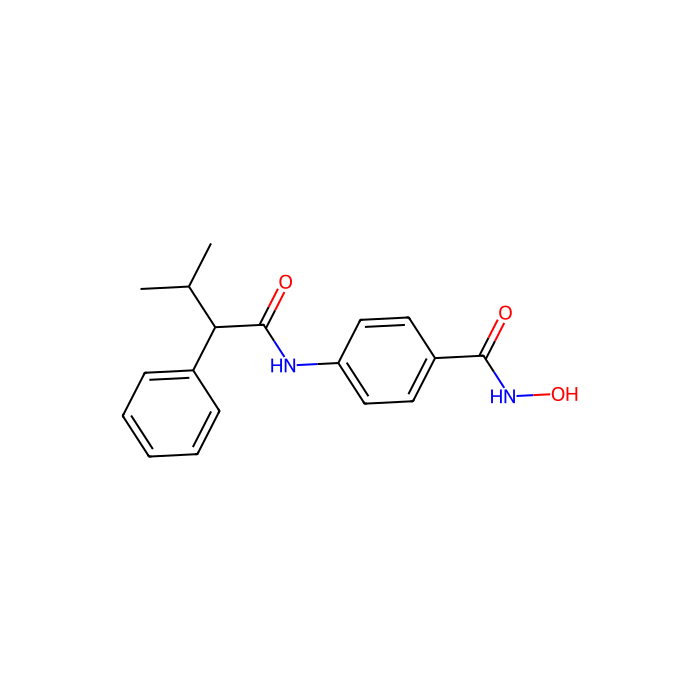
AR-42 AR-42 (HDAC-42) is an HDAC inhibitor with IC50 of 30 nM. Phase 1.
In vitro
AR-42 treatment induces histone hyperacetylation and p21WAF/CIP1 overexpression, and inhibits the growth of DU-145 cells with IC50 of 0.11 μM. HDAC42 is potent in suppressing the proliferation of U87MG and PC-3 cells, in part, because of its ability to down-regulate Akt signaling. AR-42 inhibits the growth of PC-3 and LNCaP cells with IC50 of 0.48 μM and 0.3 μM, respectively. Compared to SAHA, AR-42 exhibits distinctly superior apoptogenic potency, and causes markedly greater decreases in phospho-Akt, Bcl-xL, and survivin in PC-3 cells. AR-42 treatment induces growth inhibition, cell- cycle arrest, apoptosis, and activation of caspases-3/7 in malignant mast cell lines. AR-42 treatment induces down-regulation of Kit via inhibition of Kit transcription, disassociation between Kit and heat shock protein 90 (HSP90), and up-regulation of HSP70. AR-42 treatment down-regulates the expression of p-Akt, total Akt, phosphorylated STAT3/5 (pSTAT3/5), and total STAT3/5. AR-42 potently inhibits the growth of JeKo-1, Raji, and 697 cells with IC50 of <0.61 μM. AR-42 also sensitizes CLL cells to TNF-Related Apoptosis Inducing Ligand (TRAIL), potentially through reduction of c-FLIP. AR-42 treatment also induces autophagy through downregulation of Akt/mTOR signaling and inducing ER stress in hepatocellular carcinoma (HCC) cells.
In vivo
The growth of PC-3 tumor xenografts is suppressed by 52% and 67% after treatment with AR-42 at 25 mg/kg and 50 mg/kg, respectively, whereas SAHA at 50 mg/kg suppresses growth by 31%. In contrast to mice treated with SAHA, intratumoral levels of phospho-Akt and Bcl-xL are markedly reduced in AR-42 treated mice. In the transgenic adenocarcinoma of the mouse prostate (TRAMP) model, administration of AR-42 not only decreases the severity of prostatic intraepithelial neoplasia (PIN) and completely prevents its progression to poorly differentiated carcinoma, but also shifts tumorigenesis to a more differentiated phenotype, suppressing absolute and relative urogenital tract weights by 86% and 85%, respectively. AR-42 significantly reduces leukocyte counts, and prolongs survival in three separate mouse models of B-cell malignancy without evidence of toxicity.
Cell Data
cell lines:Differentiated HL60 (dHL60) cells
Concentrations:Dissolved in DMSO, final concentrations ~2.5 μM
Incubation Time:96 hours
Powder Purity:≥99%
Documento completo su pericoli, manipolazione, stoccaggio e conformità normativa.
<<<<<<< HEAD Scarica SDS → ======= Scarica SDS → >>>>>>> release248-p3Dati di qualità specifici del lotto. Inserisci il numero di lotto per recuperare il COA esatto.
Cerca COA →Riepilogo di riferimento rapido delle specifiche e applicazioni del prodotto.
Visualizza scheda tecnica →Attributi di qualità completi e criteri di accettazione per questa qualità.
Visualizza scheda delle specifiche →| Activity Type | Activity Value -log(M) | Mechanism of Action | Activity Reference | Publications (PubMed IDs) |
|---|
| Activity Type | Activity Value -log(M) | Mechanism of Action | Activity Reference | Publications (PubMed IDs) |
|---|
| Activity Type | Activity Value -log(M) | Mechanism of Action | Activity Reference | Publications (PubMed IDs) |
|---|
| Activity Type | Activity Value -log(M) | Mechanism of Action | Activity Reference | Publications (PubMed IDs) |
|---|
| Solubilità | Solubility (25°C) In vitro DMSO: 100 mg/mL (64.48 mM); Water: 100 mg/mL (64.48 mM); Ethanol: 50 mg/mL (32.24 mM); |
|---|
Item-specific, validated application protocols are not provided in the Product Data. The following are general, literature-informed procedures for using HDAC inhibitor tool compounds in research.
Cell-based assay (general)
Biochemical HDAC inhibition assay (general)
Compound handling
Controls and artifacts
Note
General/literature context (not item-specific claims): AR-42 is widely reported as a hydroxamate-based inhibitor of histone deacetylases (HDACs), enzymes that remove acetyl groups from lysine residues on histones and many non-histone proteins.
Biochemical/biological effects (literature)
Use as a research probe
Caveats
This compound is not a buffering agent and is not used to set or maintain pH. However, buffer selection is critical for its use in biochemical and cell-based assays.
Practical guidance
Stability considerations
Documentation
Green chemistry considerations for AR-42 focus on solvent and process choices during handling, formulation, and any derivatization work.
Greener handling strategies
Comparison of vehicle options (general)
Operational green tips
Note
No pharmaceutical or clinical uses are claimed for this catalog item; it is for research use only.
Formulation research context (general)
Excipient and stability notes
Compliance
Item-specific physical constants are not provided in the Product Data. Use the following guidance to plan handling and formulation; verify all critical values experimentally or via the CoA.
Item-specific values
General/literature characteristics for small-molecule HDAC inhibitors
Practical notes
Item-specific grade/purity details are not provided in the Product Data.
Guidance on interpreting common grades (general)
Quality considerations and recommended checks
Documentation
This product is primarily used as a bioactive small-molecule tool rather than as a synthetic reagent.
Research applications (literature/general for AR-42-like HDAC inhibitors)
Practical tips for biological use
Not a general reagent for named organic reactions
Not typically applicable: AR-42 is used as a bioactive small-molecule probe rather than as a reagent/catalyst in synthetic transformations.
If conducting derivatization (general literature guidance for related scaffolds)
Biological assay conditions (practical use)
Note
Authoritative safety information must come from the product’s SDS. The following points are general best practices for research compounds of this class.
GHS/Classification (item-specific)
General laboratory precautions
First-aid overview (refer to SDS for details)
Special risks/handling notes
AR-42 is typically handled as a concentrated organic stock for biological assays. Because item-specific solubility data are not provided, select solvents following general best practices for hydrophobic, heteroatom-containing small molecules.
Recommended primary solvents (general)
Co-solvent and vehicle strategies
Polarity and miscibility (general)
Comparison guidance (general)
Storage
Reconstitution
Aliquoting and stability
Shelf-life and specifications
Disposal
Brief overview: AR-42 (also known in the literature as OSU-HDAC42) is a small-molecule research compound commonly used as an epigenetic tool in discovery biology.
Structural features (literature/general):
Notes:
This product is supplied as a finished small-molecule research compound and is not commonly used as a general reagent. Nevertheless, chemists may leverage it as a scaffold for structure–activity relationship (SAR) exploration.
General/literature guidance for hydroxamate HDAC inhibitor scaffolds
Analytical support
Caveats
Item-specific reactivity, functional groups, and starting material provenance are Not specified for this item; refer to CoA/Spec Sheet if synthetic replication is intended.
Item-specific target profiling is not provided in the Product Data.
General/literature context
What is known/not known here
Recommendations
Note