Determine the necessary mass, volume, or concentration for preparing a solution.
| Activity Type | Activity Value -log(M) | Mechanism of Action | Activity Reference | Publications (PubMed IDs) |
|---|

Information
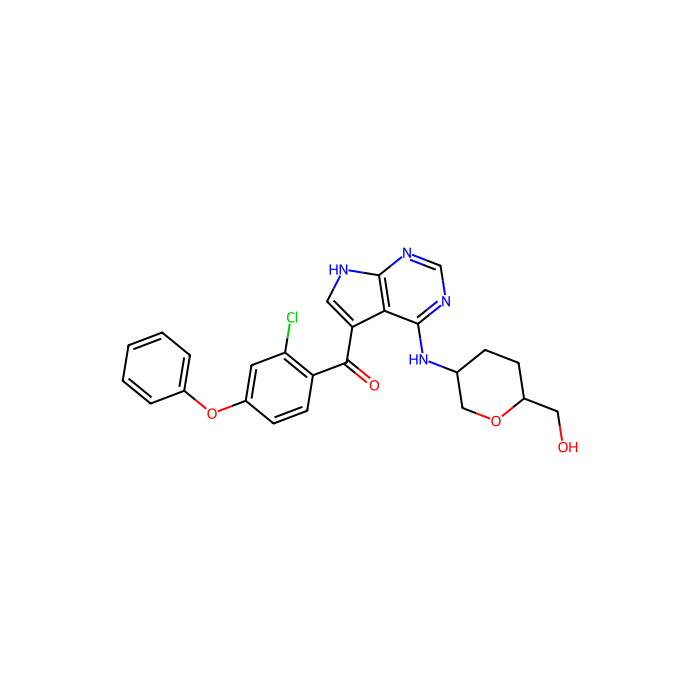
ARQ 531 ARQ 531 is an ATP-competitive tyrosine kinase inhibitor designed to target BTK with an IC50 of 0.85 nM. It also has a distinct kinase selectivity profile with strong inhibitory activity against several key oncogenic drivers from TEC, Trk and Src family kinases.
Targets
BTK (Cell-free assay); BRK (Cell-dree); BRK (Cell-free assay); LCK (Cell-free); LCK (Cell-free assay) 29927,0.85 nM; 2.45 nM; 2.45 nM; 3.86 nM; 3.86 nM
In vitro
ARQ 531 potently inhibited BTK (IC50 = 0.85 nM), the binding potency was accompanied by long residence time (51 min). ARQ 531 selectively inhibits BCR signaling dependent PI3K/AKT/mTOR, Ras/Raf/Erk and Rap-GTPase-Cofilin pathways in TMD8 cells. It potently inhibits proliferation of hematological malignant cell lines both sensitive and resistant to ibrutinib addicted to BCR signaling. Unlike ibrutinib, ARQ 531 suppressed both the upstream activating signals (via inhibition of a select member of Src kinase family) and the downstream signaling pathways (via pAKT and pERK kinases). In GCB-DLBCL cell lines (SUDHL-4 and DOHH-2), ARQ 531 potently suppressed expression of anti-apoptotic c-Myc and BCL6 oncoproteins in a dose dependent fashion, and concomitantly induced apoptotic cleavage of PARP protein.
In vivo
ARQ 531 has potent anti-tumor activity was observed in both ABC-DLBCL and GCB-DLBCL mouse xenograft models. ARQ 531 crosses the blood, brain-barrier. In a single oral dose study of 10mg/kg in monkeys, the bioavailability of ARQ 531 is 72.4% with a Cmax of 9 μM and a half-life greater than 24 hours.
Cell Research(from reference)
Cell lines:CLL cells
Concentrations:0.1 μM, 1.0 μM, or 10.0 μM
Incubation Time:72 h
Taxonomy Tree
| Kingdom | Organic compounds |
|---|---|
| Superclass | Benzenoids |
| Classe | Benzene and substituted derivatives |
| Subclass | Diphenylethers |
| Intermediate Tree Nodes | Not available |
| Direct Parent | Diphenylethers |
| Alternative Parents | Aryl-phenylketones Diarylethers Pyrrolo[2,3-d]pyrimidines Phenoxy compounds Phenol ethers Benzoyl derivatives Secondary alkylarylamines Chlorobenzenes Aminopyrimidines and derivatives Substituted pyrroles Oxanes Imidolactams Aryl chlorides Vinylogous halides Vinylogous amides Heteroaromatic compounds Oxacyclic compounds Dialkyl ethers Azacyclic compounds Primary alcohols Organopnictogen compounds Organochlorides Organic oxides Hydrocarbon derivatives |
| Molecular Framework | Aromatic heteropolycyclic compounds |
| Substituents | Aryl-phenylketone - Diphenylether - Diaryl ether - Pyrrolo[2,3-d]pyrimidine - Pyrrolopyrimidine - Phenoxy compound - Aryl ketone - Phenol ether - Benzoyl - Secondary aliphatic/aromatic amine - Halobenzene - Chlorobenzene - Aminopyrimidine - Imidolactam - Substituted pyrrole - Pyrimidine - Oxane - Aryl halide - Aryl chloride - Heteroaromatic compound - Vinylogous amide - Vinylogous halide - Pyrrole - Ketone - Oxacycle - Azacycle - Organoheterocyclic compound - Secondary amine - Ether - Dialkyl ether - Organic nitrogen compound - Organic oxygen compound - Organopnictogen compound - Organic oxide - Hydrocarbon derivative - Primary alcohol - Organooxygen compound - Organonitrogen compound - Organochloride - Organohalogen compound - Amine - Alcohol - Aromatic heteropolycyclic compound |
| Descrizione | This compound belongs to the class of organic compounds known as diphenylethers. These are aromatic compounds containing two benzene rings linked to each other through an ether group. |
| External Descriptors | Not available |
| Activity Type | Activity Value -log(M) | Mechanism of Action | Activity Reference | Publications (PubMed IDs) |
|---|
| Activity Type | Activity Value -log(M) | Mechanism of Action | Activity Reference | Publications (PubMed IDs) |
|---|
| Activity Type | Activity Value -log(M) | Mechanism of Action | Activity Reference | Publications (PubMed IDs) |
|---|
| Activity Type | Activity Value -log(M) | Mechanism of Action | Activity Reference | Publications (PubMed IDs) |
|---|
| Activity Type | Activity Value -log(M) | Mechanism of Action | Activity Reference | Publications (PubMed IDs) |
|---|
Find and download the COA for your product by matching the lot number on the packaging.
| Lot Number | Certificate Type | Data | Oggetto |
|---|---|---|---|
 H2205646 | Certificate of Analysis | May 12, 2025 | A414128 |
| Solubilità | Solubility (25°C) In vitro DMSO: 95 mg/mL (198.35 mM); Ethanol: 7 mg/mL (14.61 mM); Water: Insoluble; |
|---|---|
| DMSO (mg/mL) Solubilità massima | 95 |
| DMSO (mM) Solubilità massima | 198.358841584365 |
| Acqua (mg/mL) Solubilità massima | <1 |
| Peso molecolare | 478.9 |
| XLogP3 | 4.300 |
| Hydrogen Bond Donor Count | 3 |
| Hydrogen Bond Acceptor Count | 7 |
| Rotatable Bond Count | 7 |
| Exact Mass | 478.141 Da |
| Monoisotopic Mass | 478.141 Da |
| Topological Polar Surface Area | 109.000 Ų |
| Heavy Atom Count | 34 |
| Formal Charge | 0 |
| Complexity | 681.000 |
| Isotope Atom Count | 0 |
| Defined Atom Stereocenter Count | 2 |
| Undefined Atom Stereocenter Count | 0 |
| Defined Bond Stereocenter Count | 0 |
| Undefined Bond Stereocenter Count | 0 |
| The total count of all stereochemical bonds | 0 |
| Covalently-Bonded Unit Count | 1 |
H302:Harmful if swallowed
H315:Causes skin irritation
H319:Causes serious eye irritation
H335:May cause respiratory irritation
P261:Avoid breathing dust/fume/gas/mist/vapors/spray.
P305+P351+P338:IF IN EYES: Rinse cautiously with water for several minutes. Remove contact lenses if present and easy to do - continue rinsing.
La nostra guida alla selezione delle qualità copre purezza, stato dello stabilizzatore e idoneità all'applicazione per tutte le varianti del nostro catalogo.
Visualizza la guida alle qualità Moligand™ →