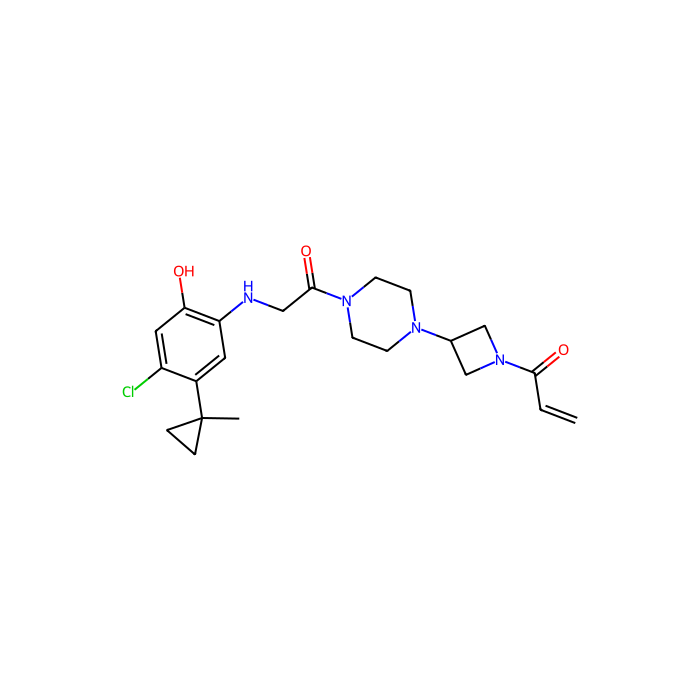
ARS-853 (ARS853) - ≥95% , CAS No.1629268-00-3

CAS: 1629268-00-3 Cat. No.: A413921 Formula: C22H29ClN4O3 Peso molecolare: 432.94
Disponibile su ordine
GRADE & PURITY ≥95%
Synonyms
2-​Propen-​1-​one,1-​[3-​[4-​[2-​[[4-​chloro-​2-​hydroxy-​5-​(1-​methylcyclopropyl)​phenyl]​amino]​acetyl]​-​1-​piperazinyl]​-​1-​azetidinyl]​-
Storage
Store at -20°C
Shipped In
Ice chest + Ice pads
★
Size
Germania (EU)
USA*
Price
Qty
1mg
A413921-1mg
—
3 Disponibile
82,35€
5mg
A413921-5mg
—
2 Disponibile
187,34€
10mg
A413921-10mg
—
2 Disponibile
336,60€
25mg
A413921-25mg
—
2 Disponibile
532,70€
50mg
A413921-50mg
—
2 Disponibile
1.055,08€
Enter a quantity for the sizes you want to add.
🧪

Why this grade

≥95% for sensitive chromatographic and analytical workflows requiring minimal baseline interference.

🌡

Storage & shipping

Store at -20°C Ships Ice chest + Ice pads Check lot-specific COA for exact specifications.

📋

Quality documents

SDS, COA, datasheet, and spec sheet available for download. Lot-specific COA accessible via lot number lookup.

📚

Literature proof

Cited in 0 peer-reviewed publications across chromatography, organic synthesis, and cross-coupling reactions.

Panoramica

Information

ARS-853 (ARS853) ARS-853 is a selective, covalent KRAS(G12C) inhibitor that inhibits mutant KRAS-driven signaling by binding to the GDP-bound oncoprotein and preventing activation. ARS-853 also induces apoptosis .


Targets

K-Ras(G12C) (in H358 cells) 2.5 μM


In vitro

ARS-853 treatment of KRASG12C cells led to a dose-dependent and nearly complete inhibition of CRAF-RBD (RBD)-mediated pulldown of KRAS from lysates, with an IC50 of approximately 1 μmol/L. Treatment of H358 cells by ARS-853 resulted in a significant loss of KRAS–CRAF interactions. Consistent with an inactive state of KRASG12C once bound to ARS-853, downstream signaling through both MAPK (including pMEK, pERK, and pRSK) and PI3K signaling (pAKT) pathways was inhibited by ARS-853 in H358 and other KRASG12C cell lines. The inhibition of RAF-RBD pulldown and KRAS downstream signaling was sustained over a period of 72 hours, accompanied by G1 cell-cycle arrest, loss of Cyclin D1 and Rb expression, and an increase in the cell-cycle inhibitor p27 KIP1. In addition, hallmarks of apoptosis, including cleaved PARP and increases in sub-diploid DNA, were observed in H358 cells following treatment with ARS-853. No effects on RAF-RBD binding or downstream signaling were observed in A549 cells (KRASG12S), and the inhibitory effects of ARS-853 in H358 cells could be rescued by ectopic expression of KRASG12V. KRASG12C is the most potent covalent target of ARS-853 across more than 2,700 cellular proteins and consistently find that this compound exerts no effects on cellular signaling or growth in non-KRASG12C cells at concentrations up to 10-fold higher than its KRASG12C potency. ARS-853 reacts only with the inactive (GDP-bound), but the not the active (GTP-bound), state of KRAS. ARS853 reduced KRAS-GTP levels and ERK phosphorylation in human embryonic kidney 293 (HEK293) or H358 cells engineered to express KRASG12C but not in those expressing KRASG12C/A59G. ARS853 traps KRASG12C in a GDP-bound conformation by lowering its affinity for nucleotide exchange factors.


Cell Research(from reference)

Cell lines:H358 (G12C) cells 

Concentrations:0.05, 0.1, 0.5, 1, 5, 10, 50 μM 

Incubation Time:5 h 

Specifications

Sinonimi
2-​Propen-​1-​one,1-​[3-​[4-​[2-​[[4-​chloro-​2-​hydroxy-​5-​(1-​methylcyclopropyl)​phenyl]​amino]​acetyl]​-​1-​piperazinyl]​-​1-​azetidinyl]​-
Specifiche e purezza
≥95%
Meccanismi biochimici e fisiologici
ARS-853 is a selective, covalent KRAS(G12C) inhibitor that inhibits mutant KRAS-driven signaling by binding to the GDP-bound oncoprotein and preventing activation. ARS-853 also induces apoptosis.
Condizioni di conservazione di stoccaggio
Store at -20°C
Spedito in
Ice chest + Ice pads
Questo prodotto richiede spedizione a catena fredda. I servizi di terra e altri servizi economici non sono disponibili.
Tipo di azione
INHIBITOR
Purezza
≥95%
Nomi e identificatori
Pubchem Sid504772479
Pubchem Sid Urlhttps://pubchem.ncbi.nlm.nih.gov/substance/504772479
Sorrisi canoniciCC1(CC1)C2=CC(=C(C=C2Cl)O)NCC(=O)N3CCN(CC3)C4CN(C4)C(=O)C=C
IUPAC Name1-[3-[4-[2-[4-chloro-2-hydroxy-5-(1-methylcyclopropyl)anilino]acetyl]piperazin-1-yl]azetidin-1-yl]prop-2-en-1-one
InChIKeyIPFOCHMOYUMURK-UHFFFAOYSA-N
INCHI1S/C22H29ClN4O3/c1-3-20(29)27-13-15(14-27)25-6-8-26(9-7-25)21(30)12-24-18-10-16(22(2)4-5-22)17(23)11-19(18)28/h3,10-11,15,24,28H,1,4-9,12-14H2,2H3
Isomeri SMILES CC1(CC1)C2=CC(=C(C=C2Cl)O)NCC(=O)N3CCN(CC3)C4CN(C4)C(=O)C=C
Peso molecolare 432.94
Reaxy-Rn 27200600
Reaxys-RN_link_address https://www.reaxys.com/reaxys/secured/hopinto.do?context=S&query=IDE.XRN=27200600&ln=

Documentazione

📋 Safety Data Sheet (SDS)

Comprehensive hazard, handling, storage, and regulatory compliance document.

Download SDS →

✅ Certificate of Analysis (COA)

Lot-specific quality data. Enter your lot number to retrieve the exact COA.

Look up COA →

📊 Datasheet

Quick-reference summary of product specifications and applications.

View datasheet →

🔬 Specification Sheet

Full quality attributes and acceptance criteria for this grade.

View spec sheet →

Advanced Data

Taxonomic Classification

Taxonomy Tree

KingdomOrganic compounds
SuperclassOrganic acids and derivatives
ClasseCarboxylic acids and derivatives
SubclassAmino acids, peptides, and analogues
Intermediate Tree Nodes Amino acids and derivatives - Alpha amino acids and derivatives
Direct ParentAlpha amino acid amides
Alternative Parents o-Aminophenols  Phenylalkylamines  Aniline and substituted anilines  M-chlorophenols  Secondary alkylarylamines  1-hydroxy-2-unsubstituted benzenoids  N-alkylpiperazines  Chlorobenzenes  Aryl chlorides  Tertiary carboxylic acid amides  Acrylic acids and derivatives  Trialkylamines  Azetidines  Azacyclic compounds  Organopnictogen compounds  Hydrocarbon derivatives  Organic oxides  Organochlorides  Carbonyl compounds  
Molecular FrameworkAromatic heteromonocyclic compounds
Substituents Alpha-amino acid amide - O-aminophenol - Aminophenol - 3-halophenol - 3-chlorophenol - Aniline or substituted anilines - Phenylalkylamine - 1-hydroxy-2-unsubstituted benzenoid - Chlorobenzene - Halobenzene - Phenol - Secondary aliphatic/aromatic amine - N-alkylpiperazine - Aryl halide - Aryl chloride - Piperazine - Benzenoid - Monocyclic benzene moiety - 1,4-diazinane - Tertiary carboxylic acid amide - Acrylic acid or derivatives - Tertiary aliphatic amine - Tertiary amine - Azetidine - Carboxamide group - Secondary amine - Azacycle - Organoheterocyclic compound - Hydrocarbon derivative - Organic nitrogen compound - Amine - Organic oxygen compound - Carbonyl group - Organopnictogen compound - Organohalogen compound - Organochloride - Organonitrogen compound - Organooxygen compound - Organic oxide - Aromatic heteromonocyclic compound
DescrizioneThis compound belongs to the class of organic compounds known as alpha amino acid amides. These are amide derivatives of alpha amino acids.
External Descriptors Not available
Struttura 3D
Modello di struttura chimica interattiva


Meccanismi d'azione
Certificati (CoA, COO, BSE/TSE e tabella di analisi)
C of A & Other Certificates(BSE/TSE, COO):
Analytical Chart:

Find and download the COA for your product by matching the lot number on the packaging.

5 results found

Lot NumberCertificate TypeDataOggetto
K2219091Certificate of AnalysisSep 04, 2025 A413921
K2219092Certificate of AnalysisSep 04, 2025 A413921
K2219093Certificate of AnalysisSep 04, 2025 A413921
K2219136Certificate of AnalysisSep 04, 2025 A413921
K2219141Certificate of AnalysisSep 04, 2025 A413921
Proprietà chimiche e fisiche
SolubilitàSolubility (25°C) In vitro DMSO: 86 mg/mL warmed with 50ºC Water: bath (198.64 mM); Ethanol: 7 mg/mL warmed with 50ºC Water: bath (16.16 mM); Water: Insoluble;
Peso molecolare432.900 g/mol
XLogP32.900
Hydrogen Bond Donor Count2
Hydrogen Bond Acceptor Count5
Rotatable Bond Count6
Exact Mass432.193 Da
Monoisotopic Mass432.193 Da
Topological Polar Surface Area76.100 Ų
Heavy Atom Count30
Formal Charge0
Complexity671.000
Isotope Atom Count0
Defined Atom Stereocenter Count0
Undefined Atom Stereocenter Count0
Defined Bond Stereocenter Count0
Undefined Bond Stereocenter Count0
The total count of all stereochemical bonds0
Covalently-Bonded Unit Count1
Calcolatori di soluzioni
Recensioni

Recensioni dei clienti

Application Protocols

Item-specific tested applications and recommended conditions: Not specified for this item; refer to CoA/Spec Sheet or internal method notes.

General research workflows (illustrative, non-binding):

  • Stock solution preparation: Dissolve ARS-853 in anhydrous DMSO to 10–50 mM. Aliquot and store at −20 °C. Thaw immediately before use, minimize freeze–thaw cycles.
  • Biochemical target engagement: Incubate purified protein with serial dilutions of ARS-853 at pH ~7.4, ambient–37 °C, for set times (e.g., 0.5–2 h). Quench and analyze by intact protein MS or peptide mapping for covalent adducts.
  • Cell-based assays: Dose cells with ARS-853 diluted from DMSO stocks to desired final concentrations while keeping DMSO low (≤0.1–0.5%). Assess target engagement via CETSA or targeted proteomics, and evaluate pathway readouts with appropriate controls.
  • Analytical QC: Verify stock integrity by LC–MS prior to critical experiments; monitor for degradation over time.

Note: The above are general guidance examples and not validated, item-specific protocols.

Biological Roles

Scope: For research use only. The following summarizes literature-reported roles of ARS-853 as a chemical biology tool; no medical or clinical claims are made.

Literature overview:

  • ARS-853 is described as a covalent small-molecule probe designed to engage the switch-II pocket of mutant KRAS proteins bearing a cysteine at position 12 (G12C). The compound’s electrophilic moiety enables selective covalent modification of the target cysteine under physiological conditions in biochemical systems.
  • As a tool compound, ARS-853 has been used to interrogate nucleotide-state dependence of target engagement, modulation of downstream signaling cascades in cell models, and time-dependent covalent occupancy.
  • Studies commonly evaluate on-target engagement using intact-protein MS, activity-based protein profiling, or thermal stabilization assays, along with orthogonal selectivity panels to monitor off-target cysteines.

Best practices for biological studies:

  • Define vehicle controls and concentration-response relationships; verify that observed effects correlate with covalent target occupancy rather than non-specific reactivity.
  • Confirm intracellular engagement using orthogonal methods (e.g., CETSA, targeted MS) and complement with genetic controls when feasible.
  • Evaluate reversibility/irreversibility and residence time in biochemical assays prior to cellular translation.

Notes:

  • Exact potency, selectivity, and kinetics parameters are not specified for this item; consult primary literature or determine experimentally under your assay conditions.
  • Handle and report ARS-853 in compliance with institutional chemical hygiene and covalent probe handling guidelines.
Buffer Applications

Applicability: ARS-853 is not a buffering agent. This section focuses on practical buffer considerations for preparing and using ARS-853 in biochemical/cellular assays.

Guidance (general):

  • Stock preparation: Dissolve in anhydrous DMSO. For biochemical assays, dilute into buffers such as HEPES, Tris, or phosphate-buffered saline (PBS) while maintaining final DMSO at the lowest effective percentage (commonly ≤0.1–0.5% v/v).
  • pH considerations: Covalent electrophiles can hydrolyze or react faster at elevated pH. Maintain assay buffers near physiological pH (7.2–7.5) unless a specific mechanistic study requires variation. Record pH carefully when comparing datasets.
  • Protein binding: Include non-ionic detergents (e.g., 0.01–0.05% Tween-20) or carrier proteins as appropriate to reduce non-specific adsorption; validate that these additives do not interfere with readouts.
  • Metal ions/reductants: Certain reductants (e.g., high DTT) can compete with covalent electrophiles. Use minimal necessary concentrations and run controls. EDTA can be included if metal-catalyzed degradation is a concern.
  • Filtration: If sterility is required, filter final working solutions through 0.22 µm (PTFE or low-binding PVDF). Confirm no significant adsorption or loss.

Item-specific buffer specs: Not specified for this item; refer to application notes or determine empirically.

Green Alternatives

Context: As a specialized research probe, ARS-853 itself does not have a “green alternative” in the sense of interchangeable solvents or bulk reagents. However, greener practices can be applied to how it is handled, dissolved, and analyzed.

Greener handling strategies:

  • Prefer water-miscible stock solvents like DMSO over chlorinated solvents. Keep final DMSO concentration as low as assay design allows.
  • Use micro-scale experiments (96/384-well) to minimize compound consumption and waste.
  • Employ benign quench/extraction procedures for biochemical assays (e.g., protein precipitation with acetonitrile or methanol rather than halogenated solvents), provided method compatibility is verified.
  • Choose LC–MS mobile phases with aqueous buffers and volatile modifiers (e.g., formic acid, ammonium acetate) to reduce environmental impact.

Trade-offs (general):

  • DMSO is relatively green compared to many aprotic solvents but can affect cell membranes at higher percentages—optimize dosing schemes.
  • Alternative co-solvents (e.g., ethanol) may be greener but often provide poorer solubility for electrophile-rich heteroaromatics.

Summary table (general):

  • DMSO: Good solvency; moderate EHS profile; broadly compatible with biology.
  • Ethanol: Greener profile; limited solubility for many probes.
  • DMF/NMP: Strong solvency; less favorable EHS—avoid in bioassays when possible.

Note: No process-scale synthesis guidance is provided here; consult green chemistry principles if developing synthetic routes to ARS-853 analogs.

Pharmaceutical Uses

This product is supplied strictly for research use only; no medical, diagnostic, or therapeutic use is intended or implied.

Formulation/context (general, non-clinical):

  • ARS-853 is used as a reference compound/chemical probe in discovery research. In preclinical assay development, it may serve as a system control to benchmark covalent engagement and signal modulation in biochemical and cellular platforms.
  • For in vitro and ex vivo studies, ARS-853 is typically prepared as DMSO stocks and diluted into assay buffers or culture media. No pharmacopeial monographs or excipient roles are associated with ARS-853.

Manufacturing/CMC relevance:

  • Not applicable. There is no item-specific information indicating GMP status, compendial compliance, or suitability for human/animal administration.

Regulatory note:

  • No pharmacopoeia status is provided. Any use beyond basic research would require independent qualification and regulatory assessment, which is outside the scope of this listing.
Physical Properties

Item-specific specifications:

  • Appearance: Not specified for this item; refer to CoA/Spec Sheet.
  • Molecular Weight: Not specified for this item; refer to CoA/Spec Sheet.
  • Molecular Formula: Not specified for this item; refer to CoA/Spec Sheet.
  • Melting point, boiling point, density, refractive index, UV cutoff, water/peroxide/metal limits: Not specified for this item; refer to CoA/Spec Sheet.

General/literature guidance (non-spec, for planning only):

  • Physical state: ARS-853 is typically supplied as a solid research compound in small-molecule libraries.
  • Solubility: Commonly dissolved in anhydrous DMSO for stock solutions (e.g., 10–50 mM working stocks in discovery workflows). Aqueous solubility is generally limited without co-solvent or surfactant. For biological assays, DMSO vehicle is typically diluted into buffered media, keeping final DMSO ≤0.1–0.5% v/v as assay-appropriate.
  • pKa/logP: Not provided here; consult primary literature or compute with cheminformatics tools if needed for permeability/partition modeling.
  • Hygroscopicity/photolysis: No item-specific data provided; protect from moisture and light as a matter of good practice for electrophile-bearing probes.

Practical notes:

  • Prepare fresh DMSO stocks immediately before use when possible; aliquot and freeze to minimize freeze–thaw cycles.
  • Filter sterilize (0.22 µm PTFE) if sterile stock is needed for cell-based assays. Verify recovery and adsorption losses in pilot tests.
Quality and Grades

Item-specific grade/purity:

  • Grade/Purity: Not specified for this item; refer to CoA/Spec Sheet.

Guidance on interpretation and use:

  • In discovery workflows, ARS-853 is typically used as a reference chemical probe or screening hit. For reproducible biochemical/cellular results, request or consult the Certificate of Analysis (CoA) for: purity by HPLC/UPLC, identity by NMR/HRMS, and residual solvent profile.
  • If HPLC/UPLC grade is indicated on CoA, expect low non-volatile residue and controlled UV absorbance suitable for bioassays. If “research grade” without additional qualifiers, independently verify purity and identity before quantitative studies.
  • Trace stabilizers are uncommon for solid bioactive probes; if any stabilizer or counter-ion is present, it should be listed on the CoA. Absence of such information here means it is not specified for this item.

Best practices:

  • Perform intake QC (e.g., quick LC–MS, 1H NMR) upon receipt to benchmark purity and confirm lot-to-lot consistency.
  • For long-term projects, retain a retained sample and store at −20 °C under inert atmosphere/desiccation to preserve integrity.
  • If working in sensitive biophysical assays (ITC, SPR, DSF), pre-clear stocks by centrifugation/filtration and check for aggregation (e.g., light scattering tests).
Reaction and Applications

Scope: ARS-853 is primarily used as a research chemical probe in biochemical and cellular studies, not as a general synthetic reagent.

Applications (research use; literature-based):

  • Employed as a tool compound in studies of RAS signaling to interrogate covalent engagement of mutant KRAS proteins in vitro and in cells.
  • Utilized in target engagement assays (e.g., mass spectrometric adduct confirmation, thermal shift, or covalent occupancy measurements), selectivity profiling against cysteine-containing off-targets, and structure–activity relationship benchmarking.
  • Serves as a positive control in screening cascades evaluating covalent ligand libraries directed at small GTPases.

Not typically applicable:

  • ARS-853 is not commonly used as a reagent in named organic reactions (e.g., cross-couplings, Grignard, oxidations). Therefore, standard synthetic application guidance is not provided.

Practical use tips:

  • Prepare fresh DMSO stocks and minimize exposure to nucleophiles to preserve electrophilic functionality.
  • Verify compound integrity by LC–MS before key experiments; covalent probes can hydrolyze or polymerize if mishandled.
  • For cellular work, include vehicle controls and confirm effective concentration ranges empirically; assess cytotoxicity of vehicle and compound separately.

Note: Manufacturer Applications field contained no additional item-specific notes; the above expands on general literature practice for compounds in this class.

Reaction Conditions

Not a reagent-focused product: ARS-853 is used as a research probe rather than as a substrate/reagent for general synthetic transformations. Consequently, no item-specific reaction condition ranges (temperatures, catalysts, yields) are applicable.

Assay/engagement conditions (literature-level, general):

  • Biochemical assays: Conduct target engagement at near-physiological pH (7.2–7.5) and ambient to 37 °C. Time-dependent covalent labeling may require incubation from minutes to hours depending on protein concentration, nucleophile availability, and compound concentration.
  • Cellular assays: Dose-response studies typically span low nanomolar to micromolar concentrations, with exposure times tailored to observe covalent engagement and downstream effects. Exact ranges are assay- and cell-line–specific and must be empirically determined.
  • Controls: Include vehicle controls, time-zero controls, and, where possible, inactive analogs to distinguish on-target covalent interactions from non-specific reactivity.

Important:

  • The above are general literature practices and are not item-specific specifications. No quantitative potency or kinetic parameters are provided for this item.
Safety and Handling

Authoritative source: Always consult the Safety Data Sheet (SDS) for definitive and current safety information.

Item-specific hazard data (from Product Data):

  • Signal Word: Not specified for this item; refer to SDS.
  • H-Statements: Not specified for this item; refer to SDS.
  • GHS Classification: Not specified for this item; refer to SDS.
  • Pictograms: Not specified for this item; refer to SDS.

General laboratory safety guidance (for small-molecule research compounds):

  • PPE: Lab coat, safety glasses, and appropriate chemically resistant gloves (e.g., nitrile). Use in a chemical fume hood to avoid inhalation of dust or solvent vapors.
  • Handling: Avoid breathing dust/aerosols. Prevent skin/eye contact. Compounds with electrophilic motifs (common in covalent probes) can cause skin sensitization—minimize exposure.
  • Storage incompatibilities: Store away from strong oxidizers, strong bases/acids that could promote decomposition, and nucleophilic reagents that may react with electrophilic warheads.
  • Spill/first aid (overview): In case of skin contact, wash with soap and water. For eye exposure, rinse cautiously with water for several minutes and seek medical advice. For inhalation, move to fresh air. For ingestion, seek medical attention—do not induce vomiting unless directed by medical personnel.
  • Waste: Collect as organic hazardous waste per institutional and local regulations.

Shipping and storage conditions (item-specific):

  • Shipped: Ice chest + ice pads (provided data)
  • Storage: Store at −20 °C (provided data)
Solvent Selection

Applicability: ARS-853 is a solid small molecule used primarily as a chemical probe; solvent selection pertains to stock preparation and assay dilution rather than process-scale dissolution.

Common choices (general literature practice):

  • DMSO (anhydrous): Primary solvent for concentrated stocks (e.g., 10–50 mM). High polarity, aprotic; excellent solubilizer for heteroaromatic electrophiles. Miscible with water for stepwise dilution into buffers/media. Minimize final DMSO in biological assays (typically ≤0.1–0.5% v/v).
  • DMF/NMP: Alternative aprotic polar solvents when DMSO is unsuitable. Higher boiling points; consider cytotoxicity if carried into biological assays.
  • Acetonitrile/THF/EtOH: Limited utility; may aid co-solvent systems for analytical sample prep. Check stability of electrophilic motifs.

Practical tips:

  • Warm gently (room temperature) and vortex/sonicate to aid dissolution; avoid heat that may promote decomposition.
  • For aqueous work, pre-dissolve in DMSO, then dilute into buffered saline or culture media with rapid mixing to prevent precipitation.
  • For analytical injections, match solvent strength to initial LC conditions to avoid on-column precipitation; 50:50 water:acetonitrile with 0.1% acid is often suitable for standards if compound is stable.

Quick comparison (general):

  • DMSO: highest solubilization power; biologically compatible at low %.
  • DMF: good solvent; more caution in cell assays.
  • NMP: strong solvent; potential assay interference—validate.

Note: No item-specific solubility numbers are provided here; consult the CoA or determine empirically.

Storage and Reconstitution

Item-specific conditions (from Product Data):

  • Storage: Store at −20 °C.
  • Shipping: Ice chest + ice pads.

Reconstitution guidance (general best practices for small-molecule probes):

  • Solvent: Reconstitute in anhydrous DMSO to prepare concentrated stocks. If aqueous stocks are required, first dissolve in DMSO then dilute into buffer with rapid mixing to avoid precipitation.
  • Aliquoting: Prepare single-use or limited-use aliquots (e.g., 10–50 µL) to prevent repeated freeze–thaw. Use low-binding plasticware or silanized glass to reduce adsorption.
  • Freeze–thaw: Avoid multiple cycles; thaw quickly at room temperature, use immediately, and return unused aliquots to −20 °C promptly.
  • Light/moisture protection: Store in amber vials within a desiccated container. Purge headspace with inert gas if long-term storage is anticipated.
  • Stability: No item-specific shelf-life or solution stability data are provided here; verify by LC–MS or HPLC prior to critical experiments and establish in-house retest periods.

Documentation:

  • Record lot number, reconstitution solvent, concentration, date, and storage conditions for traceability. For GLP-like studies, archive a retained solid sample at −20 °C.
Structure and Identity

Brief overview: ARS-853 (ARS853) is a research small molecule widely used as a chemical probe in RAS biology studies.

Item-specific identifiers (from Product Data):

  • Product Name: ARS-853 (ARS853)
  • SKU: A413921
  • CAS: 1629268-00-3
  • PubChem CID: 86279165
  • InChIKey: 146888 (as provided)
  • SMILES: Not specified for this item; refer to CoA/Spec Sheet.
  • Molecular Formula: Not specified for this item; refer to CoA/Spec Sheet.
  • Molecular Weight: Not specified for this item; refer to CoA/Spec Sheet.

Structural features (general literature description, not item-specific specifications):

  • ARS-853 is reported in the literature as a covalent small molecule designed to engage a specific cysteine residue in KRAS(G12C). Typical scaffolds in this series include an electrophilic warhead (often an acrylamide or related Michael acceptor) appended to a heteroaromatic core with substituents that target the switch-II pocket. Exact substituent pattern and stereochemistry should be confirmed from primary literature or the CoA.

2D structure in words (literature-level, qualitative):

  • A heteroaromatic core bearing substituents that direct binding into the KRAS switch-II pocket and an electrophile positioned for conjugate addition to Cys12. Multiple aromatic and heteroatom functionalities contribute to recognition; no biopolymer or macrocyclic features are involved.

Notes:

  • Where precise structural strings (SMILES/InChI) or formula are required for documentation, please consult the item’s CoA/Spec Sheet or the primary reference for ARS-853.
Synthetic Utility

Applicability: ARS-853 is a finished small-molecule probe and is not commonly employed as a reagent or building block in synthetic organic chemistry.

General notes (contextual):

  • The design principles embodied by ARS-853 (heteroaromatic recognition elements plus an electrophilic warhead) inform synthetic campaigns for covalent inhibitors. However, ARS-853 itself is typically the target of synthesis rather than a synthon.
  • For medicinal chemistry, analog development often explores warhead tuning (e.g., acrylamide variants), linker orientation, and heteroaryl substitutions to balance potency, selectivity, and ADMET-like properties in vitro.

If derivatization is desired (conceptual guidance only):

  • Late-stage diversification might involve cross-coupling on halogenated aromatic positions or amide coupling on appendages (if present in the chosen scaffold). Stability of the electrophile must be considered; protecting strategies or step ordering may be necessary.

Conclusion:

  • No routine named-reaction applications or reagent roles are associated with ARS-853. For synthetic procedures to access ARS-853 or analogs, consult primary literature; item-specific synthetic routes are not provided here.
Target Specificity

Item-specific target data: Not specified for this item; refer to CoA/Spec Sheet or manufacturer technical notes.

General note:

  • While ARS-853 is discussed in the literature as a covalent probe used in RAS biology studies, this listing does not include validated, lot-specific target binding data, cross-reactivity, or species selectivity. Users should confirm target engagement under their assay conditions using orthogonal methods (e.g., MS-based adduct detection, CETSA, biochemical activity assays).

Shall we send you a message when we have discounts available?

Remind me later

Thank you! Please check your email inbox to confirm.

Oops! Notifications are disabled.