QUALITÀ & PUREZZAMoligand™?Moligand™ — Aladdin's line of ligands and bioactive small molecules. Use for receptor, pathway, and binding studies needing defined small-molecule tools.≥98%
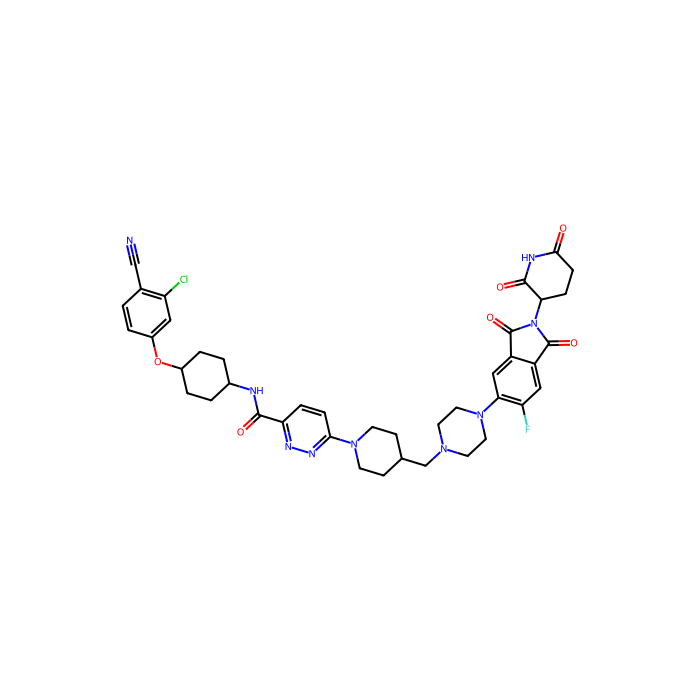
ARV-110 ARV-110 is an orally bioavailable, specific androgen receptor (AR) PROTAC degrader that leads to ubiquitination and degradation of AR. ARV-110 completely degrades androgen receptor (AR) in all cell lines tested with DC50 of < 1 nM. ARV-110 can be used for the research of prostate cancer.
Targets
AR (Cell-free assay) 1 nM(DC50)
Specifiche
Sinonimi
Bavdegalutamide [INN] | Bavdegalutamide [USAN:INN] | N-((1R,4R)-4-(3-Chloro-4-cyanophenoxy)cyclohexyl)-6-(4-((4-(2-(2,6-dioxopiperidin-3-yl)-6-fluoro-1,3-dioxo-2,3-dihydro-1H-isoindol-5-yl)piperazin-1-yl)methyl)piperidin-1-yl)pyridazine-3-carboxamide | N-[4-(3-chloro-4-cyanophenoxy)cyclohexyl]-6-[4-[[4-[2-(2,6-dioxopiperidin-3-yl)-6-fluor Mostra altro
Specifiche e purezza
Moligand™, ≥98%
Meccanismi biochimici e fisiologici
ARV-110 is an orally bioavailable, specific androgen receptor (AR) PROTAC degrader that leads to ubiquitination and degradation of AR. ARV-110 completely degrades androgen receptor (AR) in all cell lines tested with DC50 of < 1 nM. ARV-110 can be used for the research of prostate cancer.
Condizioni di conservazione di stoccaggio
Store at -20°C
Spedito in
Ice chest + Ice pads
Questo prodotto richiede spedizione a catena fredda. I servizi di terra e altri servizi economici non sono disponibili.
This compound belongs to the class of organic compounds known as n-arylpiperazines. These are organic compounds containing a piperazine ring where the nitrogen ring atom carries an aryl group.
External Descriptors
Not available
1. Djoumbou Feunang Y, Eisner R, Knox C, Chepelev L, Hastings J, Owen G, Fahy E, Steinbeck C, Subramanian S, Bolton E, Greiner R, and Wishart DS. ClassyFire: Automated Chemical Classification With A Comprehensive, Computable Taxonomy. Journal of Cheminformatics, 2016, 8:61.
Determine the necessary mass, volume, or concentration for preparing a solution.
Dilution Calculator
Determine the dilution needed to prepare a stock solution.
Reconstitution Calculator
Recensioni
Recensioni dei clienti
Application Protocols
Only product-validated protocols may be listed here.
Tested applications, recommended dilutions, positive control samples, or plate-based screening parameters: Not specified for this item; refer to CoA/Spec Sheet.
General guidance for users developing protocols:
Start with a DMSO stock (e.g., 10 mM). Perform an 8–10 point half-log dilution series in your assay.
For western blot degradation assays: treat cells for multiple time points (e.g., 2, 4, 8, 16, 24 h), lyse, and probe for AR and loading controls; quantify Dmax and DC50.
For live-cell target engagement: consider NanoBRET or HiBiT-tagged AR systems to monitor degradation kinetics in real time.
These pointers are for planning only and are not validated instructions for this specific SKU.
Biological Roles
General biological context (no clinical claims):
Mode of action (research context): ARV-110 is designed as a PROTAC to promote proteasomal degradation of the androgen receptor (AR) by recruiting the CRBN E3 ubiquitin ligase, forming a ternary complex that results in ubiquitination and subsequent degradation of AR.
Functional outcome in cells: depletion of AR protein levels can attenuate AR-dependent transcriptional programs, enabling studies of AR biology, feedback regulation, and compensation pathways.
Selectivity considerations: degradation profiles can differ from classical antagonists because target removal may reduce both ligand-dependent and -independent signaling. Off-target degradation should be assessed experimentally via proteomics or targeted immunoblot panels.
Resistance and dependency studies: the tool can be used to explore how mutations in AR or alterations in cereblon pathway components affect degradability, aiding target validation and mechanism-of-resistance research.
Kinetic features: degradation is time- and concentration-dependent; protein resynthesis post-washout informs protein half-life and pathway resilience.
Item-specific biological data (potency, DC50, Dmax, cellular models): Not specified for this item; consult literature and perform system-specific validation under your assay conditions.
Buffer Applications
Not a buffering reagent. ARV-110 is a bioactive small-molecule degrader used in chemical biology. Typical buffer-related considerations are limited to vehicle effects in assays:
Prepare concentrated DMSO stocks and dilute into cell culture media or biochemical assay buffers, keeping final DMSO within tolerated limits for your system.
Include vehicle controls to account for any buffer/serum interactions or DMSO-related effects.
No classical buffer recipes or pH-adjusted systems are applicable to this compound.
Green Alternatives
Context: As a bioactive research probe, ARV-110 usage volume is typically small, but solvent choices and workflows can meaningfully reduce environmental impact.
Greener handling strategies (general):
Prefer DMSO over DMF/NMP when solubility permits; DMSO has a more favorable environmental and toxicity profile.
Minimize halogenated solvent use for cleanup. If chromatography of related reference materials is required, consider ethyl acetate/heptane or MeTHF-based systems instead of dichloromethane.
Aliquot once, use many times: prepare single-use micro-aliquots to eliminate repeat freeze–thaw and reduce waste from degraded stocks.
Aqueous workups: where possible, employ high-dilution aqueous buffers and capture organics with activated carbon before disposal according to local regulations.
DMSO: high solvency, low volatility, relatively benign; main tradeoff is potential biological effects at >0.2% v/v in cell assays.
DMF/NMP: strong solvency but reproductive toxicity concerns; restrict to cases where DMSO solubility is inadequate.
MeTHF or CPME (for synthetic steps on analogs): greener ethers with lower peroxide tendency than THF/Et2O; not typically needed for routine use of this finished probe.
Adopt microscale assay formats (96/384-well) and automated liquid handling to cut solvent volumes and improve reproducibility.
Pharmaceutical Uses
This product is supplied strictly for research use only. No medical, diagnostic, or therapeutic uses are claimed or supported.
Formulation-related research context (general):
For in vitro and ex vivo experiments, ARV-110 is commonly handled as a DMSO stock and diluted into media containing serum proteins, which may aid apparent solubility by binding. Evaluate precipitation and adsorption empirically.
For exploratory preclinical research (if undertaken by users), common enabling formulations include DMSO:PEG400:saline mixtures or lipid-based vehicles; however, such use requires institution-specific approvals and additional QC not provided with this grade.
Regulatory/compendial status:
No pharmacopeial monograph is implied for this item.
Excipient applications are not relevant for this compound.
Please consult your institutional guidelines before any work beyond basic in vitro research.
Physical Properties
Item-specific physical data:
Appearance: Not specified for this item; refer to CoA/Spec Sheet.
Molecular Formula: Not specified for this item; refer to CoA/Spec Sheet.
Molecular Weight: Not specified for this item; refer to CoA/Spec Sheet.
Melting point, boiling point, density, refractive index: Not specified for this item; refer to CoA/Spec Sheet.
Literature/general expectations for AR-targeting PROTACs (context only):
Typical state: solid, often amorphous or microcrystalline powders with high polarity and multiple H-bond donors/acceptors.
Solubility: frequently low aqueous solubility; stock solutions commonly prepared in DMSO (e.g., 10–50 mM ranges are typical for PROTAC tools in the literature) before dilution into cell media containing serum or solubilizing excipients. Actual solubility for this item is not specified.
LogP/cLogP: often moderate-to-high lipophilicity balanced by high polar surface area; effective permeability can be context dependent. Specific logP for this item is not specified.
Handling implications from general properties:
Due to multiple amide/heteroatom functionalities, hygroscopicity can vary; minimize moisture exposure during weighing.
PROTACs can show adsorption to plastics at low nM concentrations; consider low-binding labware for quantitative work.
Always verify item-specific physical constants and solution stability on the CoA/Spec Sheet for this SKU.
Quality and Grades
Item-specific grade:
Grade/Purity: Moligand™ (as provided)
What Moligand™ implies (general explanation):
Moligand™ denotes a research-use small-molecule/probe grade intended for discovery screening, target validation, and mechanistic biology. Emphasis is typically placed on identity confirmation (e.g., NMR/LC–MS) and assay suitability rather than compliance with pharmacopeial monographs.
UV purity by HPLC, water/peroxide/metal residuals, salt form, and residual solvent specifications are not stated for this item. If your application is highly sensitivity-limited (e.g., proteomics after treatment), request the CoA/Spec Sheet for chromatographic purity and identity data.
Implications for use:
Suitable for in vitro biochemical and cellular assays, degradation time-course studies, and preliminary SAR. For in vivo exploratory work, users often perform additional in-house QC (e.g., orthogonal purity checks, endotoxin testing, or salt-form verification) as needed.
Stabilizers: Not specified for this item; refer to CoA/Spec Sheet. If no stabilizer is present, minimize freeze–thaw cycles and exposure to basic/acidic conditions that may promote amide hydrolysis.
Documentation:
For batch-specific purity, analytical traces, and exact counterion/solvate content, consult the CoA/Spec Sheet for SKU A413689.
Reaction and Applications
This product is a bioactive small-molecule degrader used as a chemical biology tool rather than a synthetic reagent.
Research/application domains (general for ARV-110-like PROTACs):
Targeted protein degradation studies: probe ubiquitin–proteasome pathway engagement for the androgen receptor (AR) using ternary complex formation with CRBN in cell-based systems.
Mechanistic profiling: perform time-course degradation assays to determine DC50 (half-maximal degradation concentration), Dmax (maximum degradation), and recovery kinetics after washout.
Pathway interrogation: evaluate downstream transcriptional consequences of AR depletion (e.g., qPCR of AR-regulated genes) while controlling for DMSO and proteasome inhibitor co-treatments (e.g., MG132 rescue experiments) to confirm proteasome dependence.
Selectivity assessment: compare degradation in AR-positive versus AR-negative cell lines, or in CRBN-knockdown backgrounds to verify E3 ligase dependency.
Practical tips:
Maintain consistent cell passage number and ligand exposure times; adsorption to plastics can reduce apparent potency—use low-bind tubes/plates for sub-µM work.
Include controls: inactive analogs, warhead-only, E3-ligand-only, and excess competitive ligands (e.g., lenalidomide or an AR antagonist) to disrupt ternary complex formation.
Proteomics: for global impact studies, consider TMT-labeling workflows after short treatments (2–6 h) to capture primary degradation effects.
Note: Item-specific application data were not provided; design assay conditions empirically for your model system.
Reaction Conditions
Not a synthetic reagent. Classical chemical reaction conditions (catalysts, temperatures, yields) are not applicable to this finished probe.
Assay-treatment conditions (general research guidance, not item-specific specifications):
Stock preparation: dissolve in anhydrous DMSO to a convenient concentration (e.g., 10 mM), vortex and, if needed, sonicate briefly. Filter through a 0.22 µm PTFE filter for particulate removal if critical.
Cellular assays: typical exposure ranges span 1–1000 nM with incubation times from 2–24 h for degradation profiling; optimize empirically for your cell line and readout.
Controls: include vehicle control (DMSO), proteasome inhibitor rescue (e.g., MG132), and excess CRBN or AR ligands to challenge ternary complex formation.
These are literature-style practices for PROTAC studies and should be tailored to your system. This item’s exact recommended conditions are not specified; consult the primary literature and perform pilot titrations.
Safety and Handling
GHS and hazard data:
Signal Word: Not specified for this item; refer to SDS.
H-Statements: Not specified for this item; refer to SDS.
GHS Classification/Pictograms: Not specified for this item; refer to SDS.
General laboratory safety (good practice, not a substitute for SDS):
PPE: wear lab coat, safety glasses, and appropriate chemically resistant gloves (e.g., nitrile). Use in a chemical fume hood to avoid inhalation of dust or aerosols.
Avoid ingestion, inhalation, and skin/eye contact. Wash hands thoroughly after handling.
Incompatibilities: strong oxidizers and strong acids/bases may cause degradation; avoid prolonged exposure to moisture and light.
First aid (overview): if inhaled—move to fresh air; if on skin—wash with soap and water; if in eyes—rinse cautiously with water for several minutes; if swallowed—rinse mouth. Seek medical attention in all cases of significant exposure.
Spill response: avoid dust formation; collect with inert absorbent, place in a suitable container for disposal. Decontaminate surfaces with appropriate solvent while observing compatibility.
Waste: dispose of as organic laboratory waste in accordance with institutional and governmental regulations.
Special considerations for PROTAC research tools:
Potent biological activity at low concentrations in cell systems—prevent cross-contamination of assay areas and instruments.
Prepare and handle concentrated DMSO stocks within secondary containment to limit accidental exposure.
Always consult the product-specific SDS for authoritative safety information.
Solvent Selection
Practical solvent guidance for PROTAC tools (general, not item-specific specifications):
Primary stock solvent: DMSO is the prevalent choice given its ability to dissolve high–molecular weight, polar heterobifunctional molecules. Dimethylformamide (DMF) or N-methyl-2-pyrrolidone (NMP) are fallbacks when higher solubility is needed, noting their toxicity and extraction into aqueous media.
Aqueous handling: Direct dissolution in water or PBS is often poor. Prepare concentrated DMSO stocks, then dilute into assay media with vigorous mixing. Maintain final DMSO below cell-tolerant thresholds (commonly ≤0.1–0.2% v/v for sensitive cell types; verify for your system).
Cosolvent systems: For biochemical assays, DMSO→buffer titration can be paired with small percentages of non-ionic surfactants (e.g., 0.01–0.05% Tween 20) to limit nonspecific adsorption; evaluate assay interference.
Polarity/miscibility context (literature, typical for PROTACs):
Polarity class: amphiphilic, high polar surface area with multiple H-bonding sites.
Miscibility: fully miscible in DMSO; partial to good in DMF/NMP; limited in MeOH/EtOH; poor in neat water.
When to choose alternatives:
For lyophilization or improved long-term storage, tert-butanol or acetonitrile:water co-solvent systems may be useful for aliquoting, then dry to film and reconstitute in DMSO immediately before use.
Always confirm solubility and stability with small pilot tests under your exact assay conditions.
Storage and Reconstitution
Item-specific instructions (from Product Data):
Storage Conditions: Store at -20°C
Shipped In: Ice chest + Ice pads
General best practices (supplemental; not item-specific specifications):
Upon receipt: allow the sealed container to equilibrate to room temperature before opening to minimize moisture condensation. Reseal promptly under dry air or inert gas if available.
Aliquoting: prepare small single-use aliquots (e.g., 10–50 µL of concentrated DMSO stock) to avoid repeated freeze–thaw. Store aliquots at -20°C or -80°C for long-term.
Reconstitution: dissolve in anhydrous DMSO to a convenient concentration (e.g., 10 mM). Mix thoroughly; brief bath sonication can help. If necessary, warm gently to room temperature—not above 40°C—and avoid prolonged heating.
Aqueous dilution: add the DMSO stock to pre-warmed media or buffer with vigorous mixing. Verify clarity; if precipitation occurs, reduce concentration or add stepwise with mixing.
Stability considerations: protect working solutions from light; use within the same day for aqueous dilutions. Monitor for signs of degradation (color change, new LC–MS peaks) and discard compromised stocks.
Always consult the product’s CoA/Spec Sheet and SDS for definitive storage, stability, and reconstitution guidance for SKU A413689.
Structure and Identity
Brief overview: ARV-110 is a heterobifunctional small-molecule degrader (PROTAC) designed to recruit an E3 ligase to the androgen receptor (AR) in research settings. It consists conceptually of three parts: an AR-binding warhead, a flexible linker, and a cereblon (CRBN)-binding ligand.
Item-specific (from Product Data):
CAS: 2222112-77-6
CID: 134414307
InChIKey: 47059 (as provided)
SMILES: Not specified for this item; refer to CoA/Spec Sheet.
Molecular Formula: Not specified for this item; refer to CoA/Spec Sheet.
Molecular Weight: Not specified for this item; refer to CoA/Spec Sheet.
Literature/general identity (for context; not item specifications):
Common research name: ARV-110 (also known in literature as a CRBN-recruiting AR PROTAC)
Structural features: one aromatic/heteroaromatic AR-ligand domain bearing H-bond acceptors/donors; a polyether/alkyl linker; an IMiD/thalidomide-like CRBN binder with a glutarimide and phthalimide motif.
2D structural description in words: a right-hand phthalimide-like ring system (CRBN ligand) connected via an amide/ether linker to a left-hand AR-directed heteroaryl amide/urea motif; multiple tertiary/secondary amide functionalities and ether linkages increase polarity relative to traditional AR antagonists.
Notes:
This product is supplied under the Moligand™ grade for research use only.
Exact stereochemistry, tautomeric preference, and salts/solvate state are not specified for this item; consult CoA/Spec Sheet for definitive identity attributes.
Synthetic Utility
ARV-110 is an end-use research probe, not a general synthetic building block or reagent.
Context for medicinal/synthetic chemists (general):
Structural motifs: AR-directed warhead (heteroaryl amide/urea), flexible linker (often polyether/alkyl with amide/ether junctions), and a CRBN-binding IMiD moiety. The molecule showcases convergent synthesis via late-stage amide coupling and carbamate/urea formation.
If preparing analogs, key transformations typically include: selective N-acylations/urea couplings, SNAr on activated heteroarenes, Mitsunobu or Williamson ether steps for linker installation, and late-stage coupling to the IMiD acid/amine.
Stereochemical integrity on the glutarimide ring and maintenance of the correct IMiD substitution pattern are critical to CRBN engagement.
For this catalog item specifically, no further synthetic applications are expected; it is intended to be used as received for degradation biology experiments.
Target Specificity
Only item-specific target data may be listed here.
Target, epitope, species reactivity, isotype/clone: Not specified for this item; refer to CoA/Spec Sheet.
General context (not item-specific claims): PROTACs of this class are designed to recruit an E3 ligase (commonly CRBN) to the androgen receptor (AR). However, exact on-/off-target profiles, DC50/Dmax values, and species selectivity must be established experimentally for the specific batch and system.
Hai bisogno di aiuto per scegliere la qualità?
La nostra guida alla selezione delle qualità copre purezza, stato dello stabilizzatore e idoneità all'applicazione per tutte le varianti del nostro catalogo.
Utilizziamo i cookie per garantire il corretto funzionamento del sito web e, ove consentito, per migliorare la tua esperienza. Puoi gestire le tue preferenze in qualsiasi momento nelle Impostazioni. Per saperne di più, consulta la nostra Cookie Policy.
Desidera che le inviamo un messaggio quando avremo sconti disponibili?
Ricordamelo più tardi
Grazie! Controlli la sua casella di posta per confermare.
Products are supplied to verified businesses, institutions, and qualified professionals for research and development use only. Not for use in humans, animals, diagnosis, or therapy.

 K2218177