GRADE & PURITYMoligand™?Moligand™ — Aladdin's line of ligands and bioactive small molecules. Use for receptor, pathway, and binding studies needing defined small-molecule tools.10mM in DMSO
Moligand™, 10mM in DMSO Moligand™ for sensitive chromatographic and analytical workflows requiring minimal baseline interference.
🌡
Storage & shipping
Store at -80°C Ships Dry ice packs + Cold packs Check lot-specific COA for exact specifications.
📋
Quality documents
SDS, COA, datasheet, and spec sheet available for download. Lot-specific COA accessible via lot number lookup.
📚
Literature proof
Cited in 0 peer-reviewed publications across chromatography, organic synthesis, and cross-coupling reactions.
Panoramica
Information
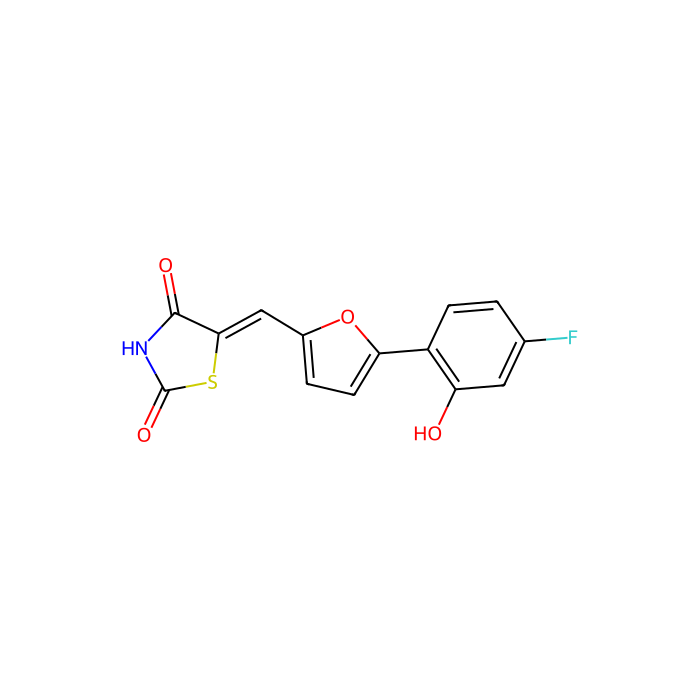
AS-252424 is a novel, potentPI3Kγinhibitor withIC50of 30 nM in a cell-free assay with 30-fold selectivity for PI3Kγ than PI3Kα, and low inhibitory activity towards PI3Kδ/β. In vitro
AS-252424 is a furan-2-ylmethylene thiazolidinedione as a selective ATP-competitive PI3Kγ inhibitor with IC50 with 33 nM. AS-252424 shows reduced potency on PI3Kα with an IC50 with 935 nM. When screening against 80 different Ser/Thr and Tyr kinases, AS-252424 doesn\'t show significant inhibit towards any of them at 10 μM except for CK2. AS-252424 inhibits C5a-mediated PKB/Akt phosphorylation in a concentration- dependent manner with submicromolar or low-micromolarIC50 value. AS-252424 inhibits MCP-1-mediated chemotaxis in wild-type primary monocytes in a concentration-dependent manner with an IC50 value of 52 μM, as well as in the monocytic cell line THP-1 with an IC50 value of 53 μM. AS252424 specifically blocks proliferation in the pancreatic cancer cell lines HPAF and Capan1, as assessed by cell counting. A recent research indicates 100 nM of AS-252424 significantly reduces [Ca2+]i, ICa and Ca2+ transients in HL-1 cardiomyocytes.
In vivo
Oral administration of AS-252424 at 10 mg/kg results in moderate reduction of neutrophil recruitment (35%), almost matching the result observed in PI3Kγ-deficient mice. Cell Data
cell lines:MCF-7, HT-29, HCT-116, OVCAR3, A549, et al.
AS-252424 is a novel, potent PI3Kγ inhibitor with IC50 of 30 nM in a cell-free assay with 30-fold selectivity for PI3Kγ than PI3Kα, and low inhibitory activity towards PI3Kδ/β.
Condizioni di conservazione di stoccaggio
Store at -80°C
Spedito in
Dry ice packs + Cold packs
Questo prodotto richiede spedizione a catena fredda. I servizi di terra e altri servizi economici non sono disponibili.
Grado
Moligand™
Tipo di azione
INHIBITOR
Meccanismo d'azione
Inhibitor of phosphatidylinositol-4;5-bisphosphate 3-kinase catalytic subunit alpha;Inhibitor of phosphatidylinositol-4;5-bisphosphate 3-kinase catalytic subunit gamma
Determine the necessary mass, volume, or concentration for preparing a solution.
Dilution Calculator
Determine the dilution needed to prepare a stock solution.
Reconstitution Calculator
Recensioni
Recensioni dei clienti
Application Protocols
No vendor-validated protocols (e.g., WB/IHC/IF/FC) or assay recommendations are provided for this item.
General screening workflow (example, not item-specific):
Prepare a 10 mM stock in dry DMSO; vortex and sonicate briefly if needed.
Plate at desired concentrations using acoustic or pin-tool dispensing to minimize DMSO carryover.
Include vehicle controls at the same final DMSO fraction; add positive and negative assay controls as appropriate to your target biology.
After assay readout, confirm hits by re-ordering or re-purifying compound and repeating dose–response with fresh stocks.
For any specific application, please design and validate protocols according to your laboratory’s standards and the requirements of the biological system under study.
Biological Roles
Item-specific biological roles, targets, or pathways are not provided for AS-252424. No target specificity or mode-of-action information is included in the Product Data.
General notes for library compounds (not item-specific):
In discovery workflows, small molecules serve as chemical probes or starting points (“hits”) for exploring biological pathways by modulating protein function, disrupting interactions, or altering enzymatic activity.
Follow-up studies typically assess selectivity across enzyme families or receptor subtypes, cellular permeability, stability, and off-target liabilities (e.g., hERG, CYP interactions) once a hit is identified.
Early triage includes assessing compound behavior in cells (cytotoxicity counterscreens), redox activity, and interference with detection modalities (fluorescence quenching, absorbance overlap).
For definitive biological role assignment of this specific catalog item, consult literature associated with the CAS or PubChem CID and verify with your own assays. This product is provided strictly for research use only.
Buffer Applications
This product is a small-molecule library member and is not a buffering agent. No acid/base pair, pKa set, or buffering capacity is provided in the Product Data.
Practical notes (general):
When dosing into buffers, maintain consistent vehicle (e.g., 0.1–1% DMSO) across control and treated samples to avoid solvent-induced pH or activity artifacts.
If precipitation occurs upon buffer dilution, increase the proportion of co-solvent incrementally or explore solubilizing excipients (HPβCD) as assay-permissible.
For buffer recipes, pH ranges, or ionic strengths, refer to the assay’s validated buffer system rather than the compound itself.
Green Alternatives
Because this item is supplied as a small-molecule library member rather than a process solvent or bulk reagent, green chemistry considerations center on dissolution vehicles and assay diluents rather than synthetic solvent replacement.
Vehicle considerations (general, not item-specific)
DMSO is standard but has environmental and occupational considerations. Potential alternatives or complements:
Cyrene (dihydrolevoglucosenone): Biobased dipolar aprotic solvent; promising for some dissolutions but less common in bioassays; evaluate assay tolerance carefully.
2-Methyltetrahydrofuran (2-MeTHF) or CPME: Greener hydrophobic solvents for preparative work; limited miscibility with aqueous buffers and often unsuitable for microplate assays.
Ethanol or isopropanol: Lower-toxicity protic solvents; may impact biological assays at modest percentages; volatility can complicate dosing precision.
Aqueous hydroxypropyl-β-cyclodextrin (HPβCD): Can enhance apparent solubility of hydrophobic molecules; assess binding artifacts.
Comparison (general guidance)
DMSO vs Ethanol: DMSO offers broader solvency and lower volatility; ethanol may be preferable for certain live-cell contexts at ≤0.1–0.5%.
DMSO vs Cyrene: Cyrene is greener but less characterized in screening workflows; validate stability and biological compatibility.
Operational green tips
Use minimal stock volumes at higher concentrations to reduce solvent use.
Standardize low final vehicle percentages to minimize environmental and biological impact.
Reuse solvent-rinsed vials where appropriate and compliant; segregate halogenated/non-halogenated waste streams.
Pharmaceutical Uses
No pharmacopeial status, excipient role, or formulation use is specified for AS-252424. This product is supplied for research use only and is not intended for human or veterinary applications.
General considerations for research formulation (non-clinical):
For in vitro work, prepare concentrated DMSO stocks (e.g., 10–50 mM) and dilute into assay media with consistent final vehicle fraction.
For exploratory in vivo research in laboratory animals (if permitted by your institution), conduct thorough pre-formulation studies: solubility screening in biocompatible vehicles (e.g., PEG-400/saline, Captisol, ethanol/cremophor/saline), stability, and dose linearity. Institutional approvals and local regulations apply.
Do not infer any therapeutic utility or safety from the availability of this compound; no clinical claims are made or implied.
For any GMP or clinical context, a different sourcing pathway and full regulatory documentation would be required; this product is not intended for such use.
Physical Properties
Item-specific data (as supplied)
Appearance: Not specified for this item; refer to CoA/Spec Sheet.
Molecular Weight: Not specified for this item; refer to CoA/Spec Sheet.
Melting point: Not specified for this item; refer to CoA/Spec Sheet.
Boiling point: Not specified for this item; refer to CoA/Spec Sheet.
Density: Not specified for this item; refer to CoA/Spec Sheet.
Refractive index: Not applicable/Not specified for this item; refer to CoA/Spec Sheet.
Solubility data (water/organic): Not specified for this item; refer to CoA/Spec Sheet.
LogP/logD, pKa: Not specified for this item; refer to CoA/Spec Sheet.
General guidance for small-molecule library members (literature/practice, not item-specific)
Working stocks are commonly prepared in anhydrous DMSO (e.g., 10–50 mM) for screening workflows; solubility should be verified empirically.
Where aqueous use is intended, dilute DMSO stock into assay buffer with vigorous mixing to minimize precipitation; keep final DMSO typically ≤0.1–1% v/v as assay-compatible (assay-dependent).
If the solid is hydrophobic, co-solvents such as DMF or ethanol may aid dissolution, followed by back-dilution into buffer; evaluate effects on biological assays separately.
Notes
Do not treat the above as specifications. For authoritative physicochemical parameters, consult the item’s CoA/Spec Sheet and SDS.
Quality and Grades
Grade (from Product Data)
Grade/Purity: Moligand™
What Moligand™ implies (program-level description; not item-specific specs)
Moligand™ denotes a screening-ready small-molecule suitable for ligand discovery and chemogenomic applications. Typical expectations for such library members include rigorous identity confirmation (e.g., LC–MS and/or 1H NMR) and preparative purity control fit for in vitro screening.
Exact acceptance criteria (e.g., purity percentage, residual solvent limits, water content, metal analysis, stabilizers, UV cutoffs) are Not specified for this item; refer to CoA/Spec Sheet.
Batch-to-batch documentation
For each lot, consult the Certificate of Analysis (CoA) for: analytical method(s) used, observed purity, retention time, MS m/z, and any special notes (e.g., polymorph, salt form, counterion balance).
Use considerations
For quantitative biology or SAR, verify purity by in-house LC–UV/LC–MS before critical assays.
If trace impurities or residual solvents could interfere with sensitive readouts (fluorescence, MS-based assays), consider additional purification or orthogonal confirmation.
Regulatory status
For research use only; not for human or veterinary use, diagnostic procedures, or food/cosmetic applications.
Reaction and Applications
Scope of use (from Product Data)
Category: Small-molecule/compound library member intended for research screening. Specific reaction chemistry is not the primary use-case for this catalog entry.
Research applications (general, non-targeted)
Ligand discovery and primary screening: Prepare DMSO stocks (e.g., 10 mM) for biochemical or cell-based assays to identify hits. Ensure vehicle-matched controls and verify solubility at working concentrations.
Biophysical characterization: Apply to thermal shift (DSF), microscale thermophoresis (MST), surface plasmon resonance (SPR), or NMR binding assays after confirming solubility and spectral cleanliness.
Orthogonal confirmation: Use dose–response curves, orthogonal readouts (e.g., enzymatic vs. biophysical) to rule out assay interference.
Assay-interference vigilance (general guidance)
Screen for aggregation-prone behavior (detergent sensitivity, light scattering) and redox/metal-chelation artifacts. Include counter-screens for PAINS-like motifs where appropriate.
If synthetic use is intended
With no disclosed structure, reaction planning cannot be specified. Obtain structural details from the CoA/Spec Sheet before considering derivatization or coupling chemistry.
Documentation
Record compound ID (AS-252424), lot, exact concentration, and plate map to ensure traceability from screening through follow-up.
Reaction Conditions
Specific reaction conditions for AS-252424 cannot be provided without structural information. This product is positioned as a screening compound rather than a reagent for named transformations.
General best practices when using small molecules in biochemical or biophysical experiments:
Stock preparation: Dissolve in anhydrous DMSO at 10–50 mM; record exact concentration by weight or quantitative NMR if needed for accuracy.
Dilution: Add stock slowly to assay buffer with mixing; maintain consistent final DMSO across all wells/samples.
Light/oxygen sensitivity: If chromophoric or easily oxidized motifs are suspected, protect from strong light and minimize air exposure; use amber vials and inert headspace.
Temperature: Prepare and store working solutions at 2–8°C for short periods when stability permits; otherwise keep frozen aliquots and thaw immediately before use.
Filtration: 0.22 µm filtration can remove particulates; verify compound recovery to avoid loss by adsorption.
For chemical reactions (synthetic chemistry), obtain the full structure and consult literature precedents for appropriate solvents, catalysts, temperatures, and times.
Safety and Handling
GHS/SDS information (item-specific)
Signal Word: Not specified for this item; refer to SDS.
Hazard Statements (H-phrases): Not specified for this item; refer to SDS.
GHS Classification and Pictograms: Not specified for this item; refer to SDS.
General laboratory precautions (good practice for organic research compounds)
Handle in a chemical fume hood; avoid inhalation of dusts/aerosols and contact with skin or eyes.
Wear appropriate PPE: lab coat, safety glasses, and nitrile gloves. Change gloves regularly and immediately if contaminated.
Avoid DMSO-mediated dermal uptake by preventing skin contact with solutions.
Prevent formation of dust; use antistatic measures when weighing fine powders.
Incompatibilities: Unknown for this item; segregate from strong oxidizers and strong acids/bases as a conservative practice until SDS review.
First-aid overview (consult SDS for details)
Inhalation: Move to fresh air; seek medical attention if symptoms persist.
Skin contact: Wash with soap and water; remove contaminated clothing.
Eye contact: Rinse cautiously with water for several minutes; remove contact lenses if present and easy to do; seek medical attention if irritation persists.
Ingestion: Rinse mouth; do not induce vomiting; seek medical advice.
Storage and stability considerations
Store at −80°C as specified. Allow container to equilibrate in a desiccator before opening to avoid moisture condensation. Keep tightly closed; minimize freeze–thaw by aliquoting upon receipt.
Solvent Selection
Item-specific solubility profile
Not specified for this item; refer to CoA/Spec Sheet.
General guidance for dissolution of library compounds (literature/practice)
Primary vehicle: Anhydrous DMSO is the default solvent for hit discovery collections due to broad solvency, chemical stability for many scaffolds, and assay compatibility at low percentages.
Secondary vehicles: DMF or ethanol can assist with recalcitrant solids; PEG-400 or aqueous cyclodextrin solutions may be used for biophysical assays requiring minimal organic content (verify compatibility).
Aqueous buffers: Often require co-solvent; add DMSO stock slowly to vigorously stirred buffer to mitigate precipitation. Maintain consistent final DMSO across controls and test wells.
Polarity and miscibility considerations (general)
Unknown for this specific compound. If hydrophobic behavior is observed (slow wetting, immediate precipitation in buffer), increase initial DMSO fraction or include nonionic surfactants at low levels (e.g., 0.01–0.05% Tween-20) if assay-acceptable.
Practical tips
Warm to ambient and sonicate briefly to aid dissolution; avoid prolonged heating.
Filter 0.22 µm if particulate persists and if the compound is not adsorbed significantly by the membrane (test recovery).
Document vehicle, concentration, and lot to ensure reproducibility across screens.
Storage and Reconstitution
Item-specific instructions (from Product Data)
Storage Conditions: Store at −80°C.
Shipped In: Dry ice packs + Cold packs.
General handling guidance
Upon receipt, keep frozen. Allow the container to equilibrate to room temperature in a desiccator before opening to prevent moisture condensation.
Immediately aliquot solid or concentrated solutions into small, dry, inert vials to minimize freeze–thaw cycles. Label aliquots with compound ID (AS-252424), lot, and concentration.
Reconstitution (general practice for screening compounds)
Solvent: Anhydrous DMSO is typically recommended; if alternative solvents are required, verify solubility and stability first.
Concentration: Common working stocks are 10–50 mM; select based on solubility and assay needs.
Mixing: Vortex and, if necessary, brief bath sonication to aid dissolution. Avoid elevated temperatures and prolonged light exposure.
Sterility: For cell-based assays, consider 0.22 µm filtration of final working solutions if compatible; confirm no loss of compound by adsorption.
Stability notes
Long-term stability data are Not specified for this item; refer to CoA/Spec Sheet.
Store solutions at −20°C to −80°C in tightly sealed, moisture-free conditions; avoid repeated freeze–thaw.
For authoritative stability and compatibility data, consult the product’s CoA and SDS.
Structure and Identity
Overview
Product Name: AS-252424 (SKU: A408539)
CAS: 900515-16-4
PubChem CID: 11630874
Category: Small-molecule and compound library (Moligand series)
Item-specific identifiers (from Product Data)
InChIKey: Not specified for this item; refer to CoA/Spec Sheet.
SMILES: Not specified for this item; refer to CoA/Spec Sheet.
Molecular Formula: Not specified for this item; refer to CoA/Spec Sheet.
Molecular Weight: Not specified for this item; refer to CoA/Spec Sheet.
Structural features
Functional groups, ring systems, stereochemistry: Not specified for this item; refer to CoA/Spec Sheet.
2D structure description (general note)
The detailed 2D connectivity and substituent pattern are not provided in the Product Data. For cheminformatics or registration purposes (SD file, InChI, canonical SMILES), please consult the product’s CoA/Spec Sheet or request structural data from Aladdin Scientific support.
Identity assurance
Typical identity verification for Moligand library members includes orthogonal methods such as 1H NMR and LC–MS (general practice; see Quality & Grades). Exact tests performed for this catalog item are Not specified; refer to CoA/Spec Sheet.
Synthetic Utility
AS-252424 is provided as a screening compound rather than a designated synthetic intermediate. Because the structure and functional groups are not disclosed in the Product Data, specific transformations cannot be recommended.
General guidance if derivatization is contemplated (after obtaining structural information):
Evaluate stability toward bases, acids, oxidants/reductants, and heat using small-scale scouting before route selection.
Protect sensitive motifs (e.g., phenols, primary amines) during multistep sequences as needed; choose orthogonal protection strategies.
Verify purity and identity (LC–MS, NMR, HRMS) after each modification, especially if biological activity is to be correlated with structure.
If the aim is solely biological screening, synthetic elaboration is not required; prioritize compound handling, solubility, and analytical verification instead.
Target Specificity
No target, pathway, or selectivity profile is provided in the Product Data for AS-252424. There are no claims of specificity to any protein, nucleic acid, or pathway.
If your project requires target annotation:
Perform primary screening followed by counterscreens to assess selectivity within relevant target families.
Use orthogonal binding/activity assays and evaluate potential assay interference.
Consult literature associated with the CAS or PubChem CID to identify any prior reports, and confirm independently.
Need help choosing the grade?
Our grade selection guide covers purity, stabilizer status, and application suitability for all variants in our catalog.
We use cookies to ensure the website functions properly and, where permitted, to improve your experience. You can manage your preferences at any time in Settings. Learn more in our Cookie Policy.
Shall we send you a message when we have discounts available?
Remind me later
Thank you! Please check your email inbox to confirm.
Products are supplied to verified businesses, institutions, and qualified professionals for research and development use only. Not for use in humans, animals, diagnosis, or therapy.

 F2419031