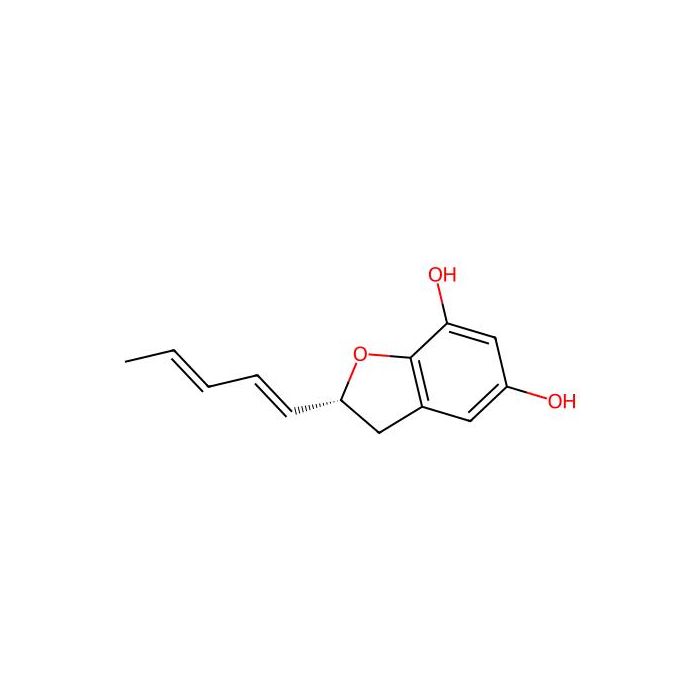
This compound belongs to the class of organic compounds known as coumarans. These are compounds containing the coumaran skeleton, which consists of a benzene ring fused to a 2,3-dihydrofuran ring.
External Descriptors
Not available
1. Djoumbou Feunang Y, Eisner R, Knox C, Chepelev L, Hastings J, Owen G, Fahy E, Steinbeck C, Subramanian S, Bolton E, Greiner R, and Wishart DS. ClassyFire: Automated Chemical Classification With A Comprehensive, Computable Taxonomy. Journal of Cheminformatics, 2016, 8:61.
Certificati (CoA, COO, BSE/TSE e tabella di analisi)
C of A & Other Certificates(BSE/TSE, COO):
Analytical Chart:
Proprietà chimiche e fisiche
Peso molecolare
218.250 g/mol
XLogP3
2.800
Hydrogen Bond Donor Count
2
Hydrogen Bond Acceptor Count
3
Rotatable Bond Count
2
Exact Mass
218.094 Da
Monoisotopic Mass
218.094 Da
Topological Polar Surface Area
49.700 Ų
Heavy Atom Count
16
Formal Charge
0
Complexity
285.000
Isotope Atom Count
0
Defined Atom Stereocenter Count
1
Undefined Atom Stereocenter Count
0
Defined Bond Stereocenter Count
2
Undefined Bond Stereocenter Count
0
The total count of all stereochemical bonds
2
Covalently-Bonded Unit Count
1
Calcolatori di soluzioni
Molarity Calculator
Determine the necessary mass, volume, or concentration for preparing a solution.
Dilution Calculator
Determine the dilution needed to prepare a stock solution.
Reconstitution Calculator
Recensioni
Recensioni dei clienti
Application Protocols
No validated application protocols are provided for this item. As a general starting point for small-molecule handling in research settings:
Preparation of stock solutions: Dissolve to 10–50 mM in anhydrous DMSO under low light. Vortex and, if needed, gentle warming (<35 °C). Record exact concentration gravimetrically or by quantitative NMR if required.
LC–MS reference standard setup: Prepare a 1.0 mg/mL primary in MeCN (or DMSO), then serially dilute to a 5–8 point calibration curve (e.g., 0.5–500 ng/mL). Use amber vials; store aliquots at −20 °C.
Stability check: Subject one aliquot to 3 freeze–thaw cycles and analyze by UPLC–MS to assess degradation. If instability is observed, increase aliquotization and add light/oxygen protection.
Bioassay dosing (general): Dilute DMSO stock into assay buffer/culture medium to a final organic content ≤1–2% v/v, verifying solubility and absence of precipitation. Include vehicle controls.
These are generic small-molecule practices. For any method-sensitive application, develop and qualify procedures internally. Always defer to the product’s CoA/SDS for constraints specific to the supplied material.
Biological Roles
Item-specific biological roles for Asperfuran are not provided in this listing.
General context (literature-level, non-item-specific):
Many “Asper-” prefixed natural products originate from Aspergillus spp. secondary metabolism and may feature furan/benzofuran scaffolds. Such metabolites can serve ecological functions including chemical defense, signaling, or metal chelation in the producing organism. The actual role and bioactivity spectrum depend on precise structure and substitution, which must be confirmed for Asperfuran via primary literature or spectral authentication.
Analytical biology: Authentic small-molecule standards are valuable in natural product dereplication, microbial chemotaxonomy, and pathway elucidation. When used as a reference, maintain traceability (lot-linked CoA, NMR, HRMS) and document retention indices and MS/MS fragmentation under your instrument conditions.
Stability in biological media: Heteroaromatic natural products may undergo oxidative or enzymatic transformation in cell lysates or microsomes. If conducting metabolism or stability studies, use time-course sampling, quench with cold MeCN (0.1% formic acid or ammonium formate), and verify mass balance.
Important: No medical or clinical claims are made or implied. Use is restricted to research applications as noted in Product Data (For research use only). Consult the SDS and primary literature before any biological experimentation.
Buffer Applications
This item is a small organic natural product rather than a buffering reagent. It is not typically used to prepare buffer systems.
Practical guidance if dosing into buffers for assays:
Prepare concentrated stocks in DMSO or MeCN and dilute into the target buffer to a final organic content typically ≤1–2% v/v to minimize solvent effects.
Verify solubility and stability at the assay pH; many heteroaromatics are more stable under mildly acidic conditions (pH 4–6) than strongly basic conditions.
Filter sterilization: If sterile solutions are required, dissolve completely in solvent, then dilute into buffer and pass through a 0.22 µm PTFE or PES membrane; avoid cellulose esters if the compound is highly lipophilic.
For traditional buffering needs, select established systems (e.g., citrate pH 3–6.2, phosphate pH 6–8, HEPES pH 6.8–8.2) rather than this reagent.
Green Alternatives
This product is a specialty small molecule (not a process solvent), so “green alternative solvent” substitution is generally not applicable.
However, greener practices around its use can reduce environmental footprint:
Solvent choice for handling/purification (general): Prefer EtOAc, ethanol, and 2-MeTHF over chlorinated solvents where feasible; validate compound stability and solubility first.
Chromatography: Employ shorter gradients and higher-efficiency stationary phases to reduce solvent consumption; consider supercritical CO2 for suitable polarity ranges.
Crystallization/workup: Explore antisolvent crystallizations using greener alcohols or water co-solvent systems if the compound’s solubility profile allows.
Energy and storage: The item stores at −20 °C; minimize door-open time and consolidate freezer space. Shipments are already cold-packed per Product Data; plan consolidated orders to reduce logistic emissions.
Tradeoffs to consider:
Replacing CH2Cl2/CHCl3 with EtOAc or 2-MeTHF may alter selectivity and recovery; conduct small-scale scouting.
DMSO (common for stocks) is relatively benign but challenging to remove; consider MeCN or EtOH stocks if solubility and stability permit.
Bottom line: While the molecule itself does not have a “green substitute,” greener solvent and purification choices around its use can meaningfully reduce environmental impact without compromising data quality.
Pharmaceutical Uses
No pharmacopeial status or excipient role is provided for this item. Asperfuran is offered for research use only.
General formulation-related notes for research applications (non-clinical, non-GLP):
Stock solutions: DMSO or ethanol stocks are common for small heteroaromatics. Confirm solubility and stability; light protection may be warranted.
Vehicle selection for in vivo research is outside the scope of this listing and is not recommended here. No medical or clinical uses are claimed or supported.
Analytical control: If using as a system suitability or reference material in method development, document purity (HPLC/UPLC), identity (NMR/HRMS), and water/residual solvent levels prior to use. Spike–recovery experiments can establish extraction efficiency in complex matrices (plasma, tissue homogenate), strictly for laboratory research workflows.
Regulatory note: This product is not approved for diagnostic, therapeutic, or human/animal consumption. No compendial monograph is implied. Users are responsible for establishing fitness-for-purpose under their internal quality systems.
Physical Properties
Item-specific physical constants are not supplied in this listing.
Appearance: Not specified for this item; refer to CoA/Spec Sheet.
Melting point: Not specified for this item; refer to CoA/Spec Sheet.
Boiling point: Not specified for this item; refer to CoA/Spec Sheet.
Density: Not specified for this item; refer to CoA/Spec Sheet.
Refractive index: Not applicable for solids; if liquid, Not specified for this item; refer to CoA/Spec Sheet.
Solubility: Not specified for this item; refer to CoA/Spec Sheet.
LogP, pKa: Not specified for this item; refer to CoA/Spec Sheet.
General/literature guidance for furan/benzofuran-type natural products (non-item-specific):
Solubility tends to be good in polar aprotic solvents (DMSO, DMF, acetone) and moderately good in medium-polar organics (EtOAc, CH2Cl2, CHCl3). Aqueous solubility is typically low unless ionizable groups are present.
UV–Vis: Conjugated heteroaromatics frequently exhibit strong UV absorbance in the 210–300 nm range; exact maxima depend on substitution.
Stability: Many oxygenated heteroaromatics are sensitive to light, air, and bases; store under inert atmosphere, desiccated, and protected from light when possible.
Note: For any quantitative property needed for method development (e.g., chromatographic method setup, formulation), obtain and rely on the current CoA/SDS or verify in-house by DSC/TGA, Karl Fischer, and solubility screening.
Quality and Grades
Grade/Purity: Not specified for this item; refer to CoA/Spec Sheet.
Guidance on interpreting grade (general):
Research-grade small molecules may be supplied at high chemical purity suitable for discovery chemistry, metabolite studies, or as analytical references. Where “HPLC grade” applies to solvents, for small molecules the analogous concept is “HPLC-assayed purity,” often determined by UV/ELSD at specified wavelengths. Absent a declared purity, confirm by your own HPLC and NMR before critical use.
Stabilizers: Not specified for this item; refer to CoA/Spec Sheet. If none are present, be mindful of potential slow oxidation or photolysis for heteroaromatic systems; consider storing under inert gas.
Quality documentation: Request CoA/SDS for each lot to review assay method, residual solvents, water content, and identity confirmation (e.g., 1H NMR, 13C NMR, HRMS). For analytical reference uses, preference should be given to lots with full spectral traceability.
Impurity profile: Natural-product isolates can contain structurally related congeners; for synthetic material, typical impurities are residual starting materials or side products. Tailor purification (flash, prep HPLC, recrystallization) as needed based on your use case.
If low-UV applications (e.g., photochemistry) are intended, verify absence of unknown chromophores by full-spectrum scanning and confirm stability under your illumination conditions.
Reaction and Applications
Manufacturer Applications: Not specified in Product Data.
General research uses for fungal-metabolite small molecules like Asperfuran (non-item-specific; literature-based context):
Reference standard: Employed as a comparator in metabolomics, dereplication, and natural product isolation workflows. Useful for LC–MS/MS method development, UV signature confirmation, and retention-time alignment. Create authenticated calibration curves if quantitative work is planned.
Chemical biology probes (preparative context): Scaffolds with heteroaromatic cores can be derivatized for target ID studies (e.g., photoaffinity tags or biotin handles). Verify the actual functional groups present on Asperfuran before planning linkers.
Biosynthetic studies: Utilized to validate gene cluster assignments or feeding studies in Aspergillus systems. Stable-isotope labeling may be applied once pathways are known for the specific congener.
Semisynthesis/scaffold modification: Typical transformations on furan/benzofuran motifs include electrophilic substitution on activated rings, oxidative functionalization (e.g., DDQ, mCPBA for ring oxidation—mindful of over-oxidation), and cross-coupling if aryl halides are present in the structure.
Practical tips:
Dry, oxygen-limited conditions minimize degradation for sensitive heteroaromatics; include antioxidants or degassing if empirical instability is observed.
For LC–MS: prefer formic acid or ammonium formate buffers (pH 3–6) to maintain peak shape; avoid strong base unless stability is established.
Consult primary literature or the item’s CoA to confirm Asperfuran’s exact substitution pattern before selecting transformations.
Reaction Conditions
No item-specific reactivity or optimized conditions are provided. The following are general, literature-level considerations for manipulating furan/benzofuran-like scaffolds.
Solvents: Dry, oxygen-free solvents (THF, toluene, MeCN, DCM) are commonly used; DMSO/DMF for polar transformations. For analytical workup, MeCN/H2O with 0.1% formic acid or ammonium formate buffers gives robust LC–MS response.
Temperatures: Many electrophilic substitutions on furans require 0 to −78 °C to control regioselectivity and avoid polymerization; milder temperatures for cross-couplings if aryl halides are present (40–90 °C, Pd-catalyzed).
Catalysts/Reagents: Lewis acids (BF3·Et2O, AlCl3) promote EAS but risk ring degradation; milder Brønsted acids or hypervalent iodine reagents are often preferred. For oxidative functionalization, IBX/Dess–Martin or photoredox methods can be gentler.
Times/Yields: Highly substrate-dependent; pilot on 5–20 mg scale to map stability and conversion. Expect need for condition scouting to balance selectivity and integrity of the heteroaromatic core.
Workup/Purification: Minimize exposure to strong acid on silica; use pre-neutralized silica or reversed-phase prep HPLC for acid-sensitive compounds. Protect from light and oxygen during concentration (amber glass, reduced pressure, ≤30–35 °C bath temperature).
These conditions are general guidance only. Establish stability profiles and kinetics for Asperfuran specifically once its exact structure is confirmed from CoA or primary literature.
Safety and Handling
Hazard classification details are not provided in this listing; handle conservatively.
GHS/Signal Word/Pictograms/H-Statements: Not specified for this item; refer to SDS.
Storage: Store at −20 °C (Product Data). Protect from light and moisture; keep container tightly closed. If the compound is air/light-sensitive (typical for some heteroaromatics), consider inert gas backfill.
Handling: Use in a fume hood with appropriate PPE: lab coat, nitrile gloves, splash goggles. Avoid dust/aerosol generation. Prevent contact with skin/eyes and avoid inhalation.
Incompatibilities (general): Strong oxidizers, strong bases, and strong acids may lead to degradation of sensitive heteroaromatic natural products. Avoid prolonged exposure to elevated temperature and UV.
First aid (general overview; defer to SDS):
Inhalation: Move to fresh air; seek medical attention if symptoms persist.
Skin: Wash with soap and water; remove contaminated clothing.
Eyes: Rinse cautiously with water for several minutes; remove contacts if present and easy to do; seek medical advice if irritation continues.
Ingestion: Rinse mouth; do not induce vomiting; seek medical attention.
Spill/Disposal: Collect with inert absorbent for solids/liquids as appropriate and dispose of according to institutional and local regulations. Decontaminate surfaces and ventilate area.
Always consult the product’s SDS for authoritative hazard and response information before use.
Solvent Selection
Item-specific solubility has not been provided; the following is general guidance for small, neutral, heteroaromatic natural products.
Polarity class: Moderately polar, organic-soluble (general expectation for furan/benzofuran motifs). Actual behavior must be confirmed experimentally.
Likely good solvents: DMSO and DMF (for stock solutions), acetone, ethyl acetate, dichloromethane, chloroform, and acetonitrile.
Variable solvents: Methanol, ethanol, and isopropanol often dissolve mg/mL levels depending on substitution. Water solubility is commonly poor unless ionizable groups are present.
Dielectric considerations: For spectroscopic assays or bioassays, DMSO stocks (10–50 mM) diluted into aqueous buffers (final DMSO ≤1–2%) are a practical starting point; verify compatibility with your system.
When to choose vs. alternatives (general):
Choose strong polar aprotics (DMSO/DMF) to ensure dissolution for screening or analytical standards.
Choose medium polarity (EtOAc/MeCN) for normal-phase or reverse-phase LC method development.
Avoid protic/basic media if instability is suspected (ring-opening or oxidative pathways can be base-catalyzed in some heteroaromatics).
Small comparison (general):
DMSO: maximal solubilization, hygroscopic, high boiling.
EtOAc: greener workup solvent, immiscible with water, good for extractions.
Confirm solubility empirically (serial dilution, visual inspection, UV area constancy) before scaling.
Storage and Reconstitution
Storage conditions: Store at −20 °C (Product Data). Keep tightly sealed in original container, protected from light and moisture. If repeated access is expected, pre-aliquot under inert gas to minimize headspace oxygen and freeze–thaw cycles.
Shipping: Ice chest + ice pads (Product Data). Upon receipt, inspect the packaging for condensation or breach and return promptly to −20 °C storage.
Stability: Item-specific stability limits (e.g., shelf life, permissible excursions) are not specified; refer to CoA/Spec Sheet. As a precaution, limit prolonged exposure to room temperature.
Reconstitution/stock preparation (general):
Choose anhydrous solvent (e.g., DMSO, MeCN, or EtOH) based on solubility testing.
Target 10–50 mM stocks; filter if needed through 0.22 µm PTFE.
Dispense single-use aliquots (amber vials) and store at −20 °C. Avoid repeated freeze–thaw; thaw only once immediately before use.
Compatibility: Avoid strong acids/bases during dissolution unless stability is known. For aqueous work, dissolve in organic solvent first, then dilute into buffer with vigorous mixing to prevent precipitation.
Documentation: Record lot number, preparation date, solvent, and concentration. For critical applications, verify concentration by UV or qNMR based on independently established extinction coefficients.
For any item-specific parameters (water content limits, residual solvents, stabilizers), consult the current CoA/Spec Sheet.
Structure and Identity
Asperfuran is cataloged as a fungal secondary metabolite–type small molecule. Item-specific identifiers are limited in this listing; consult CoA/SDS for definitive identity metrics.
CAS: 138331-36-9 (Product Data)
InChIKey: 407473 (as provided; note this is not the standard 27-character InChIKey format; verify in CoA/SDS)
SMILES: Not specified for this item; refer to CoA/Spec Sheet.
Molecular formula: Not specified for this item; refer to CoA/Spec Sheet.
Molecular weight: Not specified for this item; refer to CoA/Spec Sheet.
Structural features and context (general/literature):
The trivial name “Asperfuran” implies a furan- or benzofuran-containing scaffold associated with Aspergillus-derived metabolites. This suggests a heteroaromatic oxygen-containing ring motif, potentially with polyketide-like substitution patterns. Confirm actual functional groups from the item’s CoA or primary literature before planning derivatizations.
Expected functional groups for furan-type natural products (literature-general): conjugated heteroaromatic ring(s), possible phenolic, methoxy, carbonyl, or halogen substituents depending on isolate.
2D structure description (general guidance):
For furan/benzofuran frameworks, the planar heteroaromatic core often bears substituents that modulate polarity and UV absorbance. However, the precise regiochemistry and substituent set for Asperfuran must be verified against an authenticated structure record (e.g., vendor CoA, NMR, MS).
Synthetic Utility
With specific structure not provided in this listing, the following utility is framed generally for furan/benzofuran-type natural product scaffolds.
Functional group handles (general): Aromatic C–H positions can be leveraged for electrophilic aromatic substitution (EAS) under carefully controlled conditions; however, furan rings are sensitive and can polymerize or overreact. If halogenated analogs exist, cross-coupling (Suzuki, Sonogashira, Buchwald–Hartwig) becomes accessible.
Oxidation/Reduction: Benzylic/allylic positions (if present) can be oxidized to carbonyls; mild oxidants (e.g., DDQ, TEMPO systems) may functionalize without ring cleavage. Hydrogenation of exocyclic double bonds can tune lipophilicity.
Protection strategies: Phenolic or enolic hydroxyls (if present) benefit from silyl (TBS, TBDPS) or benzyl protection to survive subsequent steps; acidic/basic instability of the core should guide protecting group selection.
Late-stage diversification: C–H activation methods (e.g., Ir-catalyzed borylation on aryl C–H sites) can enable rapid analog generation for SAR, subject to ring stability.
Analytical support: Monitor reactions by UPLC–MS with soft ionization to avoid in-source ring opening; use short exposure to silica and prefer neutral/alumina or buffered silica for flash chromatography if acid sensitivity is suspected.
Before undertaking synthesis, confirm Asperfuran’s exact substitution pattern (CoA/literature) to select compatible transformations and to avoid degradation pathways typical for sensitive heteroaromatics.
Target Specificity
Not applicable. This product is a small molecule, not an antibody, enzyme, or affinity reagent. No target, epitope, isotype, or species reactivity information is associated with this catalog entry.
We use cookies to ensure the website functions properly and, where permitted, to improve your experience. You can manage your preferences at any time in Settings. Learn more in our Cookie Policy.
Shall we send you a message when we have discounts available?
Remind me later
Thank you! Please check your email inbox to confirm.
Products are supplied to verified businesses, institutions, and qualified professionals for research and development use only. Not for use in humans, animals, diagnosis, or therapy.