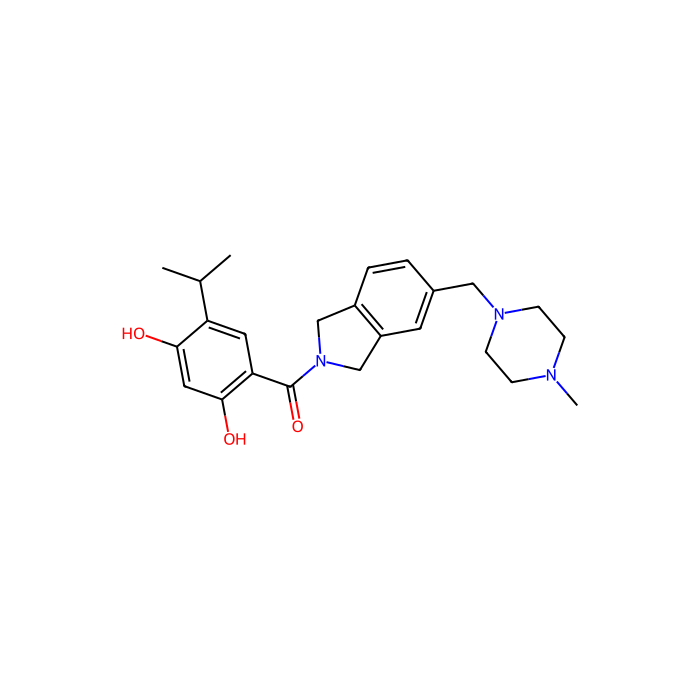
AT13387 is a synthetic, orally bioavailable, small-molecule inhibitor of heat shock protein 90 (Hsp90) with potential antineoplastic activity. Hsp90 inhibitor AT13387 selectively binds to Hsp90, thereby inhibiting its chaperone function and promoting the
Condizioni di conservazione di stoccaggio
Store at -20°C
Spedito in
Ice chest + Ice pads
Questo prodotto richiede spedizione a catena fredda. I servizi di terra e altri servizi economici non sono disponibili.
Tipo di azione
INHIBITOR
Meccanismo d'azione
Heat shock protein HSP90 inhibitor
Nota
Refer to SDS for further information Need more advice on solubility, usage and handling? Please visit our frequently asked questions (FAQ) page for more details.
This compound belongs to the class of organic compounds known as salicylamides. These are carboxamide derivatives of salicylic acid. Salicylic acid is the ortho-hydroxylated derivative of benzoic acid.
External Descriptors
Not available
1. Djoumbou Feunang Y, Eisner R, Knox C, Chepelev L, Hastings J, Owen G, Fahy E, Steinbeck C, Subramanian S, Bolton E, Greiner R, and Wishart DS. ClassyFire: Automated Chemical Classification With A Comprehensive, Computable Taxonomy. Journal of Cheminformatics, 2016, 8:61.
Determine the necessary mass, volume, or concentration for preparing a solution.
Dilution Calculator
Determine the dilution needed to prepare a stock solution.
Reconstitution Calculator
Recensioni
Recensioni dei clienti
Application Protocols
Tested applications, recommended dilutions, and positive controls are not provided in the product data for this item.
Validated applications (WB, IHC, IF, FC, enzymatic assays, cell-based readouts): Not specified for this item; refer to CoA/Spec Sheet.
Suggested working concentrations, incubation times, and vehicle controls: Not specified for this item.
Users should develop assay protocols tailored to their system, including appropriate vehicle controls, time courses, and concentration ranges, and confirm suitability through pilot experiments.
Biological Roles
General literature context (non-clinical, research use only)
AT13387 is widely reported in the chemical biology literature as a small-molecule modulator of the molecular chaperone pathway, frequently described as an inhibitor of heat shock protein 90 (HSP90). HSP90 is an ATP-dependent chaperone essential for maturation and stability of diverse client proteins involved in signaling and proteostasis.
Perturbation of HSP90 function in cells commonly produces characteristic pharmacodynamic signatures, such as induction of heat-shock response components (e.g., HSP70 upregulation) and proteasomal degradation or destabilization of selected client proteins. These readouts are often used as functional markers in mechanistic studies and assay qualification.
In biochemical systems, inhibition of chaperone ATPase activity can alter client loading/release cycles, enabling studies of chaperone–client interactions, co-chaperone dependencies, and cellular stress responses.
Because chaperone networks are highly interconnected, off-target or compensatory responses (e.g., induction of HSF1-mediated transcriptional programs) should be evaluated in parallel using orthogonal assays.
Important notes
The specific target profile, binding constants, and selectivity of AT13387 for any protein(s) are not specified in this product listing. Users should consult primary literature and confirm activity in their own assay systems.
No medical or clinical claims are made. This product is supplied strictly for research use. Experimental outcomes will depend on cell type, assay design, and exposure parameters.
Buffer Applications
This compound is not a buffering reagent and is not used to define pH.
Practical handling in buffered systems (general)
Prepare concentrated organic stocks (commonly in DMSO) and dilute into pre-warmed assay buffer or culture medium with thorough mixing to avoid precipitation. Keep final organic solvent content constant across all wells/replicates.
If adsorption or solubility issues are observed, consider adding a small amount of carrier protein (e.g., 0.1% BSA) or a minimal non-ionic surfactant to the buffer, provided this does not interfere with your assay.
Filter sterilization of working solutions should be performed only after confirming no adsorption loss on the membrane; low-protein-binding PVDF or PES membranes are often preferred.
Item-specific buffering parameters (pKa, buffer capacity, salt form): Not specified for this item; refer to CoA/Spec Sheet if applicable.
Green Alternatives
Because AT13387 is a discrete bioactive compound rather than a solvent or consumable reagent, “green alternatives” pertain mainly to how it is handled and formulated rather than substitution of the molecule itself.
Greener handling strategies (general)
Prefer high-concentration stocks to minimize solvent volumes and waste; dispense by acoustic or low-volume liquid handling to reduce plastics.
Choose lower-toxicity co-solvents where compatible with your assay window:
Ethanol or aqueous PEG400 co-solutions can sometimes replace DMF/NMP; verify solubility and biological tolerability.
Maintain DMSO at the lowest effective final v/v (e.g., ≤0.1–0.5%) to reduce solvent burden on cells.
Solvent comparison (general considerations)
DMSO: High solvency, broadly used; moderate EHS profile; miscible with water.
Ethanol: Renewable feedstock, lower toxicity; limited solvency for some hydrophobic actives.
PEG400/buffer systems: Improve aqueous compatibility; viscosity may affect dispensing and diffusion kinetics.
Operational sustainability
Use amber or foil-wrapped vials and prepare only needed aliquots to reduce discard due to degradation.
Implement microplate designs that minimize dead volume and enable reuse of carrier solvent controls across experiments.
Note: These are general principles; compound-specific solubility and stability for AT13387 are not specified for this item and must be validated experimentally.
Pharmaceutical Uses
This product is provided strictly for research use only and is not intended for human or veterinary use, diagnostic procedures, or as an excipient in commercial formulations.
Pharmacopeial status: Not specified for this item; refer to CoA/Spec Sheet.
Formulation role: Not applicable. This is a discrete bioactive compound, not a typical excipient, solvent, or processing aid.
Development context (general, non-clinical): In preformulation and discovery settings, tool compounds of this class may be assessed for solubility, permeability, and stability to support in vitro and ex vivo studies. Any such work must be performed under institutional guidelines and is outside the scope of this catalog listing.
No therapeutic, diagnostic, or clinical claims are made for this product.
Physical Properties
Only limited item-specific physico-chemical data are provided with this catalog entry.
Appearance (product data): Not specified for this item; refer to CoA/Spec Sheet.
Molecular weight (product data): Not specified for this item; refer to CoA/Spec Sheet.
Molecular formula (product data): Not specified for this item; refer to CoA/Spec Sheet.
Melting point, boiling point, density, refractive index: Not specified for this item; refer to CoA/Spec Sheet.
Solubility (item-specific): Not specified for this item; refer to CoA/Spec Sheet.
General/literature guidance (non-specification)
Bioactive screening compounds of this class are commonly handled as concentrated DMSO stocks (e.g., 10–50 mM), then diluted into aqueous assay media. Actual solubility limits, presence of polymorphs, or amorphous character must be confirmed experimentally for this item.
If aqueous work is intended, consider co-solvent systems (DMSO→buffer, or ethanol/PEG400→buffer) and verify absence of precipitation upon dilution at the intended assay temperature and protein concentration.
For analytical method development, begin with reversed-phase LC using high-organic eluents and UV/Vis or MS detection; finalize method parameters using batch-specific data.
Important
Do not treat the above as specifications. For any quantitative property, use the batch CoA/Spec Sheet or determine experimentally under your exact conditions.
Quality and Grades
Grade/Purity (product data): Not specified for this item; refer to CoA/Spec Sheet.
Interpreting grade statements (general guidance)
Research-use bioactives are typically offered at high chemical purity (often ≥95% by HPLC/LC-MS) with identity confirmed by MS and/or NMR. Exact acceptance criteria (purity %, residual solvents, water, counterions, polymorph) are batch-specific.
When provided, “HPLC grade” refers to solvents, not applicable here. For small molecules, look for: chemical purity assay, identity confirmation, and if applicable, salt form/stoichiometry and residual solvent profile.
Stabilizers: Not specified for this item. If included, stabilizers or counterions will be listed on the CoA and may influence solubility and storage.
Recommendations for QC on receipt (practical tips)
Verify lot-specific purity and identity against the CoA (HPLC trace, MS m/z, NMR, melting range if provided).
If the compound will be used in quantitative biology, confirm potency in a reference assay and establish in-house system suitability criteria.
For analytical tracking, assign internal ID, barcode vials, and record preparation dates, solvents, and concentrations.
Documentation
For any unlisted attribute (e.g., water content, metal content, UV cutoff): Not specified for this item; refer to CoA/Spec Sheet.
Reaction and Applications
This product is offered as a bioactive research compound and is not typically employed as a synthetic reagent or catalyst.
Not a general-purpose reagent: AT13387 is generally used in chemical biology, screening, and target engagement studies rather than as a stoichiometric reactant in organic synthesis.
Tool compound for pathway modulation in cell-based or biochemical assays, with readouts such as client protein stability, chaperone expression, or reporter activity.
Employed in time-course or dose-response experiments to map cellular responses to chaperone pathway perturbation.
Practical considerations
Prepare concentrated, well-characterized stocks (e.g., 10 mM in DMSO) and validate potency/freshness periodically by reference assay or LC-MS purity check.
Control for vehicle effects: include DMSO-only controls matched to the highest solvent content of treated samples.
Adsorption/aggregation: If variability is observed at low micromolar–nanomolar levels, pre-condition plastics or use low-bind consumables.
If your intent is preparative-scale chemistry or building-block usage, this item is not the optimal choice. Instead, refer to Aladdin’s catalog of synthetic reagents, catalysts, and building blocks designed for reaction development.
Reaction Conditions
Not applicable. This product is not intended as a reagent for chemical transformations.
No catalytic, stoichiometric, or polymerization reaction conditions are provided for this item.
If you require reaction condition guidance, consult entries in our reagents and catalysts portfolio where temperature ranges, solvent choices, and catalyst loadings are documented.
For biological assay conditions, see “Application Protocols” and “Biological Roles.” However, note that assay-specific parameters for this item are not provided in the product data and should be established empirically.
Safety and Handling
Safety summary for professional laboratories (authoritative information is in the SDS):
GHS classification, signal word, pictograms, H-statements (product data): Not specified for this item; refer to SDS.
Primary hazards (general): Small-molecule bioactives may present risks of skin/eye irritation and toxicity if ingested or inhaled. Avoid aerosolization and dust generation.
Personal protective equipment (PPE): Lab coat, safety glasses, and appropriate chemically resistant gloves. Use in a certified fume hood or ventilated enclosure when weighing, dissolving, or aliquoting.
Handling practices:
Minimize exposure: open vials carefully; avoid creating particulates.
Prepare concentrated stocks in a closed system (septum vials or capped tubes) to limit vapors/solvent exposure.
Use dedicated tools to prevent cross-contamination with other screening compounds.
Incompatibilities: Not specified for this item. As a prudent practice, keep away from strong oxidizers and strong acids/bases until compatibility is confirmed.
First aid (overview):
Skin/eye contact: Rinse with water for at least 15 minutes; remove contaminated clothing; seek medical attention per SDS guidance.
Inhalation: Move to fresh air; seek medical attention if symptoms persist.
Ingestion: Rinse mouth; do not induce vomiting; seek medical attention.
Spill/accidental release: Avoid dust; absorb dissolved material with inert absorbent; collect for disposal as hazardous chemical waste.
Waste: Dispose according to institutional and local regulations for research chemicals.
Always consult the SDS for lot-specific and definitive safety information.
Solvent Selection
Item-specific solubility data are not provided. The guidance below is general and should be validated experimentally for AT13387.
Likely solvent class for handling: polar aprotic organics commonly used in screening workflows.
Practical starting points
DMSO: Standard for 10–50 mM stock solutions due to broad solvency and assay compatibility at ≤0.5% v/v in final wells.
DMF or NMP: Useful for initial dissolution if DMSO solubility is limited; verify biocompatibility at final dilutions.
Ethanol: Can be used for intermediate stocks; verify assay tolerance and avoid precipitation upon aqueous dilution.
Aqueous media
Direct aqueous solubility may be low; use co-solvent strategies (e.g., DMSO→buffer, or ethanol/PEG400→buffer) and add compound last while vortexing.
Consider inclusion of minimal non-ionic surfactant (e.g., 0.01–0.05% Tween 80) in biochemical assays if adsorption/aggregation is observed.
Material compatibility: Prefer glass vials for long-term stocks; for working solutions, low-bind polypropylene can reduce adsorption losses.
Comparison (general)
DMSO vs ethanol: DMSO offers higher solvency and stability; ethanol may improve cell tolerability at low v/v but risks precipitation.
DMF/NMP: Higher solvency than ethanol; assess cytotoxicity and leachables.
Note: Because item-specific solubility and partitioning parameters are not specified for this item, confirm solution stability visually and analytically (HPLC/UV) under your use conditions.
Storage and Reconstitution
Item-specific details (from product data)
Storage conditions: Store at -20°C.
Shipping: Shipped in ice chest with ice pads.
Additional guidance (general; not item-specific specifications)
Protect from moisture and excessive heat. If the compound is light-sensitive (not specified for this item), store in amber vials or wrap in foil.
Upon receipt: Allow the sealed container to equilibrate to room temperature before opening to prevent condensation. Reseal promptly under dry atmosphere if possible.
Aliquoting: For recurring use, prepare single-use aliquots to avoid repeated freeze–thaw and headspace moisture ingress.
Reconstitution: Item-specific solvent/solubility are not specified. A common practice for bioactives is to dissolve in anhydrous DMSO to prepare a concentrated stock (e.g., 10 mM), verify complete dissolution visually, then store aliquots at −20°C. Confirm solubility and stability for AT13387 experimentally under your conditions.
Stability monitoring: Periodically check for precipitation, color change, or degradation by HPLC/LC-MS; discard if off-spec.
Note: For definitive shelf life, retest intervals, and solvent-specific stability, refer to the batch CoA/Spec Sheet and SDS.
Structure and Identity
Brief overview: AT13387 is a cataloged, research-use small molecule (bioactive screening library class). The supplier record includes limited structural details; consult the product CoA/Spec Sheet for definitive identity attributes.
Item identifiers (product data)
SKU: A127900
Product Name: AT13387
CAS: 912999-49-6
PubChem CID: 11955716
InChIKey: 139691 (as provided; note this is not a standard-length InChIKey. Verify against CoA/Spec Sheet.)
Structure descriptors
SMILES: Not specified for this item; refer to CoA/Spec Sheet.
InChI: Not specified for this item; refer to CoA/Spec Sheet.
Molecular formula: Not specified for this item; refer to CoA/Spec Sheet.
Molecular weight: Not specified for this item; refer to CoA/Spec Sheet.
Stereochemistry and functional groups
Not specified for this item; refer to CoA/Spec Sheet for any chiral centers, heteroatoms, and key pharmacophore features.
2D structural description (general)
AT13387 is widely reported in the literature as a heteroatom-rich, drug-like small molecule used as a tool compound in chaperone biology studies; precise ring systems and substituent patterns are not provided in this listing and should be verified from primary references or the CoA.
Notes
Where a definitive structural identifier is required for regulatory documentation or analytical development, use the structure and exact identifiers from the batch-specific CoA/Spec Sheet and SDS.
Synthetic Utility
Not typically applicable. AT13387 is a finished, discrete bioactive small molecule and is not commonly used as a synthetic building block, reagent, or catalyst.
If your goal is chemical synthesis or method development, consider selecting from Aladdin’s catalog of functionalized building blocks (e.g., halogenated aromatics, heterocycles, amines, acids) tailored for cross-couplings, condensations, and other transformations.
Any derivatization or conjugation of AT13387, if pursued for probe development, should be guided by primary literature and accompanied by full analytical characterization to confirm that biological activity is retained.
Item-specific functional group reactivity, protecting-group strategies, or named-reaction use cases: Not applicable/not specified for this item.
Target Specificity
Only product-data-sourced details may appear here.
Target/antigen: Not specified for this item; refer to CoA/Spec Sheet and primary literature.
Mechanism/class: Not specified for this item; refer to CoA/Spec Sheet.
Species reactivity/isoforms: Not specified for this item.
Assay-verified selectivity panel: Not specified for this item.
Note: Although the broader literature discusses potential molecular targets for AT13387, this catalog entry does not specify target details. Users should verify target engagement and selectivity in their own assay systems.
Domande frequenti
How is this product shipped?
This product ships in an insulated container with ice pads. Unpack on arrival and transfer it to the storage condition stated above.
What are the CAS number, molecular formula and molecular weight?
The CAS Number is 912999-49-6, the molecular formula is C24H31N3O3, and the molecular weight is 409.52 g/mol. InChIKey IFRGXKKQHBVPCQ-UHFFFAOYSA-N.
What is the purity of this product?
This product is supplied at ≥98% purity (chemical assay). Lot-specific values are stated on the Certificate of Analysis.
How should this product be stored?
Store at ?20 °C. Freezer storage is required to maintain the specified shelf life.
We use cookies to ensure the website functions properly and, where permitted, to improve your experience. You can manage your preferences at any time in Settings. Learn more in our Cookie Policy.
Shall we send you a message when we have discounts available?
Remind me later
Thank you! Please check your email inbox to confirm.
Products are supplied to verified businesses, institutions, and qualified professionals for research and development use only. Not for use in humans, animals, diagnosis, or therapy.

 E2429088