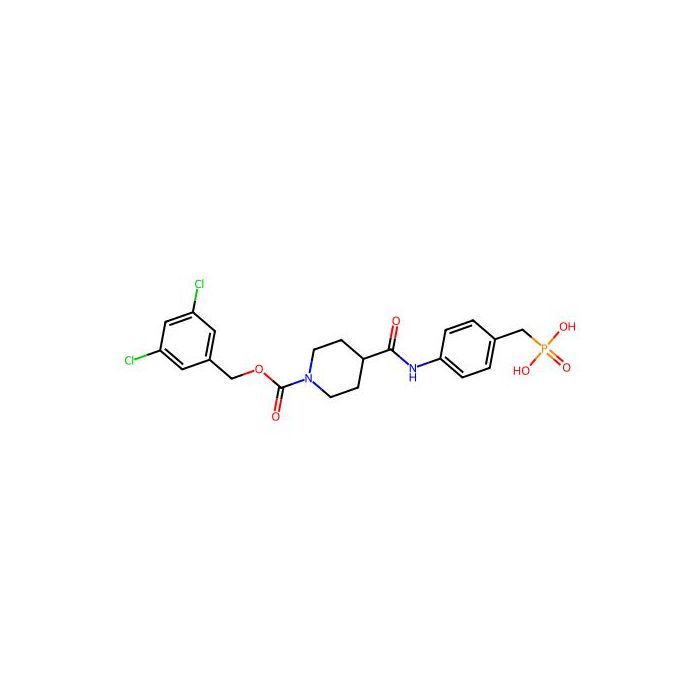
This compound belongs to the class of organic compounds known as benzyloxycarbonyls. These are organic compounds containing a carbonyl group substituted with a benzyloxyl group.
External Descriptors
Not available
1. Djoumbou Feunang Y, Eisner R, Knox C, Chepelev L, Hastings J, Owen G, Fahy E, Steinbeck C, Subramanian S, Bolton E, Greiner R, and Wishart DS. ClassyFire: Automated Chemical Classification With A Comprehensive, Computable Taxonomy. Journal of Cheminformatics, 2016, 8:61.
Certificati (CoA, COO, BSE/TSE e tabella di analisi)
C of A & Other Certificates(BSE/TSE, COO):
Analytical Chart:
Proprietà chimiche e fisiche
Peso molecolare
501.300 g/mol
XLogP3
2.200
Hydrogen Bond Donor Count
3
Hydrogen Bond Acceptor Count
6
Rotatable Bond Count
7
Exact Mass
500.067 Da
Monoisotopic Mass
500.067 Da
Topological Polar Surface Area
116.000 Ų
Heavy Atom Count
32
Formal Charge
0
Complexity
682.000
Isotope Atom Count
0
Defined Atom Stereocenter Count
0
Undefined Atom Stereocenter Count
0
Defined Bond Stereocenter Count
0
Undefined Bond Stereocenter Count
0
The total count of all stereochemical bonds
0
Covalently-Bonded Unit Count
1
Calcolatori di soluzioni
Molarity Calculator
Determine the necessary mass, volume, or concentration for preparing a solution.
Dilution Calculator
Determine the dilution needed to prepare a stock solution.
Reconstitution Calculator
Recensioni
Recensioni dei clienti
Application Protocols
The product data do not provide validated protocols, tested applications, or recommended working concentrations.
General starting points (for method development only; not specifications)
Biochemical ATX inhibition assay:
Prepare serial dilutions of the inhibitor from a DMSO stock (e.g., 0.1 nM–100 µM range as appropriate).
Incubate recombinant ATX with LPC substrate in buffer (pH 7.4–8.0) at 25–37°C. Initiate reaction by adding enzyme or substrate.
Quantify LPA formation by LC–MS/MS or coupled choline-release colorimetric/fluorometric assays. Fit dose–response to determine apparent potency.
Cell-based pathway modulation:
Titrate compound in culture medium with ≤0.1–0.5% DMSO final. Measure downstream LPA-receptor signaling endpoints (e.g., pERK, RhoA activity) or lipidomics for LPA.
Controls: Include vehicle controls, orthogonal ATX inhibitor (if available), and assess compound stability in assay matrix.
For item-specific working concentrations, incubation times, and positive controls, consult the CoA/Spec Sheet or internal assay development notes.
Biological Roles
Background (general biology; not item-specific claims)
Autotaxin (ATX; gene ENPP2) is a secreted ectoenzyme with lysophospholipase D activity that converts lysophosphatidylcholine (LPC) to lysophosphatidic acid (LPA). LPA is a potent signaling lipid acting via G protein–coupled receptors (LPAR1–6) to influence cytoskeletal dynamics, cell adhesion, and survival signaling.
ATX–LPA signaling is involved in a variety of physiological processes including wound responses, development, and tissue remodeling. Dysregulated LPA signaling is studied in diverse biological contexts. This background is provided to frame the typical use of ATX inhibitors as research probes; no therapeutic or clinical claims are made.
Use of ATX inhibitors as tools (general guidance)
Small-molecule ATX inhibitors enable dissection of LPA production pathways in vitro and in cells by attenuating ATX enzymatic activity. Effects are commonly monitored by measuring LPA species via LC–MS/MS, choline release assays, or downstream signaling readouts (e.g., RhoA activation, ERK phosphorylation), depending on the system.
Selectivity considerations: Distinguish effects on ATX from other lipid metabolic enzymes or LPA receptor antagonism by employing orthogonal controls (e.g., structurally unrelated ATX inhibitors, inactive analogs, or receptor antagonists), and by complementing chemical inhibition with genetic perturbation where feasible.
Item-specific biological potency/kinetics are Not specified for this item; consult the CoA/Spec Sheet or supporting literature tied to the exact CAS/CID.
Buffer Applications
This product is not a buffering agent. However, buffers are integral to its typical use in enzymology and cell-based assays.
Assay buffer design (general guidance):
For biochemical ATX assays: Use a physiologically relevant pH (commonly pH 7.4–8.0) with buffers such as Tris, HEPES, or phosphate. Include divalent cations only if required by your substrate/enzyme prep. Maintain ionic strength (e.g., 100–150 mM NaCl) for protein stability.
Add BSA (e.g., 0.05–0.1%) or fatty-acid–free carrier protein to stabilize lipid substrates and reduce nonspecific adsorption.
Control organic co-solvent at minimal levels (e.g., ≤0.5% DMSO final) consistent with inhibitor solubility; include vehicle controls.
Substrate handling: LPC and LPA are amphiphilic; prepare fresh, sonicate if needed, and consider using fatty-acid–free conditions to reduce background.
Analytical compatibility: Choose buffers that do not interfere with LC–MS/MS if quantifying LPA species; volatile buffers (ammonium acetate/formate) can be advantageous.
Item-specific buffer compatibility and stability are Not specified for this item; optimize empirically for your assay.
Green Alternatives
This item is a specialized bioactive small molecule used as an enzymology tool, not a process solvent or commodity reagent where green substitution frameworks typically apply.
Applicability: Limited. Greener alternatives are usually discussed for solvents, common reagents, or catalysts in scale-up chemistry.
Practical considerations:
Minimize waste by preparing small-volume, high-concentration stock solutions and using microplate formats to reduce consumption.
Prefer aqueous assay buffers and the lowest feasible percentages of organic co-solvent (e.g., ≤0.1–0.5% DMSO) consistent with solubility and activity.
Implement proper segregation of halogenated vs non-halogenated organic waste according to institutional EHS policies.
If your workflow allows, consider testing alternate ATX tool compounds with higher potency or stability in aqueous media to reduce compound mass used per assay; selection must be guided by your assay’s performance metrics and literature data.
No item-specific greener substitute can be recommended based on the provided data.
Pharmaceutical Uses
This product is supplied strictly for research use only. It is not intended for human or veterinary use, diagnostics, or as an active pharmaceutical ingredient.
No pharmacopeial status, excipient role, or GMP manufacturing details are provided.
Contextual information for researchers (non-clinical)
In drug discovery workflows, small-molecule enzyme inhibitors like this are often used as chemical probes for target validation, assay development, or as positive controls in screening cascades. Such uses occur upstream of any development activities and do not imply suitability for clinical use.
If using in preclinical research, ensure appropriate documentation of identity, purity, and stability (CoA, SDS, and in-house analytical verification as needed). Record lot numbers and maintain chain-of-custody.
Not specified for this item
Any clinical development status, dosage forms, excipient compatibility, or ICH stability data are Not specified for this item; refer to literature or internal development data where applicable.
Physical Properties
Item-specific physicochemical specifications have not been provided in the product data. Do not treat the following as specifications; consult the CoA/Spec Sheet for release criteria.
Appearance: Not specified for this item; refer to CoA/Spec Sheet.
Melting point: Not specified for this item; refer to CoA/Spec Sheet.
Boiling point: Not applicable/Not typically determined for bioactive solids; refer to CoA/Spec Sheet.
Density: Not specified for this item; refer to CoA/Spec Sheet.
Solubility: Not specified for this item; refer to CoA/Spec Sheet.
LogP, pKa, refractive index: Not specified for this item; refer to CoA/Spec Sheet.
General laboratory guidance (literature/practice; not item-specific)
Many small-molecule ATX inhibitors are hydrophobic solids that are readily dissolved for biological assays as DMSO stock solutions (commonly 10–50 mM), then diluted into aqueous assay buffers containing ≤1% DMSO final. Actual solubility and stability must be verified empirically for this exact product.
If preparing aqueous formulations, consider co-solvent systems (DMSO, ethanol) and surfactants (e.g., low % Tween-20) where consistent with your assay design; confirm lack of assay interference.
Perform a small-scale solubility screen under your chosen buffer conditions and temperature to avoid precipitation and adsorption losses.
Quality and Grades
Grade/Purity: Not specified for this item; refer to CoA/Spec Sheet.
Context for bioactive small molecules (general guidance)
For enzyme inhibitors used in discovery biology, vendors commonly control identity by NMR/HRMS and purity by HPLC/UPLC (often ≥95% area by UV). Actual acceptance criteria for this SKU must be confirmed on the item-specific CoA.
Low-residual solvent and low inorganic residue are typically preferred for cell-based assays; however, specific limits (e.g., water, metals, residual solvents) are Not specified for this item.
Batch-to-batch consistency: Bioactivity can be sensitive to polymorph/solvate form, trace impurities, and degradation. Verify consistency by re-checking purity and storing under recommended conditions.
Stabilizers: Not specified for this item; refer to CoA/Spec Sheet. If stabilizers are present, they may influence UV, assay readouts, or chromatographic behavior—plan controls accordingly.
Documentation
For regulated or GLP-adjacent work, retain CoA, SDS, and any spectral data supplied with the lot. Consider incoming inspection by orthogonal methods (NMR, LC–MS, qNMR) if required by your QA procedures.
Reaction and Applications
This product is a bioactive small-molecule inhibitor intended for biochemical and cell-based studies, not a general synthetic reagent.
Synthetic reaction usage: Not typically applicable. It is not commonly employed as a reagent, catalyst, or ligand in organic synthesis.
Research application (general): Used as a tool compound to modulate autotaxin (ATX/ENPP2) activity in vitro (enzymology) or in cells, enabling interrogation of lysophosphatidic acid (LPA) pathway signaling. Specific activity parameters for this SKU are Not specified for this item.
Assay contexts (general):
Biochemical ATX assays (e.g., LPC→LPA conversion readouts by choline release or LC–MS quantification).
Cellular pathway studies where LPA levels or downstream signaling are measured after ATX modulation.
Practical tips:
Prepare fresh DMSO stocks; minimize freeze–thaw.
Validate inhibitor performance in your assay format (substrate, buffer, temperature), as potency can be matrix-dependent.
Include vehicle controls and, if available, an orthogonal ATX inhibitor to benchmark assay sensitivity.
For item-specific potency/IC50/selectivity, consult the CoA/Spec Sheet or primary literature corresponding to the exact CAS.
Reaction Conditions
Not typically applicable. This product is intended as a biochemical tool compound rather than a reagent for promoting or participating in named organic reactions.
General practical conditions for biological evaluation (not item-specific)
Stock preparation: Dissolve in anhydrous DMSO to a known concentration (e.g., 10–50 mM). Store aliquots at −20°C, protected from light. Avoid repeated freeze–thaw.
Enzyme assays: Incubate ATX with lysophospholipid substrate (e.g., LPC) in a suitable buffer (pH 7.4–8.0) at 25–37°C. Add inhibitor across a concentration range to determine potency metrics. Monitor product formation by choline release assays or LC–MS for LPA.
Cell-based assays: Pre-dilute DMSO stocks into media to maintain low DMSO final percentage. Confirm cytotoxicity profile and off-target effects with appropriate controls.
Item-specific kinetic parameters, optimal temperatures, and incubation times are Not specified for this item; determine empirically for your assay format.
Safety and Handling
Hazard classification and pictograms are not provided in the product data. Always refer to the current SDS for authoritative guidance.
GHS classification / Signal word / H-statements / Pictograms: Not specified for this item; refer to SDS.
Primary hazards (general for research chemicals): May cause irritation to skin, eyes, and respiratory tract. Avoid ingestion, inhalation of dust, and contact with skin/eyes. Handle in a fume hood.
Personal protective equipment (PPE): Laboratory coat, safety glasses or face shield, and appropriate chemical-resistant gloves (e.g., nitrile). Use dust mask or respirator if dust/aerosols may form (per risk assessment).
Storage conditions: As provided, store at −20°C in a tightly closed container. Protect from light and moisture. Minimize freeze–thaw cycles by preparing single-use aliquots.
Incompatibilities: Avoid strong oxidizers and strong acids/bases unless compatibility is known. Keep away from ignition sources and reactive reducing agents until compatibility is assessed.
First aid (overview; defer to SDS): If inhaled, move person to fresh air. In case of skin contact, wash with soap and water. For eye contact, rinse cautiously with water for several minutes; remove contact lenses if present and easy to do. If swallowed, rinse mouth and seek medical attention.
Spill response: Avoid dust formation; collect with inert absorbent, place in chemical waste. Decontaminate area per institutional procedures.
Solvent Selection
Item-specific solubility and solvent compatibility are not provided. The following is general guidance for small-molecule enzyme inhibitors; verify empirically for this SKU.
Primary stock solvent (typical practice): DMSO for concentrated stocks (e.g., 10–50 mM), filtered through 0.22 µm if needed. Record exact concentration by weight or qNMR.
Aqueous use: Dilute DMSO stocks into assay buffer to ≤0.1–1.0% DMSO final, ensuring no precipitation. Include solvent-matched vehicle controls.
Alternative co-solvents: Ethanol or DMF may be used for screening if compatible with the assay biology; confirm lack of interference and maintain low final percentages.
Buffer additives: Small amounts of non-ionic surfactants (e.g., 0.01–0.05% Tween-20) can reduce adsorption and aid solubility; confirm effects on enzyme kinetics.
Adsorptive losses: Hydrophobic inhibitors may adsorb to plastics; consider low-bind polypropylene tubes or glass vials, and pre-condition tips/vials with buffer containing carrier protein if appropriate for the assay.
Stability checks: Monitor for degradation by LC–MS/UPLC after freeze–thaw, prolonged bench time, or incubation at 37°C. Light protection (foil-wrapped tubes) is prudent.
Not specified for this item
Solubility limits in DMSO/water, pKa, logP/logD, and stability profiles are Not specified for this item; refer to CoA/Spec Sheet or determine experimentally.
Storage and Reconstitution
Storage (from product data): Store at −20°C.
Shipping: Shipped in an ice chest with ice pads to maintain cold chain.
Container: Keep tightly closed, desiccated, and protected from light. Use amber vials where possible.
Reconstitution: Specific solvent and concentration limits are Not specified for this item; refer to CoA/Spec Sheet. General practice is to dissolve bioactive small molecules in anhydrous DMSO to prepare concentrated stock solutions (e.g., 10–50 mM), then aliquot.
Aliquoting: Prepare single-use aliquots to avoid repeated freeze–thaw. Record aliquot concentrations and dates.
Handling: Allow frozen vials to equilibrate briefly on ice before opening to minimize moisture ingress; purge headspace with inert gas if long-term storage is planned and the compound is air/moisture sensitive (sensitivity not specified here).
Stability: Long-term stability, thaw stability, and solution stability are Not specified for this item; verify by LC–MS/UPLC or activity assays as appropriate.
Research use only: As stated, this material is for research use only; not for human or veterinary use.
Structure and Identity
Product name: ATX inhibitor 1 (tool compound)
CAS: 2225892-70-4
PubChem CID: 137628644
InChIKey: 57038 (as provided)
SMILES: Not specified for this item; refer to CoA/Spec Sheet.
Molecular formula: Not specified for this item; refer to CoA/Spec Sheet.
Molecular weight: Not specified for this item; refer to CoA/Spec Sheet.
Structural features
Item-specific structural features (ring systems, heteroatoms, stereochemistry): Not specified for this item; refer to CoA/Spec Sheet.
2D description in words: Not available because the structural formula has not been provided in the product data.
Identity notes
The designation “ATX inhibitor 1” indicates a small-molecule inhibitor targeting autotaxin (ATX, ENPP2), typically used as a biochemical tool for LPA pathway research. However, detailed structural identifiers beyond CAS/CID are not included here.
For unambiguous identification (SMILES, full InChI, HRMS), consult the product’s Certificate of Analysis (CoA) or Spectral Pack (if available).
Synthetic Utility
This material is a targeted bioactive small molecule rather than a general synthetic building block or reagent.
Use in synthesis: Not typically applicable. There is no standard role for this compound as a reagent, catalyst, ligand, or protecting group based on the provided data.
Derivatization: If structure were available, analog synthesis could be pursued for SAR studies; however, structural details and functional handles are Not specified for this item.
Purification/analysis (general): For analogs in medicinal chemistry, reverse-phase HPLC/UPLC with MS detection is standard. Solid-phase extraction can aid cleanup of lipidic assay mixtures.
Because the molecular structure and functional groups are not provided, no further synthetic guidance specific to this compound can be offered. Consult the CoA/Spec Sheet or primary literature associated with the exact CAS for any reported synthetic routes or intermediates.
Target Specificity
Only item-specific details should appear here; however, the product data do not include potency, selectivity, or secondary target information.
Primary target: Not specified for this item; refer to CoA/Spec Sheet.
Reported activity metrics (IC50/Ki/Kd): Not specified for this item; refer to CoA/Spec Sheet.
Off-target profile / selectivity vs related enzymes: Not specified for this item; refer to CoA/Spec Sheet.
General background (for context only; not item-specific)
“ATX inhibitor 1” nomenclature typically denotes a small-molecule modulator of autotaxin (ENPP2), the lysophospholipase D responsible for conversion of LPC to LPA. Confirm exact specificity and potency from the documentation accompanying this SKU or primary literature tied to the CAS/CID listed above.
We use cookies to ensure the website functions properly and, where permitted, to improve your experience. You can manage your preferences at any time in Settings. Learn more in our Cookie Policy.
Shall we send you a message when we have discounts available?
Remind me later
Thank you! Please check your email inbox to confirm.
Products are supplied to verified businesses, institutions, and qualified professionals for research and development use only. Not for use in humans, animals, diagnosis, or therapy.