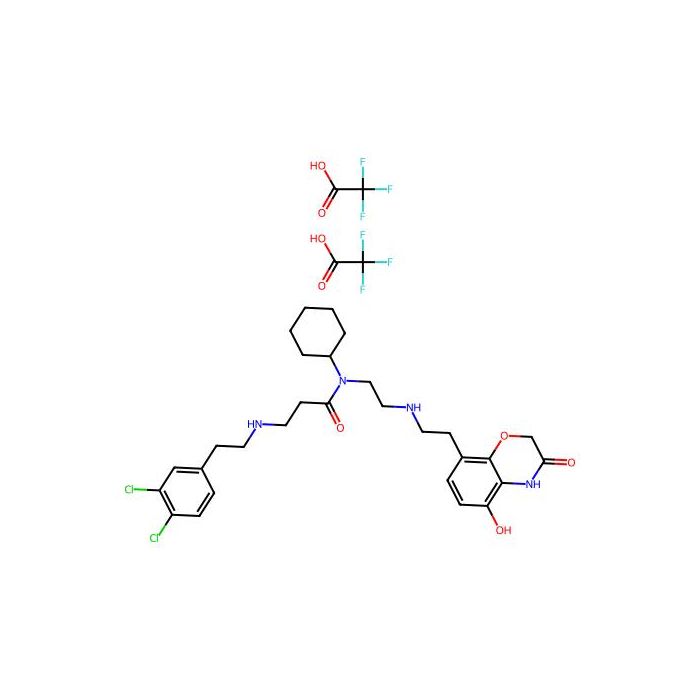
10mM in DMSO for sensitive chromatographic and analytical workflows requiring minimal baseline interference.
🌡
Storage & shipping
Desiccated,Store at -80°C Ships Dry ice packs + Cold packs Check lot-specific COA for exact specifications.
📋
Quality documents
SDS, COA, datasheet, and spec sheet available for download. Lot-specific COA accessible via lot number lookup.
📚
Literature proof
Cited in 0 peer-reviewed publications across chromatography, organic synthesis, and cross-coupling reactions.
Panoramica
AZ505 ditrifluoroacetate is a potent and selective SMYD2 inhibitor with IC 50 of 0.12 μM.
In Vitro
AZ505 ditrifluoroacetate is highly selective and shows an activity at submicromolar concentrations in vitro. The IC 50 of AZ505 ditrifluoroacetate for SMYD2 is 0.12 μM, which is >600-fold greater than the IC 50 s of AZ505 ditrifluoroacetate for other histone methyltransferases, such as SMYD3 (IC 50 >83.3 μM), DOT1L (IC 50 >83.3 μM) and AZ505 ditrifluoroacetate (IC 50 >83.3 μM). AZ505 ditrifluoroacetate is a potent and selective SMYD2 inhibitor with an IC 50 of 0.12 μM. The human SMYD (SET and MYND domain-containing protein) family of protein lysine methyltransferases contains five members (SMYD1-5). Moreover, AZ505 ditrifluoroacetate fails to inhibit the enzymatic activities of a panel of protein lysine methyltransferases. AZ505 ditrifluoroacetate is nominated for ITC binding study with K d of 0.5 μM. In contrast, the calculated K d for the p53 substrate peptide is 3.7 μM. AZ505 ditrifluoroacetate binding to SMYD2 is driven primarily by entropy, which often suggests that binding is mediated by hydrophobic interactions with few specific hydrogen bonds. MCE has not independently confirmed the accuracy of these methods. They are for reference only.
IC50& Target:IC50: 0.12 μM (SMYD2)
Specifications
Specifiche e purezza
10mM in DMSO
Meccanismi biochimici e fisiologici
AZ505 ditrifluoroacetate is a potent and selective SMYD2 inhibitor with IC 50 of 0.12 μM.
Condizioni di conservazione di stoccaggio
Desiccated,Store at -80°C
Spedito in
Dry ice packs + Cold packs
Questo prodotto richiede spedizione a catena fredda. I servizi di terra e altri servizi economici non sono disponibili.
Certificati (CoA, COO, BSE/TSE e tabella di analisi)
C of A & Other Certificates(BSE/TSE, COO):
Analytical Chart:
Calcolatori di soluzioni
Molarity Calculator
Determine the necessary mass, volume, or concentration for preparing a solution.
Dilution Calculator
Determine the dilution needed to prepare a stock solution.
Reconstitution Calculator
Recensioni
Recensioni dei clienti
Application Protocols
No validated application protocols are provided in the Product Data for this SKU.
Tested applications, recommended dilutions, and positive controls: Not specified for this item; refer to CoA/Spec Sheet.
General guidance (non-specific):
Prepare single-use DMSO aliquots at a convenient stock concentration.
Titrate across a broad range (e.g., 10-point serial dilutions) with matched vehicle controls.
Verify solubility and absence of precipitation in your assay matrix before full experiments.
For detailed, assay-specific SOPs, consult peer-reviewed literature for AZ505 and adapt to your platform.
Biological Roles
Context (literature/general): AZ505 is widely cited as a chemical probe used to investigate lysine methylation biology mediated by SET-domain methyltransferases. It is not a nutrient, metabolite, or endogenous molecule; rather, it modulates enzyme activity in research settings.
Target class (literature): Protein lysine methyltransferases (PKMTs) within the SET-domain family. Tool compounds like AZ505 are leveraged to explore substrate methylation on histones and non-histone proteins.
Pathway insights (general):
Modulation of histone methylation can alter chromatin accessibility and transcriptional programs.
Non-histone substrates (e.g., transcription factors, signaling proteins) may exhibit altered stability or protein–protein interactions upon methylation changes.
Use in systems biology: Enables mapping of methylation-dependent signaling cascades, validating antibodies against specific methyl-lysine marks, and benchmarking proteomic pipelines for methylation site discovery.
Selectivity considerations: Literature emphasizes the need for target validation via orthogonal methods (e.g., CRISPR knockdown/knockout, chemical genetics) alongside probe treatment to ascribe phenotypes to on-target effects.
Important notes:
No clinical/therapeutic claims are made. Effects observed with such probes can be context- and concentration-dependent.
For this specific catalog item, numerical potency/selectivity values and definitive target annotations are not provided; consult primary literature and the CoA where applicable.
Buffer Applications
This product is a bioactive small molecule and is not a buffering agent. There are no canonical “buffer recipes” for AZ505 ditrifluoroacetate.
Practical notes (general):
Prepare working solutions by diluting a DMSO stock into your assay buffer (e.g., HEPES, Tris, or phosphate-buffered saline) while maintaining final DMSO at a validated, low percentage.
Consider adding low levels of carrier protein (e.g., 0.1% BSA) or nonionic surfactant (e.g., 0.01–0.05% Tween-20) to reduce adsorption and precipitation if needed.
Item-specific buffer specifications: Not specified for this item; refer to CoA/Spec Sheet.
Green Alternatives
Green chemistry considerations are limited for a bioactive tool compound, where function and data quality dominate solvent/environmental choices. Nonetheless, you can reduce environmental impact without compromising data integrity.
Opportunities (general guidance):
Minimize DMSO usage: Use the highest practical stock concentration to reduce total DMSO volume; keep final assay DMSO at the lowest validated level consistent with solubility (often ≤0.1% v/v).
Solvent alternatives where feasible: For certain biophysical assays, consider aqueous buffers with cyclodextrins or PEG-400 as co-solvents, recognizing potential effects on binding or readouts.
Right-sized aliquots: Aliquot single-use volumes to prevent freeze–thaw waste and degradation.
Waste segregation: Combine DMSO/organic waste streams to optimize solvent recovery or disposal.
Compact comparison (general):
DMSO: benchmark solubilizer; excellent for HTS, but contributes to organic solvent waste.
EtOH/MeOH: greener than some aprotics by certain metrics; biological tolerance can be lower; flammability considerations apply.
Trade-offs should be evaluated empirically to ensure that greener choices do not compromise assay fidelity.
Pharmaceutical Uses
AZ505 ditrifluoroacetate is supplied strictly for research use and is not an excipient or active pharmaceutical ingredient in any pharmacopeial context per this listing.
Regulatory status: Research use only. Not for human or veterinary use. Not GMP.
Formulation relevance (research): In preclinical research experiments, small-molecule probes are sometimes formulated for in vitro or ex vivo studies using DMSO, aqueous buffers, or inclusion complexes; such practices are highly context-dependent and are not specifications of this product.
Pharmacopeia monographs: None indicated for this item.
No pharmaceutical manufacturing or therapeutic claims are made for this product.
Physical Properties
Item-specific specifications are not provided in the Product Data. The following are general/literature-style notes typical for small-molecule TFA salts; do not treat them as specifications for this SKU.
Appearance (item-specific): Not specified for this item; refer to CoA/Spec Sheet.
Molecular Weight (item-specific): Not specified for this item; refer to CoA/Spec Sheet.
Melting point (literature, salt-form): Many organic TFA salts are crystalline solids with melting transitions often >100 °C; exact value for AZ505•(TFA)2 not confirmed in literature here.
Boiling point: Not applicable to ionic organic salts (decompose before boiling at 1 atm).
Density: Not typically reported for micro-quantities of research salts; not specified.
Solubility (literature/guidance):
High solubility in DMSO; working stocks (e.g., 10–50 mM) are commonly prepared for screening (literature/good practice).
Variable solubility in methanol or ethanol; limited water solubility as the free base but salt form may disperse better with co-solvent and surfactant/carrier proteins.
pKa/logP (literature/guidance): The free base of AZ505 is designed to be cationic at physiological pH (basic amine); exact pKa/logP for this catalog item are not provided here.
Hygroscopicity (general): Many TFA salts are mildly hygroscopic; store desiccated as directed.
Refractive index/UV cut-off: Not specified for this item; refer to CoA/Spec Sheet.
Quality and Grades
Grade/Purity (item-specific): Not specified for this item; refer to CoA/Spec Sheet.
Discussion of quality considerations for bioactive research compounds:
Assay suitability: Screening-grade small molecules are typically assessed by identity (e.g., HRMS/1H NMR) and purity by HPLC/UPLC. For cell-based work, impurities with UV activity can confound readouts; consult the CoA chromatogram where available.
Counterion identity: This product is the ditrifluoroacetate salt. The TFA content and stoichiometry can influence mass balance and pH upon dilution. If precise dosing by molarity is critical, calculate based on the salt’s formula weight from the CoA, not the free base.
Residual solvents/volatile acids: TFA salts may retain traces of TFA or solvent; drying under vacuum at ambient temperature is typically used. Avoid heat.
Stabilizers: None specified for this item. If present, stabilizers would be disclosed on the CoA; verify compatibility with planned assays.
Library handling: For high-throughput screening, verify lot-to-lot consistency and maintain aliquot records to avoid freeze–thaw cycles that may degrade sensitive scaffolds.
Documentation:
For definitive grade, purity percentage, water/peroxide/metal limits, and UV profile: Not specified for this item; refer to CoA/Spec Sheet.
Reaction and Applications
This product is intended as a research chemical (bioactive probe), not primarily as a synthetic reagent. Accordingly, “applications” refer to experimental biological studies rather than chemical transformations.
Research applications (literature/guidance):
Epigenetics tool compound: AZ505 is reported in the literature as a selective small-molecule inhibitor used to interrogate the activity of a SET-domain lysine methyltransferase in biochemical and cellular assays. Researchers employ it to modulate histone or non-histone lysine methylation states and assess downstream signaling consequences.
Assay contexts:
Biochemical enzyme inhibition assays with purified methyltransferase and peptide substrates (radioactive SAM, fluorescent SAM analogs, or coupled assays).
Cell-based target engagement studies and methylation biomarker readouts by Western blot or MS (general practices).
Practical tips:
Prepare a concentrated DMSO stock (e.g., 10–50 mM, literature practice) and dilute into assay buffer keeping final DMSO typically ≤0.1–0.5%.
Include vehicle controls and, when possible, an orthogonal probe to confirm on-target effects.
Adsorption to plastic can reduce effective concentration; pre-wet tips/tubes with dilute compound solution to improve reproducibility.
Time- and concentration-dependence should be profiled for each cell line or enzyme prep; avoid assuming equilibrium is reached without verification.
Note: Numerical potency/selectivity values are system-dependent and are not specified for this catalog item; consult primary literature and your own pilot data.
Reaction Conditions
As a research probe rather than a synthetic reagent, “reaction conditions” pertain to solution preparation and assay delivery rather than chemical transformations. The following are general, literature-informed practices; they are not specifications for this item.
Stock preparation: Dissolve the solid in anhydrous DMSO to prepare concentrated stocks (commonly 10–50 mM). Vortex and, if necessary, gently warm to room temperature to aid dissolution. Avoid aqueous exposure until final dilution.
Working concentrations: Determine empirically per assay. Many enzyme and cell assays evaluate small molecules in the low nanomolar to tens of micromolar range; validate upper solubility and cytotoxicity limits for your system.
Vehicle controls: Match final DMSO content across all wells/samples (often ≤0.1–0.5% v/v).
Incubation: Time-dependent effects are common with enzyme inhibitors. Include time-course and washout controls where relevant.
Materials compatibility: Use low-binding plastics or glass; precondition pipette tips and tubes with diluted compound to minimize adsorption.
Light/moisture sensitivity: Keep solutions capped, protected from ambient moisture, and use freshly thawed aliquots to maintain consistency.
For any chemistry transformations involving this compound (uncommon), no validated conditions are provided for this SKU.
Safety and Handling
Always consult the SDS for authoritative safety information. No GHS details are provided in the Product Data for this SKU.
GHS Classification (item-specific): Not specified for this item; refer to SDS.
Signal word / H-statements / Pictograms: Not specified for this item; refer to SDS.
General laboratory guidance for bioactive small-molecule TFA salts:
PPE: Lab coat, safety glasses, and appropriate chemical-resistant gloves. Handle powders in a fume hood to avoid inhalation of dust/aerosols.
Handling notes:
Prepare concentrated stocks in anhydrous DMSO to reduce airborne powder handling.
Avoid skin contact—DMSO facilitates transdermal absorption of solutes.
Use dedicated tools to prevent cross-contamination in screening libraries.
Incompatibilities: Strong bases may liberate free base and trifluoroacetic acid; avoid mixing with strong oxidizers.
First aid (general):
Inhalation: Move to fresh air; seek medical attention if symptoms persist.
Skin/eye contact: Rinse with water for at least 15 minutes; remove contaminated clothing; seek medical advice.
Ingestion: Rinse mouth; do not induce vomiting; seek medical attention.
Waste: Dispose as organic hazardous waste per institutional and local regulations. Avoid drain discharge.
Storage risks: Moisture uptake and hydrolysis of TFA counterions can occur; keep tightly closed, desiccated, and frozen as specified.
Solvent Selection
AZ505 ditrifluoroacetate is a bioactive small-molecule salt. Solvent choice primarily concerns preparing concentrated stocks and achieving reliable assay delivery.
Primary stock solvent (common practice):
DMSO: Preferred due to strong solubilizing power for cationic/aromatic scaffolds and excellent compatibility with biochemical and cell assays at ≤0.1–0.5% v/v.
Secondary options (compatibility-dependent):
Methanol or ethanol for intermediate solutions; typically diluted promptly into aqueous buffers to ≤1% v/v organic.
Aqueous buffers with co-solvent and carrier proteins (e.g., 0.1–0.5% DMSO, 0.01–0.1% surfactant like Tween-20, or 0.1% BSA) to limit nonspecific binding (general/literature guidance).
pH considerations: As a di-TFA salt of a basic amine, neutral to slightly basic buffers (pH 7.2–7.8) generally maintain solubility of the protonated form while minimizing acid-catalyzed degradation.
Avoid: Nonpolar solvents (hexanes, toluene) are typically unsuitable for ionic salts; neat water may give limited solubility without co-solvent.
Quick comparison (general):
DMSO: highest solubility; minimal assay interference when ≤0.1–0.5%.
MeOH/EtOH: workable but may perturb enzymes/membranes above ~1–2%.
Aqueous only: risk of precipitation; consider cosolvent or cyclodextrin inclusion where appropriate.
Storage and Reconstitution
Follow the item-specific storage and shipping instructions below. Where necessary, general practices are provided for reconstitution and handling of small-molecule TFA salts used in research.
Storage conditions (item-specific): Desiccated; Store at −80 °C.
Shipped in (item-specific): Dry ice packs + Cold packs.
Research use note (item-specific): For research use only.
Reconstitution and handling (general best practices):
Allow the container to equilibrate to room temperature in a desiccator before opening to prevent moisture condensation.
Dissolve the solid in anhydrous DMSO to make a concentrated stock (e.g., 10–50 mM, literature practice). Filter through a 0.2 µm PTFE syringe filter if particulate persists.
Aliquoting: Dispense single-use aliquots into dry, inert vials or 96-well plates; purge headspace with inert gas if available; seal tightly.
Storage of solutions: Store DMSO stocks at −20 to −80 °C, protected from light and moisture. Avoid repeated freeze–thaw; use each aliquot once when possible.
Stability: No item-specific stability data are provided. Monitor by LC/MS or HPLC for critical studies.
For any additional item-specific attributes (appearance, exact formula weight for molarity calculations): Not specified for this item; refer to CoA/Spec Sheet.
Structure and Identity
Brief description: AZ505 ditrifluoroacetate is a bioactive small-molecule salt commonly used as a research probe in epigenetics. The listing corresponds to the ditrifluoroacetate (2×TFA) salt of AZ505.
Product Name: AZ505 ditrifluoroacetate
SKU: A656142
CAS: 1035227-44-1
PubChem CID: 78357790
Synonyms (literature): AZ-505 di-TFA; AZ505 2TFA salt (literature)
Molecular Formula: Not specified for this item; refer to CoA/Spec Sheet.
Molecular Weight: Not specified for this item; refer to CoA/Spec Sheet.
InChIKey: Not specified for this item; refer to CoA/Spec Sheet.
SMILES: Not specified for this item; refer to CoA/Spec Sheet.
Structural features (general/literature):
AZ505 is reported in the literature as a heteroaromatic, amine-containing scaffold designed to bind the lysine channel of a SET-domain methyltransferase. The ditrifluoroacetate form indicates protonated basic centers paired with two trifluoroacetate anions.
Functional groups (literature): typically includes one or more tertiary/secondary amines (protonated as the TFA salt), aromatic/heteroaromatic rings, and H-bond acceptors suitable for enzyme pocket engagement.
2D structural description (general):
The free-base cation of AZ505 comprises fused/aromatic ring motifs with a basic nitrogen; the salt contains two counterions of CF3–COO− (trifluoroacetate). Exact atom connectivity for this catalog item is not specified here; consult the CoA/technical data for definitive identifiers.
Synthetic Utility
This compound is supplied as a finished bioactive small-molecule salt and is not commonly used as a synthetic reagent or building block.
Functional group reactivity: While the free-base scaffold likely contains amine and aromatic functionalities (literature), the product is intended for biological assay use rather than for transformations or as a protecting/activating group.
Recommended use: Employ as a research probe in biochemical/cellular studies rather than as a substrate, catalyst, or coupling partner.
If you require a synthetic intermediate or building block with similar core chemistry, consult Aladdin’s catalog for structurally related heteroaromatics or amine-containing scaffolds with defined reactive handles.
Target Specificity
Item-specific target, binding, and selectivity data have not been provided for this SKU.
Target identity, affinity/IC50, selectivity versus related enzymes, and cellular target engagement: Not specified for this item; refer to CoA/Spec Sheet and primary literature for AZ505.
Note: Do not infer pharmacology for this lot without experimental verification in your assay context.
We use cookies to ensure the website functions properly and, where permitted, to improve your experience. You can manage your preferences at any time in Settings. Learn more in our Cookie Policy.
Shall we send you a message when we have discounts available?
Remind me later
Thank you! Please check your email inbox to confirm.
Products are supplied to verified businesses, institutions, and qualified professionals for research and development use only. Not for use in humans, animals, diagnosis, or therapy.