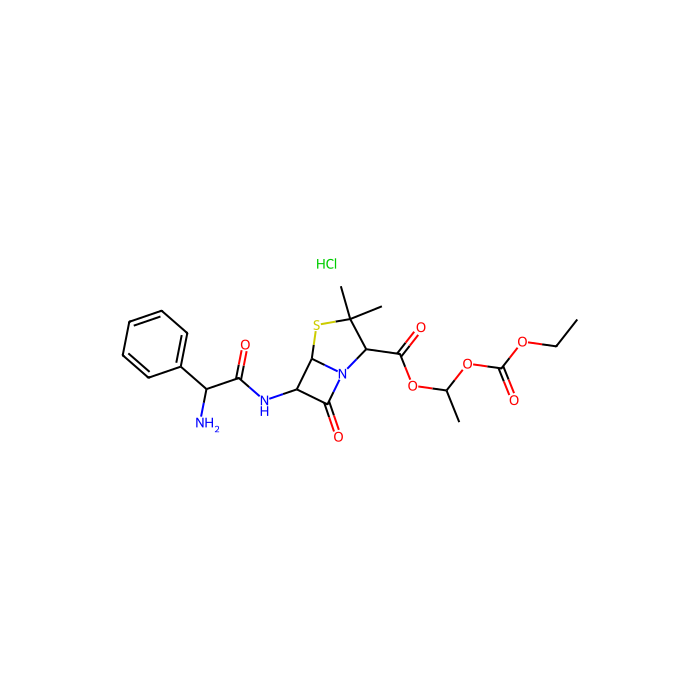
This compound belongs to the class of organic compounds known as penicillins. These are organic compounds containing the penicillin core structure, which is structurally characterized by a penam ring bearing two methyl groups at position 2, and an amide group at position 6 [starting from the sulfur atom at position 1].
External Descriptors
hydrochloride
1. Djoumbou Feunang Y, Eisner R, Knox C, Chepelev L, Hastings J, Owen G, Fahy E, Steinbeck C, Subramanian S, Bolton E, Greiner R, and Wishart DS. ClassyFire: Automated Chemical Classification With A Comprehensive, Computable Taxonomy. Journal of Cheminformatics, 2016, 8:61.
Certificati (CoA, COO, BSE/TSE e tabella di analisi)
C of A & Other Certificates(BSE/TSE, COO):
Analytical Chart:
Proprietà chimiche e fisiche
Peso molecolare
502.000 g/mol
XLogP3
Hydrogen Bond Donor Count
3
Hydrogen Bond Acceptor Count
9
Rotatable Bond Count
10
Exact Mass
501.134 Da
Monoisotopic Mass
501.134 Da
Topological Polar Surface Area
163.000 Ų
Heavy Atom Count
33
Formal Charge
0
Complexity
756.000
Isotope Atom Count
0
Defined Atom Stereocenter Count
4
Undefined Atom Stereocenter Count
1
Defined Bond Stereocenter Count
0
Undefined Bond Stereocenter Count
0
The total count of all stereochemical bonds
0
Covalently-Bonded Unit Count
2
Calcolatori di soluzioni
Molarity Calculator
Determine the necessary mass, volume, or concentration for preparing a solution.
Dilution Calculator
Determine the dilution needed to prepare a stock solution.
Reconstitution Calculator
Recensioni
Recensioni dei clienti
Application Protocols
Item-specific validated applications: Not specified for this item; refer to CoA/Spec Sheet.
General example workflows (research use only; adjust to your lab SOPs)
LC–MS reference standard preparation: Weigh an appropriate amount quickly at room temperature, dissolve in chilled water or minimal DMSO, bring to volume with buffered aqueous phase (pH ~6.5), and aliquot into amber vials. Analyze immediately or store aliquots frozen.
Esterase assay (in vitro): Prepare fresh substrate solution in buffer (e.g., 50 mM phosphate, pH 7.0). Incubate with esterase preparation at 25–37°C. At defined time points, quench with cold acidified acetonitrile, centrifuge, and quantify bacampicillin and ampicillin by RP-HPLC.
Forced degradation for stability-indicating method development: Split aliquots into acidic, neutral, and basic media at elevated temperature; sample over time to map degradation pathways and develop peak purity criteria.
Notes
Exact concentrations, incubation times, and detection wavelengths are method-specific and should be optimized. No item-specific parameters are provided.
Biological Roles
Literature/General background (no clinical claims)
Bacampicillin is an ester prodrug of ampicillin. In biological systems, esterases can convert bacampicillin to ampicillin, which bears the active β-lactam motif characteristic of penicillins. The hydrochloride salt affects solubility and ionization but not the core β-lactam function.
In vitro models use bacampicillin to study prodrug activation kinetics, transport, and permeability relative to parent ampicillin. Hydrolysis yields ampicillin and corresponding alcohol/acid fragments from the promoiety.
β-Lactam stability is pH-dependent, with hydrolysis rates increasing in alkaline conditions; protein binding and matrix effects can modulate apparent stability and recovery in biological assays (literature).
Item-specific biological attributes
Specific bioactivity values, MICs, or enzyme kinetic constants are not provided for this item and are outside the scope of product specifications. For research-only applications, determine relevant parameters empirically under your assay conditions.
Cautions
Handle as a potential sensitizer. Avoid cross-contamination in shared lab spaces due to allergy potential associated with β-lactams.
Buffer Applications
Applicability
Bacampicillin hydrochloride is not a buffering reagent and is not typically used to prepare pH buffer systems.
Practical guidance
If dissolved in buffers for assays, select near-neutral buffers (e.g., phosphate, MOPS) and avoid strong alkaline conditions that accelerate β-lactam and ester hydrolysis (literature). Ensure the buffer composition does not catalyze ester cleavage (avoid high concentrations of primary amines).
Item-specific details
No buffer recipes, pKa values, or recommended buffer ranges are specified for this item; refer to CoA/Spec Sheet and optimize empirically for your application.
Green Alternatives
Applicability
As a specialty bioactive/prodrug, “green alternative” considerations primarily concern handling solvents and assay design rather than substitution of the active itself.
Greener handling strategies (general guidance)
Prefer water or aqueous buffers over chlorinated solvents whenever compatible with your assay; optimize pH to balance solubility and stability.
If an organic co-solvent is required, consider ethanol or isopropanol in place of higher-toxicity solvents; keep organic fractions as low as practical (<5–10%).
Minimize waste by preparing small, single-use aliquots to avoid discarding degraded solutions.
Comparison of common co-solvents (general)
Water/buffer: safest and lowest environmental burden; may require pH control to maintain stability.
Ethanol/IPA: relatively green, renewable options; moderate solvating power for salts and esters.
DMSO: effective cosolvent but persistent; use sparingly and segregate waste.
Not specified for this item
No item-specific environmental certifications or green metrics are provided for this product; refer to CoA/Spec Sheet if available.
Pharmaceutical Uses
Scope of this section
Provided strictly for formulation and manufacturing research context; no therapeutic or clinical claims.
Literature/General formulation context
As a hydrochloride salt of a penicillin prodrug, bacampicillin HCl has been studied for its improved handling characteristics relative to the free base, including enhanced aqueous solubility for solution processing and potential suitability for solid dosage research (e.g., salt screening, polymorph evaluation).
Research activities include impurity profiling, stability-indicating method development, and excipient compatibility assessments (e.g., with lactose, microcrystalline cellulose, Mg stearate) to understand β-lactam and ester stability during processing.
In preformulation studies, attention is given to moisture sensitivity, solid-state transformations, and hydrolytic degradation pathways; controlled humidity and low-temperature storage are commonly employed (literature/general).
Item-specific information
Pharmacopeial status, compendial assays, and specific excipient compatibilities are not provided for this item; consult CoA/Spec Sheet and perform application-specific studies.
Physical Properties
Item-specific (Product Data)
Appearance: Not specified for this item; refer to CoA/Spec Sheet.
Molecular weight (as supplied): Not specified for this item; refer to CoA/Spec Sheet.
Literature/General properties (informational, not product specifications)
Physical form: penicillin prodrug hydrochloride salts are typically white to off-white solids that are hygroscopic and water-soluble.
Solubility: hydrochloride salts of β-lactams are generally freely soluble in water; solubility in lower alcohols is moderate; insoluble or sparingly soluble in nonpolar solvents. Exact solubility for this item is not specified.
Stability considerations: β-lactam rings can undergo hydrolysis in aqueous media; prodrug esters are susceptible to base- or enzyme-catalyzed cleavage. Hydrolysis is accelerated at elevated temperature or extreme pH (literature).
pKa/logP: penicillin derivatives possess a basic amine (often pKa ~7–9, literature) and masked carboxylate in prodrugs, leading to increased apparent lipophilicity versus ampicillin. Specific values for this item are not specified.
Melting point, refractive index, density, UV cutoff: Not specified for this item; refer to CoA/Spec Sheet.
Practical implications
Use freshly prepared aqueous solutions and minimize exposure to heat and alkaline conditions to limit β-lactam and ester hydrolysis (general guidance from literature).
Quality and Grades
Item-specific (Product Data)
Grade/Purity: Not specified for this item; refer to CoA/Spec Sheet.
How to interpret quality for this material (general guidance)
For small-molecule bioactives used in life science research, suppliers typically specify identity (NMR/LC–MS), purity by HPLC/LC, and sometimes residual solvents/heavy metals. In the absence of an explicit grade here, consult the CoA for chromatography purity, assay basis (anhydrous vs as-is), and water content.
Hydrochloride salts: assay may be reported on free-base or salt basis; confirm the basis when preparing solutions.
Stability/impurity profile: β-lactams can form known degradation products (e.g., penicilloic acids after hydrolysis). High-quality material should show minimal related substances by HPLC. If stabilizers or specific limits (e.g., residual solvents, peroxides) are not listed, they are Not specified for this item; refer to CoA/Spec Sheet.
Batch documentation: request and review CoA, analytical chromatograms, and where relevant, residual solvent and elemental analysis to ensure suitability for regulated or critical research applications.
Reaction and Applications
Item-specific (Product Data)
Manufacturer applications: Not specified for this item.
Research uses (literature/general; non-clinical)
Enzymology and metabolism studies: bacampicillin HCl can serve as a substrate/standard in in vitro esterase- or β-lactamase-related experiments, enabling evaluation of prodrug activation and β-lactam ring stability.
Analytical reference: used as a system suitability or reference standard for LC/LC–MS method development targeting penicillin-class compounds, including quantitation of prodrug and hydrolysis products (e.g., ampicillin).
Stability testing: useful for forced-degradation studies (acid/base, oxidative, thermal, photolysis) to establish degradation pathways and validate stability-indicating methods.
Practical tips
Prepare fresh solutions immediately before use; keep samples chilled and minimize exposure to alkaline conditions to reduce ester and β-lactam hydrolysis.
For kinetic assays, maintain strict pH control (e.g., 6.0–7.0) and quench samples rapidly (acidification, rapid cooling, or organic protein precipitation) prior to analysis by HPLC.
Use internal standards (structurally related β-lactams) to correct for on-instrument hydrolysis during LC–MS runs.
Notes
This product is supplied for research use only. No medical, diagnostic, or therapeutic applications are supported.
Reaction Conditions
Item-specific (Product Data)
Reaction conditions are not specified for this item; refer to CoA/Spec Sheet if needed.
Literature/General guidance for handling and study
Hydrolysis studies: Typical conditions for forced-degradation assays include aqueous solutions at pH ~2, 7, and 9 at 25–60°C over hours to days, with periodic sampling for HPLC analysis. β-Lactam and ester hydrolysis proceeds faster at higher pH and temperature.
Enzymatic activation: In vitro esterase assays are commonly run in buffered aqueous media (pH 6.5–7.5) at 25–37°C; reactions are quenched by acidification or organic precipitation prior to LC–MS.
Analytical separation: Reversed-phase HPLC with water–acetonitrile (acidified with 0.05–0.1% formic acid) is frequently used; detection by UV in the 200–230 nm region is common for β-lactams (literature). Exact UV maxima for this item are not specified.
Storage during studies: Keep stock solutions on ice and protect from light where possible; prepare fresh daily to limit degradation artifacts.
Yields/kinetics
No item-specific kinetic constants or yields are provided. Literature reports vary by matrix and pH; determine under your exact experimental setup.
Safety and Handling
Item-specific (Product Data)
GHS classification: Not specified for this item; refer to SDS.
Signal word / H-statements / pictograms: Not specified for this item; refer to SDS.
Storage conditions: Store at -20°C.
Shipped in: Ice chest + Ice pads.
General safety guidance (consult the SDS for authoritative instructions)
Potential hazards (literature/general): β-Lactams are known sensitizers; avoid inhalation of dust and skin contact. Prodrug esters/hydrochloride salts can be irritating to eyes, skin, and respiratory tract.
PPE: use lab coat, gloves (nitrile), and safety glasses; handle powders in a fume hood or ventilated enclosure to avoid aerosolization.
Incompatibilities: avoid strong bases, strong acids, and nucleophiles that can open the β-lactam ring or hydrolyze ester functions. Keep away from oxidizing agents.
First aid (general): in case of skin contact, wash with soap and water; for eye exposure, rinse cautiously with water for several minutes; if inhaled, move to fresh air; if ingested, rinse mouth. Seek medical attention if symptoms persist. Inform healthcare providers of potential β-lactam allergy concerns.
Thermal/chemical stability: maintain frozen storage and protect from moisture. Thaw only what is needed; limit freeze–thaw cycles to preserve integrity (general best practice).
Waste: dispose of aqueous and organic waste containing β-lactams according to institutional hazardous waste protocols; avoid drain disposal.
Solvent Selection
Polarity and miscibility (literature/general)
As a hydrochloride salt of a zwitterion-forming β-lactam amine, bacampicillin HCl is typically soluble in water and aqueous buffers. Solubility often decreases in purely nonpolar media; limited solubility in alcohols and polar aprotic solvents is common, but varies by lot and hydration.
Practical choices
Aqueous media: Use cold, buffered aqueous solutions (near-neutral pH) for short-term handling to minimize β-lactam and ester hydrolysis. Avoid strong base; mildly acidic buffers can enhance stability.
Organic media: If organic dissolution is required (e.g., for stock solutions), consider minimal amounts of methanol, ethanol, or DMSO, then dilute into buffer while monitoring for precipitation. Verify compatibility with downstream assays.
Comparisons and tips
Compared to ampicillin trihydrate, the bacampicillin prodrug typically exhibits higher apparent lipophilicity (literature), improving solubility in mixed aqueous–organic systems. However, hydrolysis can regenerate ampicillin, altering solubility during use.
Filter sterilization: use 0.22 µm PTFE or PES filters; avoid prolonged filtration times at elevated temperatures.
Item-specific limits and exact solubility values: Not specified for this item; refer to CoA/Spec Sheet.
Storage and Reconstitution
Item-specific (Product Data)
Storage conditions: Store at -20°C.
Shipping: Ice chest + Ice pads.
Appearance and diluent recommendations: Not specified for this item; refer to CoA/Spec Sheet.
General handling and reconstitution guidance
Equilibrate the sealed container to room temperature in a desiccator before opening to avoid condensation on the material.
For stock solutions, use cold, degassed water or suitable buffer near neutral pH; alternatively, dissolve in minimal DMSO or ethanol before dilution into buffer if required by solubility constraints. Prepare single-use aliquots to limit freeze–thaw cycles.
Working solution stability: due to β-lactam and ester lability, prepare immediately before use and keep on ice during experiments. Discard unused solution at end of day unless stability has been validated under your conditions.
Storage of solutions: if necessary, store aliquots at -20°C, protected from light and moisture. Avoid repeated thawing; thaw on ice and use promptly.
Specifications not provided
Exact solubility, pH range for maximum stability, and shelf-life are not specified for this item; refer to CoA/Spec Sheet and SDS for authoritative guidance.
Structure and Identity
Item-specific (Product Data)
CAS: 37661-08-8
CID: 441398
InChIKey: 152578 (as provided)
SMILES: Not specified for this item; refer to CoA/Spec Sheet.
Molecular formula: Not specified for this item; refer to CoA/Spec Sheet.
Molecular weight: Not specified for this item; refer to CoA/Spec Sheet.
Literature/General description (for context)
Bacampicillin hydrochloride is the hydrochloride salt of bacampicillin, an ester prodrug of the β-lactam antibiotic ampicillin. Its core features a bicyclic β-lactam (azetidin-2-one fused to a thiazolidine ring) characteristic of penicillins, bearing an α-amino side chain.
Prodrug moiety: bacampicillin commonly incorporates an esterified promoiety on the carboxylate (e.g., a benzyl-type and an alkyloxymethyl carbonate functionality in literature forms) to increase lipophilicity; the hydrochloride counterion protonates the amine, enhancing aqueous solubility for handling.
2D structure in words: a four-membered β-lactam ring fused to a five-membered thiazolidine, with an exocyclic acyl side chain containing a primary amine, and the carboxylate masked as an ester prodrug; the salt bears HCl associated with the aminium center.
Notes
Exact stereochemistry and full line formula for this catalog item are not provided in the Product Data. For definitive structure identifiers (stereochemical SMILES, full InChI, elemental analysis), please consult the product’s CoA/Spec Sheet.
Synthetic Utility
Applicability
Bacampicillin hydrochloride is a finished small-molecule prodrug rather than a general-purpose synthetic building block. Its synthetic utility in routine organic synthesis is limited.
Literature/General context
In medicinal chemistry and prodrug design research, bacampicillin serves as a canonical example of masking a carboxylate of a β-lactam via esterification to modulate permeability and stability. It is useful as a benchmark compound when exploring alternative promoieties or linkers.
Analytical chemistry utility: serves as a reference for developing and validating derivatization-free LC–MS/MS methods aimed at labile β-lactam prodrugs and their hydrolysis products.
Practical considerations
Due to β-lactam and ester lability, avoid conditions typical for coupling or base-mediated transformations; material is better used as an analytical standard or biological probe substrate rather than as a reagent.
Item-specific notes
No functional group specifications (e.g., residual protecting groups, salt stoichiometry beyond “HCl”) are provided; refer to CoA/Spec Sheet for any batch-specific details relevant to research synthesis.
Target Specificity
Not applicable
This section pertains to biological binding reagents (e.g., antibodies, ligands) with defined antigen/epitope specificity. Bacampicillin hydrochloride is a small-molecule prodrug and does not have an antigen/epitope specificity in the context of this catalog entry.
No clone, isotype, or species reactivity information applies.
We use cookies to ensure the website functions properly and, where permitted, to improve your experience. You can manage your preferences at any time in Settings. Learn more in our Cookie Policy.
Shall we send you a message when we have discounts available?
Remind me later
Thank you! Please check your email inbox to confirm.
Products are supplied to verified businesses, institutions, and qualified professionals for research and development use only. Not for use in humans, animals, diagnosis, or therapy.