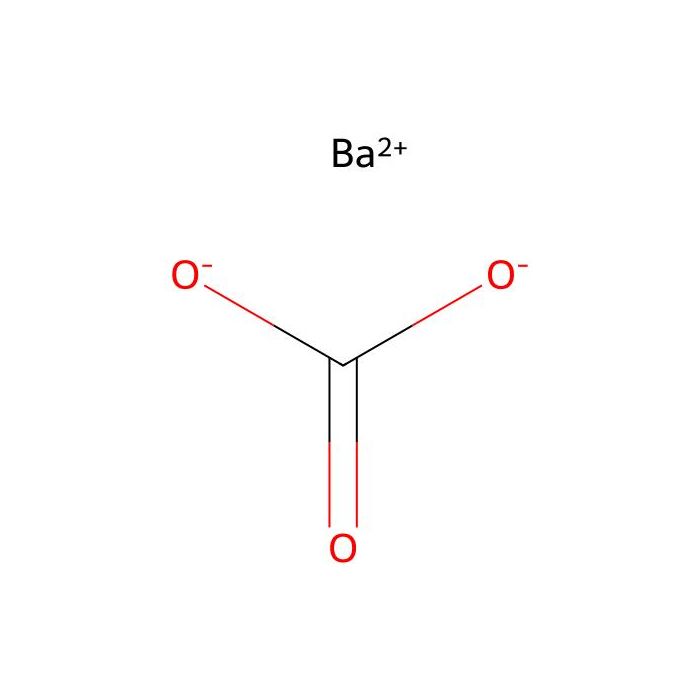
Barium carbonate - for optical glass , CAS No.513-77-9

CAS: 513-77-9 Cat. No.: B759101 Formula: BaCO3 Peso molecolare: 197.34 Beilstein Registry Number: 7045119 Numero EC: 208-167-3
Disponibile su ordine
QUALITÀ & PUREZZA for optical glass
Storage
Room temperature
Shipped In
Normal
★
Dimensione
Germania (EU)
USA*
Prezzo
Qtà
1g
B759101-1g
Su ordinazione · 8–12 settimane
86,69€
5g
B759101-5g
Su ordinazione · 8–12 settimane
373,04€
Enter a quantity for the sizes you want to add.

Specifiche

Specifiche e purezza
for optical glass
Condizioni di conservazione di stoccaggio
Room temperature
Spedito in
Normal
Nomi e identificatori
SMILES
C(=O)([O-])[O-].[Ba+2]
IUPAC Name
barium(2+);carbonate
InChIKey
AYJRCSIUFZENHW-UHFFFAOYSA-L
InChI
1S/CH2O3.Ba/c2-1(3)4;/h(H2,2,3,4);/q;+2/p-2
Isomeri SMILES
C(=O)([O-])[O-].[Ba+2]
RTECS
CQ8600000
Peso molecolare
197.34
Beilstein
7045119
Reaxys
7045119
Reaxys-RN_link_address
https://www.reaxys.com/reaxys/secured/hopinto.do?context=S&query=IDE.XRN=7045119&ln=

Dati avanzati

Taxonomic Classification

Taxonomy Tree

KingdomOrganic compounds
SuperclassOrganic acids and derivatives
ClasseOrganic carbonic acids and derivatives
SubclassOrganic carbonic acids
Intermediate Tree Nodes Not available
Direct ParentOrganic carbonic acids
Alternative Parents Carbonate salts  Organic salts  Organic oxides  Hydrocarbon derivatives  Carbonyl compounds  
Molecular FrameworkAliphatic acyclic compounds
Substituents Carbonate salt - Carbonic acid - Organic oxygen compound - Organic oxide - Hydrocarbon derivative - Organic salt - Organooxygen compound - Carbonyl group - Aliphatic acyclic compound
DescrizioneThis compound belongs to the class of organic compounds known as organic carbonic acids. These are compounds comprising the carbonic acid functional group.
External Descriptors Not available
Struttura 3D
Modello di struttura chimica interattiva


Certificati (CoA, COO, BSE/TSE e tabella di analisi)
C of A & Other Certificates(BSE/TSE, COO):
Analytical Chart:
Proprietà chimiche e fisiche
SensibilitàMoisture sensitive.
Peso molecolare197.34
XLogP3
Hydrogen Bond Donor Count0
Hydrogen Bond Acceptor Count3
Rotatable Bond Count0
Exact Mass197.89 Da
Monoisotopic Mass197.89 Da
Topological Polar Surface Area63.200 Ų
Heavy Atom Count5
Formal Charge0
Complexity18.800
Isotope Atom Count0
Defined Atom Stereocenter Count0
Undefined Atom Stereocenter Count0
Defined Bond Stereocenter Count0
Undefined Bond Stereocenter Count0
The total count of all stereochemical bonds0
Covalently-Bonded Unit Count2
Sicurezza e pericoli (GHS)
Pictogrammi
Segnale
Warning
Indicazioni di pericolo

H302:Harmful if swallowed

Precauzioni

P264:Wash hands [and …] thoroughly after handling.

P270:Do not eat, drink or smoke when using this product.

P501:Dispose of contents/container to an approved waste disposal plant.

P301+P312+P330:IF SWALLOWED: Call a POISON CENTER/ doctor if you feel unwell. Rinse mouth.

RTECS
CQ8600000
Reaxys
7045119
Reaxys-RN_link_address
https://www.reaxys.com/reaxys/secured/hopinto.do?context=S&query=IDE.XRN=7045119&ln=
Domande frequenti e articoli
Structure, Synthesis, and Applications of Barium Titanate – A Closer Look at the Core Dielectric Material in MLCCs
From Spectral Mismatch to Device Gain: Key Mechanisms, Experimental Guidance, and Aladdin Material Selection for Lanthanide Upconversion and Downconversion (Quantum Cutting) in Solar Cells
SOFC Solid Oxide Fuel Cells: From “What It Is and How It Generates Power” to a Key Materials Map, Application Scenarios, and Selection Navigation (Electrolytes / Electrodes / Interconnects / Sealing)
Selection of Common Research Salts: A Task Map for Alkali Metal Salts & Alkaline Earth Metal Salts (with Product Tables 1–6)
Ceramic Materials Guide: Basic Definitions, Classification Framework, and Research-Task-Oriented Selection (with Product Navigation and Tables 1–4)
Why Metal Nanocatalysts Can “Save Energy Yet Lose Performance Easily”: Durability Logic from Active Sites to Support/Interface Engineering (Including Selection Guide and Product Tables A–D)
Perovskite Oxides for Energy and Environmental Catalysis: How Oxygen Vacancies, B-Site Metals, and the Metal–Oxygen Bond Network Regulate Reaction Performance
From Barium Titanate Dielectrics to Multilayer Ceramic Capacitors: Dielectric Properties and Experimental Evaluation of Barium Titanate-Based Ceramics
Citations of This Product
Calcolatori di soluzioni
Recensioni

Recensioni dei clienti

Domande frequenti

How is this product shipped?
This product ships under standard ambient conditions. No temperature-controlled packaging is required.

Desidera che le inviamo un messaggio quando avremo sconti disponibili?

Ricordamelo più tardi

Grazie! Controlli la sua casella di posta per confermare.

Ops! Le notifiche sono disabilitate.