GRADE & PURITYCosmetic grade?Cosmetic grade — meets purity and safety expectations for personal-care formulations. Use for cosmetics and topical products, not pharmaceutical claims.~70%
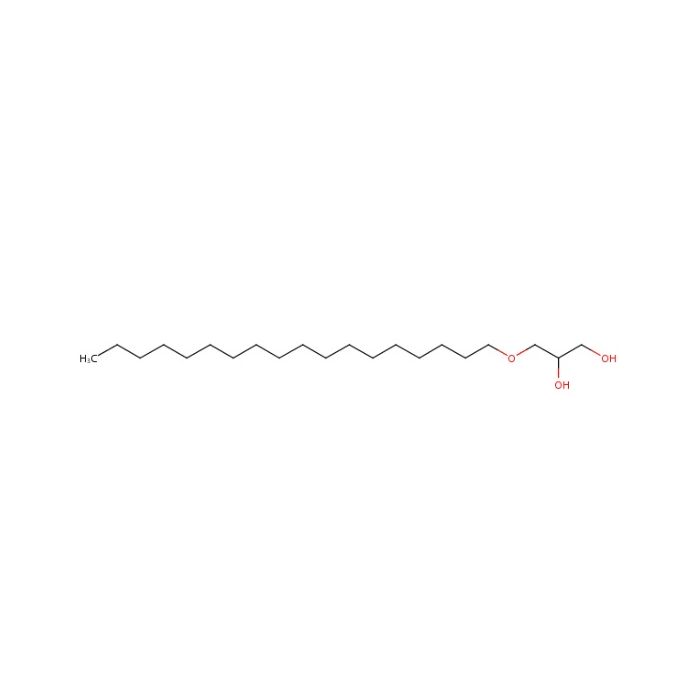
This compound belongs to the class of organic compounds known as monoalkylglycerols. These are glycerolipids containing exactly one aliphatic chain linked to the glycerol moiety. This chain is the only one linked to the glycerol.
External Descriptors
Fatty ethers - Monoalkylglycerols
1. Djoumbou Feunang Y, Eisner R, Knox C, Chepelev L, Hastings J, Owen G, Fahy E, Steinbeck C, Subramanian S, Bolton E, Greiner R, and Wishart DS. ClassyFire: Automated Chemical Classification With A Comprehensive, Computable Taxonomy. Journal of Cheminformatics, 2016, 8:61.
Certificati (CoA, COO, BSE/TSE e tabella di analisi)
C of A & Other Certificates(BSE/TSE, COO):
Analytical Chart:
Proprietà chimiche e fisiche
Punto di fusione (°C)
71 °C
Peso molecolare
344.600 g/mol
XLogP3
7.600
Hydrogen Bond Donor Count
2
Hydrogen Bond Acceptor Count
3
Rotatable Bond Count
20
Exact Mass
344.329 Da
Monoisotopic Mass
344.329 Da
Topological Polar Surface Area
49.700 Ų
Heavy Atom Count
24
Formal Charge
0
Complexity
221.000
Isotope Atom Count
0
Defined Atom Stereocenter Count
0
Undefined Atom Stereocenter Count
1
Defined Bond Stereocenter Count
0
Undefined Bond Stereocenter Count
0
The total count of all stereochemical bonds
0
Covalently-Bonded Unit Count
1
Calcolatori di soluzioni
Molarity Calculator
Determine the necessary mass, volume, or concentration for preparing a solution.
Dilution Calculator
Determine the dilution needed to prepare a stock solution.
Reconstitution Calculator
Recensioni
Recensioni dei clienti
Application Protocols
Item-specific, tested application protocols are not provided for this product.
General handling examples (literature/practice; for research use only)
Organic stock preparation: dissolve at 10–100 mM in ethanol or DMSO. Warm to 40–50 °C and vortex until clear. Store aliquots tightly sealed.
Thin-film for lipid formulations: dissolve required mass in chloroform/methanol (2:1), evaporate under reduced pressure to a uniform film, dry under high vacuum ≥2 h, then hydrate above 80 °C with buffered aqueous phase while vortexing/sonicating to disperse.
Selective acylation (example setup): dissolve in dry CH2Cl2 (0.05–0.2 M), add Et3N (2.0 eq) and catalytic DMAP (0.1 eq), cool to 0 °C, add acyl chloride (1.1 eq) dropwise, then warm to rt and stir to completion (TLC). Work up and purify by silica gel chromatography.
Always adapt conditions to scale, equipment, and safety constraints, and consult primary literature for your specific transformation.
Biological Roles
Literature/general background (not item-specific; for research context only)
Class: ether-linked glycerolipid (alkylglycerol). Batyl alcohol features an n-octadecyl chain at the sn-1 position of glycerol.
Occurrence: alkylglycerols are natural constituents of marine oils (e.g., shark liver oil) and are intermediates in ether lipid biosynthesis.
Metabolic pathway: can be converted enzymatically to 1-O-alkyl-2-acylglycerols and ether phospholipids via acyltransferases and phosphotransferases; related to biosynthesis of platelet-activating factor (PAF) analogs when phosphorylcholine is introduced at sn-3.
Biophysical role: contributes hydrophobic anchoring in membrane-mimetic systems; useful in model membrane studies due to its defined C18 chain and ether stability compared to esters.
Enzymatic stability: the alkyl ether resists non-specific esterase-mediated hydrolysis, enabling studies of metabolism distinct from diacylglycerols.
Important note
No medical or clinical claims are made. Any discussion here is limited to biochemical and biophysical research contexts. Researchers should design experiments acknowledging the compound’s hydrophobicity and potential for membrane incorporation.
Buffer Applications
This product is a highly hydrophobic ether lipid and is not used as a buffer or pH control reagent.
Practical note (literature)
For aqueous work, prepare concentrated stocks in DMSO or ethanol and dilute into buffered systems with vigorous mixing and suitable carriers (e.g., surfactants, cyclodextrins, or lipid vesicles). Adjust final organic co-solvent content (often ≤1–2% v/v) to maintain buffer function and sample compatibility.
Green Alternatives
Context
Batyl alcohol itself is a hydrophobic ether lipid. “Greener” considerations mainly concern solvent and reagent choices during handling and synthesis, not substitution of the molecule.
Greener handling strategies (literature/guidance)
Prefer bio-derived or safer solvents when feasible: 2-MeTHF in place of THF; cyclopentyl methyl ether (CPME) or heptane in place of toluene/hexanes; ethyl acetate or dimethyl carbonate as moderately polar alternatives to chlorinated solvents.
Reduce chlorinated solvent use (e.g., CHCl3, DCM) by adopting MTBE/MeOH or EtOAc/EtOH systems for dissolution and thin-film preparation where performance allows.
Employ catalytic acylation methods (enzymatic lipases, organocatalysts) to minimize activating reagents and waste.
Use solid-supported reagents (e.g., PS-DMAP) for easier workups and reduced solvent consumption.
Illustrative comparison (literature; performance must be validated for your system)
THF vs 2-MeTHF: similar solvating ability for acylations; 2-MeTHF offers better safety profile, partial renewability, and easier phase separation with water.
DCM vs EtOAc: EtOAc can dissolve many lipid intermediates at elevated temperature; eliminates chlorinated waste but may require longer dissolution times.
Trade-offs
Non-chlorinated solvents sometimes reduce solubility for long-chain lipids; modest heating and longer mixing may be necessary. Always verify purity/outcomes and adjust processes accordingly.
Pharmaceutical Uses
Item-specific (from Product Data)
Grade: Cosmetic grade (not pharmaceutical grade)
General formulation context (literature; no therapeutic claims)
Potential roles in R&D: hydrophobic excipient/emollient component for topical or cosmetic prototype formulations; lipid phase constituent in nanoemulsions, liposomes, or solid lipid nanoparticle research.
Functionality: contributes to occlusivity, texture, and rheology; ether linkage enhances oxidative and hydrolytic stability relative to analogous esters.
Regulatory/compendial status: Not specified for this item; refer to CoA/Spec Sheet and applicable regulatory references for any compendial listings.
Notes for formulators
Verify impurity profile and any stabilizers/antioxidants with the lot CoA when developing sensitive formulations.
Evaluate compatibility with other excipients (surfactants, fatty alcohols, triglycerides) and with packaging to avoid extraction or crystallization on storage.
Physical Properties
Item-specific (from Product Data)
Appearance: Not specified for this item; refer to CoA/Spec Sheet.
Literature/general values for batyl alcohol (for planning only; not item specifications)
Physical state: waxy, hydrophobic solid or semi-solid at ambient temperature (literature)
Melting point: typically reported ~78–82 °C (literature; values vary with purity/polymorph)
Boiling point: very high; not commonly distilled under ambient pressure; thermal decomposition may precede bp (literature)
Density: approximately 0.90–0.94 g/cm³ at 25 °C (literature, approximate)
Solubility: insoluble in water; soluble in ethanol, isopropanol, acetone (limited), chloroform, dichloromethane, diethyl ether, hexanes, and oils/lipids (literature)
Partitioning: expected high logP (>6) consistent with long-chain ether lipid (literature)
pKa: not applicable (no acidic/basic ionizable centers in the alkyl ether/glycerol region; only neutral alcohols) (general)
Practical implications
Warmth (40–60 °C) can assist dissolution in organic solvents and oils. Gentle heating and sonication help form clear solutions.
Due to hydrophobicity, emulsification or co-solvent systems (e.g., ethanol + buffer, or DMSO stocks) are often employed for biological assays.
Quality and Grades
Item-specific (from Product Data)
Grade/Purity: Cosmetic grade
What “Cosmetic grade” generally indicates (context; not a guarantee of any unstated spec)
Intended for formulation and R&D use in personal care or topical product development settings (non-therapeutic). Emphasis on appearance, odor, and impurity profile compatible with cosmetic formulation practice.
Typical expectations (literature/industry): controlled levels of residual solvents, color, and odor; may not include analytical guarantees required for pharmaceutical GMP use.
UV/LC specifications, trace metals, water, and peroxide values: Not specified for this item; refer to CoA/Spec Sheet.
Implications for researchers
Suitable for synthesis, lipid formulation studies, and materials testing where cosmetic-grade organoleptic and impurity profiles are acceptable.
For high-sensitivity analytical applications (e.g., LC-MS standards), verify impurity profile and background by consulting the lot-specific CoA or request higher analytical grade if required.
Stabilizers/antioxidants
Not specified for this item; refer to CoA/Spec Sheet. If present, common antioxidants in cosmetic contexts include BHT or tocopherols; confirm before use in sensitive assays.
Reaction and Applications
Applications (literature/general)
Lipid chemistry building block: precursor to ether phospholipids (e.g., 1-O-alkyl-2-acyl-glycero-3-phosphocholines/ethanolamines) by selective acylation at sn-2 followed by phosphorylation at sn-3.
PAF analog synthesis: alkylglycerol frameworks are used to prepare platelet-activating factor analogs via phosphorylation/choline installation and sn-2 acylation.
Surface science/materials: hydrophobizing additive; component of model membranes and monolayers due to C18 chain.
Cosmetic/formulation R&D: emollient/lipid phase component for stability and sensorial tuning (non-therapeutic, research use only).
Reactivity notes (general)
The ether at sn-1 is robust to many conditions (acid/base) compared with esters; free OH groups enable selective derivatization.
Chemoselectivity: primary OH (sn-3) is typically more reactive than the secondary OH (sn-2) in acylations and alkylations; use steric/electronic control (e.g., DMAP catalysis) for selectivity.
Protection strategies: silyl ethers (TBDMS/TBDPS) or acetonide-type protections can differentiate hydroxyls when orthogonal selectivity is required.
Practical tips
Drying: while not highly hygroscopic, residual moisture affects acylation/phosphorylation steps; dry under high vacuum at 40–50 °C or by azeotrope with toluene.
Thin-film hydration: dissolve in chloroform/methanol, rotary evaporate to a thin film, and hydrate above the melting transition to prepare dispersions or liposomes.
Analysis: monitor derivatizations by TLC (hexane/EtOAc with 1–2% AcOH; visualize with anisaldehyde or phosphomolybdic acid) and confirm by 1H/13C NMR and HRMS.
Reaction Conditions
General literature guidance (typical, not item-specific)
Selective acylation (sn-2 preferred):
Solvent: CH2Cl2, toluene, or 2-MeTHF
Reagents: acyl chloride or anhydride; catalytic DMAP (0.05–0.2 eq) + base (pyridine or Et3N)
Temperature: 0 °C to rt; 2–16 h
Notes: primary OH is often more reactive; use sterics, protecting groups, or enzyme catalysis (lipases) to favor sn-2.
Phosphorylation (sn-3):
Methods: POCl3/triester routes, phosphoramidite chemistry, or CDI-activated phosphate transfer
Solvent: dry CH2Cl2/THF; base: DIPEA
Temperature: −20 °C to rt; anhydrous conditions essential
Tosylation/mesylation of primary OH:
Solvent: CH2Cl2 or pyridine
Reagents: TsCl or MsCl; base: pyridine/Et3N
Temperature: 0 °C→rt; 1–4 h
Workup/analysis:
Quench with aqueous NaHCO3; extract into organic phase. Monitor by TLC (hexane/EtOAc 7:3 to 1:1) and confirm by NMR/MS.
Expected outcomes
Yields for individual steps commonly 60–90% (literature, method-dependent). Strict drying and temperature control improve regioselectivity and minimize over-acylation.
Safety and Handling
Item-specific (from Product Data)
GHS classification: Not specified for this item; refer to SDS.
Signal word: Not specified for this item; refer to SDS.
Hazard statements (H-phrases): Not specified for this item; refer to SDS.
Pictograms: Not specified for this item; refer to SDS.
Storage conditions: Room temperature
Shipping: Normal
General safety guidance (literature/practice; not a substitute for the SDS)
Expected hazards: low volatility; may cause skin/eye irritation like many long-chain alcohols/ethers. Avoid inhalation of dust/aerosols.
PPE: lab coat, safety glasses, disposable nitrile gloves. Use in a fume hood when heating, weighing fine powders, or preparing organic solutions.
Incompatibilities: strong oxidizers (risk of exothermic reaction/oxidation of long alkyl chain); strong acids/bases can promote ether cleavage under forcing conditions; avoid open flames when using flammable solvents for dissolution.
First aid (overview): rinse eyes/skin with water for ≥15 min upon contact; move to fresh air after inhalation of dust/solvent vapors; seek medical attention if irritation persists. If ingested, rinse mouth—do not induce vomiting; obtain medical advice.
Handling tips: minimize prolonged heating in air to reduce oxidation; use dry, clean glassware to prevent adventitious hydrolysis/contamination.
Always consult the product-specific SDS supplied by Aladdin Scientific for authoritative hazard and response information.
Solvent Selection
General solvent behavior (literature)
Polarity: strongly nonpolar to amphiphilic; dominates hydrophobic interactions due to the C18 alkyl chain, with limited hydrogen-bond donor capability (two free OH groups) localized on the glycerol moiety.
Water miscibility: essentially insoluble; forms emulsions with surfactants.
Good solvents: ethanol, isopropanol, n-propanol, methanol (warming may be required), chloroform, dichloromethane, ethyl acetate (warm), diethyl ether, THF, toluene, hexanes, isooctane, and oils/lipids.
Stock solutions for bioassays: DMSO or ethanol stocks (e.g., 10–100 mM) are common; dilute into media with vigorous mixing and appropriate carriers (e.g., BSA, cyclodextrins, liposomes) to avoid precipitation.
Selection tips
For lipid extraction/formulation work: chloroform/methanol (2:1, v/v) or MTBE-based systems provide robust solubilization for thin-film hydration or liposome loading.
For organic synthesis: toluene or THF are typical for ether-stable transformations; pyridine or DMAP-containing media assist selective acylations.
For topical/cosmetic prototyping: blend into oils (e.g., caprylic/capric triglyceride) or fatty alcohols with gentle heat to ensure uniformity.
Comparison (guidance)
Versus shorter-chain alkylglycerols: higher hydrophobicity and melting point; improved incorporation into hydrophobic matrices but reduced aqueous dispersibility.
Versus diacylglycerols: ether is more hydrolytically stable; different enzymatic fate in biological systems.
Storage and Reconstitution
Item-specific (from Product Data)
Storage conditions: Room temperature
Shipped in: Normal
General guidance (literature/practice)
Container: store in a tightly closed, light-resistant container to minimize slow oxidation. For long-term storage, consider under inert gas (N2/Ar).
Stability: ether linkage is robust; free alcohols are stable. Prolonged exposure to air/heat can promote oxidation of the long alkyl chain—limit headspace oxygen and avoid excessive heating.
Recommended stock solutions: prepare in ethanol, isopropanol, or DMSO. Typical concentrations 10–100 mM depending on downstream use. Warm gently (40–60 °C) and vortex/sonicate to aid dissolution.
Aqueous use: disperse with co-solvent (≤1–2% v/v organic) and optional carriers (surfactants, cyclodextrins, or preformed liposomes). Add slowly with vigorous mixing to prevent precipitation.
Freeze–thaw: solid material tolerates ambient storage; solutions in organic solvents should be aliquoted to avoid repeated freeze–thaw and moisture ingress.
Where specific shelf-life or stabilizer information is needed: Not specified for this item; refer to CoA/Spec Sheet.
Structure and Identity
Item-specific (from Product Data)
SKU: B1519842
Product name: Batyl Alcohol
CAS: 544-62-7
PubChem CID: 3681
InChIKey: 257066 (as provided)
Grade: Cosmetic grade
Literature/computed (general reference for batyl alcohol; not item-specific)
Structural features: glycerol backbone bearing an ether-linked n-octadecyl chain at the primary (sn-1) position; two free alcohol groups (one primary, one secondary). Typically supplied as racemate at the secondary center (no defined stereochemistry).
2D description: a long, linear C18 alkyl chain attached via an ether oxygen to a three-carbon glycerol unit; terminal of the glycerol has a primary hydroxymethyl and an adjacent secondary alcohol.
Notes
Where Product Data are absent or differ, defer to the item’s CoA/Spec Sheet for definitive identity attributes.
Synthetic Utility
Literature/general guidance
Functional group handles: two free hydroxyls (one primary, one secondary) plus a non-labile alkyl ether at sn-1 enable diverse derivatizations while maintaining the C18 hydrophobe.
Key transformations:
Selective acylation: install acyl groups at sn-2 (secondary) or sn-3 (primary) using acyl chlorides/anhydrides with catalytic DMAP or enzymatic selectivity (e.g., lipase-mediated regioselectivity).
Phosphorylation: convert the remaining free OH to phosphate diesters (e.g., phosphocholine/ethanolamine) to access ether phospholipids.
Tosylation/mesylation of the primary OH followed by displacement provides access to diverse sn-3 substituents.
Protection: silyl ethers (TBDMS/TBDPS) or acetonide-type protection can orchestrate orthogonal manipulations.
Stability advantages: the alkyl ether at sn-1 tolerates acidic/basic conditions that might cleave esters, allowing sequences otherwise challenging with diacylglycerols.
Retrosynthetic value
Serves as a convergent entry to libraries of ether lipids varying only at sn-2 acyl and sn-3 headgroup. Facilitates SAR studies in membrane-active or lipid-signaling analogs without re-installing the hydrophobic tail each time.
Target Specificity
Not applicable. This product is a small-molecule lipid and is not an antibody, probe, or biologic with defined antigen/epitope specificity.
Item-specific test applications or biological targets are not specified for this item; refer to CoA/Spec Sheet if needed.
Need help choosing the grade?
Our grade selection guide covers purity, stabilizer status, and application suitability for all variants in our catalog.
We use cookies to ensure the website functions properly and, where permitted, to improve your experience. You can manage your preferences at any time in Settings. Learn more in our Cookie Policy.
Shall we send you a message when we have discounts available?
Remind me later
Thank you! Please check your email inbox to confirm.
Products are supplied to verified businesses, institutions, and qualified professionals for research and development use only. Not for use in humans, animals, diagnosis, or therapy.