GRADE & PURITYCosmetic grade?Cosmetic grade — meets purity and safety expectations for personal-care formulations. Use for cosmetics and topical products, not pharmaceutical claims.≥95%
This compound belongs to the class of organic compounds known as monoalkylglycerols. These are glycerolipids containing exactly one aliphatic chain linked to the glycerol moiety. This chain is the only one linked to the glycerol.
External Descriptors
Fatty ethers - Monoalkylglycerols
1. Djoumbou Feunang Y, Eisner R, Knox C, Chepelev L, Hastings J, Owen G, Fahy E, Steinbeck C, Subramanian S, Bolton E, Greiner R, and Wishart DS. ClassyFire: Automated Chemical Classification With A Comprehensive, Computable Taxonomy. Journal of Cheminformatics, 2016, 8:61.
Certificati (CoA, COO, BSE/TSE e tabella di analisi)
C of A & Other Certificates(BSE/TSE, COO):
Analytical Chart:
Proprietà chimiche e fisiche
Punto di fusione (°C)
71 °C
Peso molecolare
344.600 g/mol
XLogP3
7.600
Hydrogen Bond Donor Count
2
Hydrogen Bond Acceptor Count
3
Rotatable Bond Count
20
Exact Mass
344.329 Da
Monoisotopic Mass
344.329 Da
Topological Polar Surface Area
49.700 Ų
Heavy Atom Count
24
Formal Charge
0
Complexity
221.000
Isotope Atom Count
0
Defined Atom Stereocenter Count
0
Undefined Atom Stereocenter Count
1
Defined Bond Stereocenter Count
0
Undefined Bond Stereocenter Count
0
The total count of all stereochemical bonds
0
Covalently-Bonded Unit Count
1
Calcolatori di soluzioni
Molarity Calculator
Determine the necessary mass, volume, or concentration for preparing a solution.
Dilution Calculator
Determine the dilution needed to prepare a stock solution.
Reconstitution Calculator
Recensioni
Recensioni dei clienti
Application Protocols
No assay-validated protocols are provided in the Product Data for this small-molecule lipid. General research-use suggestions (non-validated; literature-informed):
Stock solution preparation:
Prepare concentrated stocks (e.g., 10–100 mg/mL) in warm ethanol, isopropanol, or DMSO. Filter if necessary while warm using PTFE membranes.
For dispersion into aqueous media, premix with a suitable surfactant or formulate into liposomes/vesicles.
Formulation screening (cosmetic R&D):
Melt phase: combine batyl alcohol with oils/waxes at 70–80 °C; emulsify into heated aqueous phase under high shear; cool with controlled agitation to develop structure.
These are general suggestions only. For application-specific protocols, design and validate methods appropriate to your laboratory and consult the literature.
Biological Roles
Note: The following describes general biochemistry of alkylglycerols; this product is for research use only.
Ether lipid context (literature):
Batyl alcohol (1-O-octadecylglycerol) is an alkylglycerol related to natural ether lipids found in marine oils and mammalian tissues.
In cellular metabolism, 1-O-alkylglycerols can serve as precursors to ether phospholipids (e.g., plasmanyl phosphatidylcholines) via phosphorylation and headgroup attachment.
Structural/biophysical features:
The saturated C18 ether chain confers strong hydrophobicity and a propensity to pack into ordered lamellae.
The free diol headgroup enables derivatization into phosphorylated lipids that integrate into membranes.
Metabolic entry points (literature):
Kinases can convert glycerol derivatives to glycerol-3-phosphates; subsequent enzymatic pathways yield ether phospholipids in peroxisomes/ER in vivo. Batyl alcohol per se is a simplified model substrate for studying such chemistry in vitro.
Research relevance:
Useful as a defined standard or substrate analog in lipid enzymology assays, membrane-model studies, and structure–property investigations of ether-linked lipids.
No medical or clinical claims are made. Use is restricted to laboratory research.
Buffer Applications
Batyl alcohol is a highly hydrophobic, nonionic lipid and is not typically used to prepare aqueous buffers or classical biochemical buffer systems.
Practical note:
If incorporation into aqueous systems is required for research, use co-solvents (e.g., ethanol) or surfactant-based vehicles (e.g., mixed micelles, liposomes) prepared in a suitable buffer. Optimize by pre-dissolving the compound in a minimal amount of an organic solvent before dilution into the buffered medium under vigorous mixing.
For standard buffer recipes and pH control, refer instead to dedicated buffering agents (HEPES, PBS, Tris, MES, etc.).
Green Alternatives
For dissolving and processing batyl alcohol, solvent selection drives environmental impact more than the substrate itself.
Greener solvent choices (literature guidance):
Ethanol, isopropanol: bio-based, low toxicity, good solvency for batyl alcohol when warmed.
Ethyl acetate: readily biodegradable; effective for extractions and chromatography.
2-MeTHF: from renewable sources; good for some synthetic steps (e.g., protection reactions), though solubility may vary.
Less preferred due to EHS concerns:
Chloroform and dichloromethane: effective but halogenated; consider replacements when feasible (e.g., EtOAc, heptane/IPA blends).
Trade-offs:
Alcohols may require heating and longer dissolution times versus chlorinated solvents.
Hydrocarbons (heptane) are low-toxicity but may necessitate higher temperatures or cosolvents to achieve full solubility.
Small comparison (general):
CH2Cl2: fast dissolution; high EHS burden.
Ethanol (warmed): safer/greener; slower dissolution, potential crystallization upon cooling.
Ethyl acetate: balanced profile; moderate dissolution rate; recyclable via distillation.
Process tips:
Use minimal effective solvent volumes; employ heat/sonication to avoid switching to halogenated solvents.
Evaluate solvent blends (e.g., EtOAc/EtOH or heptane/IPA) to optimize solubility and sustainability.
Pharmaceutical Uses
No therapeutic claims are made. The following addresses formulation roles in a research/manufacturing context.
Excipient/formulation roles (general/literature):
Emollient and structuring agent in topical and cosmetic R&D due to the long C18 chain and glycerol headgroup, which can influence viscosity, spreadability, and occlusivity in emulsions and anhydrous systems.
Co-emulsifier or consistency modifier in oil-in-water and water-in-oil systems; can interact with other lipids/waxes to tune lamellar structures.
Potential lipophilic carrier for actives in prototype delivery systems (e.g., lipid matrices) during pre-formulation studies.
Regulatory/compendial status:
Cosmetic grade is indicated for this item. No pharmacopeial monograph is specified; users should verify compliance if considering regulated drug product development.
Processing considerations:
Melt-processing with oils/waxes at 70–80 °C, followed by controlled cooling to develop desired microstructure.
Compatibility testing recommended with emulsifiers, antioxidants, fragrances, and UV filters commonly used in personal care R&D.
Verification required (not specified for this item):
Residual solvent limits, peroxide values, and specific impurity profiles should be confirmed via CoA/Spec Sheet for regulated applications.
Physical Properties
Item-specific values from Product Data:
Appearance: Not specified for this item; refer to CoA/Spec Sheet.
Molecular Formula: Not specified for this item; refer to CoA/Spec Sheet.
Molecular Weight: Not specified for this item; refer to CoA/Spec Sheet.
Literature/typical properties for batyl alcohol (for reference; not item specifications):
Physical state: waxy, white to off-white solid; long-chain lipid-like material.
Melting point: typically ~73–78 °C (literature range for 1-O-octadecylglycerol).
Boiling point: decomposes before boiling at ambient pressure; high bp expected for C21 ether (literature).
Density: ~0.85–0.90 g/cm³ at 25 °C (literature, approximate for long-chain alkylglycerols).
Solubility: insoluble in water; soluble in ethanol (hot), isopropanol (hot), chloroform, dichloromethane, ethyl acetate; sparingly soluble in cold alcohols (literature).
LogP (estimated): high, typically >6 (literature/estimates for C18 ether glycerol).
Refractive index: not typically reported for solids of this class.
pKa: not applicable (no ionizable groups in neutral range; only neutral alcohols present).
Practical handling notes (general):
Gentle warming (40–60 °C) can aid dissolution in organic solvents.
Forms viscous melts near its melting point; thin-layer spreading improves dissolution.
For quantitative solution prep, weigh accurately and dissolve in prewarmed solvent to ensure complete solubilization.
Implication: Suitable for cosmetic/formulation R&D where raw materials typically meet purity and contaminant expectations aligned with cosmetic industry norms (e.g., appearance, odor, and general impurity control). Cosmetic grade is not equivalent to pharmaceutical (USP/EP) or analytical/HPLC grades.
What cosmetic grade generally emphasizes (general guidance):
Consistency in appearance and sensory profile.
Control of typical impurities relevant to cosmetic formulations (e.g., residual solvents within acceptable limits, low color/odor).
May include testing for certain allergens or restricted substances depending on region; exact specs vary by supplier.
Not specified for this item; refer to CoA/Spec Sheet:
Exact assay/purity percentage
Limits on metals, peroxides, and water content
Residual solvent profile and UV cut-off
Stabilizers/antioxidants (if any)
Choosing this item:
Appropriate for research, method development, and formulation screening in personal care or materials applications.
For quantitative analytical use (e.g., trace analysis, photometric baselines), consider verifying suitability or requesting higher analytical grades.
Documentation: For batch-specific quality attributes, request the Certificate of Analysis (CoA) and Specification Sheet. Always verify that the grade aligns with your regulatory and technical requirements for the intended application.
Reaction and Applications
As a saturated C18 alkylglycerol with two free hydroxyls and one ether linkage, batyl alcohol is a versatile lipid precursor and surface-active building block.
Representative research and formulation applications (general/literature):
Lipid synthesis: precursor to ether phospholipids (e.g., alkylglycerophosphocholines) via selective protection, phosphorylation, and headgroup installation.
Surfactant/emollient studies: evaluation as a structurant, co-emulsifier, or consistency modifier in cosmetic formulation R&D.
Materials/colloid science: modifier for lamellar phases and model membranes; hydrophobic tail promotes ordered assemblies.
Functional transformations (literature):
Selective protection of the 2-OH (secondary) as acetal/ketal or silyl ether to direct subsequent chemistry at the primary OH.
Primary OH activation (e.g., tosylation/mesylation) to enable nucleophilic substitutions or phosphorylation.
Oxidation of primary OH to aldehyde/acid derivatives for further coupling (using mild oxidants to preserve the ether).
Carbonate/carbamate formation for polymer/lipid conjugates.
Practical notes:
Maintain anhydrous, oxygen-limited conditions for sensitive downstream lipid chemistries.
The long alkyl chain can impede mass transfer; employ efficient stirring and cosolvents.
Purification: silica gel chromatography with hexane/ethyl acetate; include 0.1–1% triethylamine if tailing occurs due to adsorption of diols.
Related named methodologies (literature):
Appel/Mitsunobu-type approaches for selective transformations of glycerol derivatives.
Phosphoramidite or POCl3-based phosphorylation to access glycerophospholipid analogs.
Reaction Conditions
General literature guidance for transforming batyl alcohol; adjust based on your route and scale.
Selective protection strategies:
Acetonide formation (with acetone, catalytic p-TsOH or camphorsulfonic acid) to protect both diol positions; typical 0–25 °C to reflux conditions; quench promptly to avoid ether cleavage.
Silyl protection (TBS-Cl, imidazole in DMF or DCM) favoring the primary OH; 0–25 °C, 1–12 h.
Primary OH activation and substitution:
Tosylation: TsCl, pyridine or TEA, DCM, 0–25 °C, 2–18 h; typical isolated yields 70–90% (literature ranges).
Phosphorylation: POCl3/DMAP/TEA in DCM or THF at 0–25 °C; or phosphoramidite chemistry (2-cyanoethyl N,N-diisopropylchlorophosphoramidite) with tetrazole activation, then oxidation (mCPBA/I2/H2O2).
Acylation at sn-2:
Steglich conditions: DCC or EDCI, DMAP, carboxylic acid, DCM or THF, 0–25 °C; 60–90% yields commonly reported for related glycerol derivatives.
Oxidations (primary OH):
TEMPO/NaOCl or Dess–Martin periodinane for selective oxidation to aldehyde/acid; 0–25 °C, 0.5–3 h; protect secondary OH if needed.
Workup and purification tips:
Include aqueous bicarbonate washes to remove acidic residues.
Use minimal heat during concentration to avoid phase separation/foaming.
All conditions above are literature/general guidance for alkylglycerols and are not item-specific specifications.
Safety and Handling
GHS classification and hazard statements (item-specific):
Signal Word: Not specified for this item; refer to SDS.
H-Statements: Not specified for this item; refer to SDS.
GHS Classification: Not specified for this item; refer to SDS.
Pictograms: Not specified for this item; refer to SDS.
General safety considerations for long-chain alkylglycerols (literature/typical):
Low acute toxicity expected; may cause mild skin/eye irritation as a fatty alcohol/ether lipid.
Use in a well-ventilated area; avoid inhalation of dust or aerosols.
Wash thoroughly after handling; avoid prolonged skin contact due to defatting potential.
Storage incompatibilities and precautions:
Avoid strong oxidizers and strong acids/bases that can promote degradation.
Long-chain lipids can slowly oxidize; minimize exposure to air and light for prolonged storage.
No peroxide-forming tendency like ethers of low MW; nevertheless, maintain good storage hygiene.
First-aid overview (general guidance; defer to SDS):
Eye contact: Rinse cautiously with water for several minutes; remove contact lenses if present and easy to do; seek medical attention if irritation persists.
Skin contact: Wash with soap and water; remove contaminated clothing.
Inhalation: Move to fresh air; seek medical advice if symptoms occur.
Ingestion: Rinse mouth; do not induce vomiting; seek medical advice.
Always consult the product-specific SDS for authoritative safety information.
Solvent Selection
Batyl alcohol is a highly hydrophobic, long-chain ether glycerol. Solvent choice focuses on dissolving a waxy, high-logP solid and maintaining stability.
Polarity/miscibility (literature-based):
Water: immiscible; negligible solubility.
Alcohols: sparingly soluble in cold ethanol/isopropanol; readily soluble when warmed.
Chlorinated solvents: good solubility in CH2Cl2 and chloroform.
Ethers/esters: soluble in ethyl acetate, MTBE, and diethyl ether (often improved by warming).
Hydrocarbons: soluble in toluene, hexanes/heptane when warmed.
Practical solvent choices by task:
Stock solutions for formulation screens: ethanol, isopropanol, propylene glycol (with heat), or ethanol/PEG cosolvent systems.
Synthetic transformations: anhydrous dichloromethane, THF, toluene, or DMF depending on reaction (e.g., protection, tosylation, phosphorylation).
Chromatography: elute on silica with hexane/ethyl acetate (gradient); the free diol headgroup gives moderate polarity relative to the C18 tail.
Selection tips:
Gentle heating (40–60 °C) and brief sonication often suffice for complete dissolution.
Avoid prolonged exposure to strong protic acids/bases in solution if preserving the ether linkage is critical.
Quick comparison (literature tendencies):
Ethanol (warmed): safe, greenish, slow to dissolve at RT; good for cosmetic/formulation trials.
CH2Cl2/CHCl3: fast dissolution; volatile and halogenated—use with appropriate controls.
Toluene/hexanes: good for nonpolar blends; limited for processing without heat.
Storage and Reconstitution
Item-specific storage and shipping (from Product Data):
Storage Conditions: Room temperature
Shipped In: Normal
General storage guidance for long-chain alkylglycerols:
Keep container tightly closed in a cool, dry place away from direct light and heat sources.
To maximize shelf life, purge headspace with inert gas after opening and store under air-tight conditions; consider amber containers to limit photo-oxidation.
Avoid prolonged exposure to strong oxidizers.
Reconstitution/preparation notes (general):
For solution preparation, gently warm the solid (40–60 °C) and dissolve in ethanol, isopropanol, chloroform, dichloromethane, ethyl acetate, or other suitable organic solvents.
For aqueous systems, use co-solvents or surfactants and add the pre-dissolved lipid slowly under vigorous stirring to minimize precipitation.
Prepare fresh solutions for critical experiments; long-term storage in solution is not recommended unless stabilized and stored under inert atmosphere at reduced temperature.
Stability indicators:
Monitor for changes in color, odor, or consistency which may indicate oxidation or contamination.
Always refer to the product’s CoA/Spec Sheet and SDS for batch-specific guidance.
Structure and Identity
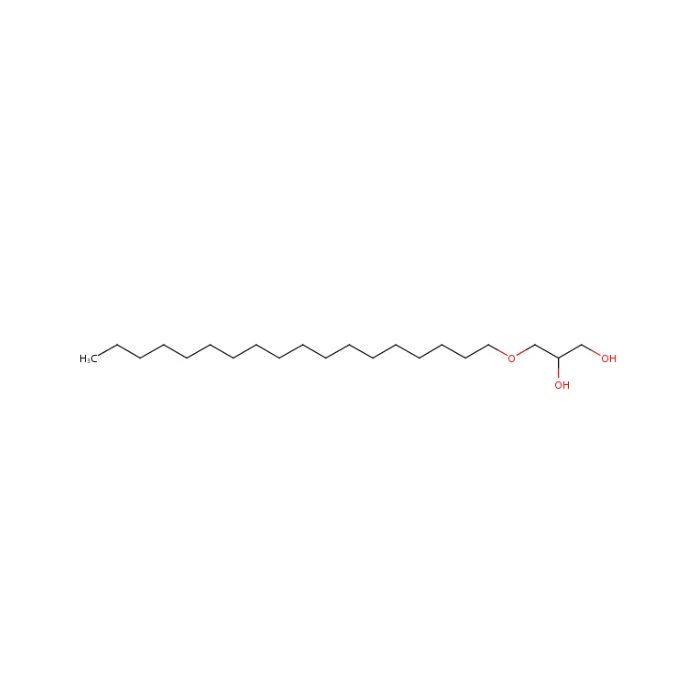
Brief description: Batyl alcohol is a long-chain ether lipid (an alkylglycerol), consisting of a saturated C18 alkyl chain ether-linked at the sn-1 position of glycerol; the sn-2 and sn-3 positions are free primary and secondary alcohols.
Item-specific identifiers (from Product Data):
SKU: B1519856
CAS: 544-62-7
Category Path: 全部 / 可售 / 化学和生化试剂
Grade: Cosmetic grade
Research Use Note: For research use only
Literature identifiers and structural data (for reference; not item-specific specs):
InChIKey: commonly reported for batyl alcohol; specific key not provided in Product Data. Representative (literature) entries can be consulted in PubChem for CAS 544-62-7.
SMILES: typically represented as a glycerol backbone etherified by n-octadecyl; consult databases for precise canonical string (literature).
Structural features (general description):
Functional groups: one ether (alkyl–O–glycerol) and two free hydroxyls (one primary, one secondary).
Carbon skeleton: linear C18 saturated chain attached at glycerol C1 via ether; no rings; no stereogenic centers specified in generic “batyl alcohol,” though sn-notation implies the glycerol stereochemistry used in lipid nomenclature (literature).
2D description: HO–CH2–CH(OH)–CH2–O–(CH2)18–CH3, with the long hydrophobic tail conferring strong amphiphobic character and the glycerol headgroup providing limited polarity.
Synthetic Utility
Batyl alcohol serves as a platform for constructing ether lipid derivatives and amphiphiles by leveraging its two alcohols and stable ether linkage.
Functional group leverage:
Primary OH (sn-3): amenable to selective activation (tosylate/mesylate), oxidation to aldehyde/acid, or phosphorylation for headgroup installation.
Secondary OH (sn-2): can be differentially protected (e.g., TBS, TIPS, acetonide with the primary OH) or engaged in selective acylation to form 2-O-esters.
Ether at sn-1: robust to moderate acids/bases and many oxidants, preserving the hydrophobic tail throughout multistep sequences.
Typical transformations (literature):
Access to 1-O-alkyl-2-acyl-sn-glycerols via selective 2-O-acylation, precursors to ether triacylglycerol mimics.
Synthesis of ether phospholipids (plasmanyl species) via phosphorylation (POCl3, CDI, or phosphoramidite chemistry) followed by choline/ethanolamine headgroup coupling.
Installation of carbonate/carbamate/urethane linkers to tether dyes, polymers, or bioactive headgroups for probe development.
Retrosynthetic value:
Provides the challenging C18 ether linkage pre-installed, avoiding harsh Williamson-ether steps on sensitive intermediates.
Purification and analysis:
Silica gel chromatography with hexane/EtOAc gradients; add 0.1–1% Et3N if necessary.
Not applicable to this chemical product. Batyl alcohol is a small-molecule lipid, not an antibody or affinity reagent. No target/epitope specificity, clone, isotype, or species reactivity data apply.
Need help choosing the grade?
Our grade selection guide covers purity, stabilizer status, and application suitability for all variants in our catalog.
We use cookies to ensure the website functions properly and, where permitted, to improve your experience. You can manage your preferences at any time in Settings. Learn more in our Cookie Policy.
Shall we send you a message when we have discounts available?
Remind me later
Thank you! Please check your email inbox to confirm.
Products are supplied to verified businesses, institutions, and qualified professionals for research and development use only. Not for use in humans, animals, diagnosis, or therapy.