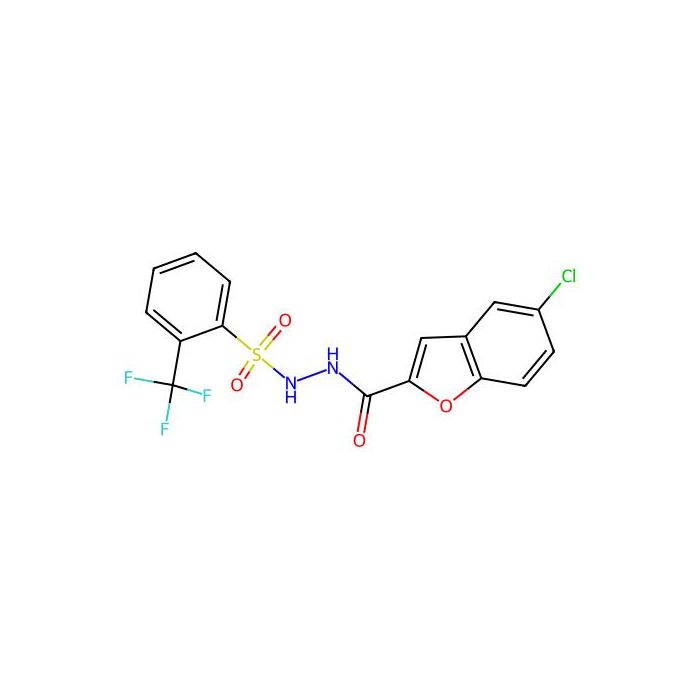
BCATc Inhibitor 2 is a selective branched-chain aminotransferase (BCAT) inhibitor for research of neurodegenerative diseases. The IC 50 s of 0.2 μM, 0.8 μM and 3.0 μM for rat cytosolic isoenzyme rBCATc, human cytosolic isoenzyme hBCATc and rat mitochondrial isoenzyme rBCATm, respectively. BCATc, also called BCAT1, is in the cytoplasm
In Vitro
BCATc Inhibitor 2 decreases calcium influx in neuronal cultures with an IC 50 =4.8±1.2 μM. MCE has not independently confirmed the accuracy of these methods. They are for reference only.
In Vivo
BCATc Inhibitor 2 also blocks calcium influx into neuronal cells following inhibition of glutamate uptake, and demonstrates neuroprotective efficacy in vivo . ?\nFollowing a 30 mg/kg subcutaneous injection to Lewis rats, BCATc Inhibitor 2 reaches a peak plasma concentration (Cmax) of 8.28 μg/mL at 0.5 h (t max ).? The mean plasma exposure (AUC) value is 19.9 μg h/mL, and the mean terminal half-life ranged from 12 to 15 h, indicating favorable PK parameters of BCATc Inhibitor 2 . MCE has not independently confirmed the accuracy of these methods. They are for reference only.
BCATc Inhibitor 2 is a selective branched-chain aminotransferase (BCAT) inhibitor for research of neurodegenerative diseases. The IC 50 s of 0.2 μM, 0.8 μM and 3.0 μM for rat cytosolic isoenzyme rBCATc, human cytosolic isoenzyme hBCATc and rat mitochondri
Condizioni di conservazione di stoccaggio
Protected from light,Store at -80°C
Spedito in
Dry ice packs + Cold packs
Questo prodotto richiede spedizione a catena fredda. I servizi di terra e altri servizi economici non sono disponibili.
Utilizziamo i cookie per garantire il corretto funzionamento del sito web e, ove consentito, per migliorare la tua esperienza. Puoi gestire le tue preferenze in qualsiasi momento nelle Impostazioni. Per saperne di più, consulta la nostra Cookie Policy.
Desidera che le inviamo un messaggio quando avremo sconti disponibili?
Ricordamelo più tardi
Grazie! Controlli la sua casella di posta per confermare.
Products are supplied to verified businesses, institutions, and qualified professionals for research and development use only. Not for use in humans, animals, diagnosis, or therapy.