GRADE & PURITYMoligand™?Moligand™ — Aladdin's line of ligands and bioactive small molecules. Use for receptor, pathway, and binding studies needing defined small-molecule tools.10 mM in DMSO
Moligand™, 10 mM in DMSO Moligand™ for sensitive chromatographic and analytical workflows requiring minimal baseline interference.
🌡
Storage & shipping
Argon charged,Store at -80°C Ships Dry ice packs + Cold packs Check lot-specific COA for exact specifications.
📋
Quality documents
SDS, COA, datasheet, and spec sheet available for download. Lot-specific COA accessible via lot number lookup.
📚
Literature proof
Cited in 0 peer-reviewed publications across chromatography, organic synthesis, and cross-coupling reactions.
Panoramica
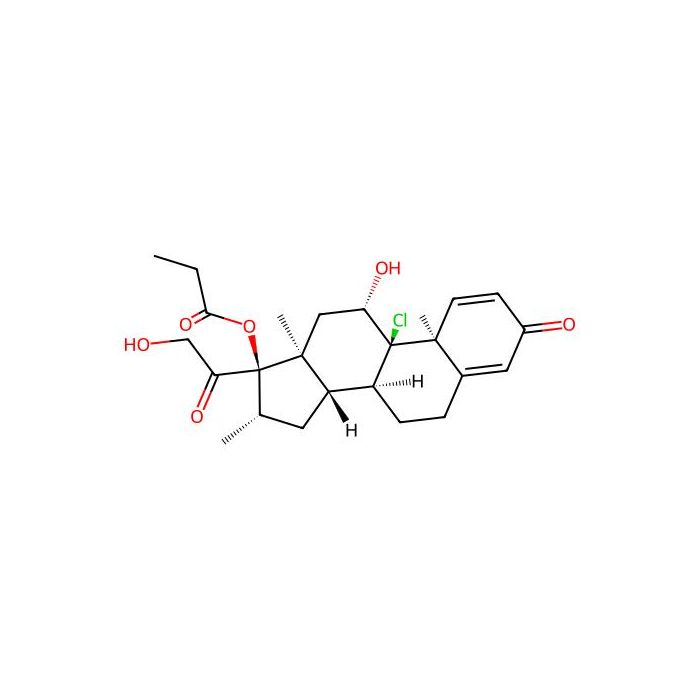
Beclomethasone 17-propionate (Beclomethasone-17-monopropionate), an active metabolite of Beclomethasone dipropionate, is a glucocorticoid receptor (GR) agonist. Beclomethasone 17-propionate exhibits greater affinity for GR than Beclomethasone dipropionate. Beclomethasone 17-propionate effectively suppresses cytokine production in chronic obstructive pulmonary disease (COPD) lung macrophages.
Specifications
Specifiche e purezza
Moligand™, 10 mM in DMSO
Condizioni di conservazione di stoccaggio
Argon charged,Store at -80°C
Spedito in
Dry ice packs + Cold packs
Questo prodotto richiede spedizione a catena fredda. I servizi di terra e altri servizi economici non sono disponibili.
Certificati (CoA, COO, BSE/TSE e tabella di analisi)
C of A & Other Certificates(BSE/TSE, COO):
Analytical Chart:
Proprietà chimiche e fisiche
Indice di rifrazione
n20D1.58 (Predicted)
Punto di ebollizione (°C)
~608.9° C at 760 mmHg (Predicted)
Punto di fusione (°C)
119-120° C (dec.)
Calcolatori di soluzioni
Molarity Calculator
Determine the necessary mass, volume, or concentration for preparing a solution.
Dilution Calculator
Determine the dilution needed to prepare a stock solution.
Reconstitution Calculator
Recensioni
Recensioni dei clienti
Application Protocols
No item-specific, validated protocols were provided. The following are general, non-clinical research procedures suitable for small-molecule ligands of limited aqueous solubility.
Preparation of DMSO stock
Weigh compound quickly in a balance enclosure. Prepare a 10 mM stock in anhydrous DMSO. Vortex until dissolved. Aliquot into amber, argon-purged vials. Store at −80°C.
GR reporter assay (general outline)
Cells: GR-expressing line transfected with GRE-luciferase reporter.
Dosing: serially dilute DMSO stock into assay medium to achieve 0.1–1% final DMSO. Include vehicle and positive control (reference glucocorticoid) wells.
Incubation: 6–24 h at 37°C. Read luminescence and analyze EC50/efficacy.
Radioligand displacement or fluorescence polarization binding assay (general)
Incubate GR ligand-binding domain with tracer and test compound over a dilution series. Determine Ki via appropriate binding models.
Analytical QC of working solutions
Verify concentration by UV or LC–MS where possible. Inspect for precipitation after dilution into aqueous media.
These procedures are provided for research use only and require optimization for specific cell lines, receptor constructs, and readouts.
Biological Roles
General biological context (literature; no clinical claims)
Beclomethasone 17-propionate is a synthetic glucocorticoid-class molecule with a steroidal backbone bearing a 9α-chloro, 16β-methyl, and a single propionate ester at C17. Compounds of this class act as agonists of the glucocorticoid receptor (GR), modulating transcription of glucocorticoid-responsive genes in research models.
The 17-propionate ester increases lipophilicity and membrane permeation relative to the parent triol, while the free 21-OH can influence receptor interactions and metabolic turnover (e.g., phase II conjugation) compared with the 17,21-dipropionate analog.
Research utility
Employed as a reference ligand in GR binding assays, reporter gene systems (GRE-luciferase), and in vitro profiling of nuclear receptor selectivity (GR vs MR/PR/AR) to study structure–activity relationships among corticosteroids.
Serves as a process intermediate and analytical reference when characterizing impurity profiles and metabolites associated with the corresponding diester.
ADME-relevant features (general)
Neutral, moderately lipophilic profile supports passive diffusion; multiple hydrogen-bond donors/acceptors contribute to target affinity. Ester hydrolysis (particularly at C17 under basic/enzymatic conditions) is a common metabolic/degradation pathway; oxidation at the 20-ketone and reduction pathways may also occur in biological matrices.
Note: Use strictly for research; not for diagnostic, therapeutic, or in vivo clinical applications.
Buffer Applications
This compound is a poorly water-soluble, neutral steroidal small molecule and is not used as a buffer component. It does not provide pH control or ionic strength.
Practical guidance
For aqueous assays, prepare a concentrated DMSO stock and dilute into buffered media (e.g., PBS, HBSS, HEPES-buffered solutions) keeping final DMSO ≤0.1–1% v/v as dictated by assay tolerance.
Use surfactants (e.g., 0.01–0.05% Tween 80) or carrier proteins (e.g., 0.1% BSA) if nonspecific binding or precipitation occurs; validate that additives do not interfere with the biology under study.
Green Alternatives
When handling steroidal monoesters like beclomethasone 17-propionate, solvent and reagent choices drive most of the environmental footprint. Below are greener considerations compared to conventional choices.
Solvent selection (general guidance)
Replace dichloromethane/chloroform with ethyl acetate, 2-methyltetrahydrofuran (2-MeTHF), or cyclopentyl methyl ether (CPME) where feasible (particularly for extractions and some acylations).
Use bio-derived alcohols (ethanol, isopropanol) for crystallization and cleaning; avoid methanol when possible due to toxicity.
For stock solutions, DMSO remains a pragmatic choice; maintain minimal volumes and reuse vials to reduce waste.
Acylation to dipropionate (comparative, literature)
Conventional: propionyl chloride or propionic anhydride in DCM with DMAP/pyridine.
Greener alternative: propionic anhydride or propionic acid with catalytic DMAP in 2-MeTHF or EtOAc; or employ carbodiimide-free coupling systems (e.g., propionic anhydride with catalytic imidazole) to minimize urea waste.
Workup and purification
Favor liquid–liquid extraction with EtOAc/brine over chlorinated solvents; use minimal silica and consider reverse-phase purification with aqueous acetonitrile to reduce organic waste load.
Energy and stability
Low-temperature storage is required for product stability; however, conduct reactions at ambient temperature when possible and avoid unnecessary cryogenic steps.
Tradeoffs: greener ethers (2-MeTHF/CPME) may alter chemoselectivity or solubility vs DCM; verify by small-scale screens.
Pharmaceutical Uses
No therapeutic claims are made for this reagent. It is supplied strictly for research and development.
Typical roles in pharmaceutical R&D/manufacturing (general)
Process intermediate: used to access beclomethasone 17,21-dipropionate via selective acylation of the 21-hydroxyl.
Reference/analytical standard: useful for impurity profiling, stability-indicating method development, and system suitability in chromatographic assays that monitor beclomethasone-related substances.
Excipient role: none; this is an active-class small molecule used as a ligand/intermediate rather than a formulation excipient.
Regulatory notes
For research use only; not a compendial-grade API or excipient. If used in GMP development, qualify the lot per internal procedures (identity, purity, residual solvents, elemental impurities) and maintain full documentation (CoA, SDS, chain of custody).
Practical tips
Establish orthogonal analytical methods (RP-HPLC with UV/ELSD/MS; NMR) to distinguish mono- vs di-propionate species and potential degradants (hydrolysis products, acyl migration isomers).
Define storage and handling controls in procedures to prevent unintended hydrolysis/oxidation during stability studies.
Physical Properties
Item-specific numeric specifications were not provided. Values below are qualitative or literature-derived and should be confirmed experimentally for your method development.
Item-specific (from Product Data)
Appearance: Not specified for this item; refer to CoA/Spec Sheet.
Molecular weight: Not specified for this item; refer to CoA/Spec Sheet.
Physical state: typically a white to off-white crystalline solid for steroid monoesters.
Polarity/lipophilicity: moderately lipophilic due to 9α-Cl and 17-propionate; increased polarity vs the dipropionate because the 21-OH is free. Expect poor intrinsic aqueous solubility and good solubility in polar aprotic organics.
Solubility (qualitative, literature): soluble in DMSO, DMF, and dichloromethane; sparingly to moderately soluble in ethanol and isopropanol; practically insoluble in water without cosolvents or complexation (e.g., cyclodextrins).
Acid–base: neutral compound (no strongly ionizable groups in physiological pH range); multiple H-bond donors (OH) and acceptors (C=O/O-ester, ketone).
Solid-state behavior: like many corticosteroids, may exhibit polymorphism and hydrate/solvate formation; melting behavior can be broad if solvates or amorphous content are present (verify by DSC/XRPD for formulation work).
Stability (general): ester at C17 is susceptible to base-catalyzed hydrolysis; the Δ1,4-3-keto system is light/oxidation sensitive. Minimize exposure to strong base, oxidants, and UV.
Always consult the item’s CoA/SDS for measured values (mp, water content, residual solvents, etc.) relevant to your QA/QC acceptance criteria.
Quality and Grades
Grade/Purity (from Product Data)
Moligand™ grade: supplied as part of a curated small-molecule/ligand library for discovery and screening applications.
What Moligand™ implies (general explanation)
Intended use: research use only; suitable for biochemical assays, target engagement studies, and medicinal chemistry SAR as a well-characterized ligand/intermediate.
Curation focus: identity confirmation and library-ready handling (argon-charged packaging, low-temperature storage, traceability by SKU/CAS). Exact assay-specific specs (e.g., UV cutoff, metals, water, residual solvents) are not implied by this grade.
Item-specific quality notes
Appearance, assay purity, related substances, residual solvents, water content: Not specified for this item; refer to CoA/Spec Sheet.
Stabilizers/additives: Not specified for this item; refer to CoA/Spec Sheet.
Practical guidance
For bioassays, verify purity by your platform (HPLC/UPLC with UV/ELSD/MS). If needed, perform a quick prep by recrystallization or flash chromatography to meet internal thresholds.
For synthetic use (e.g., conversion to the dipropionate), confirm the ratio of 17-monoester to any 21-esterified or hydrolyzed species by NMR/LC–MS.
Document batch-specific data (lot, CoA, and in-house QC) in ELN/LIMS to ensure reproducibility across screens.
Reaction and Applications
Research applications (from category context; expanded)
Serves as a reference glucocorticoid-class ligand in receptor binding, transactivation, and target-engagement assays (research use only). Useful comparator to the diester (beclomethasone dipropionate) for probing the role of the free 21-OH in potency and permeability.
Synthetic applications (literature/general)
Intermediate to beclomethasone 17,21-dipropionate: selective acylation of the 21-OH with propionic anhydride or propionyl chloride using DMAP or pyridine bases at 0–25°C affords the diester. Careful control minimizes acyl migration and overacylation.
Protection strategies: temporary protection of the 11β-OH (e.g., silyl ethers) can be employed to control chemoselectivity in subsequent transformations.
Functional group interconversions: the 20-ketone can be derivatized (oximes, hydrazones) for analytical or conjugation purposes; the 3-keto-Δ1,4 system participates in typical enone chemistry (Michael additions are generally avoided to preserve the scaffold but may be used in derivatization studies).
Practical tips
Maintain anhydrous, oxygen-reduced conditions to suppress hydrolysis/oxidation (argon-charged storage is provided for this reason).
Base-sensitive: avoid strong bases that can saponify the 17-propionate; if basic conditions are required, use mild, non-nucleophilic bases (e.g., DIPEA) and monitor closely.
Analytical tracking: monitor reactions by LC–MS (ESI+) using characteristic steroidal fragments; 1H/13C NMR can confirm absence of 21-ester formation or acyl migration (check C17/C21 chemical shifts and HMBC correlations).
Reaction Conditions
The following conditions are representative literature-style procedures for transformations commonly performed on beclomethasone 17-propionate. They are provided as general guidance only; optimize for your system.
21-O-propionylation to beclomethasone dipropionate (selective diester formation)
Reagents: propionyl chloride (1.2–1.5 equiv) or propionic anhydride (1.5–2.0 equiv), catalytic DMAP (5–10 mol%), base (pyridine or Et3N, 2–3 equiv).
Solvent: dichloromethane, acetonitrile, or 2-MeTHF.
Temperature/time: 0°C to rt, 1–4 h; monitor by TLC or LC–MS.
Notes: maintain anhydrous conditions; quench with saturated NaHCO3; minimal exposure to strong base to avoid 17-ester cleavage.
Protection/deprotection of 11β-/21-OH (for selective chemistry)
Protection: TBSCl (1.2–1.5 equiv per OH), imidazole (2–3 equiv), DMF, rt, 2–6 h.
Deprotection: TBAF (1.0–1.5 equiv), THF, 0–25°C, 0.5–2 h.
C20 ketone derivatization (analytical tagging)
Oxime formation: hydroxylamine·HCl (1.5–2.0 equiv), pyridine or Et3N (2–3 equiv), EtOH/MeOH, rt to 50°C, 2–6 h.
Purification/analysis
Silica gel chromatography (hexanes/EtOAc or DCM/MeOH gradients) or preparative RP-HPLC (ACN/H2O + 0.1% FA). LC–MS in ESI+ mode typically provides strong [M+H]+ signals for monitoring.
Expected yields for these steps vary with scale and protection strategy; consult primary literature or conduct small-scale scouting experiments before scale-up.
Safety and Handling
Item-specific GHS details
Signal word: Not specified for this item; refer to SDS.
H-statements/GHS classification/pictograms: Not specified for this item; refer to SDS.
General safety considerations for halogenated corticosteroid monoesters (literature/good practice)
Potency: Glucocorticoid-active small molecules can exhibit biological activity at low concentrations. Avoid inhalation, ingestion, and skin contact. Handle in a chemical fume hood; for powder manipulations consider a ventilated enclosure or balance enclosure.
PPE: lab coat, safety glasses, and nitrile gloves as a minimum. For extended contact or large-scale operations, consider double-gloving and using sleeve covers.
Incompatibilities: avoid strong bases (risk of ester saponification), strong oxidizers (may degrade the Δ1,4-3-keto steroid nucleus), and strong acids (possible dehydration or acyl migration under harsh conditions).
Special risks: fine powders may become airborne; implement dust control. As with many steroids, protect from prolonged light exposure and oxygen to minimize oxidation/isomerization.
First-aid overview (consult SDS for definitive guidance)
Inhalation: move to fresh air; seek medical attention if symptoms occur.
Skin/eye contact: rinse with plenty of water for at least 15 minutes; remove contaminated clothing; obtain medical advice.
Ingestion: rinse mouth; do not induce vomiting; seek medical attention.
Waste: collect organic solutions and contaminated disposables as hazardous chemical waste per institutional and regulatory requirements.
Solvent Selection
Beclomethasone 17-propionate is a neutral, moderately lipophilic steroid monoester with limited aqueous solubility. Solvent choice depends on whether you are preparing analytical stocks, running bioassays, or performing derivatization chemistry.
Preferred: DMSO (excellent solubility; stable under inert, dark storage). Typical lab stocks: 10–50 mM in dry DMSO; aliquot to minimize freeze–thaw.
Alternatives: DMF, acetonitrile, ethanol or isopropanol (often with DMSO cosolvent); for aqueous use, pre-dissolve in DMSO then dilute into buffer with vigorous mixing and a final DMSO content of 0.1–1% v/v as assay-compatible.
Synthetic/processing solvents
Nonprotic: dichloromethane, chloroform, toluene, ethyl acetate for workups and extractions.
Polar aprotics: THF, DMSO, DMF, acetonitrile for acylations and coupling reactions (mind base sensitivity of the 17-ester).
Alcohols: ethanol or methanol for crystallization screens, mindful of potential transesterification under acidic/basic conditions.
Miscibility and polarity (general)
Practically insoluble in water; miscible with polar aprotic solvents; moderate solubility in chlorinated solvents and alcohols.
Esterification to dipropionate: DCM/ACN with catalytic DMAP and propionic anhydride; or DMF with coupling reagents.
Purification: normal-phase silica with EtOAc/hexanes or DCM/MeOH gradients; reverse phase (C18) with ACN/water + 0.1% formic acid for analytical LC–MS.
Storage and Reconstitution
Item-specific conditions (from Product Data)
Storage: Argon charged, store at −80°C.
Shipping: Dry ice packs + cold packs.
Research use note: For research use only.
General handling guidance
Keep container tightly closed under inert gas. Allow shipment vials to equilibrate to room temperature in a desiccator before opening to avoid moisture condensation.
Minimize headspace oxygen and repeated freeze–thaw cycles. Prepare single-use aliquots for assay or synthesis.
Preparing stock solutions
Solvent: anhydrous DMSO is recommended for concentrated stocks (e.g., 10–50 mM). For synthetic workflows, dissolve in dry DCM/ACN/DMF as appropriate.
Filtration: if particulate is observed, pass solutions through a 0.2 µm PTFE syringe filter.
Light sensitivity: store in amber vials or wrap in foil to limit photodegradation of the enone system.
Stability notes (general)
The 17-propionate ester is base-labile; avoid prolonged exposure to basic solutions. Hydrolytic and oxidative degradation are minimized by the provided low-temperature, inert-atmosphere storage.
For working solutions in DMSO, short-term storage at −20°C (days to weeks) is often acceptable; for long-term storage, maintain at −80°C per product guidance and periodically re-verify by LC–MS/HPLC.
Always refer to the batch CoA and SDS for definitive, lot-specific instructions and stability information.
Structure and Identity
Beclomethasone 17-propionate is a halogenated corticosteroid monoester on a pregnane (steroidal) backbone, widely used as a synthetic intermediate and reference ligand in glucocorticoid research.
Item-specific identifiers (from Product Data)
CAS: 5534-18-9
SKU: B1496471
Category: Small molecules and compound library (Moligand)
Molecular formula: Not specified for this item; refer to CoA/Spec Sheet.
Molecular weight: Not specified for this item; refer to CoA/Spec Sheet.
InChIKey: Not specified for this item; refer to CoA/Spec Sheet.
SMILES: Not specified for this item; refer to CoA/Spec Sheet.
Literature structural description (non-item-specific)
Substituents/features: 9α-chloro; 16β-methyl; 1,4-ene-3,20-diketo system (Δ1,4-3-oxo-20-one typical of glucocorticoids); 11β-hydroxyl; 17β-esterified as a propionate; 21-hydroxymethyl (free alcohol).
Stereochemistry: Multiple defined stereocenters typical of corticosteroids (A/B cis fusion, B/C and C/D trans fusions; 11β-OH, 16β-CH3, 17β-ester orientation).
2D structure in words
Four fused rings (three six-membered, one five-membered). C3 bears a conjugated ketone; the Δ1,4 diene extends across ring A. C11 carries a β-oriented OH. The side chain at C17 (on ring D) is esterified with propionic acid (–O–C(O)–CH2–CH3), while C20 is a ketone and C21 terminates in a primary alcohol. A chlorine at C9 increases lipophilicity and receptor affinity.
Note: Exact line notations (SMILES/InChI) and elemental composition should be confirmed from the item’s CoA/Spec Sheet before reporting in regulated documentation.
Synthetic Utility
Beclomethasone 17-propionate is a versatile scaffold for medicinal and process chemistry around the glucocorticoid pharmacophore.
Functional groups and reactivity
3-keto-Δ1,4 enone: conjugated system typical of corticosteroids; generally preserved but can be derivatized for analytical tagging (oxime/hydrazone formation at C3 is also possible after appropriate activation/derivatization strategies).
11β-OH and 21-OH: nucleophilic sites for selective acylation/alkylation; 21-OH is more accessible for esterification to form the dipropionate.
17β-propionate: base-labile ester; avoid strong nucleophiles/bases to prevent saponification or acyl migration.
20-ketone: amenable to oxime/hydrazone formation or selective reduction to secondary alcohols (e.g., with NaBH4/L-Selectride) under conditions that retain other sensitive sites.
9α-Cl: typically inert under neutral conditions; can direct reactivity and modulate lipophilicity.
Typical transformations (literature)
21-O-acylation: propionic anhydride/DMAP or propionyl chloride/pyridine at 0–25°C to give the dipropionate.
Protection schemes: silylation (TBDMS/TBS) of 11β- and 21-hydroxyls to guide site-selective chemistry; deprotection with HF·pyridine/TBAF under mild conditions.
Reduction/oxidation tuning at C20 to explore SAR or prepare analytical derivatives.
Retrosynthetic value
Provides a pre-installed 17-ester while retaining a free 21-OH, enabling concise access to a variety of 21-derivatives and facilitating late-stage diversification without modifying the 17-position.
Target Specificity
This product is a small-molecule ligand and not a biologic/antibody. Antigen/epitope, clone, isotype, and species reactivity are not applicable.
Research context (general)
In nuclear receptor profiling, beclomethasone-class compounds are typically assessed against glucocorticoid receptor (GR) and counter-screened versus mineralocorticoid (MR), progesterone (PR), and androgen (AR) receptors to evaluate selectivity; specific binding constants and selectivity ratios should be determined experimentally for each assay system.
Need help choosing the grade?
Our grade selection guide covers purity, stabilizer status, and application suitability for all variants in our catalog.
We use cookies to ensure the website functions properly and, where permitted, to improve your experience. You can manage your preferences at any time in Settings. Learn more in our Cookie Policy.
Shall we send you a message when we have discounts available?
Remind me later
Thank you! Please check your email inbox to confirm.
Products are supplied to verified businesses, institutions, and qualified professionals for research and development use only. Not for use in humans, animals, diagnosis, or therapy.