Determine the necessary mass, volume, or concentration for preparing a solution.
Dilution Calculator
Determine the dilution needed to prepare a stock solution.
Reconstitution Calculator
Recensioni
Recensioni dei clienti
Application Protocols
No item-specific, validated protocols are provided for SKU B336564. The following general research protocol outlines a common colorimetric assay workflow using bis(4-nitrophenyl) phosphate as a phosphodiester substrate (literature guidance):
Stock preparation:
Prepare a concentrated stock in anhydrous DMSO (e.g., 50–100 mM). Store on ice during use.
Assay buffer:
Use a suitable buffer for your catalyst/enzyme (e.g., 50 mM Tris, pH 7.5–8.0, with defined salts or metal ions if required). Include a matched DMSO percentage in all wells/tubes (typically ≤1–2%).
Initiation:
Add substrate to pre-equilibrated buffer/catalyst solution to reach final substrate concentration in the low sub-mM to mM range, depending on sensitivity.
Monitoring (continuous or quench):
Continuous: If operating at alkaline pH where phenolate forms during the reaction, read A405 at regular intervals (ensure linear range, A405 < 1).
Quench-and-develop: Incubate at desired pH, then quench aliquots with strong base to develop color and read A405.
Controls:
Blank without catalyst/enzyme; heat-inactivated catalyst control; and solvent-only control to correct background.
Data analysis:
Convert A405 to concentration using an extinction coefficient determined under identical conditions. Fit initial rates to appropriate kinetic models.
Note: Adjust concentrations, temperature, and pH to your system. For research use only.
Biological Roles
Item-specific biological roles: Not applicable; this product is a synthetic small molecule intended for research use only.
General/literature context:
Model substrate: Serves as a canonical phosphodiester model for studying enzyme-mimetic and metalloenzyme-catalyzed cleavage of phosphate diesters, which are central to nucleic acid backbone chemistry. While not a natural metabolite, it mimics the leaving-group behavior of activated aryl diesters.
Readout advantages: The para-nitrophenol/phenolate reporter exhibits a large change in visible absorption upon deprotonation (pH-dependent), enabling sensitive, continuous spectrophotometric assays of diesterase activity.
Mechanistic probes: Used to evaluate the roles of general acid/base catalysis, metal-ion coordination (e.g., Zn2+, Ln3+), and nucleophilic catalysis in phosphate diester cleavage—mechanistic features analogous to those exploited by natural phosphodiesterases and ribozymes.
Educational utility: Common in physical-organic studies to establish linear free-energy relationships (e.g., Brønsted plots) for phosphoryl transfer and to benchmark catalyst efficiency under controlled conditions.
Note: No biological or therapeutic effects are claimed or implied; usage is confined to in vitro laboratory experiments.
Buffer Applications
Relevance: As a chromogenic phosphodiester substrate, buffer selection directly impacts rate, stability, and spectroscopic readout.
General guidance (literature):
pH control:
Stability best maintained near neutral or mildly acidic pH prior to assay start.
Hydrolysis/readout often accelerated in alkaline conditions to develop the 4-nitrophenolate signal (A405). Many protocols quench at defined times with strong base (e.g., NaOH) to convert 4-NP to its phenolate for consistent extinction coefficients.
Common buffers (choose per catalyst/enzyme system):
Tris (pH 7.5–8.5), HEPES/MOPS (pH 7.0–7.5), borate (pH 8–10) for base-promoted readouts; ensure buffer components do not chelate essential metals (if using metal catalysts) or act as competing nucleophiles.
Ionic strength and co-factors:
For metal-promoted reactions, include defined concentrations of metal salts (e.g., Zn2+, Ln3+) and counter-ions compatible with your catalyst system.
Maintain constant ionic strength (e.g., with NaCl) to improve reproducibility.
Practical tips:
Prepare fresh working solutions; avoid extended preincubation at high pH to limit non-specific hydrolysis.
Record blanks containing buffer + solvent without substrate to correct for baseline drift.
Note: No prescribed clinical or cell culture buffering is intended; optimize conditions for your specific research assay.
Green Alternatives
Perspective: Bis(4-nitrophenyl) phosphate is effective but contains nitroaromatic leaving groups and may require polar aprotic solvents with EHS concerns. Greener choices can be considered depending on the objective.
Options and tradeoffs (general literature guidance):
Alternative substrates:
p-Nitrophenyl phosphate (monoester) in aqueous buffers: Reduces organic load and can often be run fully in water, but models monoester rather than diester hydrolysis.
Fluorogenic phosphate diesters (e.g., resorufin-based): Higher sensitivity enables lower loadings; however, synthesis and fate of fluorophores may present their own EHS profiles.
Aryl phosphate diesters with less hazardous chromophores (e.g., salicylate derivatives): Potentially lower toxicity than nitrophenols; extinction coefficients and pH windows differ.
Solvent choices:
Favor water-rich buffers with minimal cosolvent (≤5–10% DMSO/MeCN) when kinetics permit.
Replace DMF with MeCN or ethanol where compatible; consider 2-propanol for workup stages.
Process considerations:
Temperature control and pH-neutral storage decrease waste by extending reagent life.
Microplate-based assays minimize reagent consumption relative to cuvette-scale experiments.
Analytical substrate: Can be used in pharmaceutical analytical labs as a chromogenic model substrate to evaluate phosphodiesterase-like activity, screen catalysts, or validate kinetic methods, with absorbance monitored at ~405 nm after alkalinization.
Method development: Useful in developing and qualifying UV–Vis plate-based assays (e.g., linearity, precision, limit of detection) for phosphate ester cleavage under controlled conditions.
Reference material handling: When used as an internal laboratory reference, maintain tight control of storage (2–8°C, dry) and document lot-specific purity from the CoA to ensure method transferability.
No claims are made regarding therapeutic use, excipient status, or pharmacopeial monograph compliance for this item.
Physical Properties
Item-specific specifications (this lot):
Appearance: Not specified for this item; refer to CoA/Spec Sheet.
Molecular weight: Not specified for this item; refer to CoA/Spec Sheet.
Other specs (bp, mp, density, UV cutoff, water/peroxide/metal limits): Not specified for this item; refer to CoA/Spec Sheet.
Literature/general properties (for reference, not item-specific):
Phase: Typically an organic solid; many aryl phosphate diesters are low-melting solids or crystalline powders.
Ionization/acidic character: Contains one acidic P–OH; diaryl phosphate monoacids generally have an acidic pKa in the low-to-mid single digits, leading to deprotonation above neutral pH and enhanced aqueous solubility as salts.
Solubility profile: Often sparingly soluble in neutral water as the free acid; improved solubility in polar aprotic solvents (DMSO, DMF, acetonitrile) and moderately in alcohols; aqueous solubility increases under basic conditions or upon salt formation.
UV–Vis characteristics: The para-nitrophenolate chromophore exhibits strong absorption around 400–420 nm under alkaline conditions, enabling colorimetric monitoring of hydrolysis or transesterification reactions.
Stability considerations: Susceptible to base-catalyzed hydrolysis (phosphodiester cleavage). More stable under dry, neutral-to-acidic conditions and at reduced temperature; sensitive to strong nucleophiles and prolonged exposure to high pH.
Always verify exact physical parameters for your lot on the CoA/specification sheet.
Quality and Grades
Item-specific grade/purity: Not specified for this item; refer to CoA/Spec Sheet.
Guidance on grades and implications (general):
Analytical or research grade bis(4-nitrophenyl) phosphate is typically supplied with low inorganic and organic impurities to ensure clean kinetic traces in enzyme or hydrolysis assays. Trace phenolic or nitrophenolic impurities can elevate background absorbance at ~405 nm; therefore, high-purity material is preferred for spectrophotometric workflows.
Stabilizers: None are typically required for aryl phosphate diesters; dryness and pH control are usually sufficient to maintain integrity. If a stabilizer were present, it should be disclosed on the CoA and may affect UV baselines or assay blanks.
Trace metals/ionic impurities: For catalysis or metalloenzyme-mimic studies, background metal content can influence rates. If your application is metal-sensitive, review the CoA for elemental impurities or consider pre-washing with metal scavengers.
Batch-to-batch consistency: For kinetic benchmarking or method validation, retain the CoA and record lot numbers. Consider verifying purity via 1H/13C/31P NMR and LC–MS, and assess baseline at 405 nm in the intended buffer to confirm low background.
Conclusion: Use the CoA/Spec Sheet for definitive grade, purity, and any stabilizer information for SKU B336564.
Reaction and Applications
Applications (research, non-clinical):
Chromogenic phosphodiester substrate: Widely used to model phosphodiester hydrolysis by phosphodiesterases, artificial nucleases, and metal-ion catalysts. Reaction progress is commonly monitored at ~400–420 nm due to formation of 4-nitrophenolate after cleavage and alkalinization.
Kinetic benchmarking: Useful for comparing catalytic proficiency of small-molecule or metallosupramolecular catalysts toward aryl phosphodiester bonds, relevant to DNA/RNA cleavage mimics.
Mechanistic studies: Serves as a standard substrate to dissect associative vs dissociative pathways in phosphate ester hydrolysis and to quantify Brønsted correlations with leaving-group pKa.
Test reaction families: Base-catalyzed hydrolysis, nucleophile-promoted transesterification (e.g., imidazole, alkoxides), and metal-assisted activation (Zn2+, lanthanides, Cu2+ complexes) are frequently examined with this substrate.
Practical tips:
Minimize background: Prepare fresh solutions, keep neutral to mildly acidic until assay start, and run matched blanks (same solvent/buffer) to correct for intrinsic absorbance.
Initial rates: For colorimetric readouts, ensure absorbance remains in the linear range (typically A405 < 1). Quench-and-develop workflows often add strong base at defined timepoints to convert 4-nitrophenol to the phenolate for consistent extinction coefficients.
Anhydrous handling for synthesis: In non-aqueous phosphorylation/transesterification studies, rigorously exclude water to suppress uncatalyzed hydrolysis, and consider 31P NMR to monitor P(V) speciation.
Note: No medical/diagnostic use implied; for laboratory research only.
Reaction Conditions
General literature guidance (not item-specific):
Base-catalyzed hydrolysis:
Solvent: Aqueous buffer (e.g., borate or carbonate) or water/organic mixtures (≤10–20% MeCN or DMSO).
pH/temperature: pH 8–10 at 20–37°C commonly accelerates hydrolysis to measurable rates; higher pH or temperature further increases rates but risks side reactions.
Monitoring: UV–Vis at ~400–420 nm after alkalinization to generate 4-nitrophenolate; determine ε under the exact conditions for quantitative kinetics.
Nucleophile-promoted transesterification:
Nucleophiles: Alcohols, phenolates, imidazole/azoles, or amines; stronger nucleophiles and hydrogen-bond donors can promote associative pathways.
Solvent: Dry MeCN, DMSO, or DMF; include base (e.g., DBU, tertiary amines) sparingly to generate nucleophile while minimizing background hydrolysis.
Temperature: 0–25°C to balance rate and selectivity; monitor by 31P NMR and HPLC.
Metal-ion catalysis (model systems):
Catalysts: Zn2+, Cu2+, and lanthanide salts or complexes reported to accelerate diester cleavage via Lewis acid activation.
Conditions: Buffered aqueous media (pH 6.5–8.5) with defined metal:substrate ratios; avoid chelating buffers (e.g., phosphate) that sequester metals.
Quench-and-develop protocol for assays:
Initiate reaction at desired pH; at fixed times, quench with strong base (e.g., 0.5–1.0 M NaOH) to convert 4-NP to phenolate; read A405 within minutes.
These conditions are provided as general research guidance; optimize for your specific system.
Safety and Handling
Product-specific hazard data:
Signal word: Not specified for this item; refer to SDS.
H-statements: Not specified for this item; refer to SDS.
GHS classification/pictograms: Not specified for this item; refer to SDS.
General safety guidance (literature/general):
Likely hazards: Nitroaromatic phosphates may cause eye/skin irritation and respiratory irritation; harmful if swallowed or inhaled. Avoid dust generation. Handle in a fume hood to limit exposure.
PPE: Wear lab coat, safety goggles, and appropriate chemically resistant gloves (e.g., nitrile). Consider double-gloving for extended handling. Use respiratory protection if ventilation is inadequate.
Handling: Avoid moisture and strong bases; product can undergo base-catalyzed hydrolysis releasing 4-nitrophenol/4-nitrophenolate (toxic/irritant). Prevent contact with strong nucleophiles and reducing agents (nitro groups can be reduced under harsh conditions).
Incompatibilities: Strong bases, strong nucleophiles, strong reducing agents (possible nitro reduction), and potent oxidizers (general organic incompatibility). Avoid prolonged exposure to high pH.
First aid (overview): If inhaled—move to fresh air, seek medical attention if symptoms persist. Skin—wash with soap and water, remove contaminated clothing. Eyes—rinse cautiously with water for several minutes; remove contact lenses if easy; seek medical attention. Ingestion—rinse mouth; do not induce vomiting; seek medical attention.
Spill/cleanup: Avoid dust, collect with inert absorbent, and place in a chemical waste container. Decontaminate area with suitable solvent under hood.
Always consult the official SDS for authoritative safety and regulatory information.
Solvent Selection
Applicability: As a small-molecule phosphoric acid diester, solvent choice strongly impacts stability (hydrolysis) and solubility.
Polarity class (general): Moderately polar organic compound with ionizable P–OH. Neutral form dissolves in polar aprotic solvents; salts dissolve well in aqueous buffers.
Recommended stock solvents (research practice):
DMSO: Excellent solvating power; prepare concentrated stocks (e.g., 10–100 mM) and dilute into buffered media immediately prior to use to limit background hydrolysis.
DMF or acetonitrile: Alternative anhydrous media for synthesis or assay stock preparation.
Alcohols (MeOH, EtOH): Moderate solubility; can participate in transesterification under strongly acidic/basic conditions—use with care.
Aqueous systems:
Free acid: Typically low solubility at neutral pH; solubility increases with pH as the phosphate deprotonates.
Buffers: Borate, Tris, HEPES, or MOPS can be used depending on the enzyme/catalyst system; avoid very high pH unless intentionally accelerating hydrolysis.
When to choose alternatives:
If rapid hydrolysis is a problem, switch to colder temperatures, lower pH, and dry aprotic solvents.
For greener profiles, consider aqueous-organic mixtures (e.g., 5–10% DMSO in buffer) to reduce neat solvent use.
Comparison (general): DMSO > DMF ≈ MeCN for solvency; water (neutral) < water (basic) for the free acid, but salts are readily water-soluble.
Storage and Reconstitution
Item-specific directions (from Product Data):
Storage conditions: Store at 2–8°C.
Shipped in: Wet ice.
General handling and reconstitution tips (literature/good practice):
Protect from moisture and light. Keep the container tightly closed. Consider using a desiccant in secondary containment.
Allow the container to equilibrate to room temperature before opening to prevent condensation, then promptly reseal after dispensing.
For stock solutions, dissolve in anhydrous DMSO, DMF, or acetonitrile to the desired concentration. Filter if needed (PTFE syringe filter). Aliquot stocks into small, airtight vials to minimize freeze–thaw and headspace moisture.
Short-term storage of solutions: Keep on ice during use; avoid prolonged exposure to basic conditions to limit background hydrolysis. For longer storage, freeze aliquots (e.g., −20°C) if solvent permits and validate stability before critical work.
Stability monitoring: Periodically check by 31P NMR or HPLC and by a blank A405 scan in the intended buffer to ensure low background.
Always refer to the CoA/SDS for lot-specific stability and handling information. For research use only.
Structure and Identity
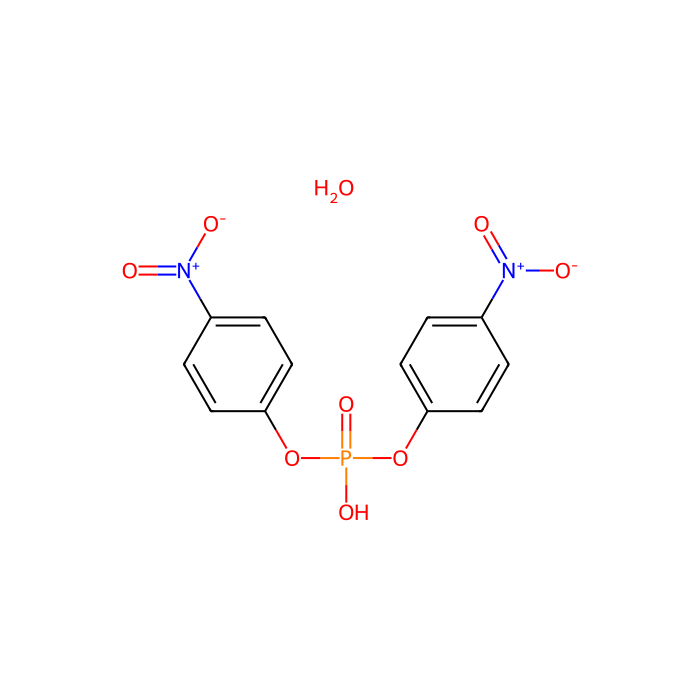
Brief description: Bis(4-nitrophenyl) phosphate is an aryl phosphoric acid diester bearing two para-nitrophenoxy groups and one acidic P–OH, widely used as a chromogenic phosphodiester substrate in research assays.
SKU: B336564
Product name: Bis(4-nitrophenyl) phosphate
CAS: 66777-94-4
PubChem CID: 16211304 (literature)
InChIKey (from Product Data): 6891
SMILES: Not specified for this item; refer to CoA/Spec Sheet.
Molecular formula: Not specified for this item; refer to CoA/Spec Sheet.
Molecular weight: Not specified for this item; refer to CoA/Spec Sheet.
Literature structural details (for reference, not item-specific):
Typical molecular formula (literature): C12H9N2O8P
Core structural motifs: one tetrahedral phosphorus center bearing a phosphoryl (P=O), one hydroxyl (P–OH), and two aryl–O– substituents (para-nitrophenyl). Two strongly electron-withdrawing nitro groups reside para to the phenoxy linkages on each ring.
2D description: A central phosphate unit P(=O)(OH)(O–Ar)2 where each Ar is a 4-nitrophenyl ring. The para-nitro groups activate the aryl–O as a leaving group under hydrolytic or nucleophilic conditions, enabling colorimetric detection via release of 4-nitrophenol/4-nitrophenolate.
Synthetic Utility
Overview: While primarily employed as a chromogenic substrate, bis(4-nitrophenyl) phosphate also offers synthetic value as an activated phosphate diester bearing good aryl leaving groups.
Potential uses (literature/general):
Phosphoryl transfer studies: Serves as a benchmark electrophile in nucleophile-promoted transesterification and hydrolysis, enabling comparison of catalyst systems under non-aqueous or mixed-solvent conditions. 31P NMR provides a convenient handle to track P(V) species.
Model for protecting-group strategies: The diaryl phosphate motif can inform the design and removal of phosphate protecting groups in nucleotide and glycol phosphorylation chemistry, with para-nitrophenyl providing spectroscopic monitoring during deprotection.
Generation of mixed phosphates: Under controlled conditions, nucleophilic substitution at phosphorus with alcohols, phenols, or amines can yield mixed phosphate esters or phosphoramidates, respectively, with displacement of a 4-nitrophenoxide leaving group. Competing pathways (Ar–O vs P–O cleavage) depend on conditions and nucleophile strength.
Practical notes:
Condition sensitivity: Reactions are highly sensitive to basicity/nucleophilicity and solvent polarity. Strong bases accelerate undesired hydrolysis; use dry, aprotic media and low temperatures to favor selective transesterification.
Byproduct handling: 4-Nitrophenoxide/nitrophenol is readily identifiable by UV–Vis; plan for its removal (basic washes, ion-exchange, or crystallization) in workups.
Target Specificity
Not applicable. This product is a small-molecule phosphate diester and is not an antibody, enzyme, or affinity reagent. No antigen, epitope, species reactivity, clone, or isotype information applies.
We use cookies to ensure the website functions properly and, where permitted, to improve your experience. You can manage your preferences at any time in Settings. Learn more in our Cookie Policy.
Shall we send you a message when we have discounts available?
Remind me later
Thank you! Please check your email inbox to confirm.
Products are supplied to verified businesses, institutions, and qualified professionals for research and development use only. Not for use in humans, animals, diagnosis, or therapy.