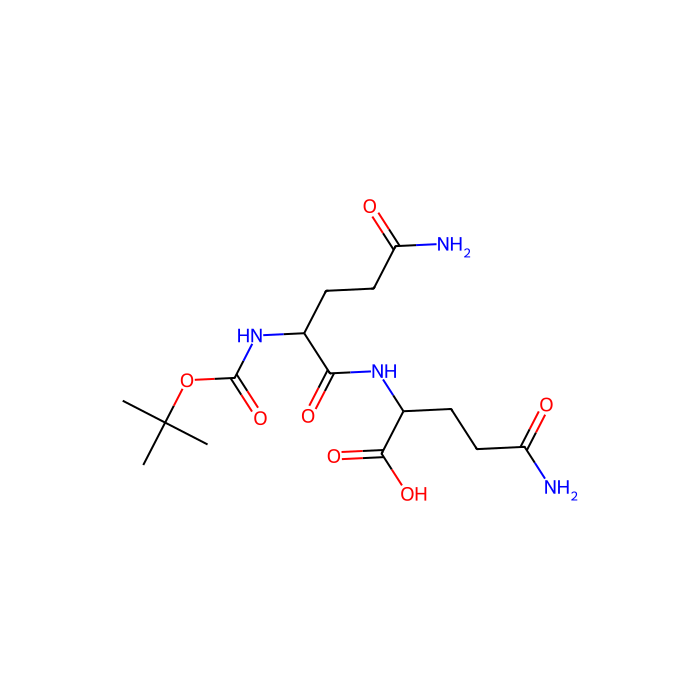
This compound belongs to the class of organic compounds known as dipeptides. These are organic compounds containing a sequence of exactly two alpha-amino acids joined by a peptide bond.
External Descriptors
Not available
1. Djoumbou Feunang Y, Eisner R, Knox C, Chepelev L, Hastings J, Owen G, Fahy E, Steinbeck C, Subramanian S, Bolton E, Greiner R, and Wishart DS. ClassyFire: Automated Chemical Classification With A Comprehensive, Computable Taxonomy. Journal of Cheminformatics, 2016, 8:61.
Certificati (CoA, COO, BSE/TSE e tabella di analisi)
C of A & Other Certificates(BSE/TSE, COO):
Analytical Chart:
Proprietà chimiche e fisiche
Solubilità
Soluble in DMSO
Peso molecolare
374.390 g/mol
XLogP3
-1.700
Hydrogen Bond Donor Count
5
Hydrogen Bond Acceptor Count
7
Rotatable Bond Count
12
Exact Mass
374.18 Da
Monoisotopic Mass
374.18 Da
Topological Polar Surface Area
191.000 Ų
Heavy Atom Count
26
Formal Charge
0
Complexity
557.000
Isotope Atom Count
0
Defined Atom Stereocenter Count
2
Undefined Atom Stereocenter Count
0
Defined Bond Stereocenter Count
0
Undefined Bond Stereocenter Count
0
The total count of all stereochemical bonds
0
Covalently-Bonded Unit Count
1
Calcolatori di soluzioni
Molarity Calculator
Determine the necessary mass, volume, or concentration for preparing a solution.
Dilution Calculator
Determine the dilution needed to prepare a stock solution.
Reconstitution Calculator
Recensioni
Recensioni dei clienti
Application Protocols
No assay-specific protocols are provided for this item. As a synthetic building block, it is typically used within standard peptide-coupling or deprotection workflows.
General guidance (literature)
Prepare stock solutions at 50–200 mM in dry DMF or DMSO.
For couplings, mix acid (this product), base (e.g., DIPEA), and coupling reagent (e.g., HATU) under inert atmosphere, pre-activate 1–5 min, then add to the amine partner.
Monitor by LC–MS; upon completion, quench and purify by RP‑HPLC if needed.
Refer to your lab’s SOPs and validated methods for exact conditions.
Biological Roles
General biochemical context (informational; not product-specific testing)
Glutamine is a central amino acid in nitrogen metabolism, serving as a donor in biosynthetic amidation reactions and as a carbon/nitrogen source in many cells. Dipeptides containing glutamine can be used to probe peptide transport (e.g., PEPT1/PEPT2 preferences for small peptides) and protease activities in research settings.
The Gln–Gln motif appears in low-complexity, Q‑rich sequences in some proteins. Boc protection renders the N‑terminus non-physiological and primarily serves synthetic utility rather than biological function.
Uses in biochemical assays (research use only)
Substrate mimetics: Boc‑capped dipeptides can act as defined fragments in enzyme profiling (e.g., amidases/peptidases), though the Boc group typically prevents recognition by transporters or peptidases that require a free N‑terminus.
Conjugation scaffolds: The side-chain amides provide hydrogen-bonding capacity influencing secondary structure propensity in model peptides.
Physicochemical implications
Polar yet moderately hydrophobic due to the Boc group; this can tune peptide retention in RP‑HPLC and modulate interaction with model membranes or matrices in chromatography-based studies.
No medical or clinical claims are made; all uses are for laboratory research only.
Buffer Applications
Boc‑Gln‑Gln‑OH is not a buffering reagent and does not constitute a defined buffer system. It lacks a conjugate acid/base pair with a useful, well-defined pKa window for buffering near neutral pH.
Practical note
If dissolution in aqueous media is required, adjust pH with standard buffers (e.g., phosphate, HEPES, Tris) and use Boc‑Gln‑Gln‑OH as a solute. Slight basification (pH 8–9) can aid dissolution, but buffering should be provided by an appropriate buffer component.
For electrophoresis or cell culture, employ established buffers; this compound serves only as an analyte or additive, not a buffer.
Green Alternatives
While Boc‑Gln‑Gln‑OH itself is the substrate, greener choices can be made around solvents, coupling reagents, and deprotection workflows.
Solvent alternatives (literature)
Replace DMF/NMP with:
2‑MeTHF or CPME for some DIC/Oxyma couplings (reduced toxicity, easier recovery)
EtOAc/MeCN or water‑co‑solvent systems where solubility allows
Comparative notes:
DMF: High solvency, reproductive toxicity concerns, difficult to remove from waste
2‑MeTHF: Bio-based, low peroxide tendency, may require warming/sonication for dissolution
Coupling systems
Safer additives: OxymaPure as a lower-risk alternative to HOBt/HOAt (reduced explosivity).
Carbodiimide choices: EDC (water-compatible) can enable aqueous/EtOAc biphasic couplings, reducing dipolar aprotics.
Enzymatic ligation: Sortase or peptiligase approaches in water for compatible motifs; sequence constraints apply.
Deprotection strategies
Minimize TFA use by small-volume, high-efficiency Boc cleavage (e.g., 20–50% TFA in DCM for shortest effective time), employ solid-supported scavengers, and neutralize/strip TFA efficiently.
Additive | HOBt/HOAt | OxymaPure | Slightly different activation profile
Deprotection | Neat TFA | Dilute TFA + scavengers | Longer time, more steps
Adopt process analytical controls (HPLC in-process checks) to avoid overuse of reagents and reduce waste.
Pharmaceutical Uses
Formulation/excipient context
This product is a research-grade protected dipeptide building block and is not specified as a pharmacopeial excipient. No pharmacopeial monograph is indicated.
Process and development relevance (general)
Synthetic intermediate: Useful for assembling larger peptide drug candidates during route scouting and fragment condensation campaigns.
Impurity studies: Can serve as a reference standard or process impurity model in analytical method development for peptide APIs rich in Gln content.
Chromatographic method development: The Boc group alters hydrophobicity, providing a probe for RP‑HPLC/UPLC gradient and selectivity optimization.
Regulatory note
No clinical or therapeutic claims are made. For any use beyond research, specification, GMP-grade material, and regulatory assessment would be required. Lot-specific purity, residual solvents, and elemental impurities must be confirmed from the CoA when used in regulated development environments.
Physical Properties
Item-specific properties
Appearance: Not specified for this item; refer to CoA/Spec Sheet.
Molecular formula: Not specified for this item; refer to CoA/Spec Sheet.
Molecular weight: Not specified for this item; refer to CoA/Spec Sheet.
Literature/computed properties (typical for Boc‑protected dipeptides; informational only)
Approximate formula/MW (L,L): C15H26N4O7; ~374.39 g/mol (computed from structure)
Physical state: Solid, often amorphous or as a white to off‑white powder (literature)
Melting behavior: Many Boc‑peptides soften/decompose >150 °C without a sharp MP (literature)
Solubility profile:
Good: DMF, DMSO, NMP, aqueous buffers at basic pH (≥ pH 8) with gradual dissolution (literature)
Moderate: Methanol, ethanol; may require sonication (literature)
HPLC purity (% area): Commonly used to define peptide-grade material (e.g., ≥95%); higher purities reduce byproducts in coupling steps.
Counterions/salt form: Boc‑protected peptides are often supplied as free acids; TFA or HCl salts can be present depending on workup. Salt form influences solubility and MS analysis.
Water/volatile content: Karl Fischer moisture and residual solvents affect accurate weighing and solution molarity; check CoA.
Identity tests: Usually supported by HRMS/ESI‑MS, 1H NMR (in DMSO‑d6 or D2O with base), and analytical HPLC/UPLC trace.
Chiral integrity: L,L configuration is standard; racemization during synthesis/coupling should be minimal but is monitored by chiral or sequence-resolving HPLC when applicable.
Stabilizer and additives
Boc‑protected peptides are typically shipped without stabilizers. Any additives (e.g., anti-caking agents) would be declared on the CoA; none are specified here.
Practical QA/QC tips
Verify purity and identity upon receipt if critical to your application (analytical HPLC, MS).
If using for subsequent couplings, run a small-scale test coupling and compare conversion vs. an internal standard dipeptide.
Record exact lot-specific purity to calculate charge equivalents in synthesis.
Reaction and Applications
Role in synthesis
Boc‑Gln‑Gln‑OH is a protected dipeptide fragment for solution-phase or fragment-condensation peptide synthesis. It introduces a Gln–Gln motif while masking the N‑terminus with Boc to control chemoselectivity.
Typical applications (literature/general)
Fragment coupling: Activation of the C‑terminal acid (e.g., HATU/HBTU/TBTU with DIPEA; or DIC/EDC with Oxyma/HOAt) and coupling to an amine-bearing partner (resin-bound or solution).
Library synthesis: Useful in combinatorial peptide libraries to bias sequences toward polar, hydrogen-bonding character.
Enzymology: Substrate or spacer in assays of proteases or transglutaminase that recognize Gln‑rich sequences (non-clinical, research only).
Materials/bioconjugation: Incorporation in peptide-based hydrogels or adhesion motifs where side-chain amides enhance hydration.
Practical tips
Racemization control: Use OxymaPure or HOAt with carbodiimides, or uronium salts (HATU/HBTU) under mild base to limit epimerization at the C‑terminal Gln.
Side reactions: Gln side-chain amide is stable under standard coupling; avoid strong bases that could lead to partial deamidation on prolonged exposure.
Boc stability: Boc is acid-labile; avoid strong acids (TFA) until intended global or N‑terminal deprotection.
Workup: Quench active esters with dilute amine scavengers if necessary; extract under minimal basic conditions to prevent hydrolysis.
Analysis
Monitor couplings by LC–MS; expected mass increase equals partner amine minus water. Use RP‑HPLC with water/MeCN, 0.1% FA for MS compatibility.
Reaction Conditions
The following are general literature guidelines for Boc‑Gln‑Gln‑OH in peptide synthesis; adjust based on your system and confirm by small-scale scouting.
Coupling to an amine (solution phase)
Solvent: DMF or NMP (anhydrous). Green alternatives: MeCN or 2‑MeTHF with DIC/Oxyma when solubility allows.
Base: DIPEA (2–4 equiv vs acid).
Activators: HATU or HBTU (1.0–1.2 equiv) with Oxyma; or DIC/EDC (1.1–1.5 equiv) + Oxyma (1.1–1.5 equiv).
Temperature/time: 0–25 °C; 0.5–4 h typical. Monitor by LC–MS/HPLC.
Double coupling: 2× 30–60 min can improve completeness for dipeptide fragments.
Capping: Ac2O/DIPEA or isopropyl chloroformate to terminate unreacted amines.
Boc deprotection (N‑terminus)
Reagent: 20–50% TFA in DCM or neat TFA.
Conditions: 0–25 °C for 10–60 min (monitor). Include scavengers (e.g., water, TIPS) when sensitive side chains are present.
Workup: Evaporate TFA, co-evaporate with toluene, neutralize residual acid, then proceed to next coupling.
Purification and analysis
RP‑HPLC using water/MeCN with 0.1% formic acid (MS-compatible) or 0.1% TFA (UV) at 25–60 °C.
Expected isolated yields: Highly sequence- and scale-dependent; 70–95% for single fragment couplings are common under optimized conditions (literature guidance).
Stability
Stable at ambient for short operations; avoid prolonged exposure to acids/bases and moisture. Store at −20 °C as specified.
Safety and Handling
Item-specific hazard data
GHS classification, signal word, pictograms, and H‑statements: Not specified for this item; refer to the SDS.
General safety guidance for peptide reagents (informational; defer to SDS)
Expected hazards: Low volatility organic solid; may cause irritation to skin, eyes, or respiratory tract as dust.
PPE: Lab coat, safety glasses, and appropriate chemical-resistant gloves (e.g., nitrile). Use a dust mask or work in a fume hood when handling powders.
Handling: Avoid dust generation; use antistatic measures and weigh in a draft-free, dry environment. Do not inhale dust. Avoid contact with strong acids/bases that could promote hydrolysis.
Incompatibilities: Strong oxidizers. Prolonged exposure to strong acids/bases or elevated temperatures may cause peptide bond or Boc carbamate cleavage.
First aid overview: If inhaled, move to fresh air. If on skin/eyes, rinse with water for at least 15 minutes; remove contaminated clothing. If ingested, rinse mouth and seek medical attention. Always consult the SDS for detailed instructions.
Fire safety: Organic combustible solid. In case of fire, use water spray, CO2, dry chemical, or foam; wear SCBA.
Spill response: Avoid raising dust; collect mechanically and place in a suitable container for disposal according to local regulations.
Always consult the product-specific SDS for authoritative safety and regulatory information.
Solvent Selection
This product is a Boc‑protected dipeptide building block rather than a solvent. Solvent choice here refers to dissolving/processing Boc‑Gln‑Gln‑OH for synthesis or analysis.
Polarity and miscibility considerations (literature/general)
Preferred polar aprotics: DMF, DMSO, NMP readily solubilize Boc‑peptides at 10–100 mM; miscible with many organic co-solvents.
Alcohols: MeOH/EtOH can dissolve at lower concentrations; may promote limited transesterification under strong acidic/basic conditions—avoid prolonged exposure when activated.
Aqueous media: Solubility increases with slight basification (e.g., 1–10 mM NaHCO3 or pH 8–9 buffer). At neutral pH, Boc decreases water solubility vs. unprotected dipeptides.
Nonpolars: Poor solubility in ethers and hydrocarbons; use only as anti-solvents for precipitation.
Use scenarios
Coupling reactions: DMF or NMP with DIPEA are standard; MeCN or 2‑MeTHF mixtures are possible with DIC/Oxyma.
Analytics: For HPLC, dissolve in water/MeCN with 0.1% formic acid (MS) or 0.1% TFA (UV), or in DMSO followed by dilution.
Quick comparison (literature)
DMF vs DMSO: DMF offers lower viscosity and easier removal; DMSO can improve solubility of more hydrophobic Boc‑peptides but suppresses some coupling kinetics.
Water-adjusted systems: Add small % DMSO or DMF as co-solvent to reach target concentration while maintaining biocompatibility for enzyme assays.
Storage and Reconstitution
Item-specific storage
Store at −20 °C (per Product Data).
Shipping: Ice chest with ice pads (per Product Data).
Handling
Allow container to equilibrate to room temperature in a desiccator before opening to prevent condensation.
Reseal promptly under dry atmosphere; consider aliquoting into inert-atmosphere vials to minimize freeze–thaw and moisture uptake.
Reconstitution (general guidance)
Organic stocks: Dissolve at 50–200 mM in anhydrous DMF or DMSO; vortex and sonicate if needed.
Aqueous use: Prepare a small DMF/DMSO concentrate, then dilute into buffer (e.g., phosphate, HEPES). Slight basification (pH 8–9) may aid dissolution. Filter (0.22 μm) if required.
Storage of solutions: At 2–8 °C for short term (days) or −20 °C for longer term (weeks). Avoid multiple freeze–thaw cycles; aliquot.
Stability notes
Avoid prolonged exposure to strong acids/bases or elevated temperatures, which can cleave Boc or hydrolyze peptide bonds.
Protect from light is generally not critical for this structure, but amber vials are good practice for peptide solutions.
For exact lot-specific stability and solution shelf life, consult the CoA/Spec Sheet.
Structure and Identity
Boc-Gln-Gln-OH is an N-terminally Boc-protected dipeptide composed of two L-glutamine residues with a free C-terminus.
Item-specific (from Product Data)
SKU: B356192
Product name: Boc-Gln-Gln-OH
CAS: 250290-76-7
InChIKey: 405408 (catalog entry; full InChIKey not specified for this item)
Storage: Store at −20°C; shipped on ice packs
Research use: For research use only
Literature/computed identifiers and features (for reference; not item specifications)
Typical molecular formula (L,L-stereochemistry): C15H26N4O7 (literature/computed)
Peptide backbone: L‑Gln–L‑Gln dipeptide with one peptide amide bond and a terminal carboxylic acid
Side chains: Each glutamine bears a γ‑CONH2 amide; overall molecule contains three amide-type carbonyls plus one carbamate carbonyl and a terminal carboxyl group
Stereochemistry: Two chiral α-centers (L,L configuration in typical peptide-grade materials)
2D description: Boc–NH–CH(CO–Gln)–CH2–CH2–CONH2, followed by –CO–NH–CH(COOH)–CH2–CH2–CONH2
Note: Exact stereochemical purity, salt form, and analytical identifiers for this specific item are not specified; refer to CoA/Spec Sheet.
Synthetic Utility
Functional group synopsis
C‑terminal carboxylic acid (couplable to amines/alcohols)
N‑terminal Boc carbamate (acid-labile protecting group enabling orthogonal deprotection)
Backbone amide (peptide bond)
Two side-chain primary amides (from glutamine) – typically non-reactive under coupling conditions but hydrogen-bonding and polarity modifiers
Key transformations (literature/general)
Amide bond formation: Activation with HATU/HBTU/TBTU or DIC/EDC + Oxyma to couple into N‑termini of fragments/resins.
N‑deprotection: Boc removal with TFA (10–50% in DCM or neat), HCl/dioxane, or gaseous HCl, revealing a free N‑terminus for subsequent coupling.
Esterification: Formation of methyl/ethyl esters under mild Fischer or Steglich-like conditions if required for protection of the C‑terminus.
Ugi/post-Ugi: The free acid can participate in multicomponent strategies after temporary deprotection of the N‑terminus when sequence diversification is desired.
Retrosynthetic value
Enables stepwise assembly of Q‑rich peptides while minimizing side reactions on Gln side chains (no additional side-chain protection needed).
Fragment condensation reduces coupling steps in long sequences containing repetitive Gln motifs.
Tips
Use slight excess (1.1–1.5 equiv) with in situ activation to drive couplings cleanly.
Maintain low temperatures during activation to limit O→N acyl migration or aspartimide-like side processes (less common for Gln but good practice).
Target Specificity
Not applicable. This product is a small-molecule/peptide building block and not an antibody, probe, or affinity reagent. No target, epitope, or species specificity is defined.
We use cookies to ensure the website functions properly and, where permitted, to improve your experience. You can manage your preferences at any time in Settings. Learn more in our Cookie Policy.
Shall we send you a message when we have discounts available?
Remind me later
Thank you! Please check your email inbox to confirm.
Products are supplied to verified businesses, institutions, and qualified professionals for research and development use only. Not for use in humans, animals, diagnosis, or therapy.